Table of Contents7 sections
- Why does an FOMC decision move crypto at all if the rate barely changes?
- How does open interest build before an FOMC meeting?
- What happens to perpetual funding rates as positioning crowds one side?
- What is the post-decision deleveraging and liquidation reset?
- How do you size around a scheduled event like FOMC?
- Where can you watch the FOMC window in derivatives data live?
- FAQ
TLDR: An FOMC decision moves crypto through positioning, not just price: open interest builds into the event, perpetual funding swings as leverage crowds one side, then the 14:00 ET statement triggers a deleveraging and liquidation reset. The next live test is the June 16-17, 2026 meeting (statement 14:00 ET, with a fresh dot plot).
Macro conviction is only half the trade. The other half is where leverage sits when the catalyst lands. An FOMC decision is the cleanest recurring example of this in crypto: a scheduled, market-wide event whose footprint shows up in derivatives data before, during, and after the announcement. This is a mechanics walkthrough of how a rate decision propagates into perpetual funding rates and open interest, with a dated, checkable example. It is not a forecast and contains no buy or sell calls.
Why does an FOMC decision move crypto at all if the rate barely changes?
The Federal Open Market Committee sets the federal funds target range, which anchors the cost of dollar liquidity. When policy or the accompanying language leans tighter, demand for risk assets like Bitcoin tends to soften; when it leans easier, liquidity and risk appetite expand. The decision itself is often priced in. What moves markets is the *surprise* relative to expectations, and the forward guidance in the statement and the Chair's press conference.
That uncertainty is exactly why crypto reacts even when the rate is held. In 2025, Bitcoin declined after seven of eight FOMC meetings and rallied after only one, a "sell the news" pattern that held regardless of whether the Fed cut or paused. In January 2026, the Fed held the target range at 3.50%-3.75% as expected, yet Bitcoin still fell from roughly $90,400 to $83,383 within 48 hours, a drop of about 7.3%. The decision was no surprise. The positioning reaction was the story.
How does open interest build before an FOMC meeting?
Open interest (OI) is the total number of derivatives contracts outstanding. Rising OI means new positions are being opened; falling OI means positions are being closed or liquidated.
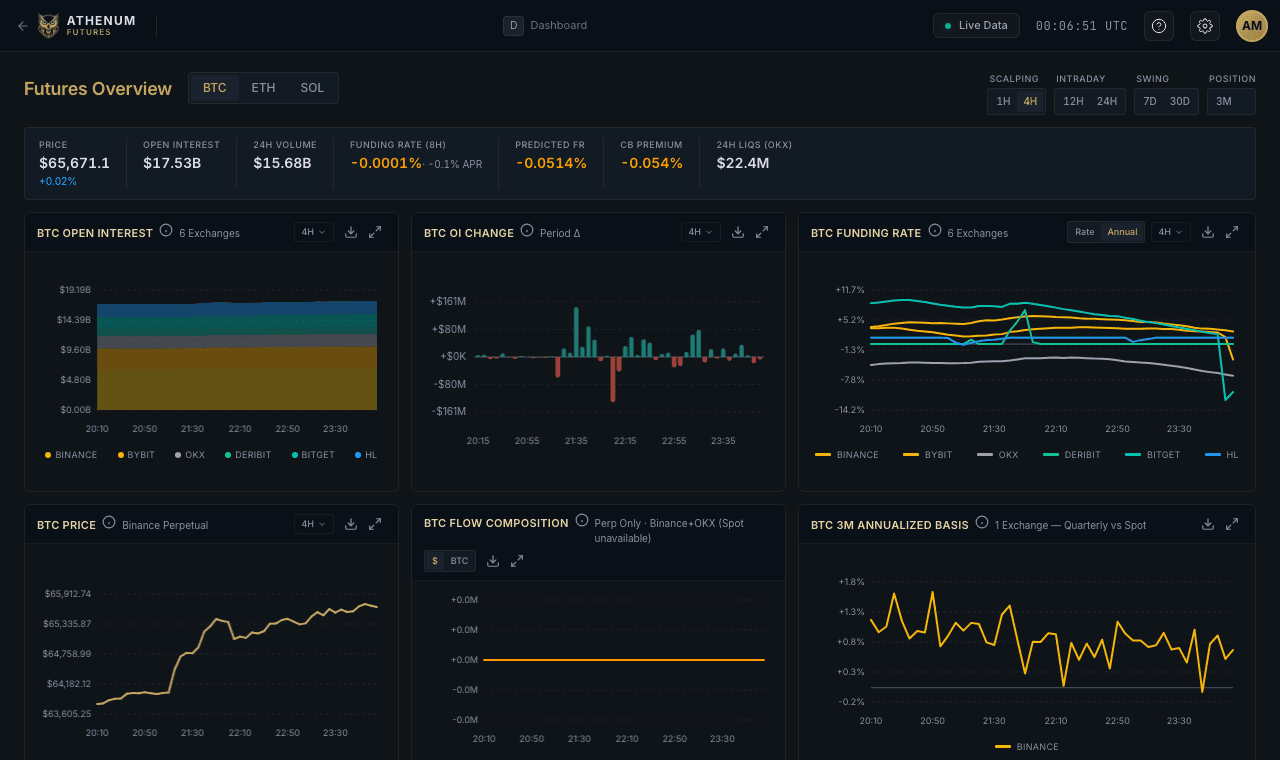
Heading into a scheduled macro event, OI often climbs as traders pre-position for the move. Some are directional bets on the outcome; some are hedges against existing spot or futures exposure. The result is a market carrying more leverage into the announcement than it did a week earlier. That matters because the same headline lands very differently on a lightly positioned market than on a heavily leveraged one. A high pre-event OI reading is a measure of how much fuel is sitting on the table when the statement crosses at 14:00 ET.
Watching OI by exchange, rather than as a single aggregate, adds resolution. A build concentrated on offshore perpetual venues behaves differently into the event than one spread across regulated futures, because the perpetual side is where funding and liquidation mechanics bite hardest.

BTC futures open interest across major venues. Source: Athenum.
What happens to perpetual funding rates as positioning crowds one side?
Perpetual swaps have no expiry, so the funding rate is the mechanism that tethers the perp price to spot. When perps trade above spot (more aggressive longs), funding goes positive and longs pay shorts. When perps trade below spot (more aggressive shorts), funding goes negative and shorts pay longs.
In the run-up to an FOMC decision, funding becomes a real-time gauge of which side the crowd is leaning. If traders pile into longs expecting a dovish surprise, funding stretches positive and those longs bleed carry every funding interval while they wait. If the market is braced for a hawkish outcome, funding can swing or stay negative as shorts crowd in. The 2026 cycle has shown how persistent that can get: Bitcoin perpetual funding ran negative for an extended stretch in early 2026, the longest sustained negative run since the 2022 bear-market bottom, with OI still rising, the classic "crowded" signature where one side is paying to hold a consensus position.
The takeaway is not that a stretched funding rate predicts direction. It is that stretched funding marks where the pain trade lives. A crowded, one-sided book going into a binary event is the setup most prone to a violent unwind.

BTC perpetual funding (APR) vs open interest, last 30 days. Source: Athenum.
What is the post-decision deleveraging and liquidation reset?
When the statement and the press conference resolve the uncertainty, the positioning that built up has to clear. This is the deleveraging phase, and it is usually the most violent part of the window.
If price moves against the crowded side, leveraged positions hit their liquidation prices. Forced liquidations are market orders, so they push price further in the same direction, tripping the next cluster of stops in a cascade. FOMC days are notorious for these liquidation cascades precisely because OI and funding were already stretched before the print. You can read the reset directly in the data: OI drops sharply as positions are force-closed, and funding snaps back toward neutral as the crowded side is flushed out. In one early-2026 episode, aggregate Bitcoin OI fell from roughly $40 billion to about $28 billion as positioning flipped and funding turned negative across venues, a textbook deleveraging signature.
This is why the same nominal price move can mean different things. A 4% drop on collapsing OI and resetting funding is a positioning flush. A 4% drop on rising OI is new conviction being added. The price alone does not tell you which; the derivatives data does.
How do you size around a scheduled event like FOMC?
Event risk is, above all, a sizing problem. The variable a trader actually controls is leverage and position size relative to the volatility window, not the Fed's decision. Modeling your liquidation distance against a plausible FOMC-day range before the event is far more useful than guessing the outcome. Our free leverage calculator lets you map position size, leverage, and liquidation price so you can see how much room a position has before the 14:00 ET statement lands. The point is to know where you would get force-closed, not to predict the headline.
Where can you watch the FOMC window in derivatives data live?
The cleanest read pairs the macro schedule with the positioning data on one screen. Athenum's Macro & Institutional view and derivatives analytics put the FOMC calendar and impact context next to the open-interest heatmap and funding analytics across 14 exchanges, so you can watch the pre-event OI build, the funding swing, and the post-decision reset in one workspace. That framing, where macro conviction meets execution-level data, is the whole reason to look at the rate decision and the perp book together rather than in separate tabs.
One housekeeping note for currency: since 2026-05-29, CME crypto futures and options trade 24/7, so the legacy "weekend CME gap" no longer forms on new sessions. If you are reasoning about basis or CME positioning around an FOMC weekend, treat continuous trading as the current reality, not the old Friday-close gap.
FAQ
Does crypto always fall after an FOMC meeting? No. The 2025 pattern skewed heavily toward post-meeting weakness (down after seven of eight meetings), but that is a historical observation, not a rule. Each meeting resolves against different positioning. The consistent feature is elevated volatility around the 14:00 ET statement and the 14:30 ET press conference, not a guaranteed direction.
Is the June 2026 FOMC meeting a big one? The June 16-17, 2026 meeting is one of the four per year that includes a Summary of Economic Projections, the "dot plot." Meetings with updated projections give the market more forward-guidance surface area to react to, which can widen the volatility window beyond the rate line itself.
What is the difference between a positioning flush and a trend move after FOMC? A positioning flush shows up as a sharp price move with falling open interest and funding resetting toward neutral, the crowd being cleared out. A trend move tends to come with rising open interest, new positions being added in the direction of the move. Reading OI and funding alongside price is how you tell them apart.
Why does funding matter more than the headline rate for a leveraged trader? The headline rate sets the macro backdrop, but funding determines your carry cost while you hold a perpetual position into the event, and stretched funding flags where the crowded, liquidation-prone side is. For a leveraged trader, that carry and that crowding are immediate and measurable; the macro narrative is slower and already partly priced.
*This article is educational and describes public market mechanics. It is not financial advice and contains no buy or sell recommendations. Verify any live figure against current data before acting on it.*
Sources: Federal Reserve FOMC 2026 schedule (federalreserve.gov); CoinGecko Learn, "How Federal Reserve (FOMC) Meetings Impact Bitcoin and Crypto Prices"; KuCoin, "FOMC Interest Rate Decisions and Cryptocurrency" (2026); CoinDesk markets coverage of 2026 funding conditions; CME Group press release, "CME Group to Launch 24/7 Cryptocurrency Futures and Options Trading on May 29" (2026).
One terminal. All the data.
Liquidations, orderbook depth, whale walls & open interest from 4 exchanges, all real-time, in one place.
No credit card required

Athenum Analytics
Athenum Analytics is our three-person editorial team covering crypto derivatives, market data and macroeconomic context.