Table of Contents10 sections
- Why Perpetuals Need Funding At All
- The Two Components: Premium Index Plus Interest Rate
- The Clamp Keeps Funding From Running Wild
- The Interval: Usually 8 Hours, Sometimes 1h or 4h
- Funding Is Paid Peer-To-Peer, Not To The Exchange
- Why The Premium Index Tethers Perp To Spot
- Why The Same Asset Shows Different Funding On Different Exchanges
- Annualizing Funding So The Number Means Something
- What Persistently High Or Negative Funding Signals
- See Funding Across The Whole Market
Practise with worked lessons
- Calculate funding payments over your actual holding window
Build a settlement-by-settlement funding ledger from position notional and signed rates. Keep funding separate from margin, trading fees and price P&L.
Funding is the single most misunderstood number in perpetual futures. Traders quote it as a vibe. "Funding is hot, the longs are overcrowded." That is often true, but most people repeating it could not tell you where the number comes from, who actually pays it, or why the same coin shows a different funding rate on Binance than it does on OKX at the same moment. None of this is secret. Every major venue publishes its funding formula in plain documentation. This guide walks the mechanism end to end: the two components that build the rate, how the clamp works, the interval, who pays whom, why the premium index tethers the perp to spot, why venues disagree, how to annualize, and what a persistently stretched rate is telling you.
Why Perpetuals Need Funding At All
A traditional futures contract has an expiry date. That expiry is what drags its price back toward spot, because on settlement day the contract must converge to the underlying. A perpetual has no expiry, so it has no natural convergence force. Left alone, a perp could drift arbitrarily far from the spot price of the asset it is supposed to track.
Funding is the engineered substitute for expiry. It is a recurring cash payment exchanged between the two sides of every open contract, sized and signed so that it pushes the perpetual price back toward the spot index. When the perp trades rich to spot, longs pay shorts, which discourages new longs and rewards the shorts holding the line. When the perp trades cheap to spot, shorts pay longs. The payment is the tether.
The Two Components: Premium Index Plus Interest Rate
The published funding formula on the major venues has the same skeleton everywhere. The funding rate is built from two pieces.
The first is the premium index, which measures how far the perpetual is trading above or below the underlying index price. Conceptually it captures the gap between the perp's order book (its impact bid and impact ask) and the spot index over the funding window. If the perp consistently quotes above the index, the premium is positive. If it quotes below, the premium is negative. This is the component that does the real work, because it directly reflects whether the contract is rich or cheap relative to spot.
The second is the interest rate component, a small fixed term meant to reflect the cost-of-carry difference between holding the quote currency and holding the base asset. On Binance and several venues that mirror its spec, this defaults to a fixed 0.01% per 8-hour interval (0.03% per day), unless a market is configured otherwise. It is small and usually static, so on a calm tape the interest term is what you see when the premium is near zero.
The combined rate is, in simplified form: funding rate equals the premium index plus a clamped difference between the interest rate and the premium. The premium arithmetic, the index basket and the settlement interval differ by venue. The plus or minus 0.05% clamp band does not, at least on the four largest venues for BTC. The published structure is consistent everywhere: premium does the heavy lifting, interest provides a small baseline, and a clamp caps the result.
The Clamp Keeps Funding From Running Wild
Without a limit, a violent dislocation between perp and spot could produce an enormous funding payment in a single interval. So every venue clamps the rate. On Binance, the gap between the interest rate and the premium is bounded by a published band of plus or minus 0.05% before it feeds the final rate, and each contract also carries its own published funding rate cap and floor. The exact limits are per-market parameters that vary by symbol and margin tier, not discretionary levers the venue moves by hand. The clamp exists so that funding remains a steering force rather than a liquidation weapon, and the precise bounds for any contract are listed in that venue's documentation.
The Interval: Usually 8 Hours, Sometimes 1h or 4h
The headline funding rate is settled on a fixed schedule. The most common interval on major venues is 8 hours, three settlements per day, historically at 00:00, 08:00, and 16:00 UTC on venues like Binance, OKX, and Bybit for many contracts. That is the default most traders carry in their heads.
It is not universal. Several venues and several individual contracts settle more frequently. Some markets use a 4-hour interval, and others, including a number of contracts on dYdX and certain Binance and Bybit symbols, settle hourly. The interval is published per contract. The practical consequence is that the same nominal rate means very different things at different cadences: a 0.01% rate charged hourly is far more expensive over a day than the same 0.01% charged once every 8 hours. Always read the interval before you compare two rates.
Funding Is Paid Peer-To-Peer, Not To The Exchange
This is the detail that trips up even experienced traders. The exchange does not collect funding. Funding is exchanged directly between longs and shorts. When the rate is positive, every long pays every short, sized by position notional. When the rate is negative, every short pays every long. The venue is the settlement plumbing, not the counterparty, and it takes no cut of the funding flow itself. Your funding payment is a transfer to the trader on the other side of the book, not a fee to the platform. That is also why funding is roughly zero-sum across the contract: one side's debit is the other side's credit.
Why The Premium Index Tethers Perp To Spot
Walk the loop. Suppose the perp is trading well above the index because longs are aggressive. The premium index goes positive, funding turns positive, and longs start paying shorts every interval. That cost does two things. It nudges existing longs to trim, and it pays arbitrageurs to step in: short the rich perp, buy the cheaper spot, collect funding, and stay market-neutral. Their selling pressure on the perp pulls its price back toward the index. The mechanism is self-correcting, and the premium index is the sensor that drives it. The bigger the gap, the harder funding pushes.
Why The Same Asset Shows Different Funding On Different Exchanges
If funding is just "perp versus spot," why does BTC funding differ across venues at the same instant? Because the inputs that move the number are venue-local. Each exchange computes the premium from its own order book, against its own index construction, and sometimes a different interval. A perp that is crowded long on one venue can be balanced on another. The index baskets are built from different spot constituents. The interest rate constant and the clamp band, by contrast, are not venue-specific inputs on the majors: for the BTC USDT perpetual, Binance, Bybit, OKX and Bitget all use 0.01% per 8 hours and a plus or minus 0.05% clamp. A few venues zero the interest term for specific symbols, so check the contract, not the venue. So the published rate is a venue-specific reading, not a market-wide truth. This is exactly why an aggregated, cross-venue view matters: one exchange's funding can mislead you about how the whole market is positioned.
Annualizing Funding So The Number Means Something
A raw rate like 0.01% per 8 hours is hard to reason about. Annualize it. With an 8-hour interval you get three payments per day and 1,095 per year, so 0.01% per interval is roughly 0.03% per day and about 10.95% annualized. The general formula is: annualized rate equals the per-interval rate multiplied by the number of intervals per day, multiplied by 365. Annualizing is also how you compare a basis trade against any other yield, and how you sanity-check whether a "high" funding rate is actually high once you account for the interval.

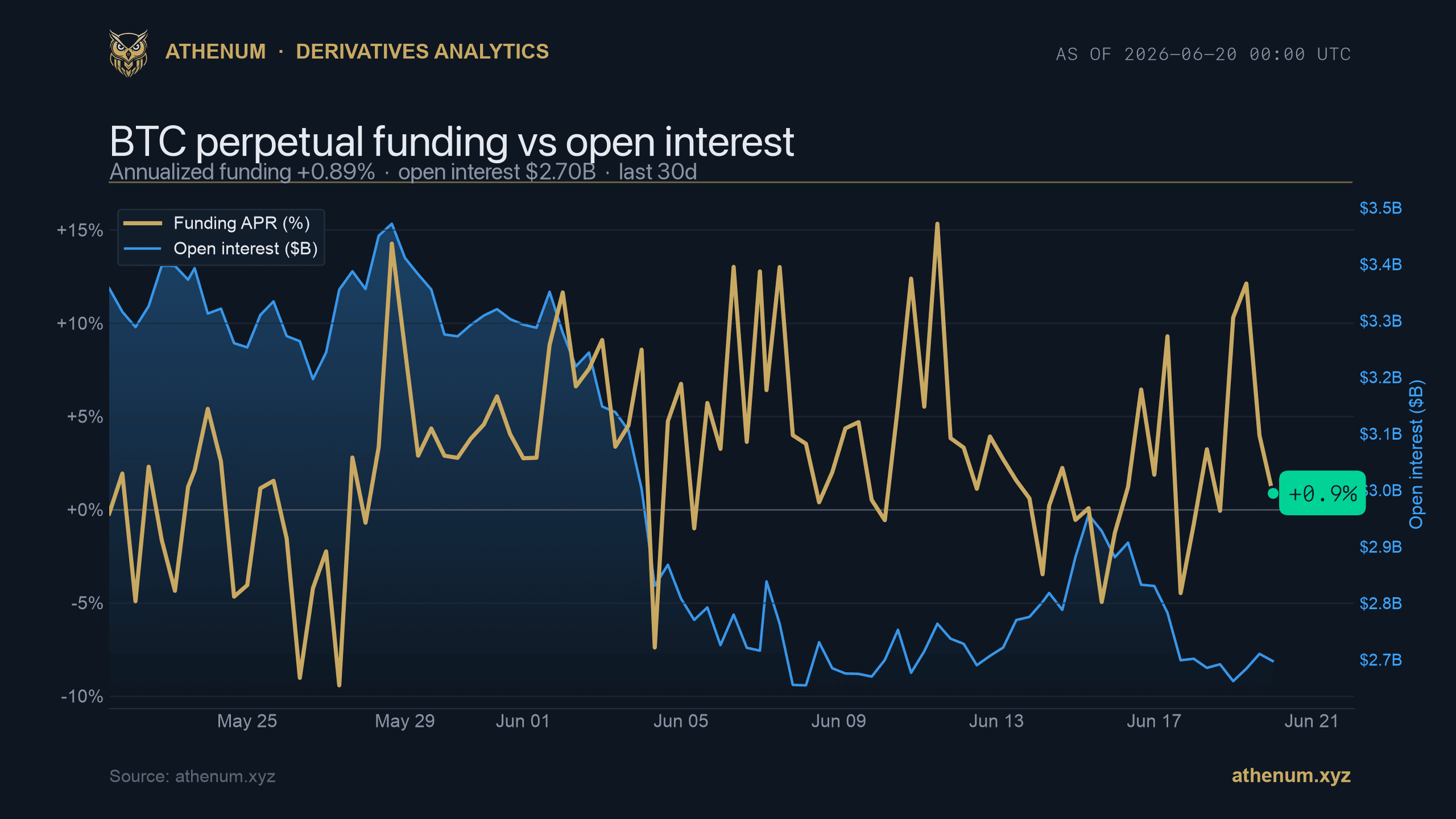
BTC perpetual funding (APR) vs open interest, last 30 days. Source: Athenum.
What Persistently High Or Negative Funding Signals
A single elevated reading is noise. A rate that stays pinned high for days is positioning. Persistently high positive funding means longs are paying continuously to hold, which marks a crowded long book: leverage is one-sided, the cost of carry is climbing, and the market is increasingly vulnerable to a long squeeze if price stalls. Persistently negative funding is the mirror image, a crowded short book where shorts are paying to stay in, which can set up a short squeeze. Funding does not predict direction. It tells you which side is paying for conviction and how stretched that conviction has become. Read it next to open interest and liquidations, not alone.
See Funding Across The Whole Market
Funding only becomes a usable signal when you can see it aggregated across venues, annualized, and lined up against open interest and liquidations instead of squinting at one exchange's tab. Athenum aggregates derivatives data across 14 exchanges and offers free tools for funding, the liquidation heatmap, open interest, and whale walls. The free tier is delayed and limited, so for the full real-time, cross-venue read the 7-day Pro+ trial is the honest way to evaluate it, with no card required. Start free at https://app.athenum.xyz/auth.
Funding is only one cost of holding a leveraged perp. To see the margin and liquidation price behind a position, use the free Athenum leverage and margin calculator.
One terminal. All the data.
Liquidations, orderbook depth, whale walls & open interest from 4 exchanges, all real-time, in one place.
No credit card required

Athenum Analytics
Athenum Analytics is our three-person editorial team covering crypto derivatives, market data and macroeconomic context.