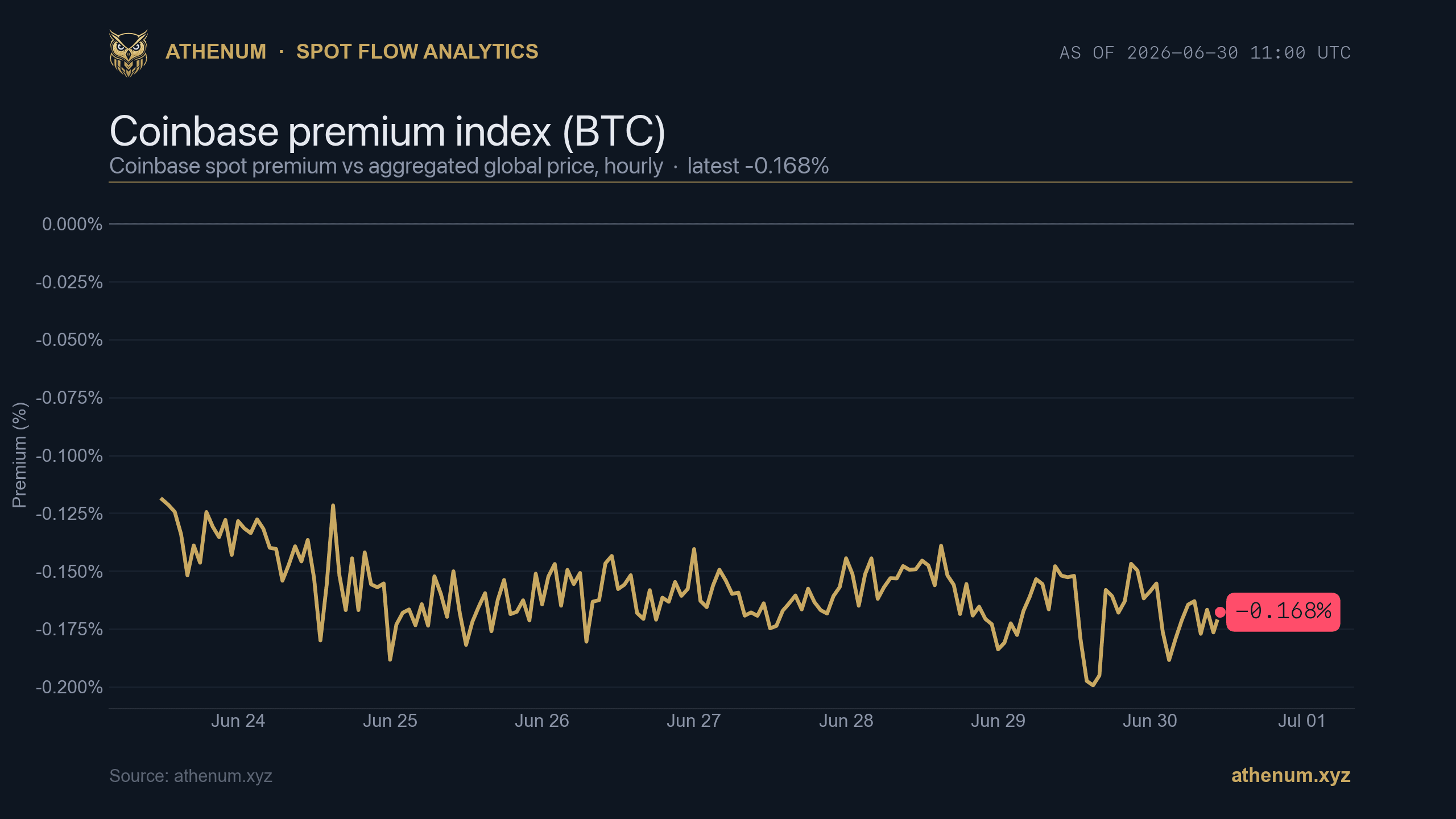
TL;DR: As of 2026-06-30 11:00 UTC the BTC Coinbase Premium Index reads -0.168%, and it was negative in 100% of hourly prints over the trailing week (2026-06-23 to 2026-06-30), ranging roughly -0.20% to -0.12% with BTC spot near $59,262. That says US, dollar-denominated spot demand is leaning soft. At the same time derivatives are crowded the other way: the BTC long/short account ratio is 2.04 and perpetual funding is +9.68% APR on $2.74B of open interest. Soft spot underneath crowded longs is a fragile structure, prone to fast unwinds, not a clean buy signal. Here is how to read the spread and what to watch next.
What is the Coinbase Premium Index?
The Coinbase Premium Index measures the price difference between BTC on Coinbase (BTC/USD spot, a US-dominated venue) and BTC on Binance (BTC/USDT, the largest global venue), expressed as a percentage. CryptoQuant created and popularized it, and the standard construction is Coinbase BTC/USD minus Binance BTC/USDT, divided by the Binance price, times 100. One precision point worth keeping straight: the percentage form is the "Index," while the absolute USD spread that traders sometimes quote as "a Coinbase premium of $X" is technically the "Coinbase Premium Gap." Both describe the same idea, that one venue is trading richer or cheaper than the other, but the Index is the normalized percentage version we use throughout this post.
What does a negative premium mean?
A negative Coinbase premium means BTC is trading cheaper on Coinbase USD than on Binance USDT at that moment. The mainstream read is relatively weaker US or institutional spot demand, or active US-based selling pressure, especially during US trading hours. It is a relative price signal and a proxy for dollar-denominated flow, not a direct measurement of who is buying, since large players can also transact through OTC desks or other venues. Because the reference leg is a USDT pair, the index can also move on stablecoin basis shifts and cross-venue liquidity differences, so it is best treated as a directional clue rather than a standalone predictor. CryptoQuant's Julio Moreno has noted that extremely negative readings have historically coincided with price bottoms, but that most of the subsequent rally only arrives once the premium turns positive again as US demand returns.
What is the premium saying right now?

BTC Coinbase premium -0.168% on 2026-06-30, negative across the full week
Right now the index reads -0.168% as of 2026-06-30 11:00 UTC, and the more important fact is the persistence: it was negative in 100% of hourly readings across the trailing week, holding in a band of roughly -0.20% to -0.12% with a mean near -0.158% while BTC spot sat around $59,262. A single negative print can be spread noise or a price-discovery lag, but a premium that stays negative for an entire week is regime information. The significance lives in the duration as much as the magnitude: a small but persistent negative premium implies a structural lean in US spot order flow rather than a one-off, volatility-driven blip. At -0.168% the reading is also meaningfully below the rough -0.08% threshold where analysts start treating the signal as more than microstructure, so duration and magnitude are pointing the same way here.
Weak spot demand, crowded longs: what the gap means
This is where the picture turns interesting, because spot and leverage are telling opposite stories. While US spot demand leans soft, positioning in the derivatives book is crowded long.

BTC long/short account ratio 2.04 on 2026-06-30, more long accounts than short
The BTC long/short account ratio is 2.04 as of 2026-06-30 11:00 UTC, meaning more than twice as many accounts are positioned long as short across aggregated venues. Read this carefully: 2.04 is an account ratio, equal-weighted by trader, so it gauges retail breadth and crowding, not how much money sits on each side. It is common for the account count to skew heavily long while a handful of large traders sit net short, so the honest framing is "long-crowded by account," not "more long money."

BTC perp funding +9.68% APR, $2.74B OI on 2026-06-30
Leverage is paying to stay long, too. Perpetual funding sits at +9.68% APR with $2.74B of open interest as of 2026-06-30 08:00 UTC, so longs are paying shorts. That confirms the long tilt directionally, but it is not overheated: +9.68% APR is roughly at or just below the common neutral baseline near 10.95% APR (about 0.01% per 8 hours), so the crowding case here leans on the account ratio and the soft spot read, not on funding being hot. Note also that funding and the L/S ratio are partly the same derivatives-long signal corroborating each other; the genuinely independent tension is spot versus leverage. When the spot bid that should anchor a market is missing while leveraged longs pile in, you get a leverage-led, spot-unsupported structure that analysts and crypto market commentators have repeatedly flagged as fragile, prone to quick liquidations if price drifts against the crowd.
How do you read it in practice?
Treat the Coinbase premium as one input in a flow-versus-leverage cross-check, not a trade trigger on its own. Gerber Kawasaki's Brett Sifling has warned that this data point alone is not enough to predict a rally. Here is a simple three-step routine:
1. Check persistence and magnitude together. Is the premium negative across hours and days, and is it below roughly -0.08%? Here both are true: -0.168% and 100% of hours negative for a week. 2. Read the derivatives side. Account ratio above 1 (2.04) plus positive funding (+9.68% APR) confirms a long-crowded book, while $2.74B open interest tells you how much sits at risk if that crowd is forced to cover. 3. Decide what would resolve the tension. Either US spot demand returns and the premium climbs back toward zero and positive, validating the longs, or the crowded book unwinds and flushes leverage. The first green light most analysts wait for is the premium turning positive again.
Coinbase premium reading | What it typically signals | This week (2026-06-30) |
|---|---|---|
Clearly positive (above 0%) | Stronger US/Coinbase spot bid, demand returning | Not present |
Around zero (-0.05% to +0.05%) | Balanced cross-venue demand, low signal | Not present |
Persistently negative (below -0.08%) | Soft US spot demand, structural sell lean | Yes: -0.168%, negative 100% of hours |
Extremely negative spikes | Historically near bottoms, but rally waits for a flip positive | Watch for it |
The cleaner way to size any position into this kind of divergence is to respect the fragility: keep position sizing conservative when leverage is crowded and the spot bid is absent, because a one-sided book is exactly what cascades.
Athenum unifies order flow, open interest and liquidity from 14 exchanges into one live, self-serve terminal, so you can watch the Coinbase premium, the long/short ratio and funding side by side instead of stitching screenshots together. It has a Free tier, and you can go deeper with the full picture in seconds. Start a 7-day Pro+ free trial (no card): https://app.athenum.xyz/auth?utm_source=blog&utm_medium=cta&utm_campaign=blog_coinbase-premium
The bottom line for 2026-06-30: a -0.168% premium that held negative all week says US spot demand is leaning soft, and a 2.04 account ratio with +9.68% APR funding says the leveraged crowd is leaning the other way. That gap between weak spot and crowded longs is the signal. It is not a forecast, but it is the kind of fragile structure that resolves fast, and the tell to wait for is the premium turning positive as real US demand comes back.
One terminal. All the data.
Liquidations, orderbook depth, whale walls & open interest from 4 exchanges, all real-time, in one place.
No credit card required

Athenum Analytics
Athenum Analytics is our three-person editorial team covering crypto derivatives, market data and macroeconomic context.