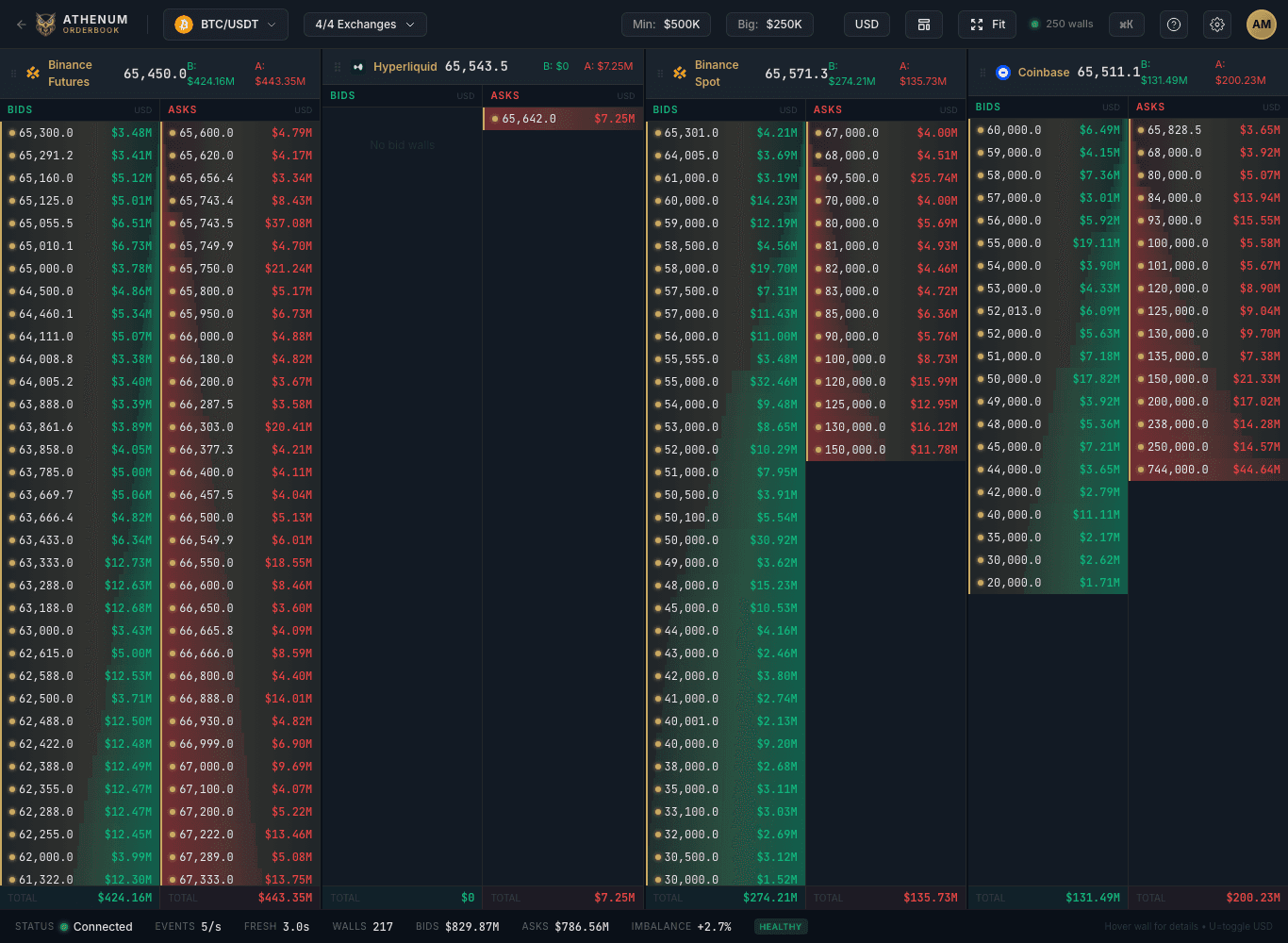
Stablecoins are the collateral behind most crypto perpetual positions, so when net stablecoin balances on exchanges rise, deployable buying power and margin capacity grow before that capital shows up as open interest or a funding-rate shift. Net stablecoin inflows to exchanges are a coincident-to-leading liquidity signal: they describe the ammunition available to derivatives traders, not the trade itself. The catch is that on-chain transfers are noisy, treasury rebalancing, custodian moves, and arbitrage can masquerade as conviction, so flow direction is context, not a trigger. Read it alongside open interest, funding, and spot depth rather than in isolation.
What are stablecoin exchange flows?
A stablecoin exchange flow is the on-chain movement of dollar-pegged tokens, primarily USDT and USDC, into or out of addresses associated with centralized exchanges. Inflows are tokens moving *to* an exchange; outflows are tokens leaving for self-custody, DeFi, or another venue. The headline number traders watch is the *net* of the two: net inflows mean exchange-held stablecoin reserves are growing, net outflows mean they are shrinking.
The reason this matters more in crypto than the equivalent would in traditional markets is structural. Most actively traded perpetual futures are *linear*, or stablecoin-margined: a trader opening a BTC/USDT or BTC/USDC perpetual posts that stablecoin as margin and settles profit and loss in it. On Deribit, for example, a linear perpetual is settled in USDC and margined in USDC by default. The stablecoin sitting on an exchange is not idle cash, it is the collateral layer that backs leveraged derivatives exposure. When more of it arrives, the maximum size of positions the market *can* hold goes up, regardless of whether anyone has acted yet.
Why do stablecoin flows precede derivatives moves?
Think of the sequence in three stages. First, capital has to be *present and deployable*, stablecoins on an exchange, in a trading account, ready to be posted as margin. Second, a trader has to *act*, open or expand a position. Third, that action becomes *visible* in derivatives metrics: open interest rises as new contracts are created, and funding rates drift as the long/short balance tilts.
Stablecoin inflows sit at stage one. Open interest and funding sit at stage three. That ordering is why flows can lead: the dry powder has to exist before it can be spent, and on-chain settlement makes the arrival of that dry powder observable. A sustained build in exchange stablecoin reserves expands the ceiling on how much new leveraged demand the market can absorb. A sustained drain does the opposite, it quietly removes the fuel that a derivatives rally would need, which is why prolonged net outflows tend to coincide with thinner participation and capped upside.
Crucially, flows tell you about *capacity*, not *direction of conviction*. Rising reserves say buying power is accumulating; they do not say it will be deployed long. The signal is strongest as a constraint: it is hard for open interest to expand durably while stablecoin capacity is draining, and easier for it to expand while capacity is building.
How do you read stablecoin flows as a liquidity signal?
Three practical habits keep this signal honest.
Read net, and read the trend, not the tick. A single large inflow is almost always noise, an exchange shifting funds between hot and cold wallets, a market maker rebalancing, or an issuer mint moving to a custodian. What carries information is a *persistent* direction in net flows over days, ideally confirmed across both USDT and USDC and across multiple venues rather than one. Because USDT and USDC together account for the large majority of stablecoin liquidity, agreement between the two is a useful filter.
Pair it with the stage-three confirmation. Flows describe potential; open interest and funding describe what was actually done with it. The combinations are what matter. Rising stablecoin reserves *plus* rising open interest is capital arriving and being put to work. Rising reserves *with flat* open interest is dry powder accumulating on the sidelines, capacity without commitment. Draining reserves *with* falling open interest is a genuine deleveraging, not just a pause. Looking at flows, open interest, and funding together on one workspace turns three separate dashboards into a single read.
Respect the limits of attribution. Exchange-address clustering is an estimate, not ground truth. Internal transfers, omnibus wallets, and chain migrations all distort raw flow numbers, and a transfer can reflect treasury or custody mechanics with no information about risk appetite at all. Treat any single flow figure as approximate and weight the trend, not the decimal.
What does this look like against funding and open interest?
The clearest setups are confirmations and divergences.

BTC perpetual funding at +6.47% annualized against open interest of $2.96B on 2026-08-03. The two sit in separate panels on purpose: they share a timeline but not a scale, and stacking them on one axis makes open interest look flat when it is not.
A *confirmation* is when capacity and commitment move together: stablecoin reserves build, open interest climbs, and funding turns positive as longs crowd in. That is straightforward demand backed by real collateral, and it tends to be more durable than a price move on flat or falling reserves.
A *divergence* is more interesting. If price is rising and funding is climbing but exchange stablecoin reserves are *flat or falling*, the move is being driven by repositioning of existing collateral and leverage rather than fresh capital, a structurally thinner foundation. Leverage-led rallies without a stablecoin-capacity tailwind are the ones most exposed to a sharp funding reset or a liquidation cascade, because there is less deployable margin underneath to absorb a shock. Watching the flow side alongside derivatives positioning and depth in one terminal is what makes that divergence legible in real time instead of in hindsight.
The practitioner takeaway
Stablecoin exchange flows are a capacity gauge, not a buy or sell signal. They tell you whether the market is accumulating or draining the collateral that leveraged positions are built from, and that capacity has to exist before open interest and funding can express it, which is why flows often register first. Use them as the foundational layer of a liquidity read: confirm the trend across stablecoins and venues, ignore single-transfer noise, and only treat the signal as meaningful once open interest and funding tell you what the dry powder was actually used for.
One terminal. All the data.
Liquidations, orderbook depth, whale walls & open interest from 4 exchanges, all real-time, in one place.
No credit card required

Athenum Analytics
Athenum Analytics is our three-person editorial team covering crypto derivatives, market data and macroeconomic context.