Table of Contents7 sections
Practise with worked lessons
- Build the full ledger for a spot–perpetual basis trade
Calculate both legs, basis change, funding and fees of a spot–perpetual basis trade. Stress a widening basis and margin needs before calling the hedge low risk.
TLDR: A crypto cash and carry trade buys spot Bitcoin and shorts a dated future or perpetual against it, so the net position is delta neutral and the profit is the basis or funding you collect as the two prices converge at expiry. It works when futures trade at a premium to spot, and it stops working when that premium compresses below your cost of capital. The yield is not fixed, so you have to read the basis and funding live before you size the trade.
What is the cash and carry trade in crypto?
The cash and carry trade is a market neutral strategy that buys an asset in the spot market and simultaneously sells a futures contract or perpetual swap on the same asset. If you hold 1 BTC of spot and short 1 BTC of futures, your directional exposure nets to roughly zero. You no longer care whether Bitcoin goes to 50,000 or 150,000. What you care about is the gap between the two prices, called the basis, and any funding payments you receive while you hold the short.
The trade exists because crypto futures frequently trade at a premium to spot during bullish periods. That premium is not free money, it is compensation for the cost of carrying the position, and it converges to zero at expiry. The cash and carry trader locks in that premium at entry and harvests it as the prices come together. It is the same structural arbitrage that has run in commodity and equity index markets for decades, transplanted onto crypto rails.

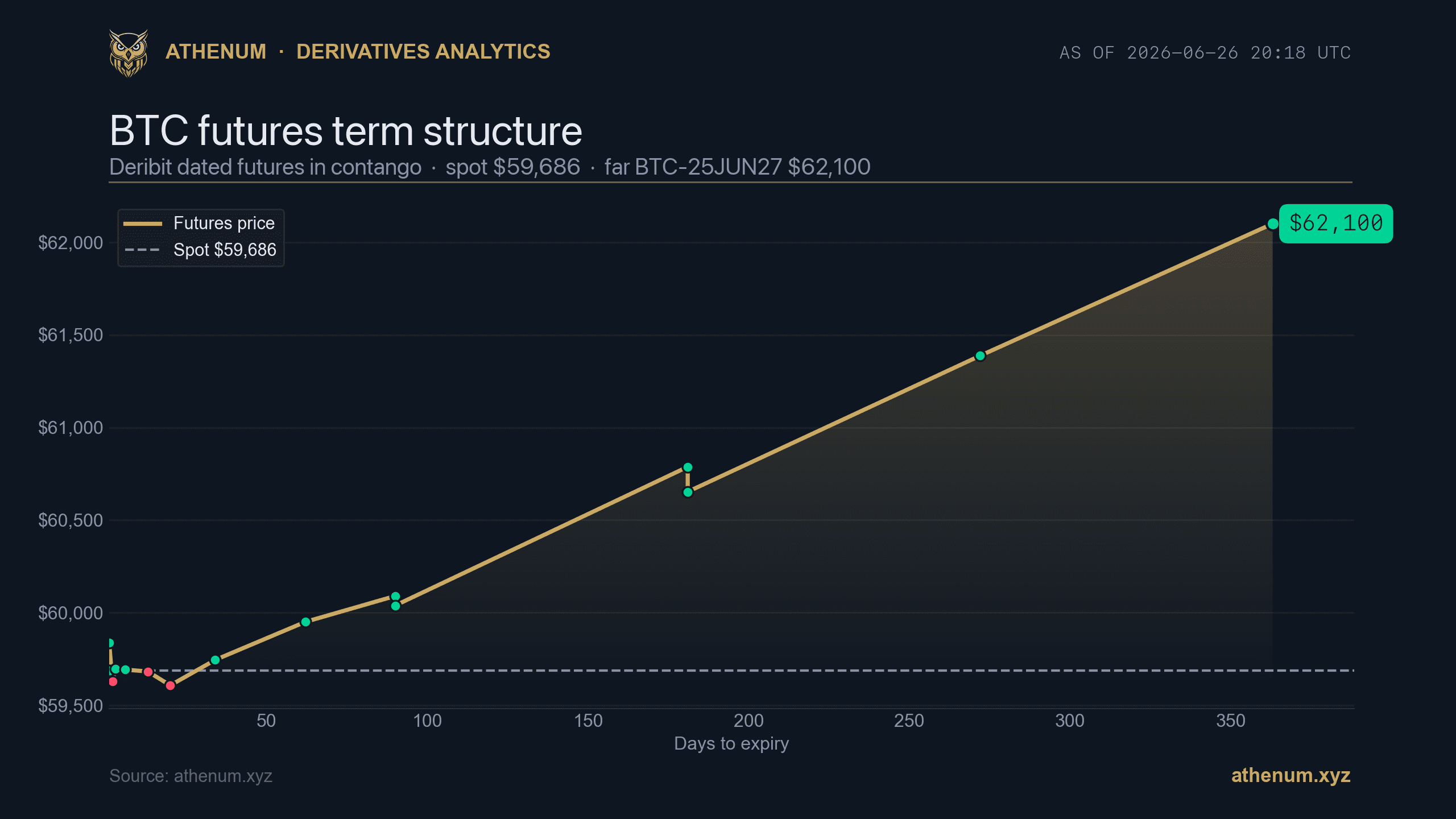
BTC futures term structure: spot near 59,686 dollars rising to 62,100 dollars at the far contract, a contango worth about 4.1 percent annualized. Source: Athenum.
How does the cash and carry trade actually work, step by step?
The mechanics are simple, the execution discipline is not. Here is the numbered methodology.
1. Confirm a positive basis or positive funding. Check the annualized basis on the dated future, or the funding rate on the perpetual. If futures sit above spot, the trade is live. If they sit below spot (backwardation), the dated version inverts and you would do the opposite trade. 2. Buy spot. Acquire the underlying, for example 1 BTC, on a spot venue. 3. Short an equal notional of futures or perps. Open a 1 BTC short on a dated quarterly contract or a perpetual. The position is now delta neutral. 4. Collect the carry. On a dated future you earn the basis as it decays to zero. On a perpetual you collect funding payments each interval while funding stays positive, because longs pay shorts when funding is positive. 5. Unwind at convergence. For a dated contract, hold to expiry where futures and spot settle to the same price, or close early if the basis has already compressed. For a perpetual, close once funding turns unattractive.
The profit you locked at step 2 and 3 is realized as the spread closes. With a dated contract that convergence is mechanical and guaranteed at expiry. With a perpetual there is no expiry, so the trade is path dependent on funding staying positive.
How do you calculate the annualized yield?
The headline number is the annualized basis, the percent return from buying spot and shorting a future that expires some months out. The formula for a dated contract is straightforward.
Annualized basis = ((Futures price / Spot price) minus 1) times (365 / days to expiry).
If a 90 day future trades 3 percent above spot, the annualized yield is 0.03 times (365 / 90), which is about 12.2 percent before fees and capital costs.
For the perpetual version you annualize the funding rate. A common baseline funding rate is 0.01 percent per 8 hour interval, which the funding rate consists of an interest component plus a premium index, and rates default to that 0.01 percent per 8 hours when the perpetual price does not deviate much from spot (Binance Academy and BitMEX funding mechanics, ongoing as of mid 2026). Three intervals per day means 0.01 percent times 3 times 365, which annualizes to roughly 10.95 percent. At 0.03 percent per 8 hours the same math scales to about 32.85 percent annualized.
Funding per 8h | Daily | Approx. annualized |
|---|---|---|
0.005% | 0.015% | 5.5% |
0.01% (baseline) | 0.03% | 10.95% |
0.03% | 0.09% | 32.85% |
You can run both legs through the Athenum funding rate calculator and check the net cash flow on the position with the PnL calculator before committing capital.
What are the real risks of the cash and carry trade?
Market neutral does not mean risk free. The strategy has a handful of failure modes that have ended real positions.
Margin and liquidation risk on the short leg. The trade is neutral in aggregate, but the futures short still marks to market. If price rallies hard, the short leg shows a loss that you must cover with margin before convergence pays you back. Research on the strategy found that with leverage of just ten times, the futures leg would have faced liquidation in over half the months in the sample (academic carry trade study, andrew.cmu.edu and BIS Working Paper 1087, ongoing reference). The fix is to run the short leg at low or no leverage and over collateralize.
Funding sign flips. On the perpetual version your income is funding, and funding can turn negative and persist. Once it does, you pay instead of receive and the net carry can turn negative. A common rule of thumb is that once funding drops below about 0.005 percent per interval, the position no longer efficiently covers fees.
Basis compression and roll risk. The spread can narrow before you want it to, eroding the locked profit, and dated contracts must be rolled to the next expiry, which reintroduces execution and basis risk each cycle.
Capital efficiency friction. On regulated venues you often cannot post spot crypto as collateral for the futures leg, so arbitrageurs effectively fund the position twice. That double funding raises your true cost of capital and is exactly what kills the trade when yields compress.
When does the trade stop working?
The cash and carry trade dies when the annualized yield falls below your risk free rate plus capital costs. This is not theoretical. The CME futures and spot ETF basis trade was a primary driver of institutional positioning, and as Bitcoin fell from above 120,000 toward under 70,000 the annualized returns fell from 15 to 20 percent to around 5 percent, and leveraged funds unwound (The Block and crypto.news basis trade unwind coverage, approximately April 2026). CME Bitcoin futures open interest slid to a 14 month low as that once crowded trade collapsed (The Block, approximately April 2026). When the premium compresses, the marginal carry trader exits, which removes the short pressure that the trade itself was adding to futures.
That is the core lesson. The yield is a live, mean reverting variable, not a constant. The whole edge is reading the basis and funding accurately before you size anything.
How do you read basis and funding before you trade?
This is where execution discipline lives. You want to see, in one place, the dated basis, the perpetual funding rate, and the open interest behind both legs across venues, because a quoted yield on a thin venue is not a real yield. Athenum aggregates funding, open interest, and basis across 14 exchanges so you can confirm a premium is real and consistent rather than a single venue artifact. The same dashboards surface the liquidation heatmap, order book and whale walls, and CVD, which matter for the short leg, because a cluster of liquidation levels above your entry tells you where a squeeze could pressure your margin.

BTC perpetual funding versus open interest over 30 days: annualized funding near plus 4.81 percent with open interest about 2.74 billion dollars. Source: Athenum.
For the options minded, max pain and the put/call ratio at app.athenum.xyz/options add context on where dealers and positioning sit. If you want the deeper mechanics behind the perpetual leg, our explainer on how crypto perpetual funding rates are calculated breaks down the interest plus premium components, and open interest vs volume helps you judge whether a basis move is backed by real positioning or just churn.
One note on venue structure: CME crypto futures have traded 24/7 since 29 May 2026 (CME Group contract structure, May 2026), so the old weekend gap between Friday close and Sunday reopen no longer forms on those contracts. That removes a timing wrinkle that older cash and carry guides still describe for the dated CME leg.
Bottom line
The cash and carry trade is one of the cleanest structural trades in crypto, but its yield is a moving target that compresses exactly when everyone piles in. Size the short leg conservatively, watch funding for sign flips, and never enter without checking the live basis and funding first. Start a 7 day Pro+ free trial, no card required, and read the basis, funding, and liquidation map across 14 exchanges, alongside 28 free /tools calculators to size the trade before you place it.
One terminal. All the data.
Liquidations, orderbook depth, whale walls & open interest from 4 exchanges, all real-time, in one place.
No credit card required

Athenum Analytics
Athenum Analytics is our three-person editorial team covering crypto derivatives, market data and macroeconomic context.