Blog
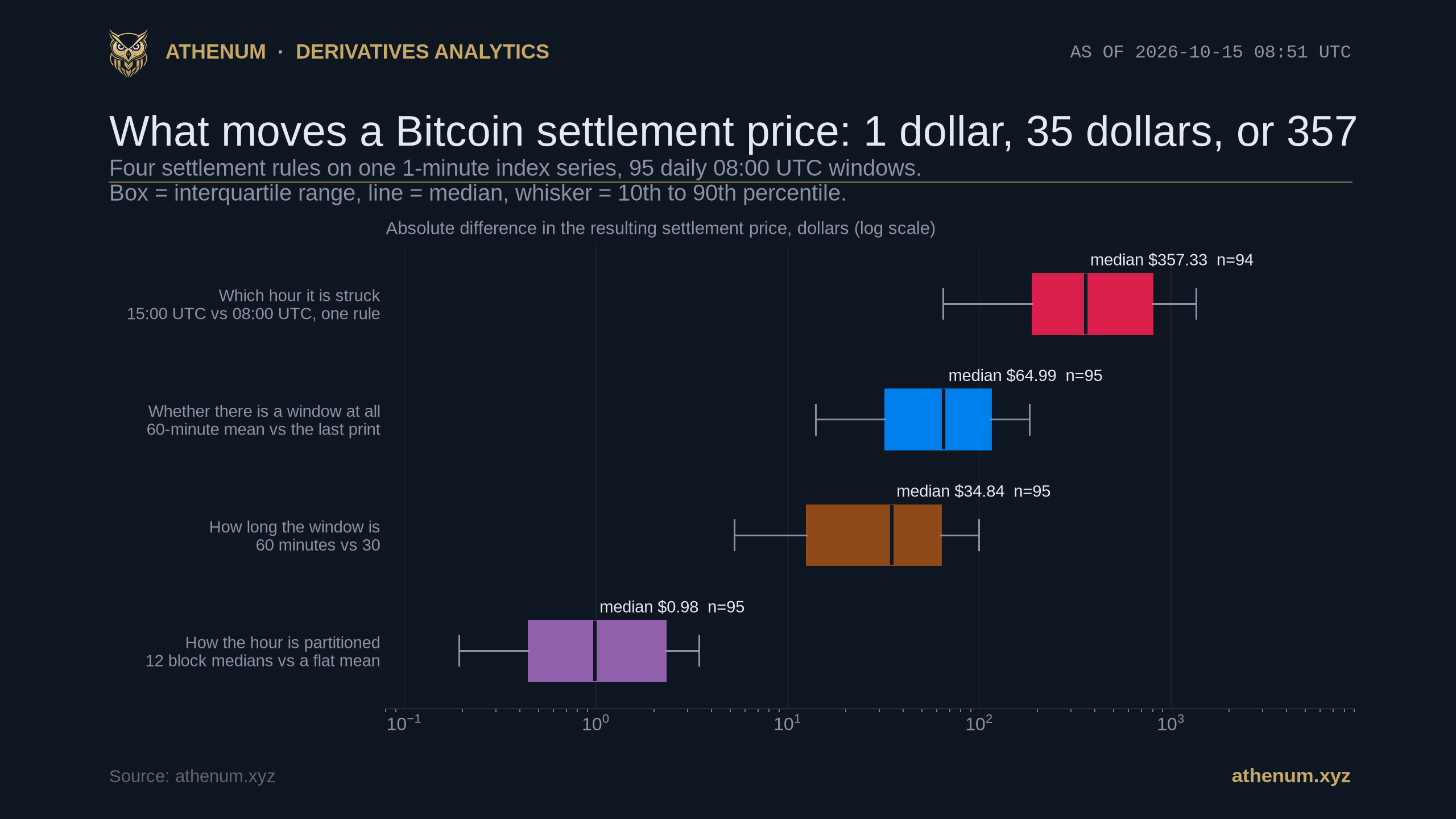
Bitcoin Futures Settlement Price: the Averaging Window Is Worth 65 Dollars, the Hour Is Worth 357
Measured on 2026-10-15 across 95 daily settlement windows: a 60 minute average lands a median 64.99 dollars from the last print, a 60 minute window differs from a 30 minute one by 34.84, and the settlement hour alone is worth 357.33.
 Athenum Analytics13 min read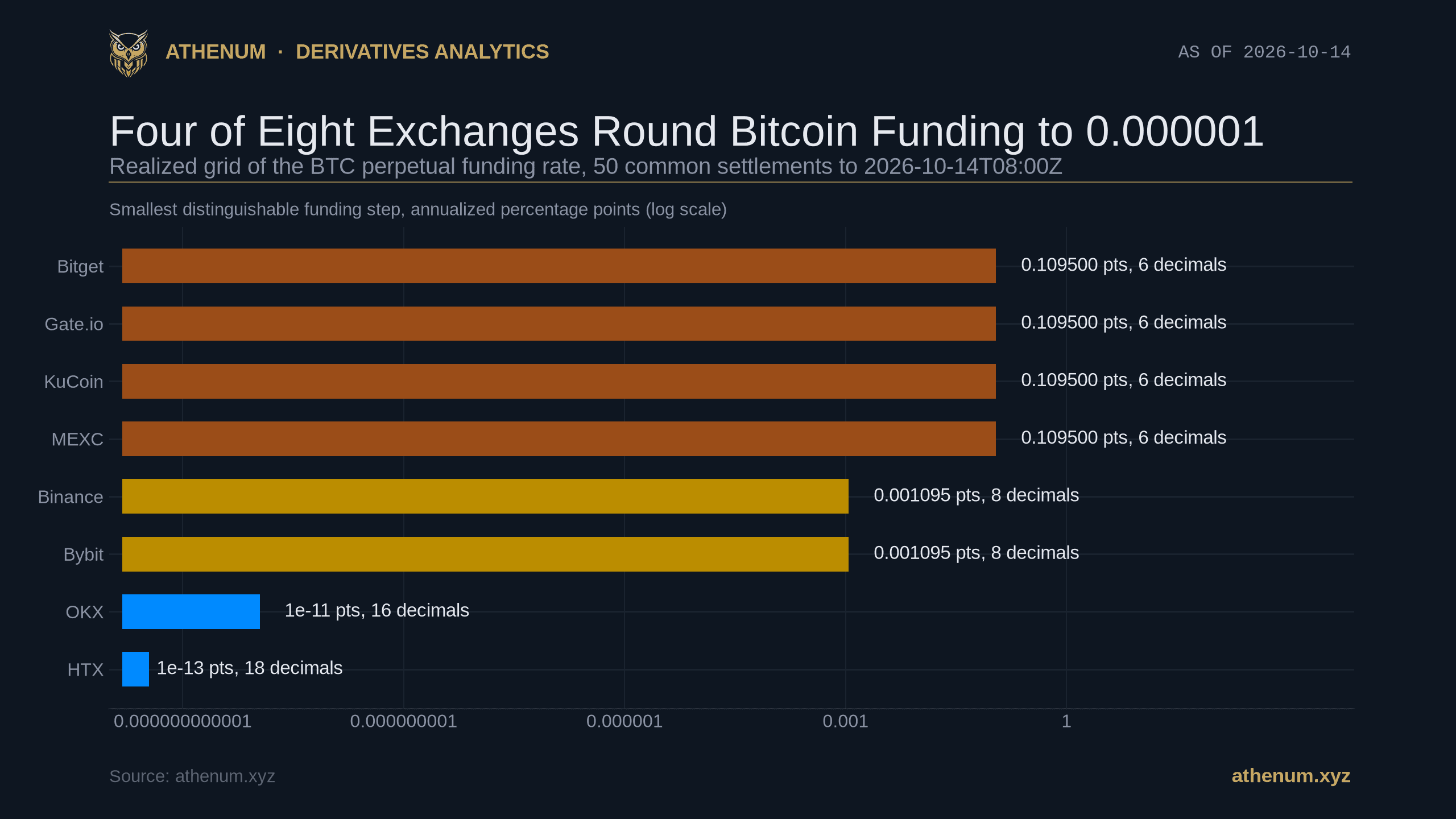
Bitcoin Funding Rate Precision: Four of Eight Exchanges Round to 0.000001
Over the 50 eight hour settlements common to eight exchanges between 2026-09-28 and 2026-10-14, Bitget, Gate.io, KuCoin and MEXC put every Bitcoin funding reading on an exact multiple of 0.000001. One step is 0.1095 annualized points.
 Athenum Analytics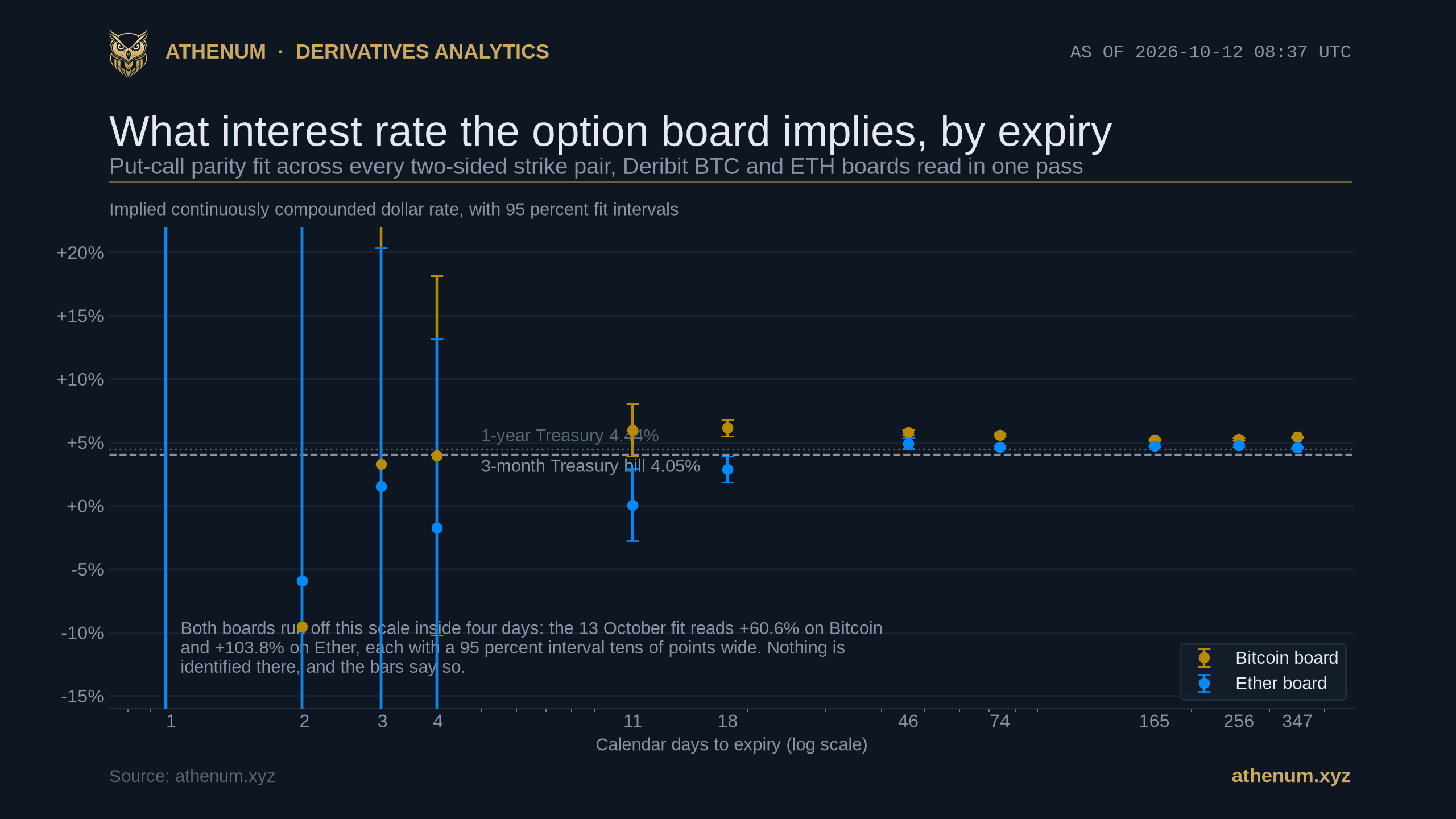
Bitcoin Options Implied Interest Rate: 5.59 Percent at 74 Days, 4.61 on the Ether Board 91 Seconds Later
On 2026-10-12 at 08:37 UTC the Deribit Bitcoin option board implied a 5.59 percent dollar rate at 74 days across 399 two-sided strike pairs. The Ether board, read 91 seconds later, implied 4.61 percent, and a dollar rate cannot depend on the coin.
Athenum Analytics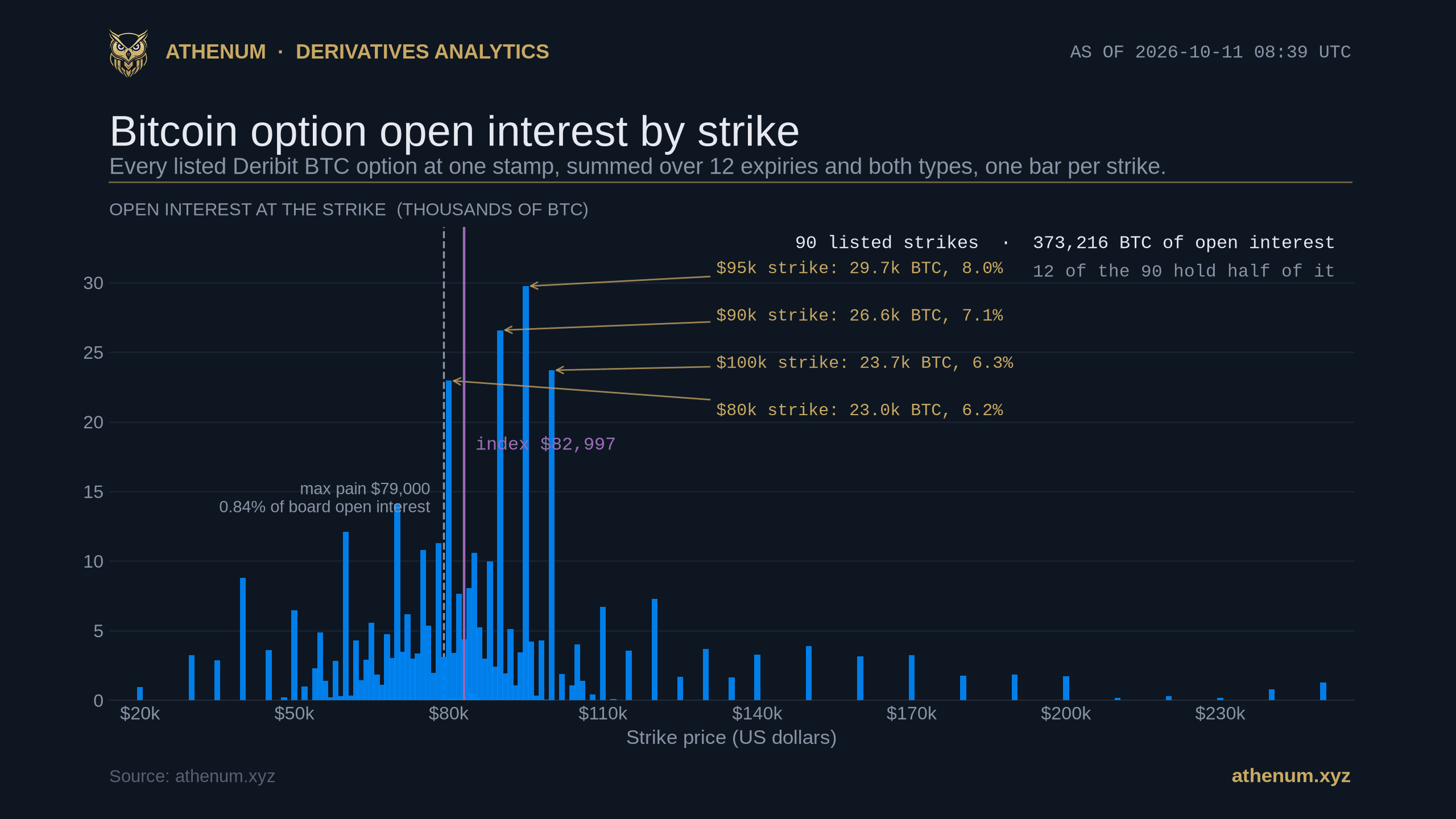
Bitcoin Option Open Interest by Strike: 12 of 90 Strikes Hold Half the Board
On 2026-10-11 at 08:39 UTC the whole Deribit Bitcoin option board held 373,216 BTC of open interest across 930 contracts and 90 strikes. Twelve strikes hold half of it, the heaviest holds 8.0 percent, and the max pain strike holds 0.84 percent.
Athenum Analytics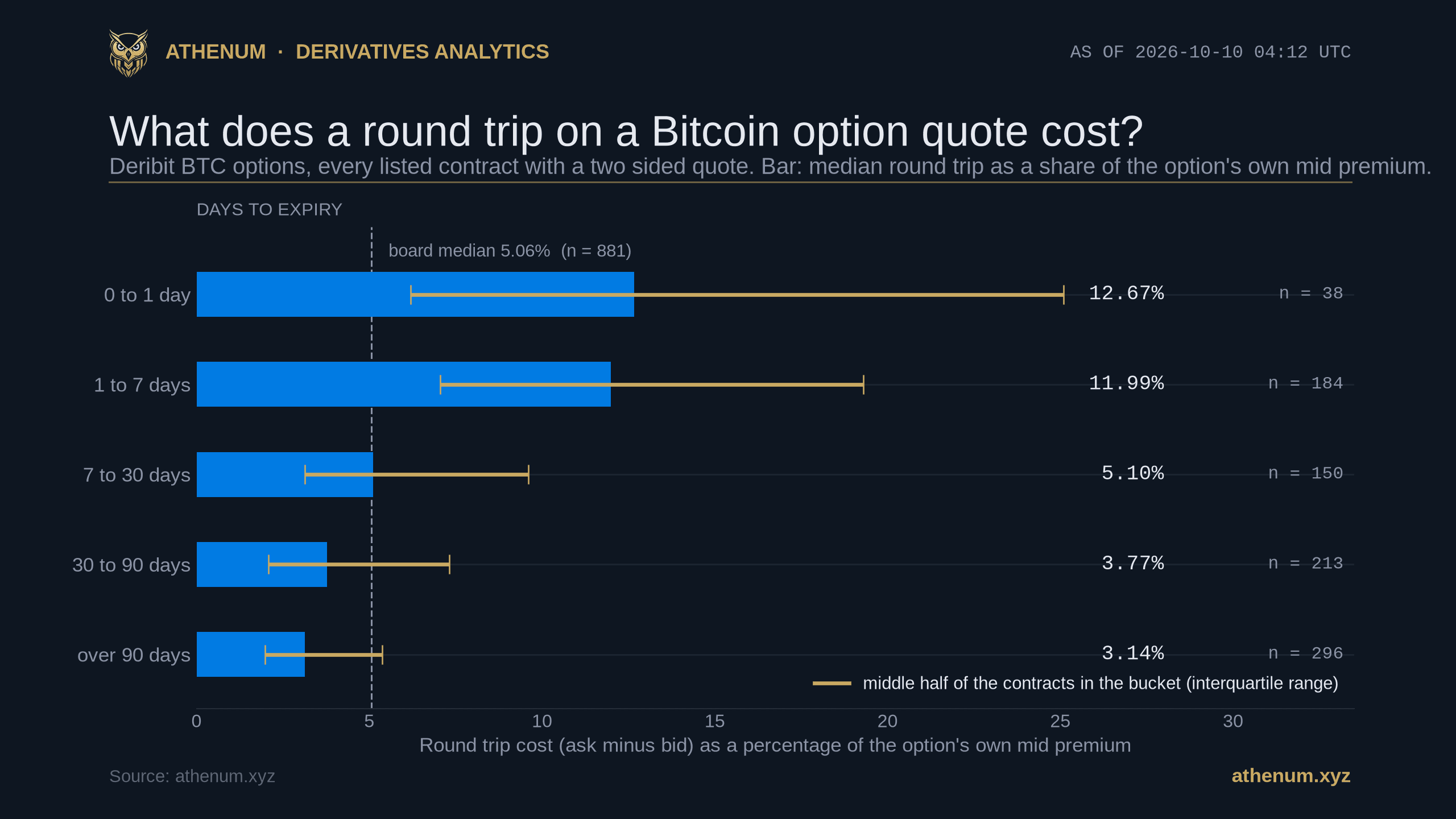
Bitcoin Options Spread: the Median Round Trip Costs 5.06 Percent of the Premium
Measured on the whole 950 contract Deribit BTC board at 2026-10-10 04:12 UTC, the 881 two sided quotes carry a median round trip cost of 5.06 percent of the option's own premium. The other 69 had no bid at any price, and 63 of those carry open positions.
Athenum Analytics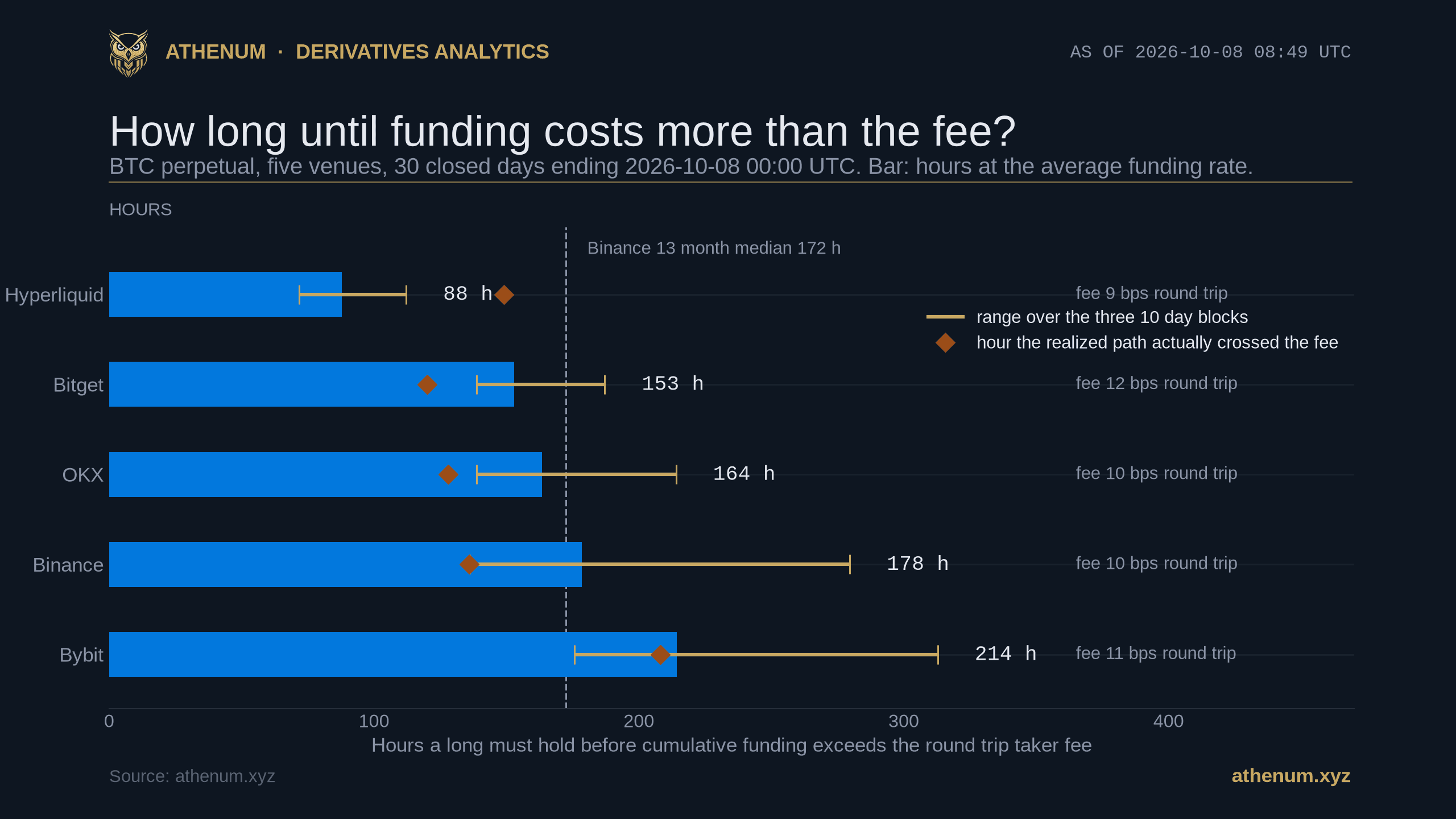
Cost of Holding a Bitcoin Perp: Funding Passes the Round Trip Fee at the 18th Settlement
The cost of holding a bitcoin perp is usually compared venue by venue on the taker fee, and that is the smaller of the two numbers as soon as the position lives longer than a few days. Over the 30 closed days to 2026-10-07 a Binance long paid 40.33 basis points of funding against a 10 basis point round trip, so the funding bill passed the fee at the 18th of 90 settlements.
Athenum Analytics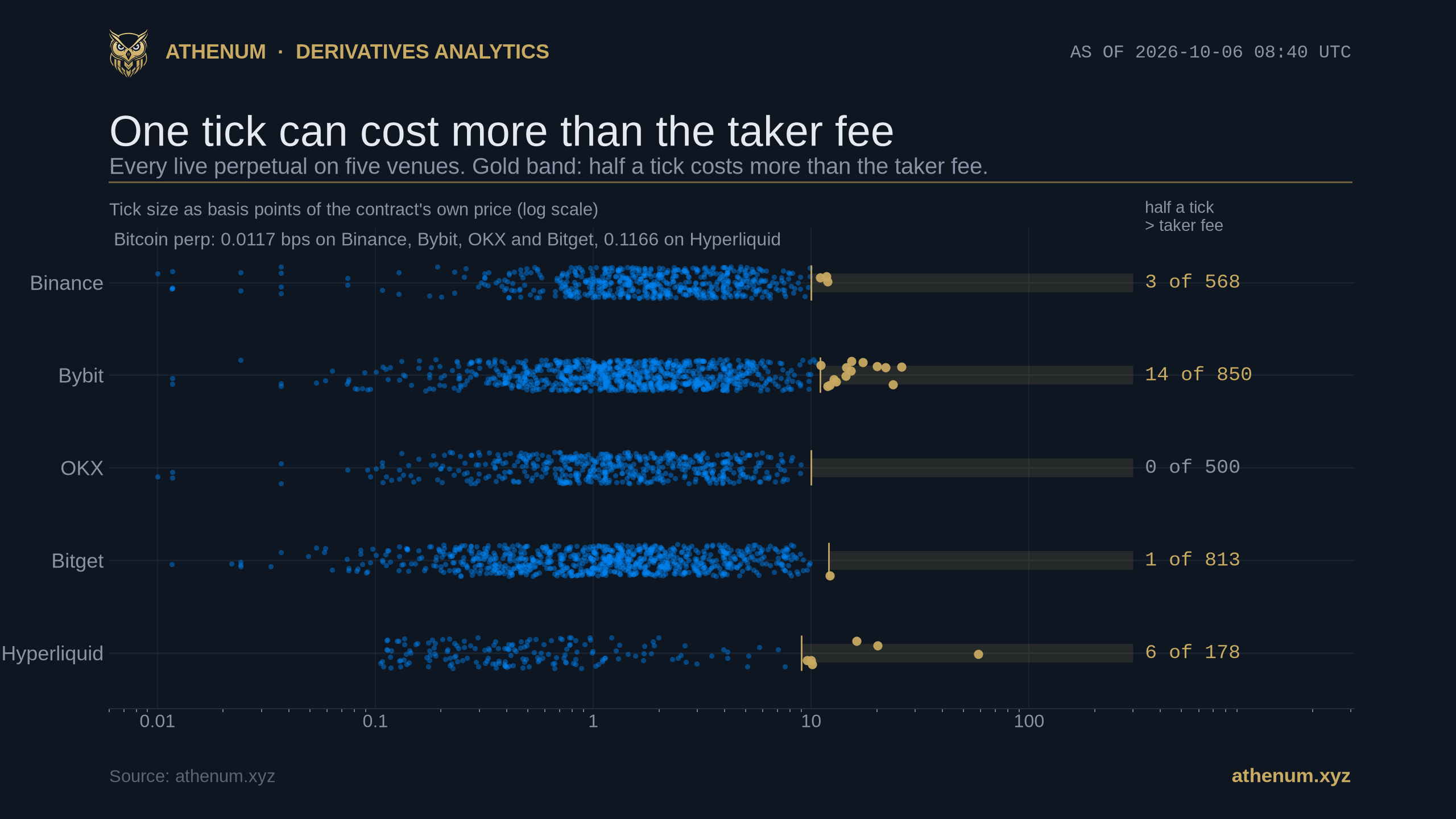
Tick Size vs Taker Fee: On 24 Perps Half a Tick Costs More Than the Fee
On a Bitcoin perpetual the taker fee dwarfs the price grid, and that is the comparison almost everyone generalizes from. Read across every live perpetual on five venues at 08:40 UTC on 2026-10-06, 2,909 contracts in all, it inverts on the long tail. The tick is a fixed number of decimal places.
Athenum Analytics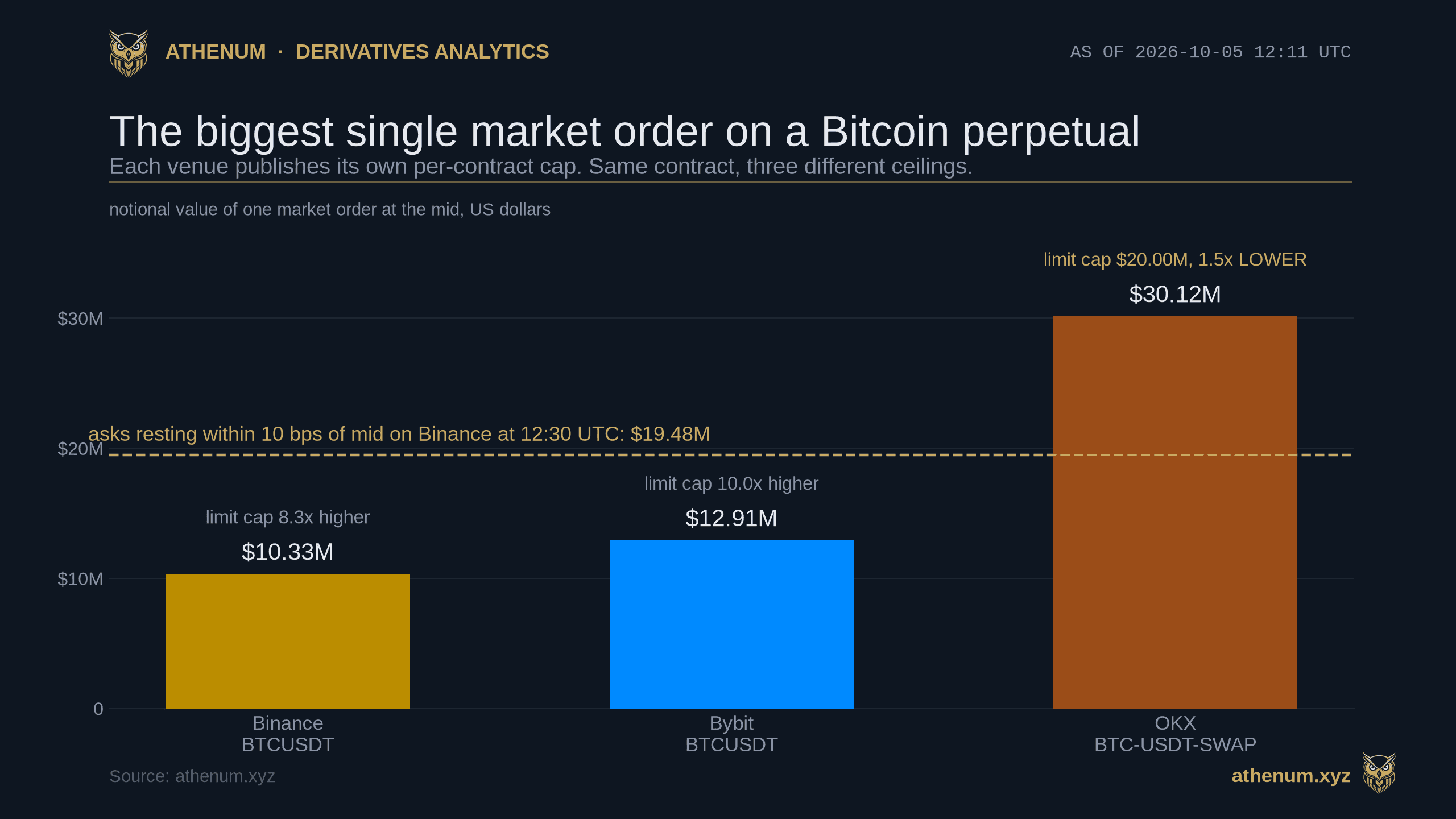
Maximum Market Order Size: Bitcoin Stops at $10.3M and a Typical Perp at $99,510
Binance, Bybit and OKX each publish a hard ceiling on how much one market order may take, and it is a different number from the limit order ceiling. On 2026-10-05 the Bitcoin perpetual stopped at $10.33M, $12.91M and $30.12M, while the median contract stopped at $99,510, $26,376 and $16,488.
Athenum Analytics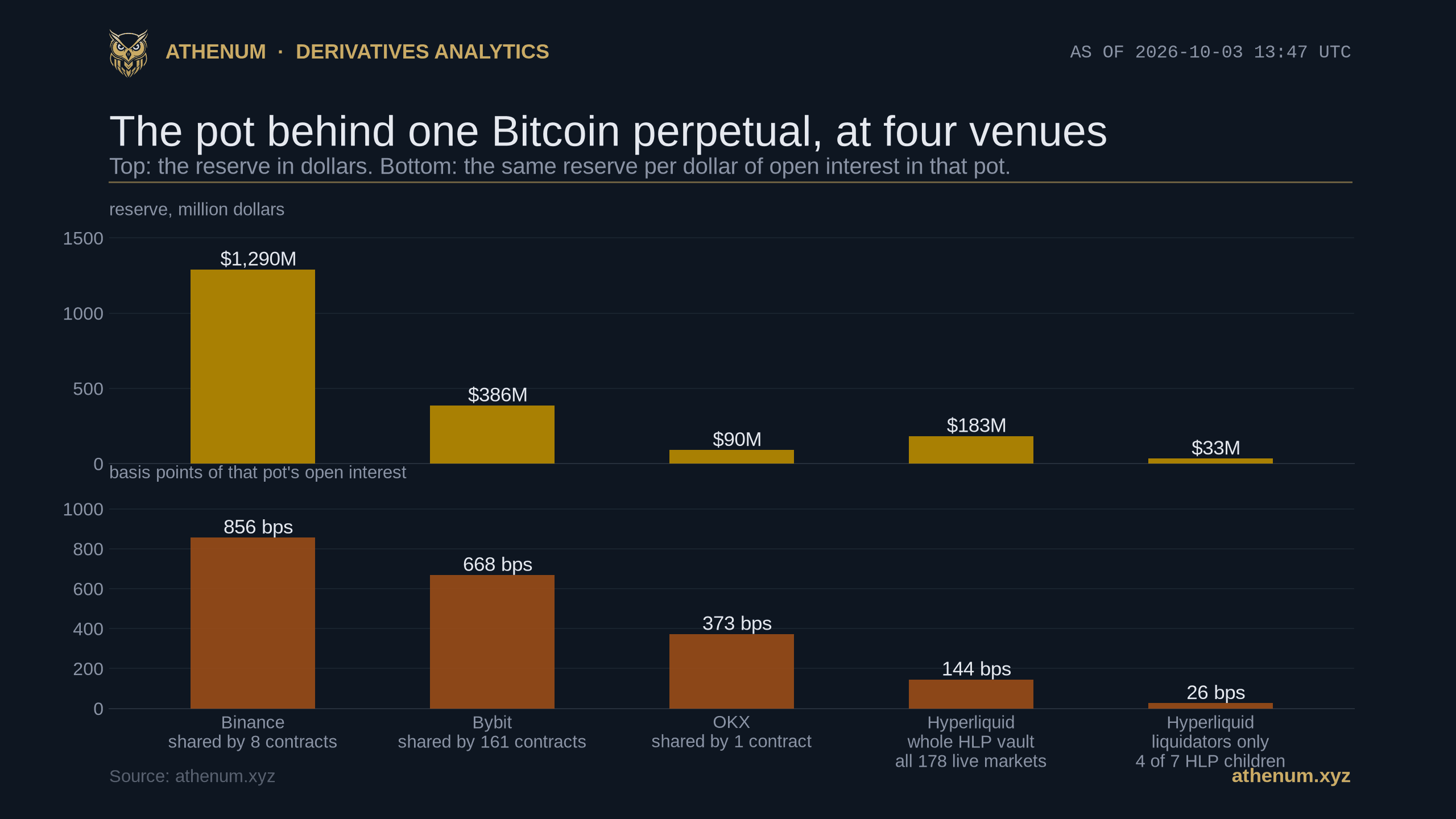
Crypto Insurance Funds Are Not One Pot: 123 at Binance, and Cover Varies a Hundredfold
The futures insurance fund is the reserve that pays the winner when a liquidation closes worse than its bankruptcy price, and when it runs out the venue reaches for auto deleveraging instead. Almost everything written about it, including two explainers on this blog, treats it as one number per excha
Athenum Analytics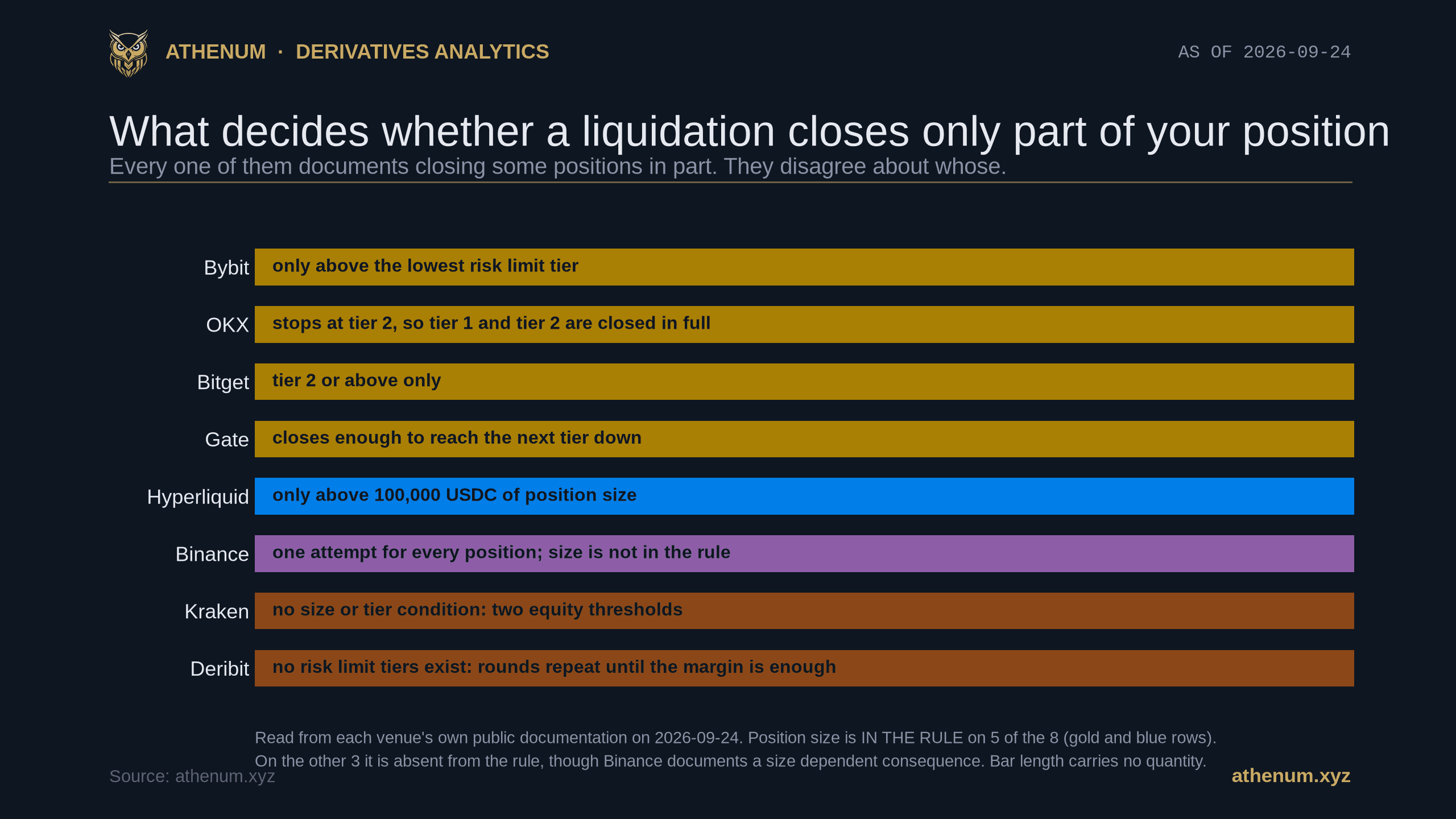
Who Gets a Partial Liquidation and Who Gets Closed All at Once
A liquidation does not always close your whole position. Reading eight venues' own liquidation documentation on 2026-09-24, all of them document closing some positions in part, and they disagree about whose. Bybit, OKX, Bitget and Gate gate the step on the risk limit tier, so a bottom tier position is closed in one action, and OKX stops a rung higher still, at tier 2. Hyperliquid gates on a flat 100,000 USDC of position size, and above it grants one slice before a 30 second cooldown in which orders go back to full size. Binance makes one Immediate or Cancel attempt for every position with no size term in its rule while documenting why smaller ones fare worse anyway. Kraken closes in fixed 10 per cent increments and Deribit repeats liquidation rounds until the requirement is met, neither with a size condition. Position size sits inside the rule itself on five of the eight venues we read and is absent from the rule on the other three.
Athenum Analytics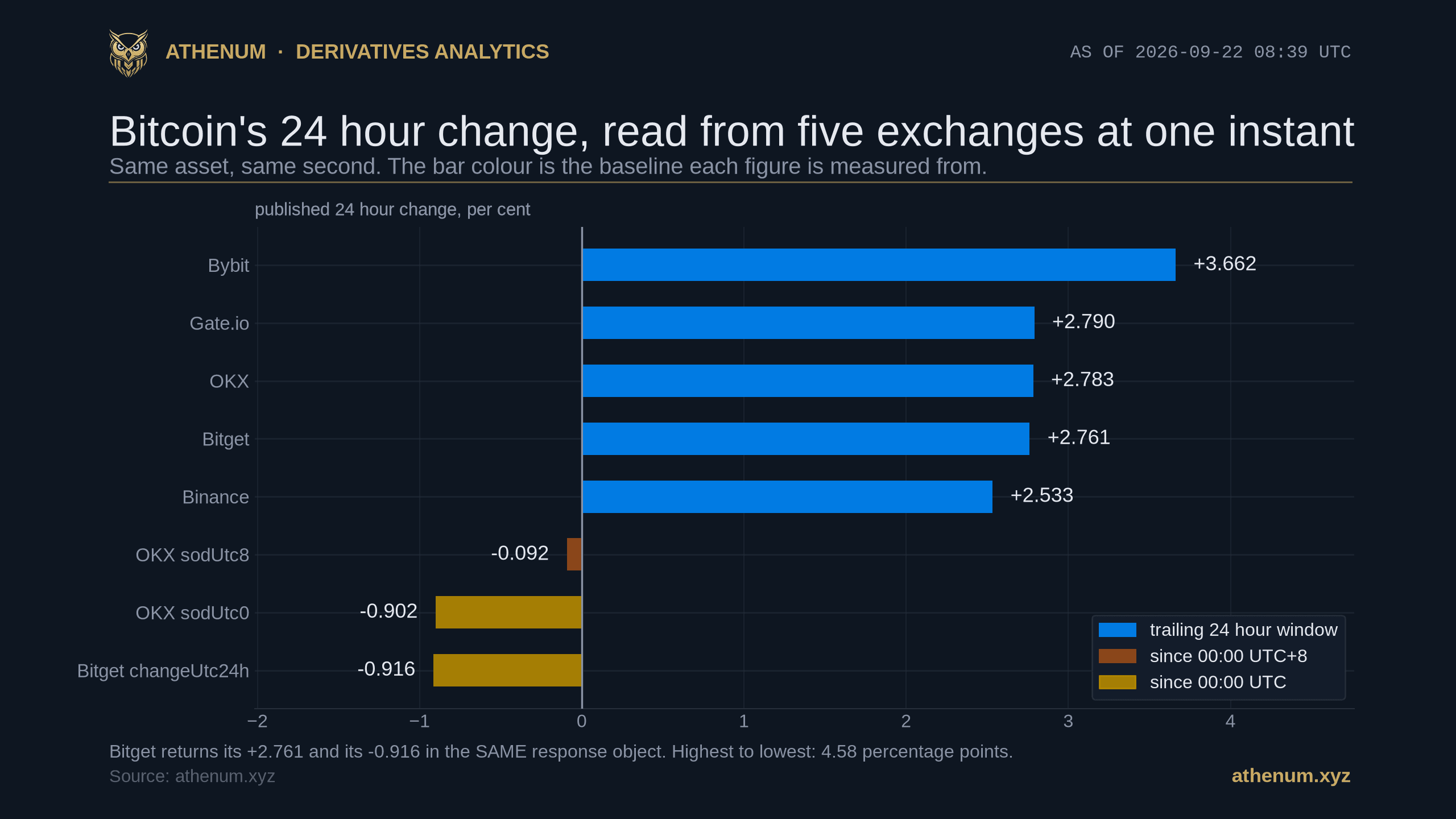
Bitcoin 24 Hour Change: Which Baseline, and Why It Flips the Sign 1 Hour in 4
A Bitcoin 24 hour change is a two point statement, and exchanges disagree about the first point. Some measure from a trailing 24 hour window, some from the price at 00:00 UTC, and OKX also publishes one from 00:00 UTC+8. Read at 2026-09-22 08:39:25 UTC in a 3.0 second capture, the BTC/USDT perpetual carried +3.662 per cent on Bybit and -0.916 per cent in Bitget's since-midnight field, a spread of 4.58 percentage points on the same asset at the same second, with Bitget returning both of its figures in one response object. This is not an edge case. Over the 8,760 hourly readings from 2025-09-22 09:00 UTC to 2026-09-22 08:00 UTC the two baselines differed by a median 0.663 percentage points, by more than 1 point at 37.1 per cent of readings and by more than 2 at 16.3 per cent, and they carried OPPOSITE SIGNS at 2,240 of 8,760, or 25.6 per cent. The disagreement is strongly patterned by the clock: at 01:00 UTC the two figures pointed opposite ways on 51.0 per cent of days, at 23:00 UTC on 4.9 per cent. The same split runs through metrics other than price. Athenum's own cross-venue Bitcoin perpetual open interest at 2026-09-22 07:00 UTC reads +6.96 per cent against 24 hours earlier and -0.81 per cent against 00:00 UTC, from one series at one stamp.
Athenum Analytics
USDC vs USDT Funding: One Exchange, Two Bitcoin Rates at the Same Settlement
USDC vs USDT funding is not a distinction most dashboards make, and it should be. A Bitcoin perpetual quoted in USDC and a Bitcoin perpetual quoted in USDT on the SAME exchange are two books with two premium indices and two quote-currency reference prices, so they charge two different rates at the s
Athenum Analytics