Blog
Page 2 of 10
Bitcoin Futures Roll: the Next Quarter Fills Before the Front One Drains
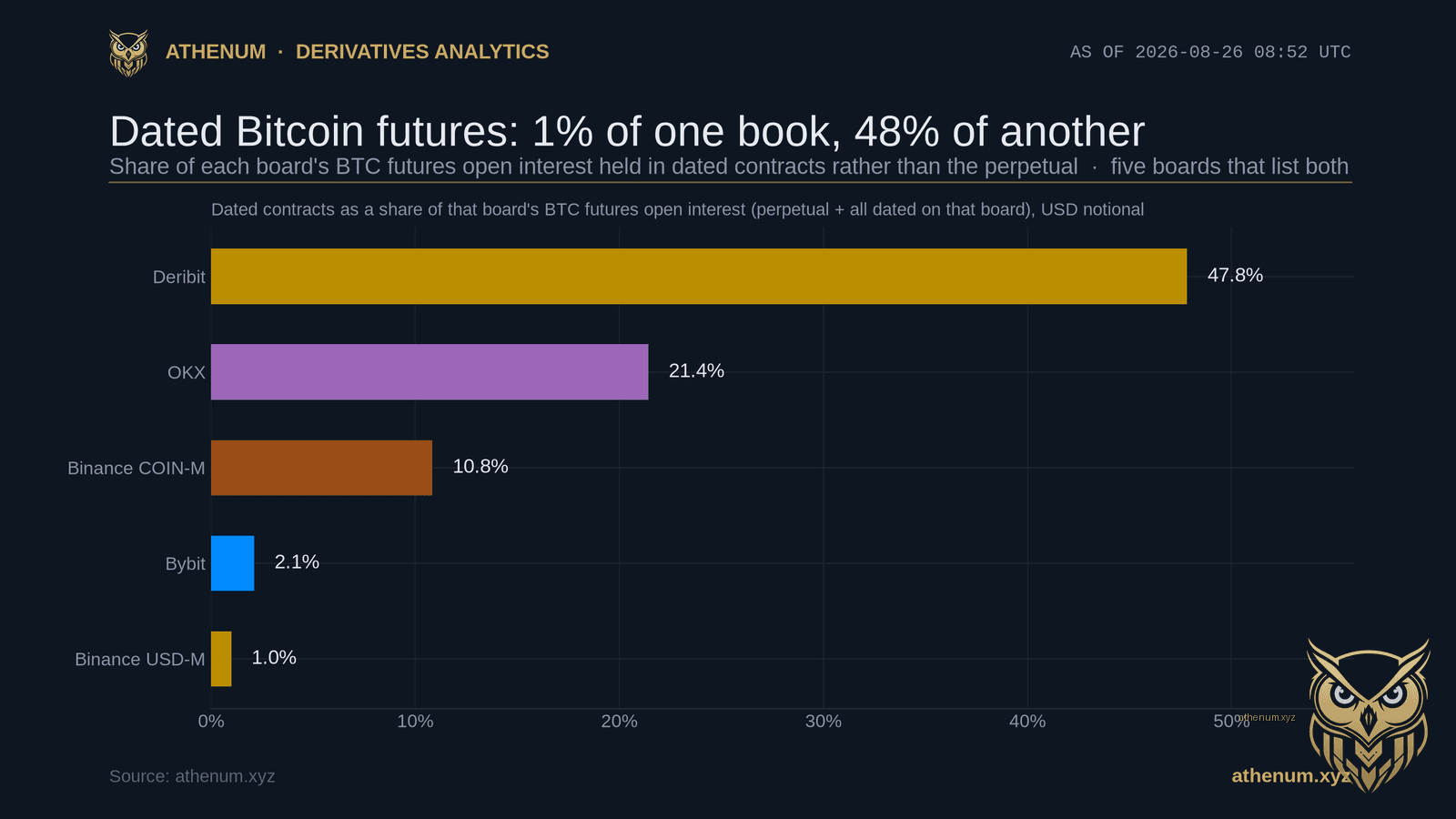
The Bitcoin futures roll is the moment traders move exposure out of an expiring contract and into the next one, and it does not look like the handover most people picture. Measured on 2026-08-26 at 08:52 UTC, about 30 days before the 2026-09-25 quarterly expiry, the December contract already held between 0.54 and 0.68 of September's open interest, median 0.61 across five boards.
 Athenum Analytics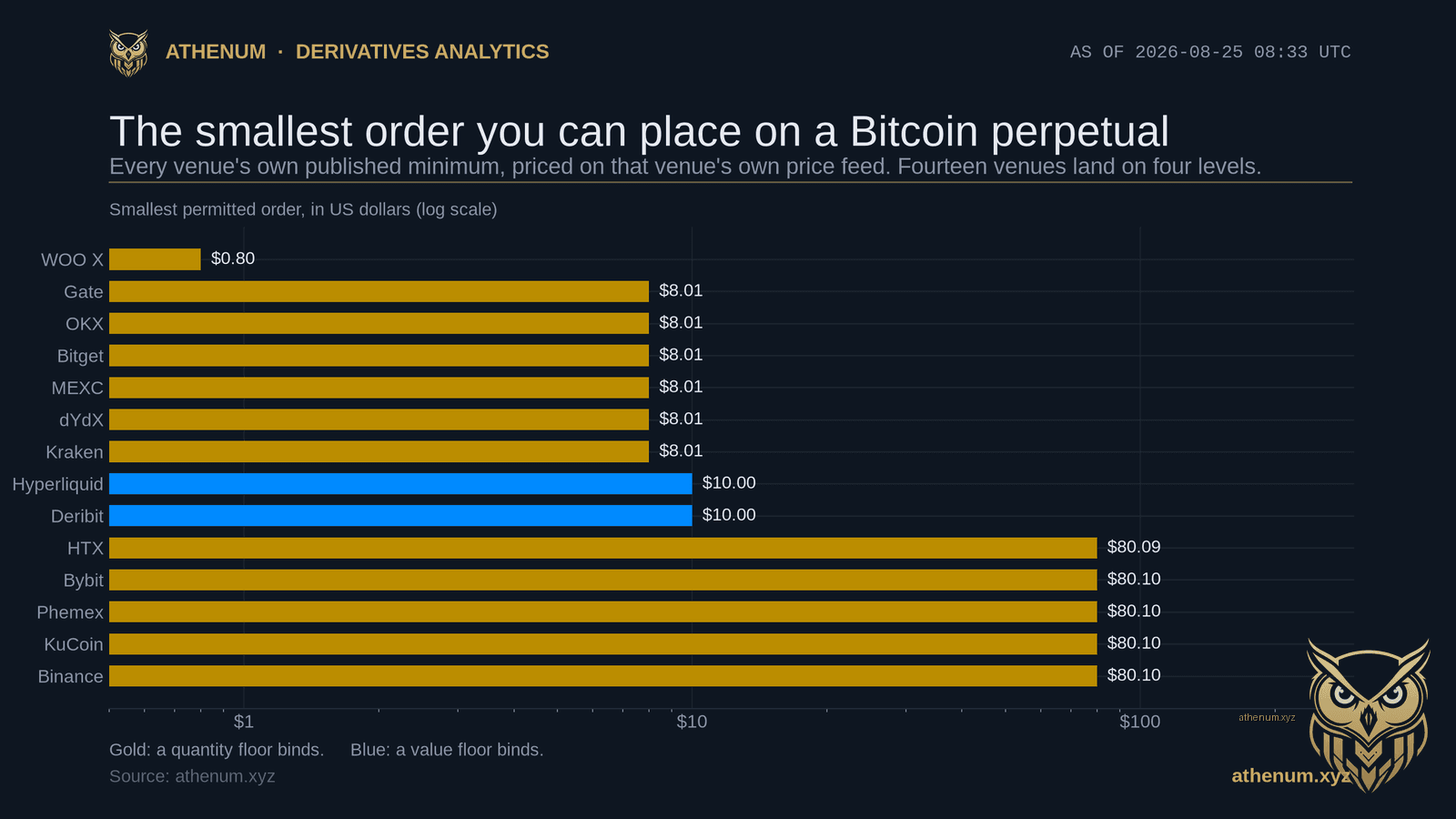
Minimum Order Size on Bitcoin Perpetuals: $0.80 to $80.10 Across 14 Venues
Measured on 2026-08-25 at 08:33 UTC across the Bitcoin perpetual on 14 venues, the smallest order you are permitted to place runs from $0.80 on WOO X to $80.10 on Binance, and the fourteen land on just four levels: $0.80, $8.01, $10.00 and about $80.10. That converted table is the answer to the question as asked. The more useful finding is underneath it. The venues are not enforcing the same kind of rule.
Athenum Analytics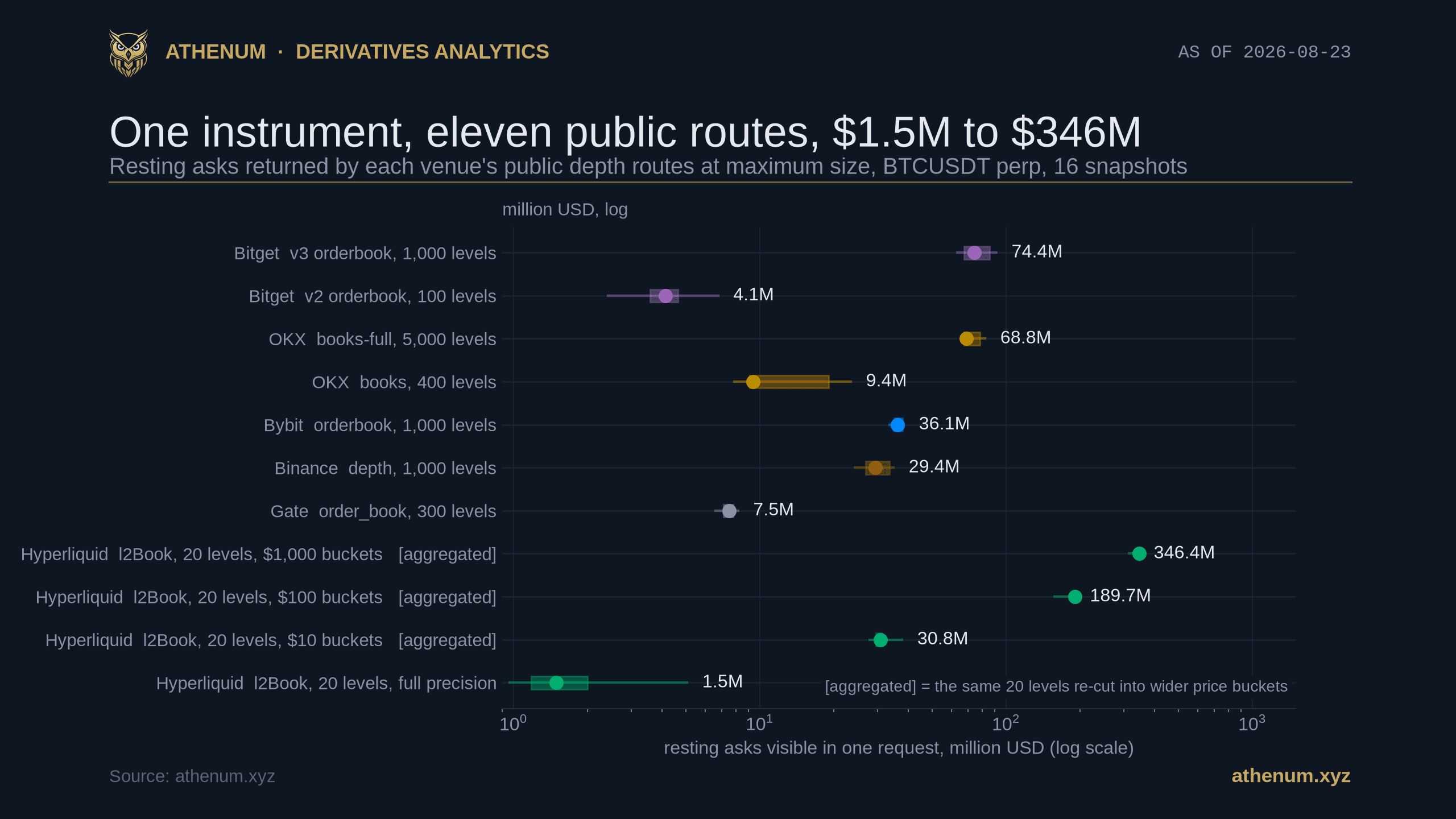
Bitcoin Order Book Depth: One Exchange, Two Routes, 18 Times the Book
Every comparison of exchange liquidity starts by downloading an order book, and almost nobody checks that the download is a choice. Measured on 2026-08-23 across 11 public depth routes on six Bitcoin perpetual venues, 16 simultaneous snapshots each, the resting asks returned by one request run from 1.49M USD to 346.37M USD. The largest single gap is not between exchanges.
Athenum Analytics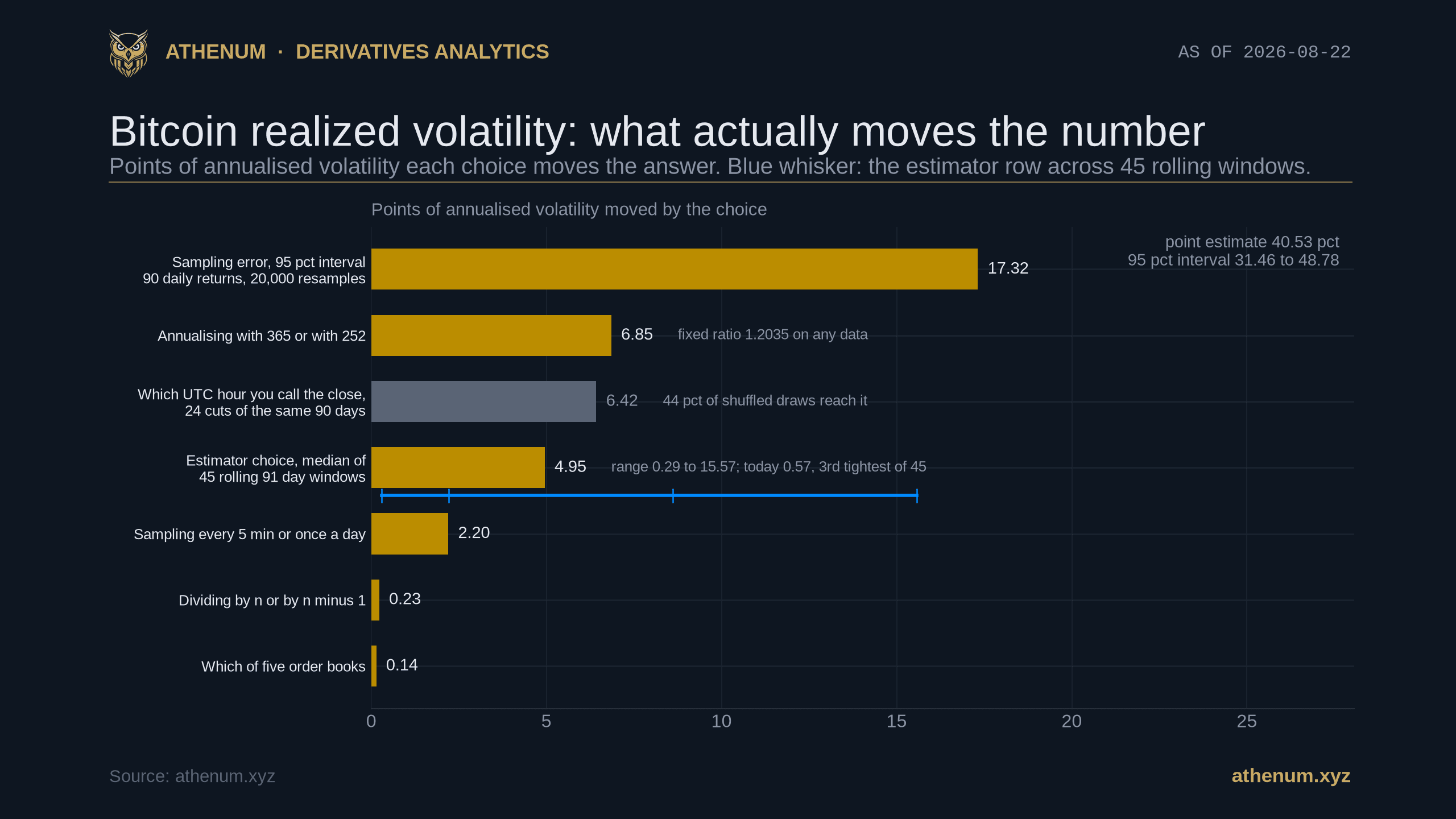
Bitcoin Realized Volatility Is 40.5 Percent, Plus or Minus 9
Realized volatility is published everywhere as a single number and almost never with an interval. We measured Bitcoin's, then measured how much every choice behind it moves the answer. The question here is whether a whole window summary statistic stays put when you re-partition the same tape, which is a different question from whether the hour of day carries return, and we treat it as such throughout.
Athenum Analytics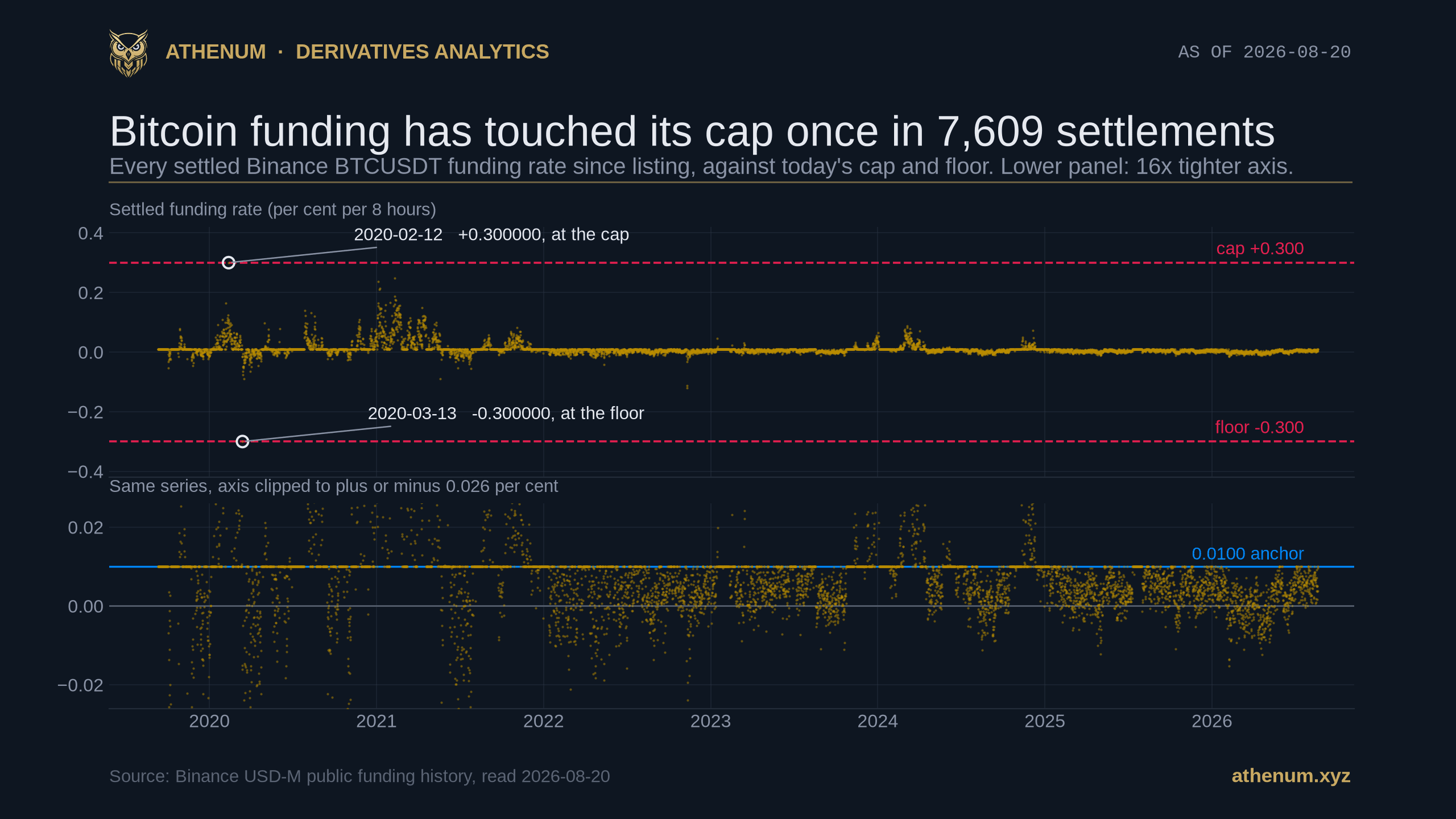
Funding Rate Cap: Once on Bitcoin in Seven Years, Routinely on the Long Tail
Every crypto perpetual publishes a maximum funding rate, and almost nobody checks how often it is actually reached. Across all 7,609 settlements of Binance's BTCUSDT perpetual, the cap was reached once, on 2020-02-12, and the floor once, on 2020-03-13. Smaller contracts reach theirs dozens of times a year, and reaching it does not cap the bill: on Binance, OKX and Bybit it switches the contract to hourly settlement, which multiplies the daily ceiling by eight.
Athenum Analytics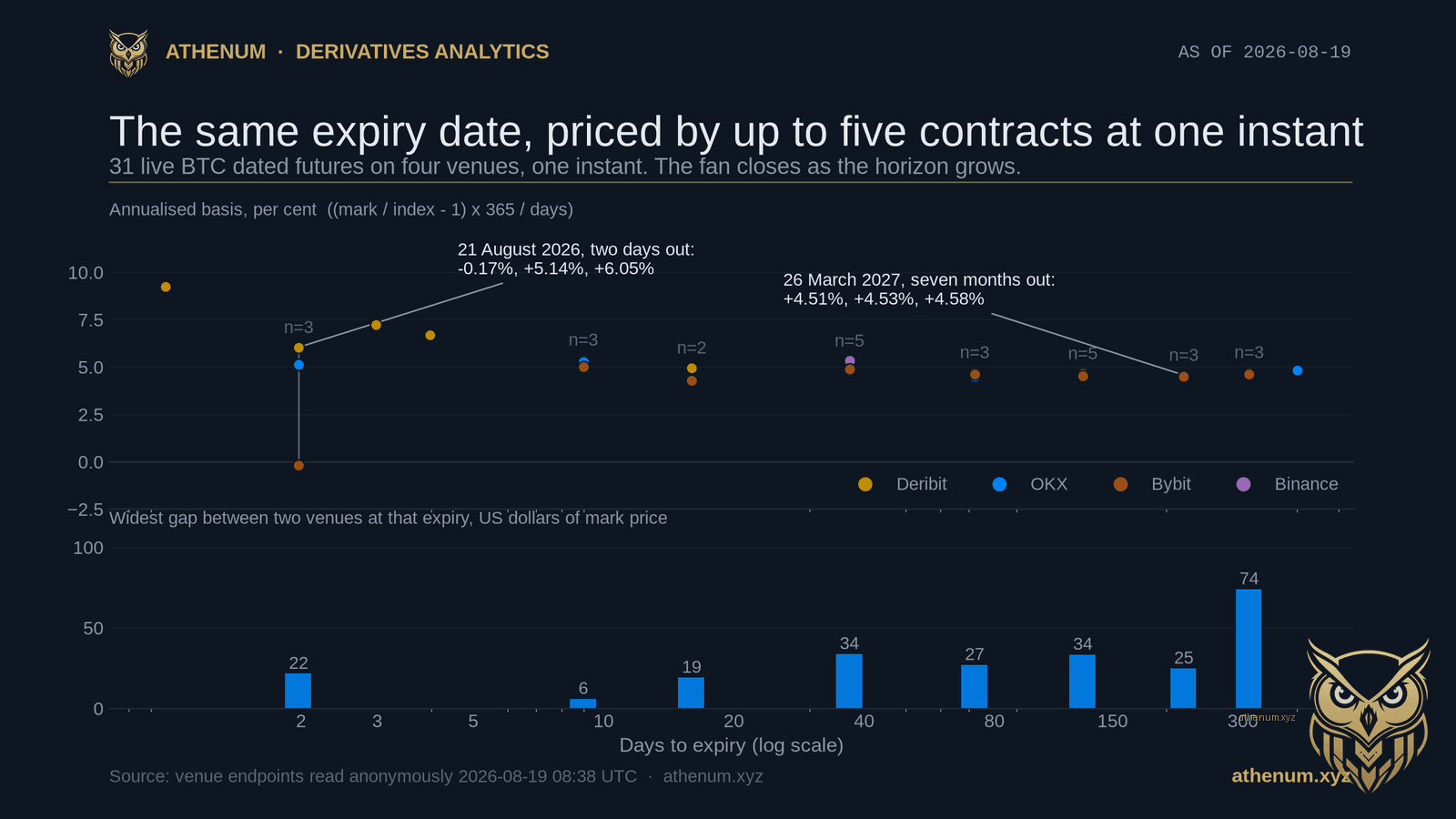
Bitcoin Futures Basis: 6.2 Points Apart at Two Days, 0.07 Apart at Seven Months
An annualised basis is a price gap divided by the time left on the contract. Read at one instant on 2026-08-19, the three venues listing the 2026-08-21 Bitcoin expiry priced it at -0.172%, +5.141% and +6.046% annualised, 6.218 points apart on 21.65 dollars of mark price. The same three sat 0.068 points apart at seven months.
Athenum Analytics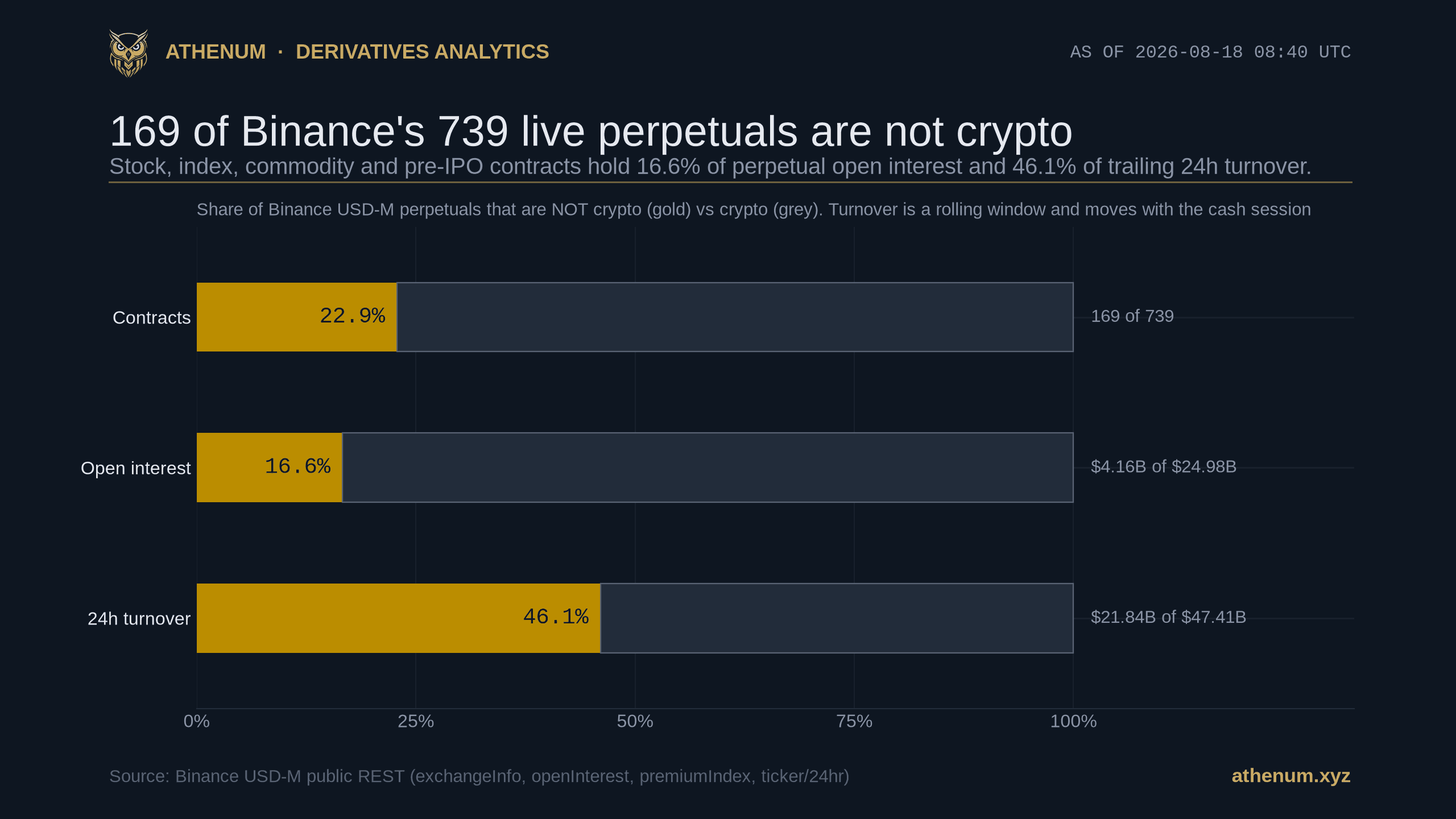
Stock Perpetuals Traded $821M on a Closed Saturday. The Median One Moved 0.09%.
Binance's USD-M futures board is no longer only crypto. Counted on 2026-08-18 08:40 UTC, 169 of its 739 live perpetual contracts track something else: 138 US equities, 12 Hong Kong names, 8 Korean ones, 8 commodities, 1 mainland Chinese name and 2 pre-IPO companies.
Athenum Analytics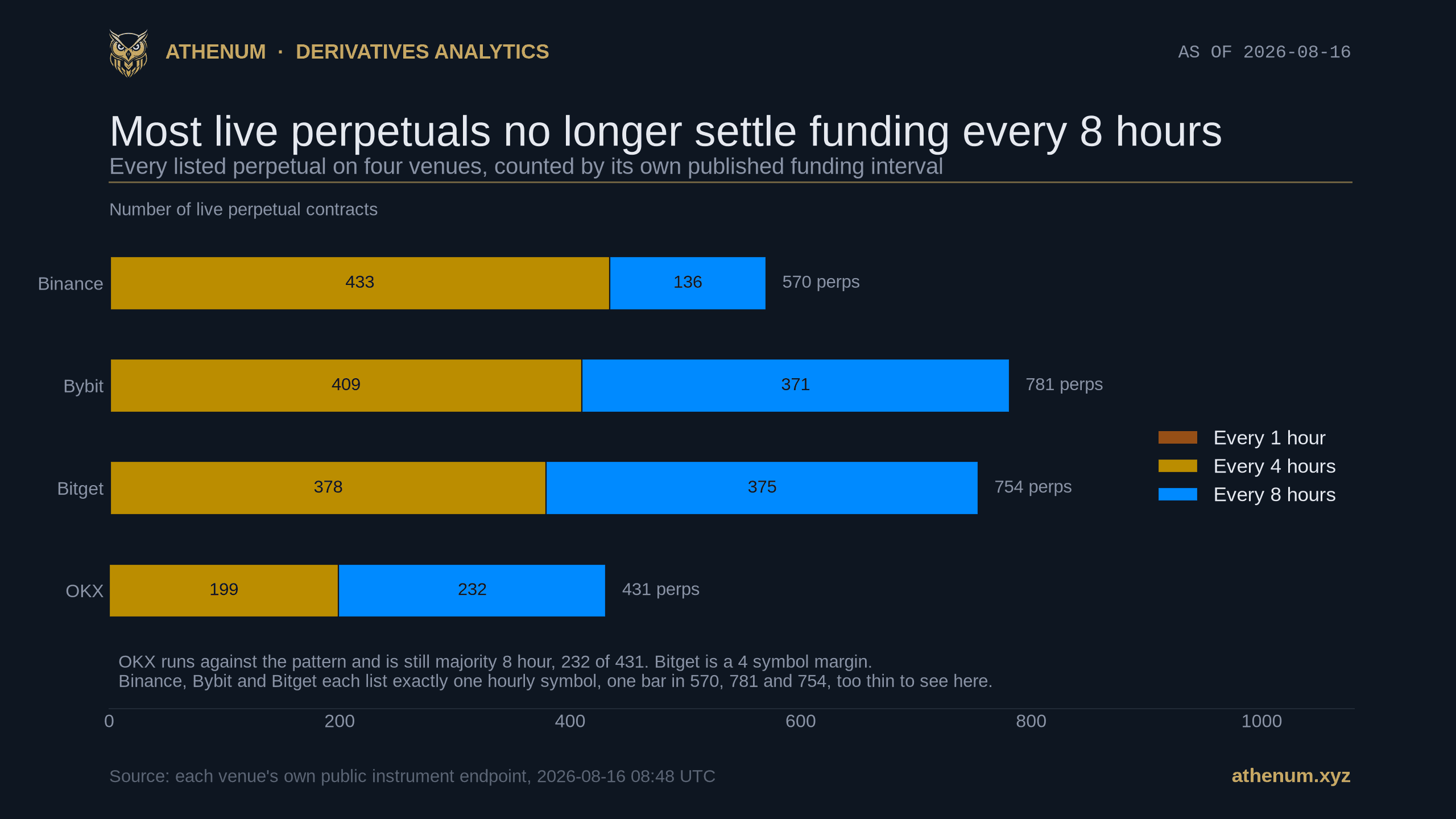
Funding Intervals Are Per Symbol: 1,422 of 2,536 Crypto Perps Are Off the 8 Hour Clock
The funding interval is how often a perpetual charges funding, and most guides, screeners and back of the envelope calculations treat it as a property of the exchange: 8 hours, three settlements a day, multiply by 1,095 for an annual rate. We counted every live crypto perpetual on the main linear board of four venues on 2026-08-16 08:48 UTC. Of 2,536 contracts, 1,422 settle on something other than
Athenum Analytics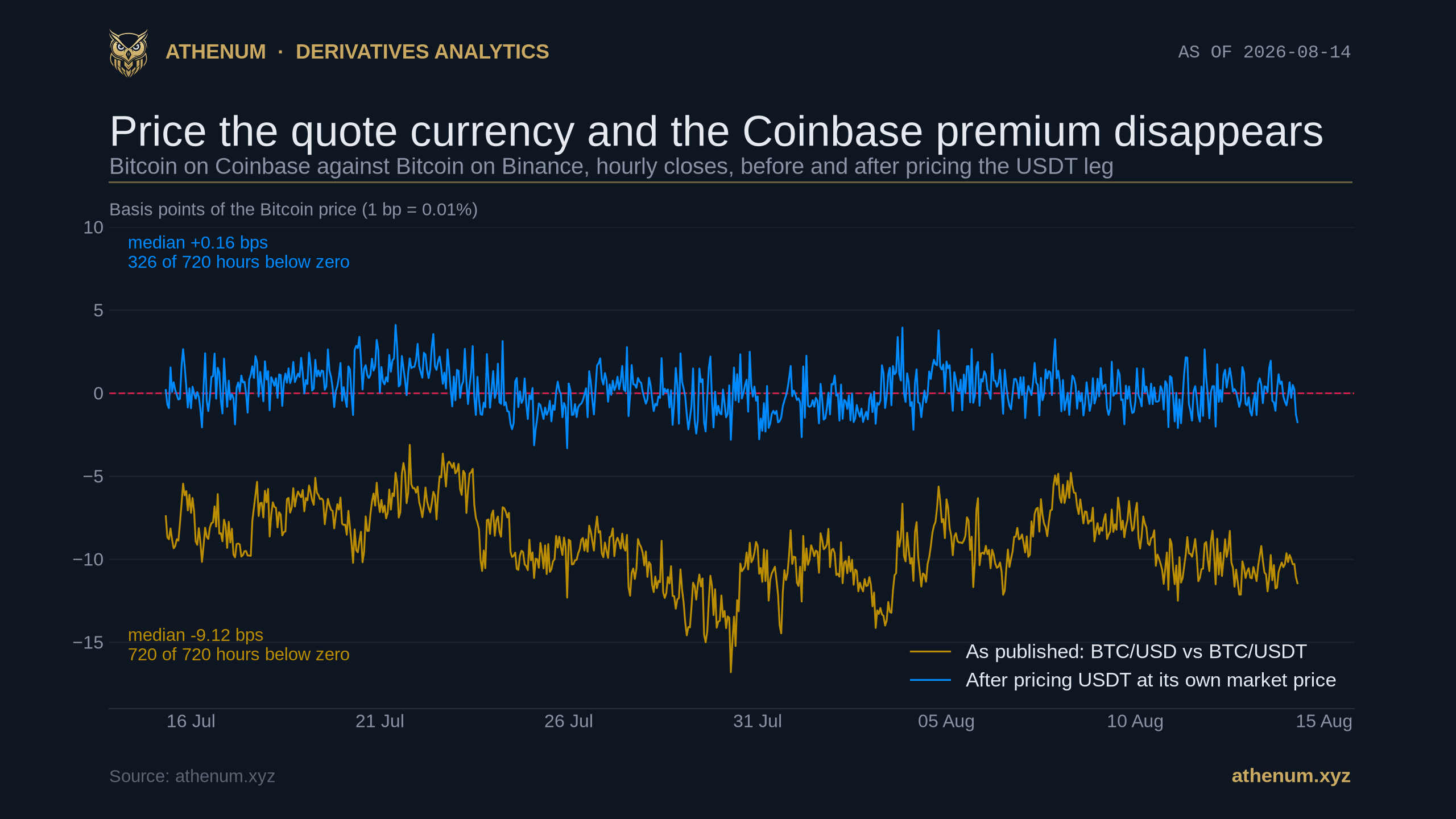
Coinbase Premium or Tether Discount? 720 Hours, One Answer
The Coinbase premium compares Bitcoin priced in US dollars on Coinbase with Bitcoin priced in USDT on Binance, and traders read it as US demand. Over the 720 hourly closes from 2026-07-15 08:00 UTC to 2026-08-14 07:00 UTC it was negative in every single hour, with a median of minus 9.12 basis points, which is 57.31 US dollars at the 62,848.68 dollar close that ended the window. Over the same 720 hours USDT never clos
Athenum Analytics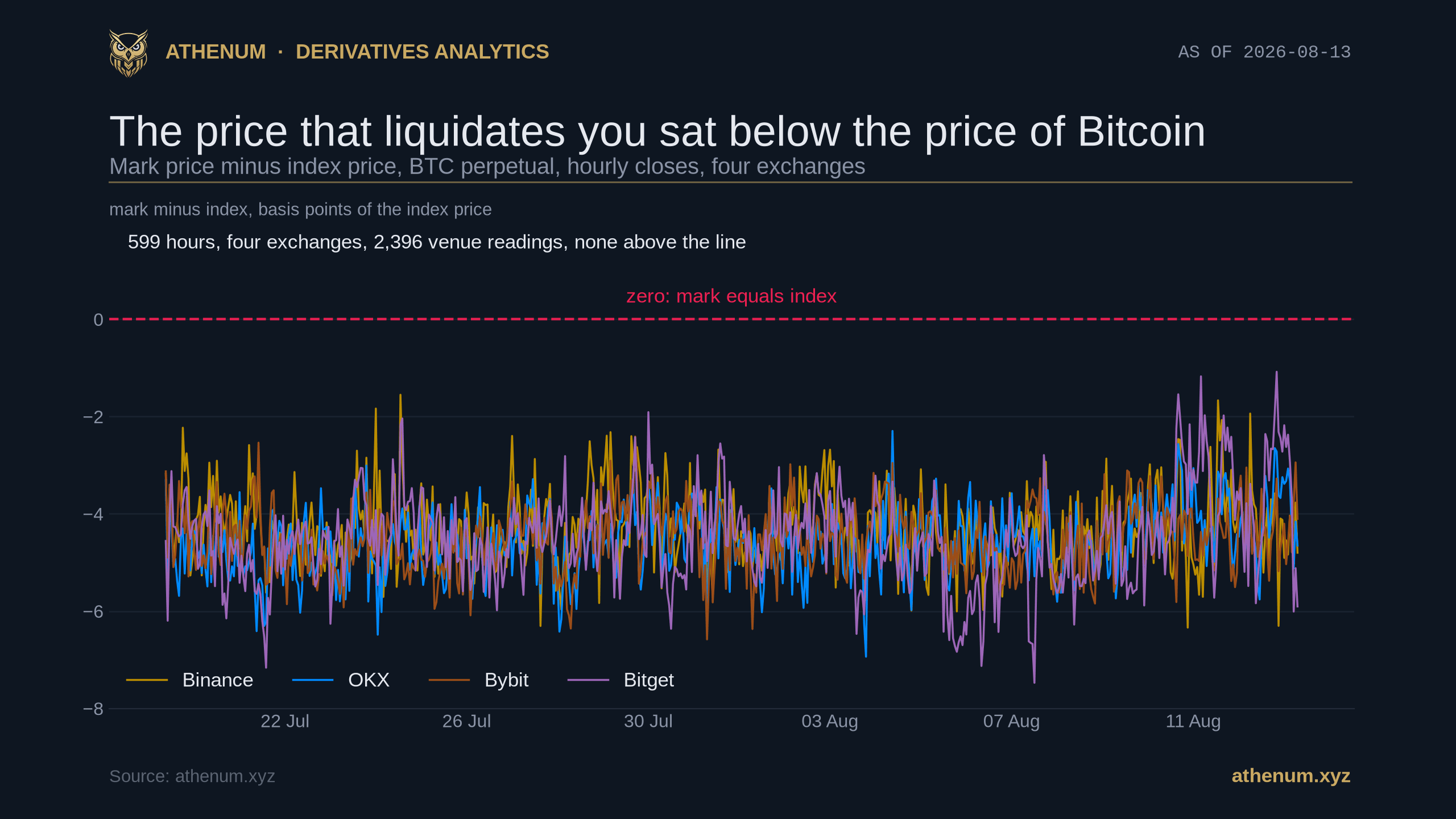
Bitcoin Perpetual Discount to Spot: 599 Hours, and Longs Still Paid
A leveraged position is not closed out at the price on the spot chart, and on Bitcoin perpetuals that difference had one sign for twenty-five days. Across the 599 hourly closes to 2026-08-13 07:00 UTC, the mark price sat below the exchange's own spot index on Binance, OKX, Bybit and Bitget in every hour, 2,396 venue readings without an exception, and funding still ran positive. Here is the measurement, the published mechanism behind it, and what it changes about a liquidation price.
Athenum Analytics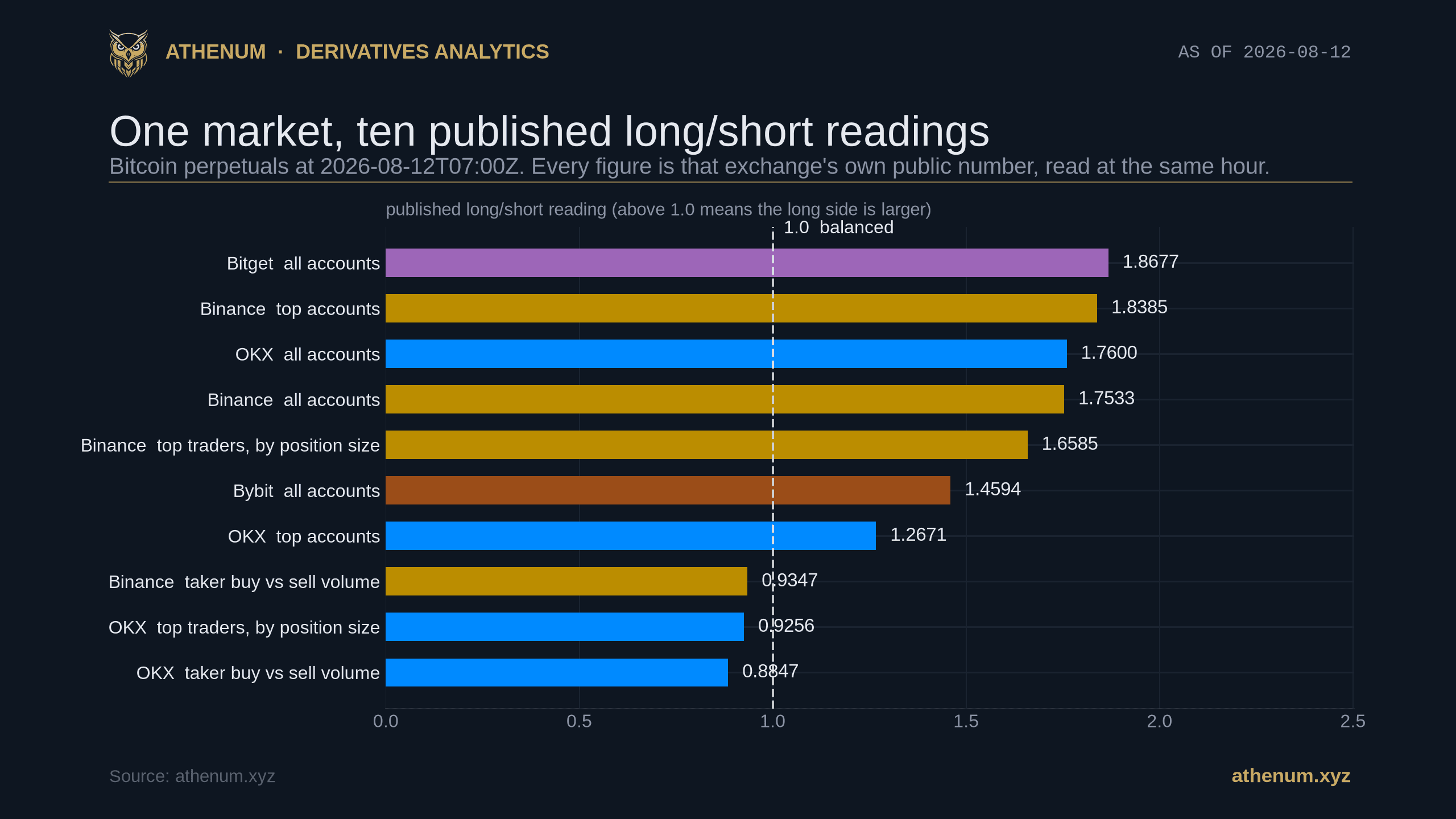
Bitcoin Long Short Ratio: Ten Published Numbers, One Market
The Bitcoin long/short ratio is not one number. For the hour ending 2026-08-12 07:00 UTC, Binance, OKX, Bybit and Bitget published ten readings for the same perpetual market, from 0.8847 to 1.8677, and three of them sat below the 1.0 that is supposed to separate a long-leaning market from a short-leaning one. This is what actually separates those numbers, and what the one reading that is a price rather than a headcount does and does not settle.
Athenum Analytics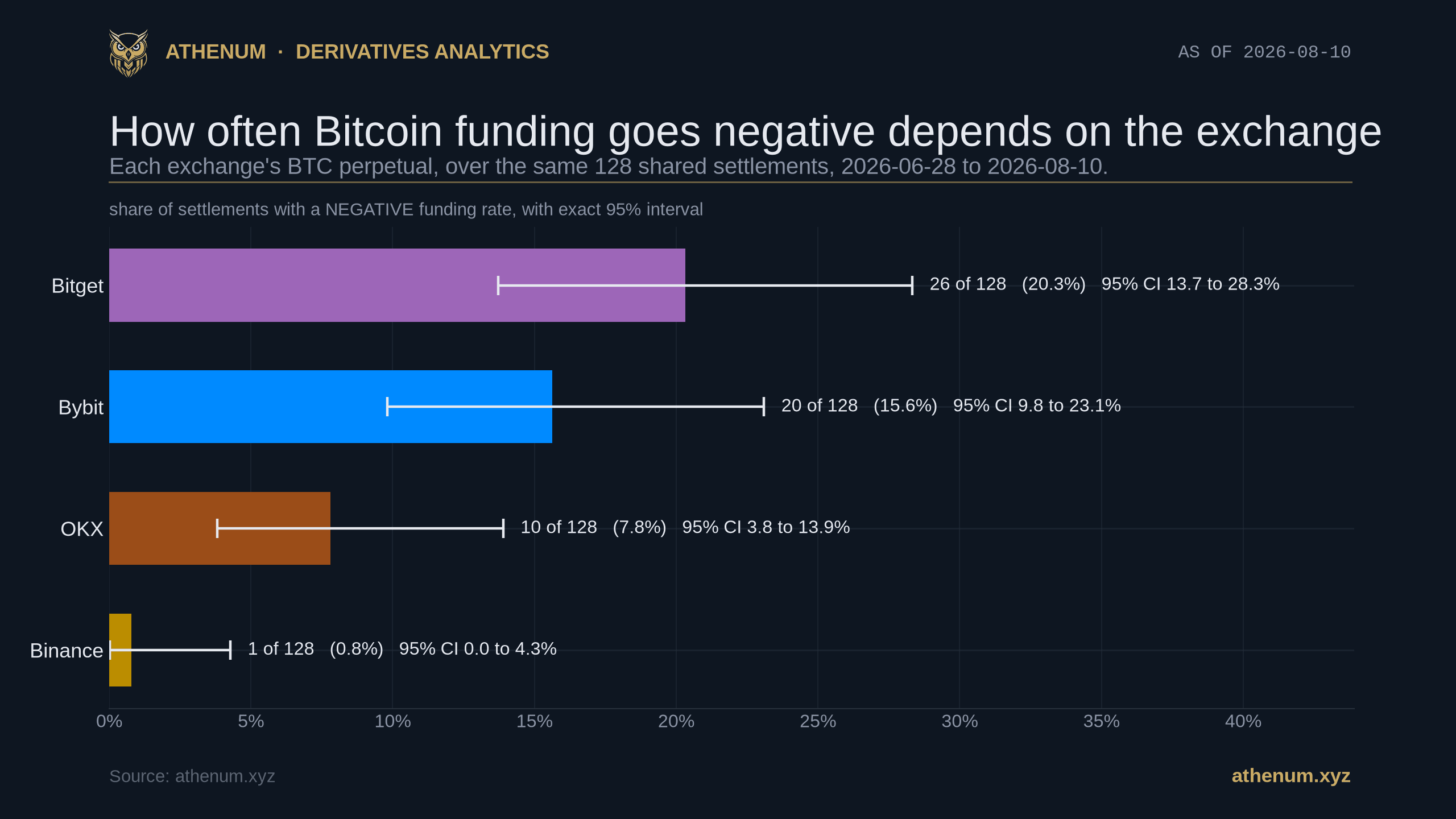
Negative Funding Rate on Bitcoin: One Exchange Printed It Once, Another 26 Times
A negative funding rate is the most quoted sentiment signal in crypto derivatives, and it is almost always quoted from one exchange as though it described the whole market. How often you see one depends enormously on which exchange you happen to read.
Athenum Analytics