Table of Contents10 sections
- Does a crypto exchange have one insurance fund?
- Which pot stands behind a Bitcoin perpetual, and how much is in it?
- Why do two contracts on the same board differ a hundredfold in cover?
- Which contracts on these boards carry the thinnest cover?
- Is any pot larger than the book it protects?
- What do the venues say about this themselves?
- What does Hyperliquid have instead of an insurance fund?
- How do you check the pot behind your own contract?
- Where that open interest sits across the venues
- What this measurement does not show
TLDR. The futures insurance fund is the reserve that pays the winner when a liquidation closes worse than its bankruptcy price, and when it runs out the venue reaches for auto deleveraging instead. Almost everything written about it, including two explainers on this blog, treats it as one number per exchange. It is not. Read from each venue's own public endpoint on 2026-10-03 between 13:47 and 13:53 UTC, the picture is this. Binance splits its USD margined insurance fund into 123 separate pots, Bybit into 76, and OKX runs a security fund for each of its 500 live swap families. Each venue publishes exactly which contracts draw on which pot. The consequence is measurable: across the 107 Binance pots whose members carry at least $10M of open interest, the reserve per dollar of open interest runs from 95 to 9,715 basis points, a hundredfold spread on one board, with a median of 1,269. The pot behind Bitcoin is not the best covered one. It holds $1,289.7M, which is 856 basis points of the $15.07B of open interest in the eight contracts that share it, below that same board's median. On OKX the thinnest cover sits on the tokenized equity, ETF and commodity contracts: GOOGL-USDT is backed by $0.081M against $16.2M of open interest, 50 basis points, and gold at XAU-USDT by $1.66M against $228.3M, 73 basis points. Hyperliquid has no insurance fund at all. Its backstop is HLP, a vault that also makes markets, and the four liquidator strategies inside it held $33.0M against the $12.66B of open interest across the whole venue, which is 26 basis points.
Does a crypto exchange have one insurance fund?
No. Every venue in this measurement splits the reserve into pots, and each pot backs a named list of contracts rather than the whole board. Binance returns 123 of them from its public insurance balance endpoint, with a combined $2,416.8M; Bybit returns 76, combining to $1,194.8M; OKX publishes a security fund per instrument family and returned a balance for all 500 live swap families, combining to $623.5M. Every venue figure here comes from one capture window, 2026-10-03 13:47:54 to 13:53:29 UTC; the one cross venue reading from our own feed, late in this post, is that day's 13:00 UTC bar. Membership is not a secret: Binance lists the symbols of every pot, Bybit lists them as a comma separated string per pot, and an OKX family resolves to its own contract. So the question a trader can actually answer is not how large an exchange's insurance fund is, but how large the pot behind one specific contract is, and how many other contracts are drawing on it.
Sorted, that board looks like this.

One exchange, 107 pots that back a book of at least $10M, and a hundredfold spread between the thinnest and the thickest cover, 95 to 9,715 basis points. The gold bar is the pot that backs the Bitcoin perpetual, at 856 basis points, below the board median of 1,269.
Which pot stands behind a Bitcoin perpetual, and how much is in it?
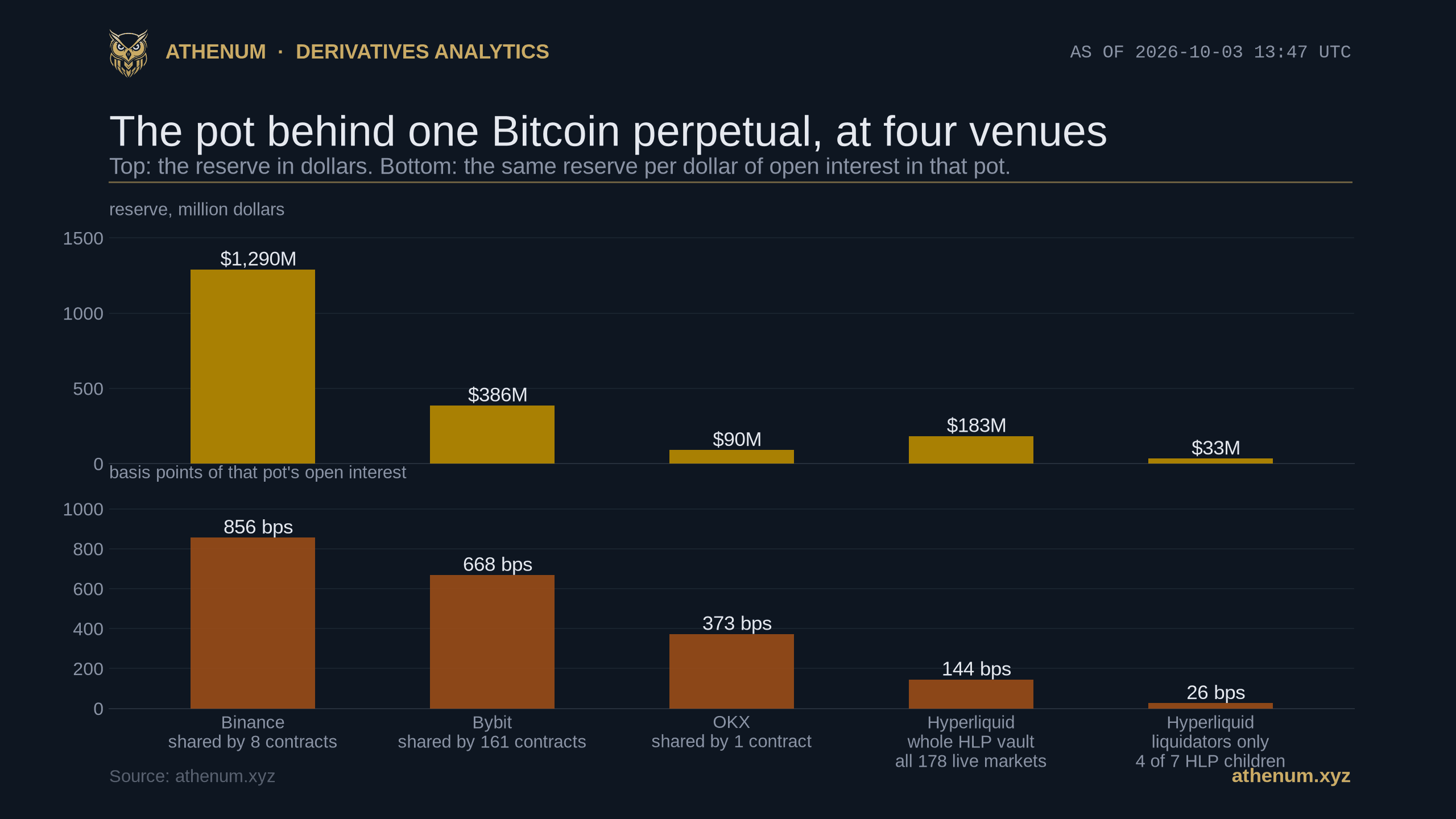
A different one at every venue, and the membership matters more than the headline balance. On 2026-10-03, Binance's BTCUSDT draws on a pot shared with seven other contracts: BNBUSDT, ETHUSDT, ETHBTC and the December 2026 and March 2027 quarterlies on Bitcoin and Ether. That pot holds 782,141,179 USDT plus 499,980,384 USDC plus smaller balances in BNFCR, Bitcoin and BNB, which comes to $1,289.7M, and its own last configuration stamp reads 2026-10-03 00:00 UTC. Bybit's BTCUSDT sits in a USDT pot shared with 160 other linear contracts, holding $386.2M. OKX's BTC-USDT-SWAP has a family to itself, holding 89,817,495 USDT. Hyperliquid publishes no insurance fund; its liquidations run through HLP, which held $182.8M at 13:53 UTC.
Venue | Pot that backs the Bitcoin perpetual | Contracts in the pot | Reserve on 2026-10-03 | Open interest in that pot | Reserve per dollar |
|---|---|---|---|---|---|
Binance | BNBUSDT, BTCUSDT, ETHUSDT, ETHBTC and 4 quarterlies | 8 | $1,289.7M | $15.07B | 856 bps |
Bybit | the USDT linear pot | 161 | $386.2M | $5.78B | 668 bps |
OKX | the BTC-USDT family | 1 | $89.8M | $2.41B | 373 bps |
Hyperliquid | whole HLP vault, no insurance fund | 178 live markets | $182.8M | $12.66B | 144 bps |
Hyperliquid | the HLP liquidator strategies inside it | 178 live markets | $33.0M | $12.66B | 26 bps |
Reserve per dollar is the pot's balance divided by the open interest of the contracts that pot names, in basis points, so 100 basis points is one cent of reserve per dollar of notional. Bybit's open interest is taken from its own single sided field, because its default field counts both sides, as Athenum measured in August. Binance states no convention on the open interest endpoint itself, and we read it as single sided, which is how its own educational material describes it. That reading only affects comparisons across venues: if Binance's field counted both sides, the true single sided book would be half of what we used, so its row would read 1,711 basis points instead of 856, since 855.6 doubled is 1,711.3. Nothing inside the Binance board would change, because halving every pot's denominator moves every pot alike. Hyperliquid gets two rows, both for the whole venue since the vault is not partitioned by contract: the first is the entire HLP vault and the second is only the four liquidator strategies inside it, which is the comparable figure and is explained below.

Each dot is one pot whose contracts carry at least $10M of open interest. Box is the middle half, bar the median: 1,269 on Binance, 1,178 on Bybit, 374 on OKX. The gold diamond is the Bitcoin pot at 856, 668 and 373 basis points.
The middle halves do most of the talking here. On Binance the middle half of those 107 pots runs from 801 to 1,943 basis points around a median of 1,269, and on OKX from 201 to 1,156 around a median of 374 across 56 families. Bybit's 16 pots have a stable median at 1,178 and unstable quartiles, because one of the 16 sits just above the $10M cutoff and four pots that miss the cutoff sit within 10 per cent below it, so one hour of drift reshuffles which pots are in the set. Its middle half is drawn in the chart and we do not compare it. Those ranges overlap heavily, so the honest reading of the cross venue ordering is that OKX runs thinner cover than the other two on a typical contract, not that any one venue's number is a league table position.
Why do two contracts on the same board differ a hundredfold in cover?
Because at one of these venues the pot balances are not sized to the books they stand behind. Rank the 123 Binance pots by the open interest they back and by their own balance, and the two orderings barely agree: the rank correlation is +0.18. Do the same for Bybit's 76 pots and it is +0.82. Bybit's reserves move with its books; Binance's largely do not, which is why its board carries a cluster of 106 pots holding between $2M and $4.5M each while the contracts behind them carry anywhere from $2.2M to $94.5M.

If a venue sized reserves to books, the dots would climb the diagonal. Bybit's blue dots do, at a rank correlation of +0.82. The flat gold band is the same few million dollars standing behind very different amounts of notional, at +0.18.
The thinnest Binance pot with a real book on 2026-10-03 holds $1.58M against $166.9M of open interest, which is 95 basis points, and it backs eight contracts: AEVOUSDT, BANDUSDT, BTWUSDT, CETUSUSDT, DODOXUSDT, PUNDIXUSDT, STEEMUSDT and ZESTUSDT. The largest pot by a wide margin, the one holding $1,289.7M, covers its own book at 856 basis points, which is nine times the cover of that small pot and still below the board median of 1,269.
Which contracts on these boards carry the thinnest cover?
On OKX, the ones that are not crypto. OKX tags every instrument with its own category field, and splitting the 56 families whose contracts carry at least $10M of open interest by that tag gives 39 crypto families with a median of 550 basis points and a middle half of 305 to 2,060, against 17 equity, ETF, metal and energy families with a median of 144 and a middle half of 81 to 304. That is a factor of about 3.8 between the medians. The thinnest four on the whole board are GOOGL-USDT at 50 basis points, QQQ-USDT at 56, gold at XAU-USDT at 73 and SKHY-USDT at 77. Gold is the one to look at twice, because it is not a small book: $1.66M of security fund standing behind $228.3M of open interest.

Median 550 basis points against 144, a factor of about 3.8, with every family of at least $10M of open interest shown as its own dot. The ranges overlap: the highest non crypto family reads 848, well inside the crypto range.
The overlap is the part to keep. Seventeen observations is a small group, the highest non crypto family reads 848 basis points and the lowest crypto family reads 111, so the two sets are not separated. What the data supports is that a contract on a non crypto underlying is more likely to sit in a thinly funded family, not that every one of them does. That matters because these contracts also trade when their underlying market is closed, which we measured on a Saturday in August.
Is any pot larger than the book it protects?
Yes, and it is the oldest contract design on the board. Bybit's inverse Bitcoin perpetual, BTCUSD, has a dedicated pot holding 5,090.21 Bitcoin, which Bybit values at $431.9M at that moment on its own mark, while the whole BTCUSD book carries $239.0M of open interest on the venue's own single sided field. That is 18,071 basis points, a reserve 1.8 times the size of the position it stands behind. The inverse Ether contract reads the same shape one notch lower, $138.3M against $86.5M, which is 1.6 times. Meanwhile the USDT pot that contains Bybit's far larger linear Bitcoin contract covers its own book at 668 basis points. The reserve is concentrated where the business used to be rather than where it is now.
What do the venues say about this themselves?
Each of them documents the split, and none of them documents all of it. Binance's own help page, stamped 2026-01-04, says that "BTC, ETH, and BNB USDT-margined contracts share the same insurance fund", that a named list of eleven tickers shares another, that "USDC-margined contracts share the same Futures Insurance Fund", and then closes the subject with "Other USDT-margined contracts are covered by other pools of Futures Insurance Funds". The API names those other pools and their members; the help page does not. The first sentence holds, and the pot is wider than the sentence: it contains BTCUSDT, ETHUSDT and BNBUSDT as the help page says, plus ETHBTC and the four quarterlies, which the help page does not mention. The second has drifted. The pot that matches that named list holds $64.05M and contains ten of the eleven, with EOSUSDT no longer on it.
Bybit's API reference distinguishes a shared pool, where contracts "are shared with one insurance pool", from an isolated pool that "returns one contract", and states that "the isolated insurance pool balance is updated every 1 minute, and shared insurance pool balance is updated every 24 hours". OKX calls the same thing a security fund and publishes it per instrument family. One detail there did not match: OKX's own notice for the changes effective 2026-06-09 on web says the endpoint "will discontinue regular_update granularity", and on 2026-10-03 the BTC-USDT family returned 100 rows, all of type regular_update, spaced 60 to 61 seconds apart over 1.65 hours, carrying 8 distinct balances. The announced retirement had not reached the response we received.
Two pages on this blog need the same correction. Our explainer of 2026-07-18 says that "each venue runs its own insurance fund and its own ADL queue", and our explainer of 2026-06-13 says that "Major venues publish a live insurance fund balance", both in the singular. The same 2026-06-13 page also writes, correctly, about "the fund for that specific contract", so our own corpus has been inconsistent with itself on this point. The measurement above is the resolution: it is per contract group, the groups are published, and the balances differ by three orders of magnitude.
What does Hyperliquid have instead of an insurance fund?
A vault that trades. Hyperliquid's documentation states that "backstop liquidations on Hyperliquid are democratized through the liquidator vault, which is a component strategy of HLP" and that "the pnl stream from liquidations go entirely to the community through HLP". So the backstop is not a segregated reserve that only pays out: it is a set of strategies inside a community owned vault whose other strategies are market making. The same public endpoint names the vault's children, and that is where the honest number is. On 2026-10-03 at 13:53 UTC the whole vault reported an account value of $182.8M, which is 144 basis points of the $12.66B of open interest across its 178 live markets, but only four of the seven children are liquidator strategies, each described as liquidating positions "as soon as they become liquidatable", and together they held $33.0M. That is 26 basis points, the thinnest backstop in this measurement by a wide margin, and it is the figure to compare with the others rather than the 144.
How do you check the pot behind your own contract?
Three public requests and two habits, with no account and no key.
1. Ask the venue which pot your symbol is in. Binance answers a single symbol query on its insurance balance endpoint and returns the pot containing it, with every other member listed. Bybit returns all pots at once and you find your symbol in the comma separated membership string. OKX answers per instrument family.
2. Read the balance and note the asset. A pot can hold several, as Binance's Bitcoin pot does, and a pot denominated in Bitcoin or Ether moves with the price of the thing it is insuring.
3. Add up the open interest of the contracts that share the pot, not just your own, and use each venue's single sided field where it publishes one. The ratio of the two is the reserve per dollar of notional in that pot.
4. Compare it to the same venue's other pots rather than across venues. The counting conventions differ enough that a cross venue ranking of this ratio carries less information than a within venue one.
5. Re-run it. The balances move: Bybit's own documentation says a shared pool is only restated once a day, so a number you cached last week is a week old by construction.
For the position side of the same question, the free liquidation calculator gives the price at which your position reaches the point where any of this starts to matter, and the leverage calculator shows how the margin behind it changes with size. The mechanics of what happens after that point are in our explainer on insurance funds and auto deleveraging, and the question of whether the venue closes all of your position or part of it is its own measurement.
Where that open interest sits across the venues
The denominators above are per venue. Across venues on the same contract, Athenum's normalized feed read Bitcoin perpetual open interest on the 2026-10-03 13:00 UTC bar as $8.28B on Binance, $4.73B on Bybit, $3.13B on Hyperliquid, $2.81B on Bitget, $2.41B on OKX and $0.80B on Deribit, with Bitcoin at $84,808.97. Printed as the feed prints them, those six legs sum to $22.16B. The Bybit leg carries that venue's double sided convention, so on a consistent single sided basis the same six legs sum to $19.80B, and that is the number to carry forward. The feed's own all venue total on that bar reads $22.32B, above the six named legs, because it is not limited to the six venues named here. The Binance leg is close to what Binance itself returned later the same hour, $8.28B against $8.29B read at 13:48 UTC, which checks the copy rather than the convention. The venue standing behind the largest of those legs is the one holding 856 basis points; OKX, at 373 basis points the thinnest of the table's three insurance funds, since Hyperliquid's two rows are a vault rather than a fund, stands behind a leg of $2.41B.
What this measurement does not show
It does not say how likely auto deleveraging is. Reserve per dollar of open interest is a ratio of two published numbers, not a probability. The loss a pot has to absorb depends on the gap between a liquidation price and the price actually achieved, on how concentrated positions are, and on how fast the book refills, none of which is in a balance sheet line. A thin pot behind a deep, liquid contract may never be touched, and a thick pot behind a contract that gaps can be emptied in one event.
It does not cover every venue or every board. Bitget, Deribit, Kraken and Gate are not in the pot comparison, because no equivalent public pot map was reachable for them in this capture. Binance's coin margined board is separate from the USD margined one measured here and has its own funds. Bybit's figures include its inverse and dated contracts, which is why it has pots of a single symbol.
Six Binance symbols returned no open interest to us, so the five pots containing them are priced from their remaining members and the cover of those five pots is overstated by whatever those six symbols carry. Four of the five clear the $10M floor and are inside the 107. Neither the six symbols nor the five pots appear in the table above.
It is one instant. Everything above is a capture between 13:47:54 and 13:53:29 UTC on 2026-10-03, and the pots move. OKX's BTC-USDT balance changed between consecutive readings seven times, across eight distinct values, in the 1.65 hours of history its endpoint returned. Nothing here should be quoted back as a current number a week from now; the point is the structure and the method, and both are easy to re-run.
It does not convert exotic balances at a market rate we verified. The Binance Bitcoin pot holds a small BNFCR balance, $1.88M of the $1,289.7M, which we counted at one dollar. Dropping it entirely moves that pot's cover from 855.6 to 854.4 basis points, which print as 856 and 854.
Every figure here was read from the venues' own public endpoints during one capture window of five and a half minutes on 2026-10-03, and the cross venue open interest comes from Athenum's normalized feed reading Binance, Bybit, OKX, Bitget, Hyperliquid and Deribit side by side. The 34 calculators that sit next to that feed stay free: no account, no email address, and no cap on how often you run them. If you would rather see those books on one screen than query six endpoints by hand, a free 7 day Pro+ trial opens the terminal at app.athenum.xyz and asks for no card.
One terminal. All the data.
Liquidations, orderbook depth, whale walls & open interest from 4 exchanges, all real-time, in one place.
No credit card required

Athenum Analytics
Athenum Analytics is our three-person editorial team covering crypto derivatives, market data and macroeconomic context.