Table of Contents8 sections
- What is a partial liquidation?
- Which positions actually get closed in steps?
- Why does the bottom tier have no step to take?
- What did our own pages say about this?
- Does this change how a liquidation total should be read?
- Can the aggregate open interest tape show any of it?
- How should this change the way you size a position?
- What this post does not say
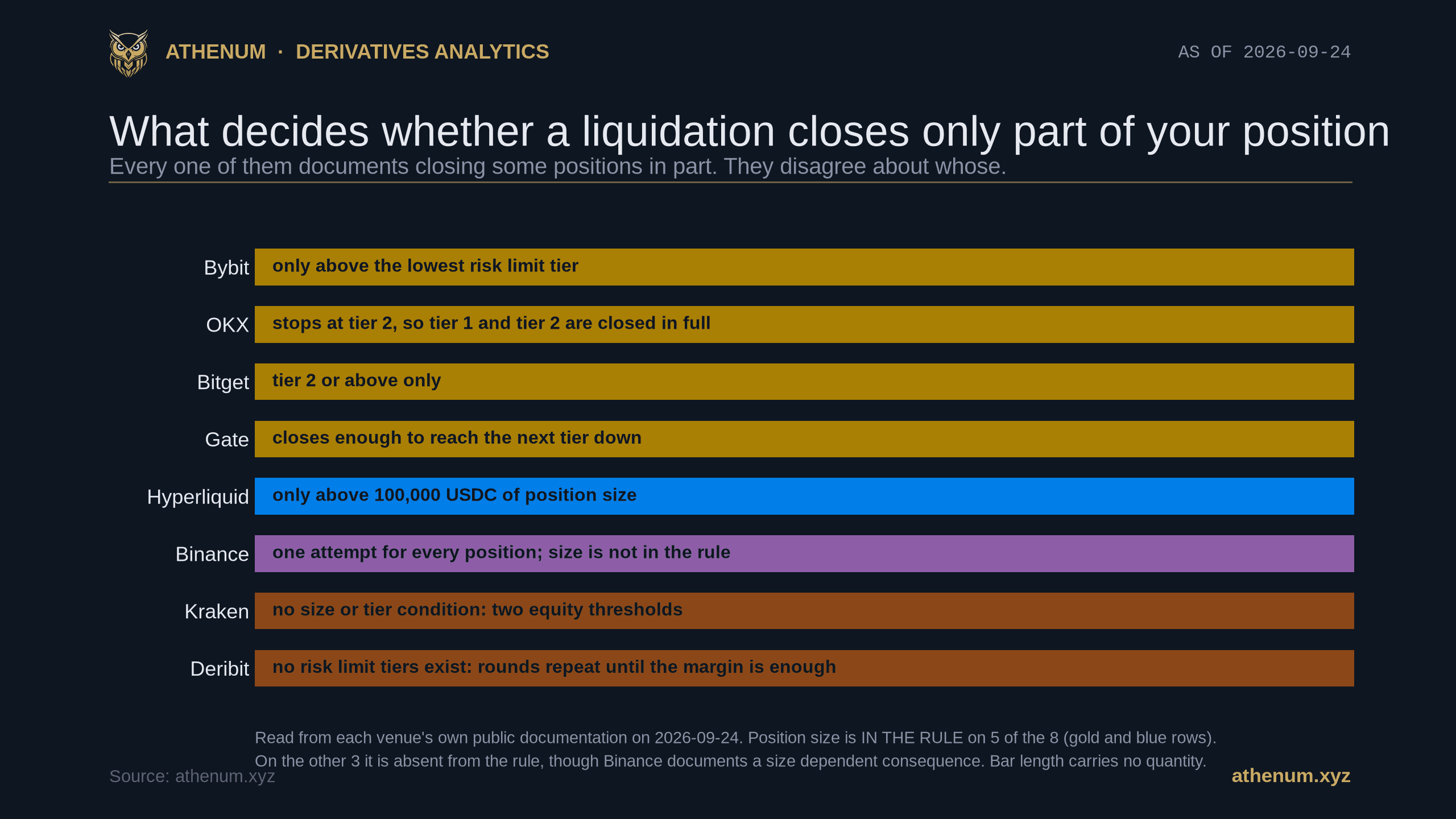
TLDR. A partial liquidation closes only enough of your position to bring the account back inside its margin requirement, and leaves the rest open. Whether you are offered one is decided differently at every venue. We read the liquidation documentation of eight perpetual venues on 2026-09-24. All eight document closing some positions in part rather than in full. They disagree about whose. Bybit, OKX, Bitget and Gate gate the step on the risk limit tier, so a position in the bottom tier is closed in a single action. OKX stops one rung higher than the others, at tier 2. Hyperliquid gates on a flat 100,000 USDC of position size, and even above it the stepping is one slice before a 30 second cooldown in which orders go back to full size. Binance makes one Immediate or Cancel attempt for every position, with no size term in its rule, but documents why smaller positions fare worse anyway. Kraken and Deribit have no size condition either: Kraken closes in fixed 10 per cent increments and Deribit repeats liquidation rounds until the requirement is met. Counted up, position size sits inside the rule itself on five of the eight. On the other three it is absent from the rule, and only Binance documents a consequence that turns on it. Exactly one page on this blog ever told readers that venues differ here, and a comparison page of ours sends them to an explainer that does not mention the subject at all.
What is a partial liquidation?
It is the step where the liquidation engine closes only enough of your position to bring the account back inside its maintenance requirement, and then stops. If it works, the rest of the position stays open. Deribit puts it plainly on its own support page: "the liquidation engine will first try to liquidate only a part of the position(s) to try to get the maintenance margin below 100% again", and if that succeeds, "any of the positions not yet liquidated will remain open".
The venues do not share a word for it. Bybit calls it a Partial Close inside a "laddered approach". OKX calls it "Partial liquidation (forced position reduction)" and labels it Forced reduction in order history. Bitget and Kraken both call it Partial liquidation. Gate calls it tiered liquidation. Deribit calls its system incremental. Binance never uses the words partial liquidation, but it does have a name for the protocol, "Smart Liquidation", "under which Binance tries to avoid the full liquidation of a position where possible", and it describes the mechanism as "The system will first attempt to reduce the trader's margin deficit without fully liquidating the position, by issuing one large Immediate or Cancel order ('IOCO') to offload the position into the market."
Venue | Its own term | What gates the step | Stamp the page carried on 2026-09-24 |
|---|---|---|---|
Bybit | Partial Close | only above the lowest risk limit tier | Last updated on 2026-08-07 |
OKX | Forced position reduction | stops at tier 2, so tier 1 and tier 2 are closed in full | Updated Sep 3, 2026 |
Bitget | Partial liquidation | tier 2 or above only | 2025-12-10 |
Gate | Tiered liquidation | closes enough to reach the next tier down | 2024-12-05 |
Hyperliquid | Partial Liquidations | only above 100,000 USDC of position size | no absolute stamp published |
Binance | Smart Liquidation | one attempt for every position; size is not in the rule | Updated on 2026-01-04 |
Kraken | Partial Liquidation | no size or tier condition: two equity thresholds | Last updated July 28, 2026 |
Deribit | Incremental auto liquidation | no risk limit tiers exist: rounds repeat until the margin is enough | updated 2025-10-17 |
The right hand column is the reason this post is worth re-reading rather than remembering. Seven of these eight pages print a date of their own, and those seven were last touched anywhere between December 2024 and September 2026, so they do not move together, and a rule you learned on one of them can be stale while the others are current. Hyperliquid publishes no absolute date at all, which is its own kind of answer.
Which positions actually get closed in steps?
On the four venues built around risk limit tiers, the step is not offered to everyone. Bybit's Unified Trading Account page, under its Isolated Margin mode tab, documents two separate procedures side by side. If the risk limit tier is at the lowest tier, the sequence is cancel active orders, then close the position at the bankruptcy price. There is no partial step in that branch. If the tier is above the lowest, a middle step appears: "The system will partially close the position by submitting a Immediate-Or-Cancelled (IOC) order of the difference between the current position value and the lower margin tier value."

Both branches are on the same Bybit help page, read on 2026-09-24. The bottom tier branch has no partial step because there is no lower tier to close down into.
Bitget states the same condition in one sentence: "If you're at Tier 2 or above, the system will try to partially liquidate your position before proceeding to full liquidation." For a bottom tier account with no open orders, its page says the remaining position is taken by the insurance fund at the bankruptcy price instead.
OKX is stricter than either. Its forced liquidation page says positions are reduced tier by tier, that "futures are lowered by 2 tiers per step, while margin and options are lowered by 1 tier per step", and that "once futures have been reduced to tier 2 and margin and options to tier 1, if the maintenance margin ratio is still less than or equal to 100%, the remaining position is fully closed at the mark price". On OKX a Bitcoin futures position sitting in tier 1 or tier 2 has no ladder underneath it.
Gate describes the same arithmetic from the other end. Its risk control page says that first, "the number of contracts that needs to be liquidated if the risk limit of the position is to be lowered to the next tier will be calculated", and that "The tiered liquidation will not stop until the margin ratio is backed to 100% or above".
Why does the bottom tier have no step to take?
Because the step is defined by where it lands. On these four venues the engine closes the amount needed to drop the position into the next tier down, where less margin is required. A position already in the bottom tier has no next tier down, so the only move left is to close it. The mechanism is not withholding anything from small traders on purpose. It simply runs out of rungs. Read from each venue's own public endpoint on 2026-09-24, that bottom rung runs to $200,000 of notional on Bitget, $300,000 on Bybit and $500,000 on Gate. OKX is missing from that list because it states its own bottom rung in contracts rather than dollars, and converting it would bake the day's Bitcoin price into a tier boundary that does not move with the price.
Two venues in our set never had rungs to begin with, and they behave the opposite way. Kraken's Equity Protection Process says that between two equity thresholds "the system attempts to restore your Margin Account Equity by partially closing your position in 10% increments", and that "A Partial Liquidation Fee is charged on each filled iteration where the fill price is more favorable than the Zero Equity Price". Nothing in that rule mentions position size. Deribit runs its liquidation trades in rounds, its own article putting the speed of those rounds at one per second, and stops as soon as the requirement is met, again with no tier condition. On those two, a small position is stepped down exactly like a large one.
Hyperliquid sits in the middle with a flat threshold rather than a ladder: "For liquidatable positions larger than 100k USDC (10k USDC on testnet for easier testing), only 20% of the position will be sent as a market liquidation order to the book." The page's general rule, stated earlier and not as a below threshold clause, is that "The orders are for the full size of the position, and may be fully or partially closed." Read the next two sentences before you count on the step, because they cap what it buys: "After a block where any position of a user is partially liquidated, there is a cooldown period of 30 seconds. During this cooldown period, all market liquidation orders for that user will be for the entire position." Crossing 100,000 USDC buys one slice, not a ladder.
Binance reaches a similar outcome to the tier venues by a different route, and says so in its own words: "Please note that generally, smaller positions are more likely to be fully liquidated in a liquidation scenario, as compared to larger positions". There is no size term in the Binance liquidation procedure itself. Size enters as a consequence instead: the page explains that the effective maintenance margin on a small position can sit below the liquidation clearance fee rate, "which may result in smaller positions being bankrupt when they enter liquidation, regardless of the final clearing price". Bankrupt is a stronger word than closed, and it is Binance's own.
What did our own pages say about this?
Not enough, and that is the part of this post we owe readers. We read seven of our own live pages on 2026-09-24, five on this blog and two comparison pages we publish off site. Four of them describe a liquidation as a single closing action: the Athenum derivatives glossary says "The venue's liquidation engine closes the position", our insurance fund explainer of 2026-06-13 says "the exchange's risk engine forcibly closes you", our leverage and liquidation price guide says "the exchange force-closes the position to avoid negative balance", and our second insurance fund explainer, of 2026-07-18, says "the exchange's liquidation engine takes the position over and tries to close it". One page, our piece on liquidation cascades, does get it right that venues differ. Its full sentence reads: "Some venues close the whole position at once, while others reduce it in steps first and only force a full close if margin keeps deteriorating, but in either case the result is the same: a liquidated long becomes forced selling, and a liquidated short becomes forced buying." The first half is right, and it is the only place we ever said it. The second half is true of the subject that page was about, the direction of the forced flow hitting the book, and false of the subject of this one. To the trader holding the position the result is not the same at all: one branch can leave the position open and smaller, the other cannot.

Each row is a verbatim sentence located by substring search in the page on 2026-09-24. Four of the seven describe a liquidation as one action.
The two off site comparison pages do tell readers that venues partially liquidate. The more recent one, from 2026-08-05, tells the reader the mechanism is "set out in Athenum's explainer on insurance funds and auto deleveraging", and links that phrase to our explainer of 2026-07-18. It is not set out there. That page uses the word partial exactly once, about taking partial profit to move down the auto deleveraging queue, and the phrase "in steps" not at all. Anyone who followed that link went looking for this mechanism and did not find it. This page is the one that citation should have pointed at. The explainer it does point at remains the right place for what happens after a full close, which is where the insurance fund and the deleveraging queue take over.
Does this change how a liquidation total should be read?
It sharpens a caveat we already published, and it also narrows it. Our post on why a reported liquidation number is a floor quotes Binance's own websocket specification: for each symbol, only the latest liquidation order inside a 1000 millisecond window is pushed as the snapshot. Set that beside the Binance rule above and the two fit together. Binance's process has two closing actions and not one, the Immediate or Cancel attempt and then, if that is not enough, the close of what remains. Two actions on the same symbol inside the same second leave one line on that stream.
Now be careful how far that travels, because the obvious next step is wrong. It is tempting to say the understatement must bite hardest where the stepping is most granular. It does not follow, and our own page says why: OKX "documents no throttle at all and admits the shortfall instead", Bybit replaced its one per second topic with one pushing "all liquidations that occur on Bybit", and Hyperliquid "does not publish one as a channel at all". So the only documented throttle in this set sits on the one venue that makes a single attempt rather than stepping. Bitget's, Gate's, Kraken's and Deribit's own liquidation feeds we did not read at all, and nothing here should be taken as a claim about them.
One more caveat on the quotation itself, because the page we are citing is the page that found it. Binance's derivatives change log records an intended edit from "the latest" to "the largest" order in that window, dated 2026-04-10 and effective 2026-04-14, which had still not been applied to the stream descriptions when that page re-read all four of them on 2026-08-02. Binance therefore "publishes two incompatible accounts" of which order it keeps. The argument above survives either word, since both keep exactly one.
Can the aggregate open interest tape show any of it?
No, and it is worth being explicit about why, because open interest is the number most often reached for here. Aggregate open interest is a net quantity. It subtracts positions closed from positions opened in the same hour, so a liquidation and a fresh position of the same size cancel out and leave no trace.

Summed from Athenum's normalized cross venue feed, 168 hourly readings to 2026-09-24 08:00 UTC. The steepest single hour decline removed 3.108 per cent of the sum as it stood an hour earlier, and the largest single hour move was a rise of 4.147 per cent.
Read from our own cross venue feed on 2026-09-24, Bitcoin perpetual open interest across Binance, Bybit, Hyperliquid, Bitget, OKX and Deribit summed to $22.674 billion at 08:00 UTC that day. Over the 167 consecutive hourly changes in the week to that stamp, the steepest single fall was -3.108 per cent, and the median absolute move was 0.214 per cent, with nine hours in ten moving less than 0.680 per cent in either direction. The window held 79 falls and 88 rises, and its largest single move was not a fall at all but a rise of 4.147 per cent on 2026-09-18.
One caveat on that total belongs here rather than in a footnote, because it decides what the word more means. The six venue sum is quoted in dollars, and over this window it grew 7.96 per cent while Bitcoin itself grew 9.98 per cent. Divide the same sum by the price at each end and the coin denominated figure goes the other way, from 274,128 to 269,083 Bitcoin, or -1.84 per cent. A week that reads as position building in dollars reads as a slightly smaller book in coins. That is not a contradiction, it is the denominator: the same reading answers two different questions and this post's question, how a venue closes one position, is answered by neither.

The steepest single hour decline is an outlier against a median absolute change of 0.214 per cent across 167 hourly changes to 2026-09-24.
One check on the word perpetual before those numbers are used anywhere, because our feed does not print a contract type. On 2026-09-24 our Deribit reading of $887.0 million, stamped 08:00 UTC, sits about 1.3 per cent from the $875.7 million Deribit itself publishes for BTC-PERPETUAL alone, read about an hour later. Deribit's own leg, not the six venue sum, moves a median 0.250 per cent an hour across this window, so an hour of drift accounts for part of that gap and not all of it. Read the rest of that venue's own board on the same request and the check has teeth: its 13 dated expiries carry a further $1,268.1 million, so Deribit's own whole futures board came to about $2.144 billion on that one request. That is the figure a feed carrying expiries would be near, and it is more than double what our leg prints for the venue. Add up our number and Deribit's expiries instead and you get a different total, because the two legs come from two different readings; the comparison that matters is board against leg, and it is not close. On this venue the series is the perpetual one. This is one venue rather than all six, and it is the one we could test most sharply, because Deribit publishes its whole futures board in a single public request.
Those numbers describe the aggregate and nothing smaller. None of them tells you whether a single trader was stepped down or closed out, which is the whole reason the answer has to come from the venue's own rulebook.
How should this change the way you size a position?
Three things follow, and none of them require you to trust our arithmetic over the venue's.
1. Find out which family your venue is in before you assume a cushion exists. On a tier venue, if your notional sits in the bottom tier there is no partial step waiting for you. 2. Treat a liquidation price as the start of a process, not a single point. Where a step exists, the position may survive smaller. Where it does not, it will not. 3. Check the fee, and check its condition. Kraken charges a partial liquidation fee on each filled iteration, but only where the fill price is more favourable than its Zero Equity Price, so more steps does not mechanically mean more charges. Hyperliquid's page says "Unlike CEXs there is no clearance fee on liquidations". Read the rest of the page before you price that in. That sentence sits near the end of a passage about liquidations sent to the order book, and a separate passage, in a different section, says that "During backstop liquidation, the maintenance margin is not returned to the user." The page never joins those two; the join is ours, and we are flagging it as ours. No fee is not the same promise as nothing withheld.
Our liquidation calculator and leverage and margin calculator will give you a first approximation of where the level sits, and the position size calculator works backwards from the risk you are willing to take. They use the standard textbook relation, which our own guide to calculating a liquidation price introduces as "a common first approximation", and which our comparison of 10x and 100x leverage calls "a first-order estimate". Before you size anything on the result, read the level off the venue's own position page, because the exact form each venue uses differs in the last decimal.
What this post does not say
It does not say these rules are stable. Each one was read on 2026-09-24 from the venue's own page and every venue can change its own rulebook. Every quotation in this post was re-fetched from the venue's own live page on 2026-09-24, and the quotations that the 2026-09-23 first draft already carried were read twice, the second time by a reader working from the URL alone. All of them came back word for word. Two Binance quotations were lengthened in the process, because the first reading had cut one short of its full stop and had dropped the hedge the other opens with. Three of the eight pages refuse our requests outright. Deribit's support article and Binance's help page were therefore read through each publisher's own content interface on the same first-party domain, the one that serves the article published at the address we cite, and Gate's page was read through a third party fetching service. That is weaker evidence than a page we loaded ourselves, and it is named here rather than buried.
It does not repeat three widely circulated claims that we could not confirm on the venue's own live page today.
- Deribit slices in 12.5 per cent steps, minimum 500 contracts. Not present in the live Deribit support article re-read on 2026-09-24. The only percentages in that article are the 100 per cent maintenance margin threshold, and the word contract does not appear in it at all. The rendered page refuses our requests, so the article was read from Deribit's own help centre interface on the same first-party host, which returns the article whose published address is the support page we cite. Widely repeated second hand, so it is dropped rather than published. - Kraken's partial liquidation went live on 2026-03-26. A banner carrying that date could not be found on the Equity Protection Process page as rendered on 2026-09-24, whose own stamp reads 28 July 2026. Dropped in favour of that stamp. - OKX partially liquidates from tier 3 and steps one tier at a time. That is the wording of a legacy OKEx page on a host that no longer resolves. The live OKX page read on 2026-09-24, itself republished on 3 September 2026, says two tiers per step with a floor at tier 2. The live page is used.
It does not cover every venue, every margin mode or every instrument. Bitget's own page excludes isolated margin positions from partial liquidation, Kraken's partial step is documented for its multi collateral accounts, Gate's wording sits in its futures isolated position section on a page stamped 2024-12-05, and the Bybit procedure quoted here is the one under its isolated margin tab, which is the tab that page opens on. Its cross margin and portfolio margin tabs carry their own procedures and we are not describing them. Those exclusions are in the venues' pages and not in ours.
It does not measure how often a partial liquidation actually saves a position. That would need per account data no venue publishes, and nothing in the paragraph above should be read as an estimate of it.
Every venue rule above was read on 2026-09-24 from that venue's own public documentation, and the open interest figures come from Athenum's normalized cross venue feed reading Binance, Bybit, Hyperliquid, Bitget, OKX and Deribit side by side. The 34 calculators that sit beside that feed stay free to use: none of them asks for an account, none takes an email address, and none caps how often you run it. If you would rather watch that feed on one screen than keep every one of these rulebooks open, a free 7 day Pro+ trial opens the terminal at app.athenum.xyz and asks for no card.
One terminal. All the data.
Liquidations, orderbook depth, whale walls & open interest from 4 exchanges, all real-time, in one place.
No credit card required

Athenum Analytics
Athenum Analytics is our three-person editorial team covering crypto derivatives, market data and macroeconomic context.