Table of Contents8 sections
- Does reported open interest count one side of the trade or both?
- How much does the counting convention change a cross-venue total?
- Does the counting convention change the venue ranking?
- Why is the factor exactly two rather than roughly two?
- Which venues actually say what they count?
- Where does the factor of two stop being exactly two?
- What is this reading built on?
- How to check this yourself
Practise with worked lessons
- Reconstruct open interest from opening and closing trades
Reconstruct open interest from opening and closing trades. See why 27 contracts can trade while open interest rises by only four.
TLDR. Reported open interest one side or both is not a style question: every futures contract has exactly one long and one short, so a venue can count the position once or count both sides, and the two answers differ by exactly a factor of two. Bybit publishes both numbers, for the same instrument at the same instant: read anonymously at 2026-08-04T08:50:14Z, its BTCUSDT perpetual returned 58,184 BTC in the default field and 29,092 BTC in the single-side field, a ratio of 2.000000. Bitget's own support pages say the same thing in words: its platform open interest is calculated bilaterally, long plus short. Add the six venues' reported figures together on 2026-08-04 at 08:00 UTC and you get $17.71B. Halve the one venue that proves it with a published pair and the same six total $15.86B. Halve the second venue that documents it too and they total $14.74B, which is $2.97B, or 20.2 percent, below the raw sum. That gap is not a one-hour artifact: over the last 168 hourly readings it stayed between 19.4 and 20.4 percent.
Does reported open interest count one side of the trade or both?
It depends on the venue, and on which field of that venue's API you read. Open interest is the stock of positions still open, and because a futures position only exists when a long is matched by a short, the same market can honestly be described as 29,092 BTC of open positions or as 58,184 BTC of open contract sides. Neither is wrong. What breaks is adding a venue that reports the first to a venue that reports the second, because the sum is then in no unit at all.
Bybit is the one venue in this group where you can settle the question from its own data rather than from its documentation, because it returns both figures side by side. Read at 2026-08-04T08:50:14Z, openInterest was 58,184 BTC ($3.70B) and singleOpenInterest was 29,092 BTC ($1.85B). The ratio is 2.000000, and on the inverse BTCUSD contract, where open interest is quoted in dollars, it is 466,861,846 against 233,430,923, a ratio of 2.0 to the digit. Bybit's open interest endpoint documents the two fields in as many words, describing the first as the sum of both sides and the second as the single side.
How much does the counting convention change a cross-venue total?
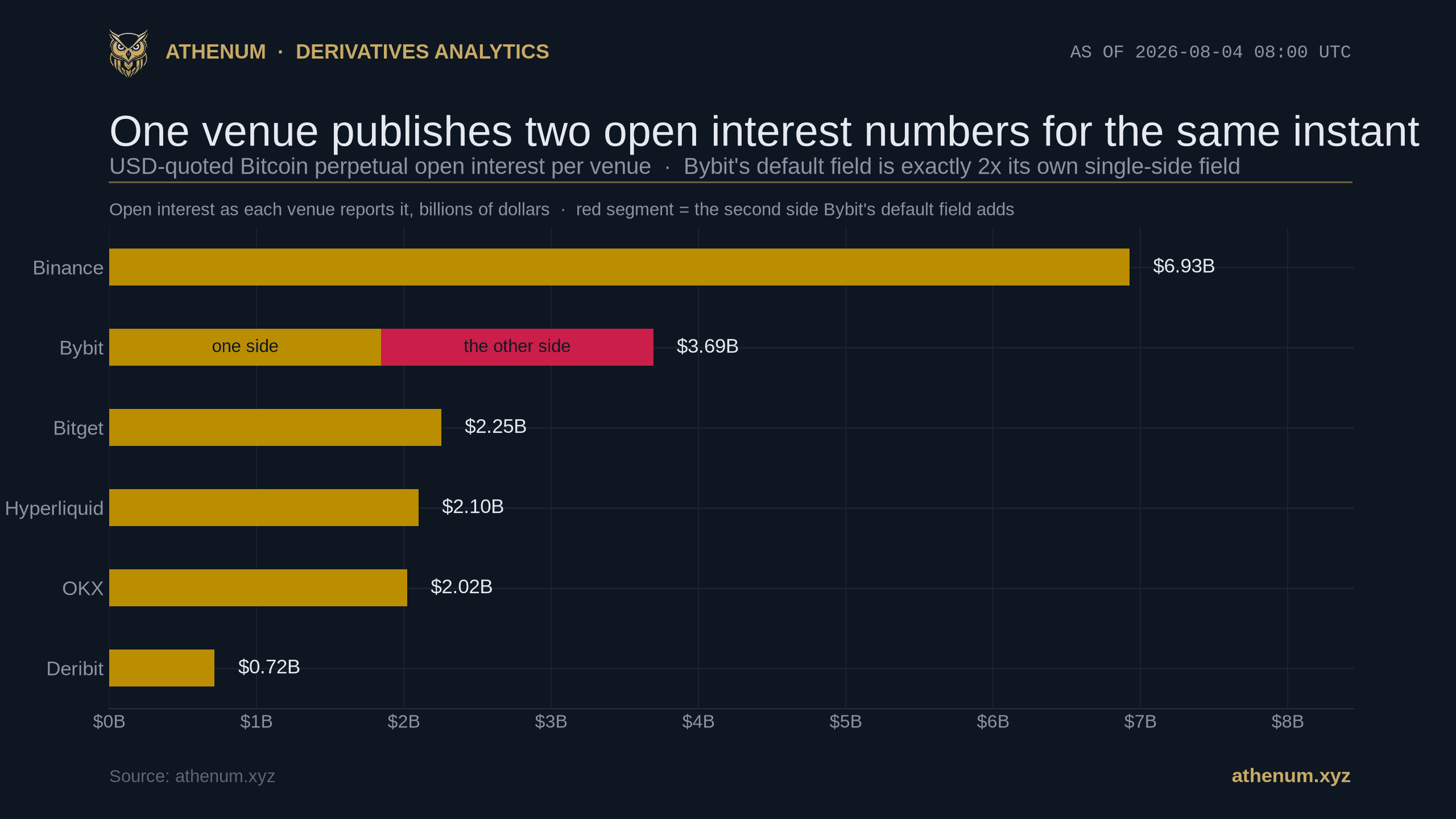
By 20.2 percent on today's reading, which is larger than most of the differences people argue about when they compare data providers. Taking each venue's own reported figure for its USD-quoted Bitcoin perpetual on 2026-08-04 at 08:00 UTC: Binance $6.93B, Bybit $3.69B, Bitget $2.25B, Hyperliquid $2.10B, OKX $2.02B and Deribit $0.72B, with BTC near $63,600. Those add to $17.71B.
Now apply the corrections in the order of how strong the evidence is, because they are not equally well established. Replace the Bybit leg with Bybit's own single-side field, which is proof rather than inference, and the same six venues add to $15.86B, $1.85B or 11.6 percent below the raw sum. Then halve Bitget as well, on the strength of its own written statement that platform open interest is calculated bilaterally, and they add to $14.74B. Against that, the raw sum is $2.97B, or 20.2 percent, high. Two venues out of six produce all of it.
Be clear about what that means for the number at the top of this post: the $17.71B figure is a sum of what each venue reports, so it carries both of those legs at face value. The $14.74B figure is the one to put next to a venue-level position count.

The same six venues at the same instant: $17.71B as reported, $15.86B once Bybit's own single-side field replaces its default, and $14.74B once Bitget, which documents bilateral counting, is halved too.
And it is stable, which is what makes it worth quoting. Across the 168 hourly readings from 2026-07-27 12:00 UTC to 2026-08-04 08:00 UTC, the raw sum ran between 19.4 and 20.4 percent above the two-venue-corrected sum, with a median of 19.9 percent and an interquartile band of 19.6 to 20.2 percent. On the Bybit-only correction the same window gives a median of 11.4 percent and a range of 10.9 to 11.7 percent. A reader who re-checks this tomorrow will not get 20.2 percent exactly, and should not expect to; they should get something in those bands, because the size of the error tracks two venues' share of the total.

The overstatement held between 19.4 and 20.4 percent across 168 hourly readings with both venues halved, median 19.9 percent, and between 10.9 and 11.7 percent on the Bybit-only correction. The shaded column is a 22 hour break with no reading, drawn as a gap rather than joined by a line.
Does the counting convention change the venue ranking?
Yes, and by more than the totals suggest, because the correction lands on two venues rather than being spread across all six. On the reported figures the order is Binance, Bybit, Bitget, Hyperliquid, OKX, Deribit. Halve the two venues whose own material says they count both sides and it becomes Binance, Hyperliquid, OKX, Bybit, Bitget, Deribit. Bybit falls from second at $3.69B to fourth at $1.85B; Bitget falls from third at $2.25B to fifth at $1.13B; and Hyperliquid, which moved nowhere, becomes the second largest venue in the group at $2.10B without a single position changing hands.
Now the part that matters more than the reshuffle. Across all 168 hourly readings from 2026-07-27 12:00 UTC to 2026-08-04 08:00 UTC, Bybit sat second on the reported figures in 168 of 168 hours, so that ranking is perfectly stable and perfectly misleading at the same time. Bitget's reported third place is a different animal: it held in only 96 of 168 hours, because it trades places with Hyperliquid. After the correction Bitget's fifth place holds in 168 of 168 and Bybit's fourth in 168 of 168. Correcting the convention made the table more stable, not less, which is the opposite of what you would expect from a number someone had merely adjusted to taste.

Reported order against the order with Bybit and Bitget halved. Bybit goes second to fourth, Bitget third to fifth, and Hyperliquid becomes the second largest venue at $2.10B. Bitget's reported third place held in only 96 of 168 hourly readings; its corrected fifth held in 168 of 168.
Why is the factor exactly two rather than roughly two?
Because it is an identity, not a measurement. Every open futures contract is held long by someone and short by someone else, so the aggregate long position and the aggregate short position are equal by construction. The US Commodity Futures Trading Commission states it plainly in the explanatory notes to its Commitments of Traders report: the aggregate of all long open interest is equal to the aggregate of all short open interest. Counting both sides therefore returns precisely double the single side, with no dependence on how the positions are distributed, how skewed the market is, or which way it has moved.
That is why the ratio measured above is 2.000000 and not something ending in a stray digit. Be precise about what is exact, though: the identity is exact, and the published pair agrees with it only to each instrument's rounding precision. On Bitcoin, which is quoted to three decimals, the two fields divide to two at every decimal place worth printing. On a thinly quoted altcoin whose size field steps in hundredths, the same division can land a ten-thousandth away from two, and that residual is rounding in the venue's own quantity field rather than a second convention hiding in the data. It also means the correction is arithmetic rather than statistical: you do not need a model to undo a both-sides figure, only a division.
Worth saying that this is not the first time the same arithmetic has been pointed at a crypto venue. Paradigm published essentially this argument about Polymarket's reported volume in December 2025, where both sides of every fill were being counted and the headline number was therefore twice what a like-for-like comparison would give. The mechanism travels: wherever a market publishes a figure that has two sides by construction, somebody has to decide whether to print one or both, and the decision usually goes unlabelled.
Which venues actually say what they count?
One, in the place a developer would look. This is the state of play for the six venues above, checked against each venue's own public material:
Venue | Says which side it counts? | Where | What it says |
|---|---|---|---|
Bybit | Yes | API reference, and it returns both fields | Both sides by default, single side in a separate field |
Bitget | Yes | A risk-control support article, not the API reference | Both sides: bilateral, long plus short |
Binance | Only in general educational material, never tied to the endpoint | Academy article | Implies a single side |
OKX | Not found | API reference gives units only | Its own learning page contradicts itself |
Deribit | Not found | Field documented by unit, not by side | Nothing stated |
Hyperliquid | Not found | Field has no description at all | Nothing stated |
Read every "not found" as "nowhere I could find", not as "undefined". A venue may well have a settled internal convention and simply not have written it down where a reader can reach it.
The sharper point is not the silence, it is what happens when the silence breaks. The two venues that state the convention plainly both say they count both sides. The one venue whose material implies a single side says so in an educational article that never mentions the field you are actually calling. So a consumer adding these six numbers is not choosing between a documented standard and some laggards; there is no standard here to be ignorant of.
Bybit's own change is instructive. In May 2026 it announced that displayed open interest would move from a both-sides to a single-side calculation from 11 June 2026, told users to expect displayed values around fifty percent lower, and stated explicitly that this did not indicate lower market activity. What is easy to miss is what happened to the interface. The change was additive: the single-side fields were added on that date, and the default field still returns the both-sides figure today, as the reading above shows. So the website switched and the interface did not, and the same venue now publishes two different open interest numbers for the same contract depending on which surface you read. Anyone who read the announcement, concluded that Bybit had switched, and kept pulling the default field is holding a doubled number.
Where does the factor of two stop being exactly two?
Three places, and they matter more than the headline.
1. Units, not sides. A venue can report open interest in contracts, in coins, or in dollars, and those differ by contract multipliers and by price, not by a factor of two. Deribit's inverse perpetual quotes open interest in dollars of notional; Hyperliquid quotes it in coins. Converting between them is a separate problem from counting sides, and confusing the two produces errors that look like sidedness but are not. 2. Netting rules. The identity holds at the level of the market, not the account. Venues that let one account hold a long and a short in the same instrument at once, and venues that net those internally, will report different totals for the same underlying positions, and neither is a factor of two away from the other. 3. Instrument scope. The six figures above are one USD-quoted perpetual per venue. Coin-margined perpetuals and dated futures sit outside them, and they are not small. Widening the scope changes the total by more than the sidedness correction does, so a total is only comparable to another total drawn on the same instrument set.
There is a fourth caveat that belongs here rather than in a footnote, because it cuts against this post. Units are a bigger mess than sides, and a reader is entitled to say so. Misread Deribit's contract size and you are wrong by a factor of ten, not two, and any competent aggregator normalizes units before it sums anything. The reply is that the error measured here survives that normalization: every figure above is already in dollars, and the 20.2 percent is what is left after the units question is settled. A correctly unit-normalized total still carries it.
The honest reading of the 20.2 percent is therefore a floor, not a full accounting. It corrects one venue that proves the convention from its own data and one that states it in writing. For the remaining four the convention is not verifiable from the venue at all, so if any of them also counts both sides, the raw sum is further out than this post can measure, and in that direction only. The Bitget leg is the one that could move the other way: its bilateral statement sits in a risk-control support article rather than in the API reference, and if the field it publishes is already single-sided, the honest figure is the 11.6 percent above rather than the 20.2.
What is this reading built on?
Two things, and they are separable. The six venue figures are each venue's own public number, pulled anonymously at 2026-08-04T08:50:14Z from that venue's own endpoint: Bybit's v5 tickers, Binance's USD-M open interest endpoint, OKX's public open interest endpoint, Bitget's mix market endpoint, Deribit's book summary and Hyperliquid's info endpoint. Anyone can reproduce them without an account.
The hourly window is Athenum's cross-venue feed, which reads the same six perpetuals every hour and is what makes the spread on this measurement possible at all. Its 08:00 UTC readings agree with the venue-primary figures pulled at 2026-08-04T08:50:14Z to within 0.21 percent at the widest venue, which is both the check that the feed passes each venue's own number through rather than transforming it, and roughly the size of the drift you would expect from reading the same market fifty minutes apart. The window carries a hole: 21 hourly readings are missing across a 22 hour break, so every figure here is computed on the 168 readings that exist rather than on a nominal 189.
How to check this yourself
Pull Bybit's openInterest and singleOpenInterest for the same symbol in one call and divide. That single request settles the general question in a way no amount of documentation reading can, because it is the venue's own arithmetic on its own book. Then decide, once, which convention your own numbers use, and apply it to every venue you add. Where the venue will not tell you, say in your own documentation that you could not verify it, rather than picking one and going quiet: the reader can work with a stated uncertainty and cannot work with a confident number that turns out to be double.
If you want to work the position-level arithmetic underneath these aggregates, Athenum's free liquidation calculator takes a single position end to end and the leverage calculator handles the margin side. For the surrounding concepts, open interest in crypto futures, explained covers what the figure counts before you worry about how it is counted, open interest in coins versus dollars covers the denomination question this post deliberately set aside, and open interest by exchange shows how the venue mix moves over longer windows.
Every venue figure above was read from that exchange's own public endpoint, and the hourly window behind the spread is Athenum's live cross-venue derivatives feed. Its 34 calculators cost nothing to use and ask nothing in return: no account, no email, no usage limits. Work a position through the free liquidation calculator, or open the live terminal and read the venue split as it moves.
One terminal. All the data.
Liquidations, orderbook depth, whale walls & open interest from 4 exchanges, all real-time, in one place.
No credit card required

Athenum Analytics
Athenum Analytics is our three-person editorial team covering crypto derivatives, market data and macroeconomic context.