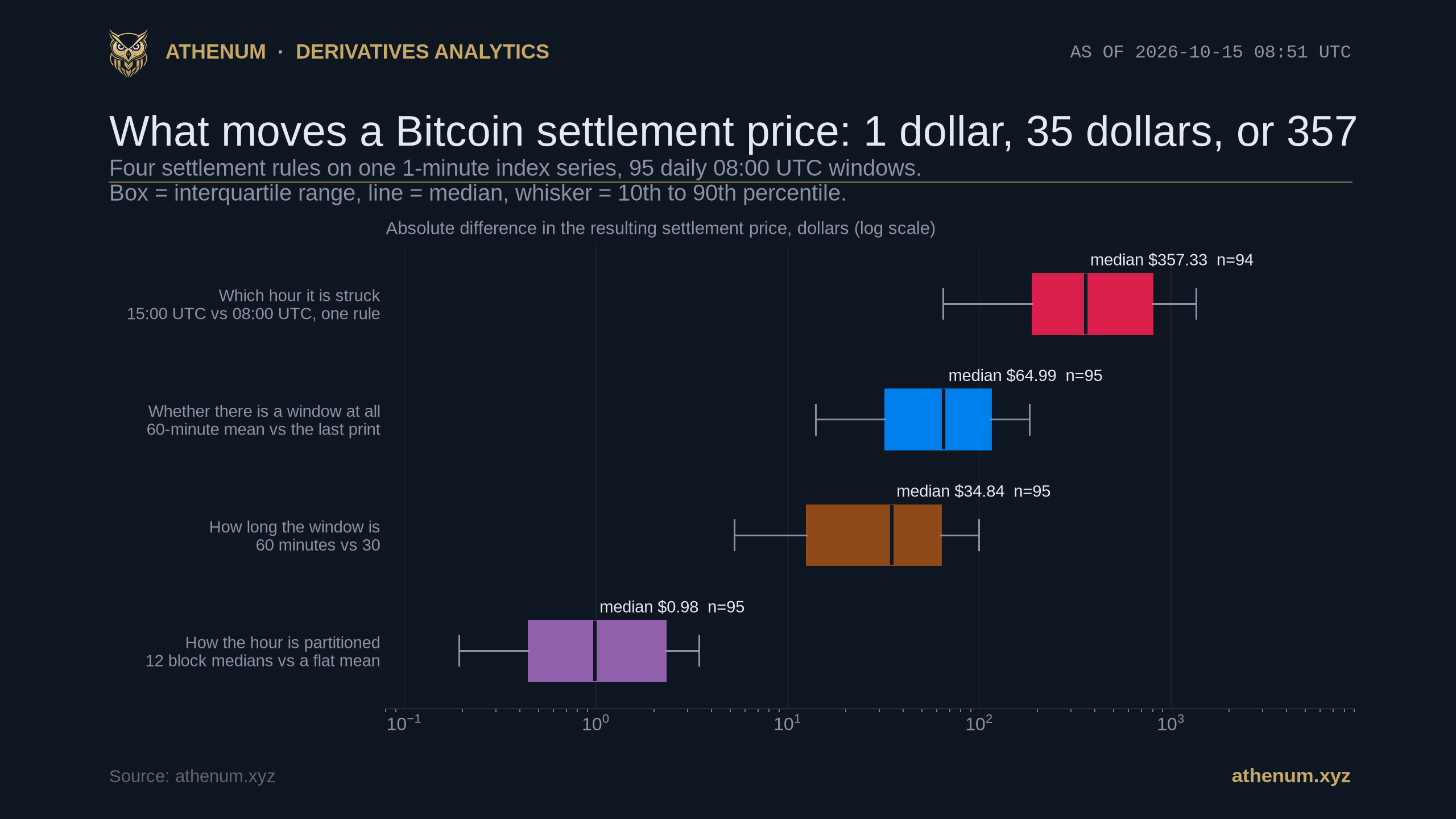
TLDR. When a dated Bitcoin future expires, somebody has to decide what number it settles at, and that number is almost never the last trade. It is an average of an index over a window before expiry, and the venues do not use the same window. Deribit settles at 08:00 UTC on a time weighted average of its own index over the final 30 minutes, sampled every four seconds for 450 readings, per its own settlement documentation. Binance delivers at the same 08:00 UTC instant on a per second average of the index over the final 30 minutes, 1,800 readings, having moved that window down from a full hour on 2024-11-11. The CME strikes its reference rate over the full hour to 16:00 London, split into twelve 5 minute partitions. The three choices buried in those sentences are worth wildly different amounts. Measured on 2026-10-15 over the 95 daily 08:00 UTC windows from 2026-07-13 onward, all 95 complete to the minute: how the hour is partitioned barely matters, a median 0.98 dollars between twelve five minute block medians and a flat mean. How long the window is matters more, a median 34.84 dollars between a 60 minute and a 30 minute average. Whether there is a window at all matters most of the three, a median 64.99 dollars, 9.13 basis points, between a 60 minute average and the last print. And the choice nobody thinks of as a rule, which hour the contract settles at, is worth a median 357.33 dollars, 10.3 times the window length and 5.5 times the window itself, though that last figure is mostly the price movement between the two hours rather than anything the rule does. None of these is a fixed cost: the same averaging rule is worth 18 dollars in the calmest quartile of hours and 141 in the most violent, and on the live board this morning the nearest of the fourteen dated Bitcoin contracts expires tomorrow.
Why is a settlement price not just the last trade?
Because the last trade is the cheapest thing in the market to move. A dated future is a promise to cash out against spot at a fixed moment, and whoever holds the losing side has a direct incentive to push the reference in the final seconds. Averaging over a window is the standard defence: to shift a 60 minute mean by a dollar you have to hold the index a dollar away for the whole hour, which costs roughly sixty times what moving one print costs.
So nearly every venue that lists a dated Bitcoin contract settles it against an average of an index, not against its own last trade. This is one of the structural differences set out in Athenum's comparison of perpetual swaps and dated futures: a perpetual never settles, so it never needs this rule at all, and pays a funding stream instead. That turns one decision into three. Which index, over how long a window, and sampled how. This post measures the last two, holding the index fixed, because that is the only way to see the rule rather than the venue.
The method is deliberately boring. Take one 1 minute index series, the Binance BTCUSD index, which is itself the input to that venue's own delivery settlement. Pick an instant. Apply four rules to the same minutes: the last 1 minute close, a 30 minute arithmetic mean, a 60 minute arithmetic mean, and a partitioned version that splits the hour into twelve 5 minute blocks, takes each block's median and averages the twelve. Then repeat on 95 consecutive days and look at the distribution, not at one day. Every window used here is complete, 60 of 60 minutes present, with no day dropped for a gap.
Each of those four is a real rule rather than a strawman. The 30 minute mean is what Deribit and Binance both apply at 08:00 UTC today. The 60 minute mean is what Binance applied before 2024-11-11. The twelve partitioned blocks are the shape of the CME CF Bitcoin Reference Rate, which takes the volume weighted median of each 5 minute partition and then the equally weighted mean of the twelve. Two approximations are being made and are worth stating rather than hiding: the venues sample far more finely than once a minute, every second at Binance and every four seconds at Deribit, where this uses 1 minute closes, and the CME partition medians are volume weighted across constituent exchanges where this takes a plain median of one index. Both approximations affect the partitioned rule most, which is the rule that turns out to matter least.
How much does the averaging window change the number?
Enough to matter at the short end of the curve, and the ordering of the three choices is stable even though the levels are not.
Choice | Median | Interquartile range | 90th percentile | Worst of the 95 |
|---|---|---|---|---|
Twelve block medians vs a flat 60 minute mean | 0.98 USD | 0.44 to 2.31 | 3.90 | 20.80 |
60 minute vs 30 minute mean | 34.84 USD | 12.39 to 64.05 | 99.54 | 226.23 |
60 minute mean vs the last print | 64.99 USD | 31.84 to 116.08 | 204.38 | 750.78 |
15:00 UTC vs 08:00 UTC, one rule held fixed | 357.33 USD | 187.94 to 809.34 | 1,463.92 | 4,066.26 |
The first row is the useful negative result. Partitioning an hour into blocks and taking medians is the elaborate part of the CME CF reference rate methodology, and against a plain average of the same hour it moves the answer by about a dollar on a roughly 81,000 dollar index, 0.15 basis points. Whatever that machinery is for, and it is for manipulation resistance rather than accuracy, it is not for changing the number.
The second row has a date attached to it. Binance ran its delivery settlement on the average of the index over the final hour, 3,600 per second readings, and on 2024-11-11 moved to the final 30 minutes, 1,800 readings. The 34.84 dollar median above is an estimate of what that one change was worth per expiry, and the interquartile range says it was between about 12 and 64 dollars on an ordinary day and up to 226 on the worst day in this sample.
The 64.99 dollar median is 9.13 basis points. What that is worth depends entirely on how far from expiry you are reading it, because basis is quoted annualized: 9.13 basis points at the settlement instant is 0.48 annualized points on a 70 day contract, 1.11 on a 30 day one, 4.76 on a seven day one, and 33.32 on a contract expiring tomorrow. Against a board quoting roughly 4 to 6 annualized points at 70 days, the settlement rule is around a twelfth of the carry at the long end and larger than the entire carry at the short end. If you are running a cash and carry roll, the free arbitrage calculator is where that enters the spreadsheet, the profit and loss calculator is where it lands on the position, and the basis it eats into is the one Athenum measured across the curve in an earlier post.
One honest limit on all four rows. Split the 95 days in half and the medians move: the 60 minute versus last print figure reads 53.38 dollars in the first half and 80.81 in the second, and the window length figure 28.85 against 39.16. The ordering survives, the levels do not. These are the numbers for this quarter, not constants.

This morning's 08:00 UTC instant, which is a bad day deliberately chosen: the hour's range of 739.77 dollars puts it in the most volatile quartile of the 95. The index rose through the window, so the longer the averaging the lower the settlement, and the four rules span 361.41 dollars. The two 60 minute rules land 52 cents apart.
When does the rule actually cost anything?
When the hour it covers is violent, and almost never otherwise. Sort the 95 windows by the range the index covered inside them and the gap between a 60 minute mean and the last print has a median of 18.04 dollars in the calmest quartile and 141.39 in the most volatile, with a Pearson correlation of 0.698 between the two quantities.
The middle is where a careless version of this post would overclaim. The four quartile medians run 18.04, 76.11, 75.42 and 141.39, so the second and third quartiles are indistinguishable from each other and the relationship is not a clean ladder. What the data supports is the comparison of the extremes and the correlation, not a monotone step at every rung.
This morning is the illustration. The hour into 2026-10-15 08:00 UTC covered 739.77 dollars, top quartile, and the four rules produced 81,432.08, 81,238.72, 81,071.19 and 81,070.67, a span of 361.41 dollars against a 95 day median of 64.99. A settlement rule is a volatility tax: it charges little on a quiet expiry and the most on exactly the expiry where the two sides disagree most about what the contract is worth.

Each dot is one settlement hour. The gold diamonds are the quartile medians, and the flat middle two are shown rather than smoothed away: this supports a calm versus violent comparison and a correlation, not a clean monotone ladder.
Does the hour it settles at matter more than the rule?
Yes, by an order of magnitude, and that is less a discovery than a reminder worth printing. Hold the rule completely fixed at a 60 minute mean and compare the same calendar day's 08:00 UTC settlement with its 15:00 UTC one: the median absolute difference is 357.33 dollars, 48.26 basis points, across 94 paired days. That gap is simply the seven hours of price movement in between, which is why it dwarfs everything else.
It matters because those two hours are not hypothetical. Deribit and Binance both deliver their dated Bitcoin contracts at 08:00 UTC, and the CME CF reference rate is struck over the hour to 16:00 London time, which through this entire sample is 15:00 UTC because the United Kingdom is on British Summer Time until 2026-10-25. Anyone marking a position against both is comparing numbers a median 357 dollars apart before a single methodological difference is considered. After 2026-10-25 that same strike becomes 16:00 UTC, so the offset itself is not even a constant.
The rule effect is itself bigger at that later hour. Over the same 95 days, the 60 minute versus last print gap has a median of 64.99 dollars at 08:00 UTC and 120.20 at 15:00 UTC, and the window length gap 34.84 against 61.39. The US morning is simply a noisier hour to measure Bitcoin in, so the hour selects both the price and the size of the rule's effect.
What does this look like on today's board?
The live Athenum board on 2026-10-15 at 08:51 UTC carries fourteen dated Bitcoin contracts across Deribit and Binance against a common spot reference of 81,173.50. Twelve are Deribit, two are Binance, and only two expiry dates are listed by both venues: 2026-12-25, where Deribit quotes 82,087.50 against Binance at 81,956.40, a gap of 131.10 dollars, and 2027-03-26, where it is 83,362.50 against 83,015.80, a gap of 346.70.
Neither gap is a stable property of the venue pair, and a second reading the same morning says so. Re-fetched at 09:14 UTC, the December gap had fallen from 131.10 dollars to 72.20 and the March gap from 346.70 to 37.50, against a spot reference that had moved from 81,173.50 to 81,255.37. A matched expiry gap is a point in time reading that can lose most of its size inside half an hour, so it belongs in a post with its timestamp attached and nowhere near a sentence about what a venue is structurally worth.
Those two gaps cannot be blamed on the settlement rule, and that is worth saying plainly because it would be the convenient conclusion. Deribit and Binance apply the same 30 minute window at the same 08:00 UTC instant, so at expiry the two contracts differ only through the index each averages and through the market itself, not through the rule. The rule is what separates either of them from a CME mark, not what separates them from each other.
The nearest of the fourteen expires tomorrow, 2026-10-16, quoted at 81,207.50, and a second one expires the day after. For those two the settlement rule is not a rounding question. At one day to expiry the median 9.13 basis point effect measured above is 33.32 annualized points, which is several times the entire basis anywhere else on this curve.

The live dated board, fetched 2026-10-15 08:51 UTC. The two expiries quoted by both venues sit 131.10 and 346.70 dollars apart at that instant and 72.20 and 37.50 twenty three minutes later, which is why the subtitle carries both. Both venues settle on a 30 minute average at 08:00 UTC, so these gaps are index and market differences rather than rule differences.
What should a reader take away?
Three things, in the order the measurements support them.
1. The partitioning inside a reference rate window is not worth arguing about on accuracy grounds. A median 0.98 dollars on an 81,000 dollar index. It exists to make manipulation expensive, and it should be judged on that. 2. The window length is worth a median 34.84 dollars and the existence of a window a median 64.99, which is negligible on a quarterly contract and larger than the whole basis on a contract expiring tomorrow. Read any settlement effect in annualized terms with the tenor attached or it means nothing. 3. The hour dominates both, at a median 357.33 dollars, so comparing a CME mark struck to 16:00 London against a Deribit or Binance 08:00 UTC settlement is mostly comparing two different moments, not two different methodologies. The honest way to quote cross venue basis is at a matched instant, which is also the point of a normalized cross exchange feed in the first place.
Every number above was measured on 2026-10-15 from one 1 minute index series and the live dated board, and anyone with the same two public sources can reproduce all of it. You can re-check the live side on Athenum, which streams derivatives data from Binance, Bybit, OKX, Deribit and the rest of the venues it covers into one normalized feed, and pairs it with a full set of calculators that are free to use, with no account, no email, and no usage limits. Open the terminal and the dated board above is the first thing on the futures page.
One terminal. All the data.
Liquidations, orderbook depth, whale walls & open interest from 4 exchanges, all real-time, in one place.
No credit card required

Athenum Analytics
Athenum Analytics is our three-person editorial team covering crypto derivatives, market data and macroeconomic context.