Table of Contents7 sections
- How do perpetual swaps and dated futures differ at expiry?
- How does each contract track the spot price?
- How are crypto futures settled, and what changed at the CME?
- What does it cost to hold each: funding versus basis carry?
- How does liquidity differ between perps and dated futures?
- When should you use a perpetual versus a dated future?
- See the term structure in one place
Practise with worked lessons
- Build the full ledger for a spot–perpetual basis trade
Calculate both legs, basis change, funding and fees of a spot–perpetual basis trade. Stress a widening basis and margin needs before calling the hedge low risk.
TLDR: Perpetual swaps never expire and track spot through a funding rate paid between traders every 8 hours; dated futures expire on a set date and track spot through a basis that converges to zero at settlement. Perps suit continuous exposure with variable funding; dated contracts let you lock carry as a fixed basis.
Crypto traders often treat perpetual swaps and dated futures as interchangeable ways to get leverage. They are not. They are two different contract designs that solve the same problem (hold a leveraged position in an asset you do not want to take delivery of) with opposite trade-offs in expiry, price tracking, and cost. Understanding where they diverge is the difference between paying a predictable carry and getting surprised by one.
This piece walks through the mechanics. No directional calls, just how the instruments actually behave.
How do perpetual swaps and dated futures differ at expiry?
A dated future has a fixed settlement date. Quarterly contracts on Binance, OKX, and Bybit settle on the last Friday of March, June, September, and December at 08:00 UTC, per their published contract specifications. The CME Bitcoin and Ether futures settle on the last Friday of the contract month as well, using a scheduled reference rate rather than a continuous market price (more on that below). When the date arrives, the contract ceases to exist and the position is closed at a settlement price.
A perpetual swap has no expiry. It was popularized by BitMEX in 2016 specifically to remove the settlement event, so a position can be held indefinitely. That single design choice cascades into every other difference between the two.
How does each contract track the spot price?
A dated future is anchored to spot by arbitrage and time. The futures price can trade at a premium (contango) or discount (backwardation) to spot, and that gap is the basis. Because the contract must settle at the reference price on a known date, the basis is mathematically forced toward zero as expiry approaches. A contract three months out can carry a meaningful annualized premium. The same contract in its final hour trades within a hair of spot, because there is no longer any time value left for the basis to express. Convergence at settlement is the defining property of a dated future.
A perpetual has no settlement date to force convergence, so it needs a different tether. That tether is the funding rate. Every funding interval, longs and shorts exchange a payment based on the gap between the perpetual's price and an index of underlying spot prices. When the perp trades above the index, longs pay shorts, which discourages further longs and pulls the price back down. When it trades below, shorts pay longs. The standard interval on Binance, OKX, and Bybit is every 8 hours, three times a day, though several venues now run shorter intervals on selected contracts. Funding is a peer-to-peer transfer between traders, not a fee paid to the exchange.
How are crypto futures settled, and what changed at the CME?
Most crypto derivatives are cash-settled. No actual Bitcoin changes hands at expiry; the contract resolves into a stablecoin or fiat payment equal to the difference between entry and the settlement price. USDT-margined perps and quarterly contracts on the major offshore venues work this way. Some products are coin-margined and settle in the underlying asset, which changes the collateral math but not the cash-settled resolution.
The CME is the case worth singling out. CME Bitcoin futures are cash-settled in USD against the CME CF Bitcoin Reference Rate, a once-a-day benchmark calculated over a defined one-hour window, with final settlement on the last Friday of the contract month. The CME contract is also the source of the well-known CME gap. For years, CME Bitcoin and Ether futures were closed over the weekend while spot Bitcoin kept trading, so any price move across that closed window showed up as a gap when the CME session reopened. In late May 2026, CME moved these contracts to near-24/7 trading on Globex, leaving only a short Saturday maintenance window (roughly 03:00 to 05:00 UTC), which removed the classic weekend gap for new sessions. The gaps printed before that change still sit on the chart, and traders continue to watch them as discrete levels rather than continuous price action, because price has a documented tendency to revisit such levels. The takeaway is structural: a scheduled-session instrument settling against a continuous spot market leaves gaps wherever the two schedules do not overlap, and the size of that mismatch shrank sharply once CME aligned its hours closer to the 24/7 spot market.
What does it cost to hold each: funding versus basis carry?
This is where the two instruments diverge most for anyone holding longer than a few hours.
On a perpetual, your carrying cost is funding, and it is variable. In a strongly bullish market with crowded longs, funding can stay positive for extended stretches, and a long position bleeds those payments at each interval regardless of whether price moves your way. The cost is recurring, paid in cash, and resets every interval. You can sketch that carrying cost over a holding period with a free funding rate calculator.
On a dated future, your carrying cost is embedded in the basis you pay when you enter. If you buy a quarterly contract at, say, a 6% annualized premium and hold it to expiry, that premium decays to zero against you over the life of the contract. You paid the carry up front in the entry price rather than in periodic payments. There is no funding leg at all. For a position you intend to hold for weeks, a dated contract converts an uncertain, compounding funding stream into a single known basis at entry, which some traders prefer for budgeting carry.
The mirror image matters too. A funding-rate strategy harvests recurring payments from one side of the perp, while a basis trade harvests the convergence of a dated contract toward spot. They are different expressions of the same cost-of-carry surface.
How does liquidity differ between perps and dated futures?
Perpetual swaps carry the dominant share of crypto derivatives volume and open interest. Because there is no expiry, liquidity does not fragment across multiple maturities; it concentrates in one continuous book per asset per venue. That generally means tighter spreads and deeper top-of-book for the most actively traded instrument, which is the perp.
Dated futures fragment liquidity across maturities (current quarter, next quarter, and so on). The front-month or current-quarter contract is usually liquid; far-dated contracts thin out quickly. The CME, by contrast, draws a distinct participant base of regulated and institutional flow, so its book behaves differently from offshore perps even when tracking the same underlying.
When should you use a perpetual versus a dated future?
Neither is strictly better. The fit depends on horizon and intent.
A perpetual suits short-horizon and continuous exposure where you want the tightest tracking of spot and do not want to manage a roll. You accept variable funding as the price of never expiring. A dated future suits a defined holding period, a view that resolves by a specific date, or a desire to lock carry as a fixed basis instead of a fluctuating funding stream. It also suits anyone who needs the regulatory and settlement profile of a venue like the CME. Calendar and basis traders use the dated structure directly, trading the spread between maturities or between a future and spot rather than taking outright direction.
The practical workflow is to watch all three signals together: perpetual funding, dated basis, and CME gaps. They are three readings of the same underlying question, what it costs to hold this position and where the term structure is leaning.
See the term structure in one place
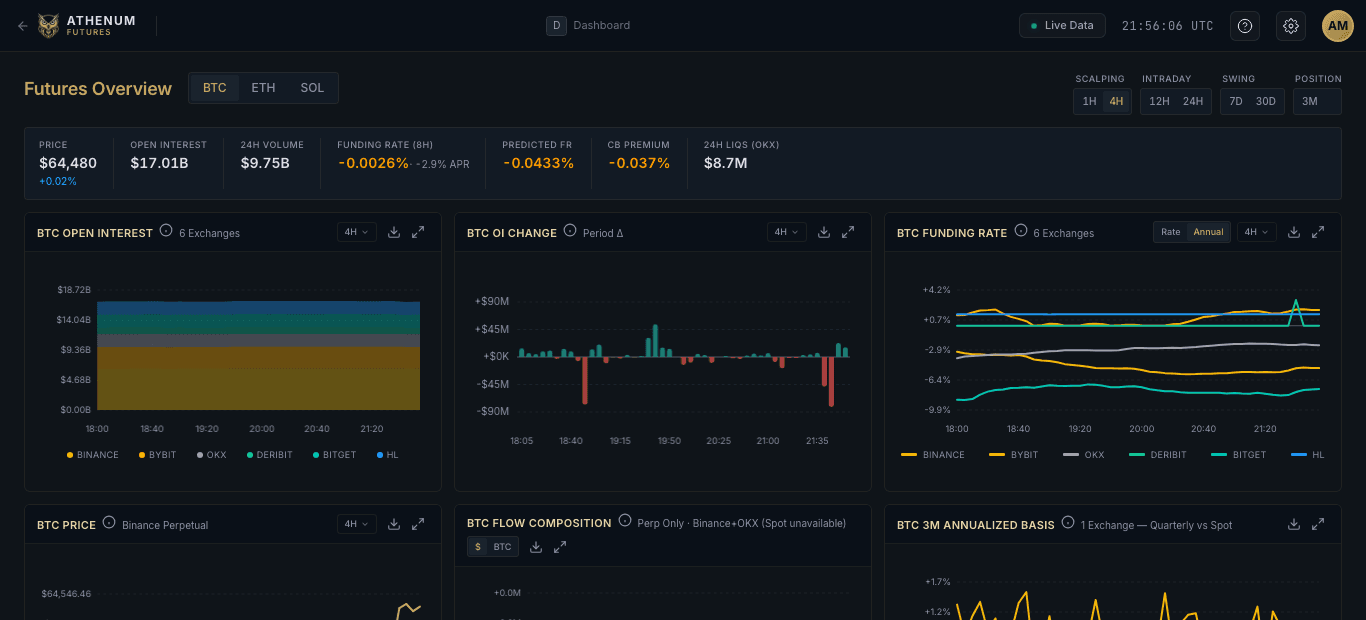
Athenum aggregates public market data across 14 exchanges into one derivatives terminal, so you can read funding rate analytics, CME gaps and basis tracking, and open interest side by side instead of tab-hopping. The free $0 tier gives you delayed data across 3 exchanges with 7 days of history, and the 7-day Pro+ trial opens full access with no credit card. Sign up with email, an Ethereum wallet, or a Solana wallet, no API keys, at https://app.athenum.xyz/auth .

Dated futures priced above spot on 2026-08-03: $62,623 spot against $64,990 on the far contract, a 4.2% annualized basis. A perpetual has no such curve and pays funding instead.
Both instruments let you trade with leverage, so it pays to know your liquidation price before sizing in. The free leverage and margin calculator on Athenum works it out for any position.
One terminal. All the data.
Liquidations, orderbook depth, whale walls & open interest from 4 exchanges, all real-time, in one place.
No credit card required

Athenum Analytics
Athenum Analytics is our three-person editorial team covering crypto derivatives, market data and macroeconomic context.