Table of Contents9 sections
- What is the maximum market order size on a crypto perpetual?
- How large is the cap on a contract that is not Bitcoin?
- Does the cap track how much the contract actually trades?
- Which stops you first, the cap or the order book?
- Why does a venue cap one market order at all?
- Does the same contract have the same cap on every venue?
- How do you check the cap on your own contract?
- Where the open interest behind these caps actually sits
- What this measurement does not show
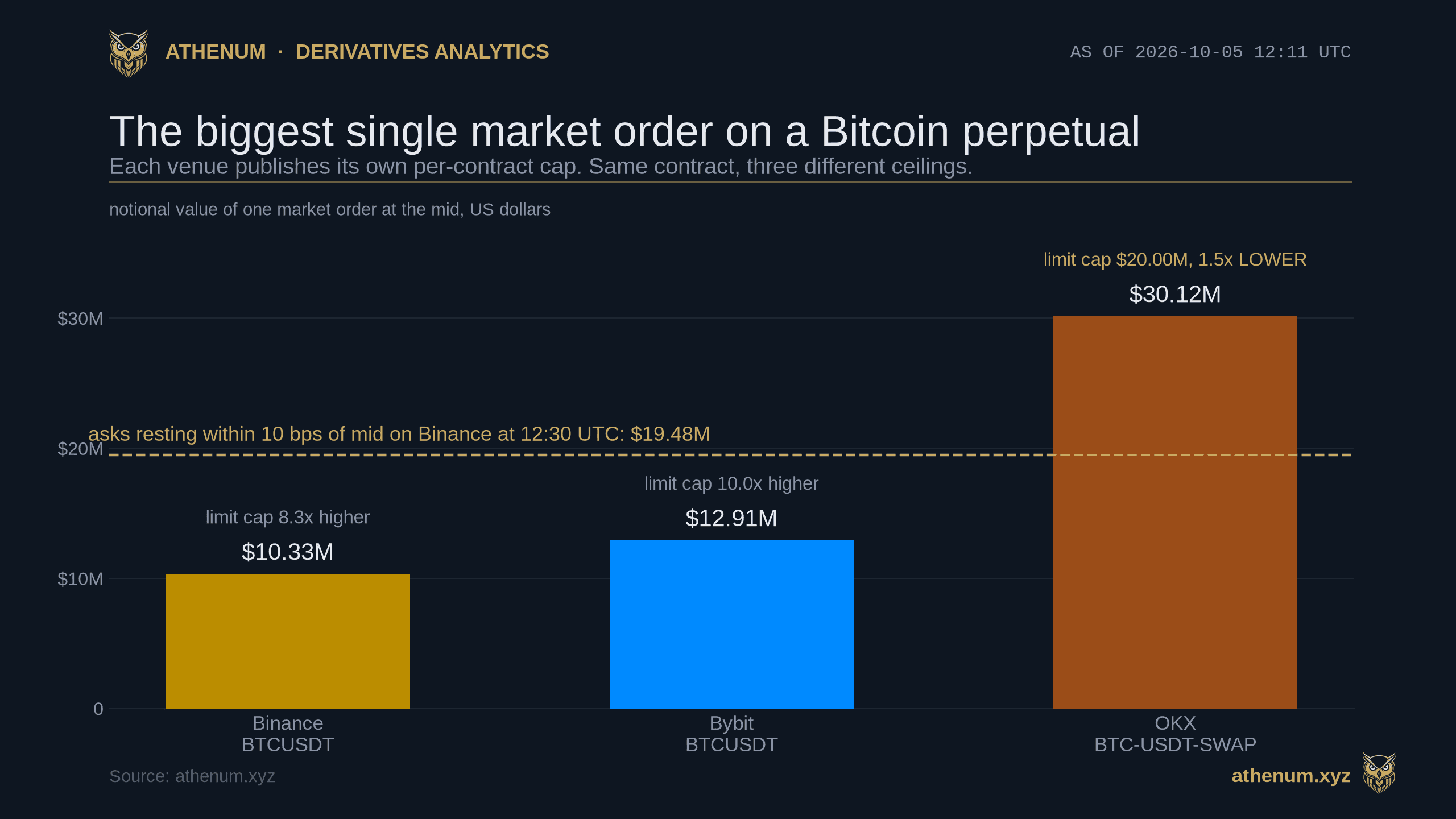
TLDR. Binance, Bybit and OKX each publish, for every perpetual they list, a hard ceiling on how much one market order may take, and it is a separate number from the ceiling on a limit order. Read from each venue's own public instrument endpoint on 2026-10-05 between 12:11:09 and 12:11:13 UTC, the Bitcoin perpetual stops at $10.33M on Binance, $12.91M on Bybit and $30.12M on OKX, so the same contract has three ceilings that differ by a factor of 2.9. Away from Bitcoin the numbers are much smaller than most traders assume: the median across the 563 USDT and USDC margined perpetuals on Binance is $99,510, across Bybit's 850 linear perpetuals $26,376, and across OKX's 500 live swaps $16,488. On Bybit, on that capture, 407 of 850 contracts cap one market order below $25,000. The ceiling is not the same thing as the depth standing in front of it. On Binance BTCUSDT at 12:30:11 UTC there was $19.48M of asks resting within 10 basis points of the mid, so the venue's own ceiling stops a single order at 53 per cent of the liquidity right at the top of the book. The limit order ceiling is a separate number, and it does not always point the way you would expect: it is 8.3 times higher than the market ceiling on Binance's Bitcoin perpetual and 10 times higher on Bybit's, while on OKX's it is 1.5 times smaller.
What is the maximum market order size on a crypto perpetual?
It is a per contract number the venue publishes, and on two of these three boards it sits below the limit order ceiling. On the third it does not. Binance states it in the MARKET_LOT_SIZE filter of its exchange information endpoint, which applies to market orders only, separately from the LOT_SIZE filter that governs order quantity in general. Bybit publishes maxMktOrderQty alongside maxOrderQty in its instruments response. OKX publishes maxMktSz alongside maxLmtSz. All three are public, require no account and no key, and all three were read for this post in a single window on 2026-10-05, 12:11:09 to 12:11:13 UTC, with prices taken from each venue's own top of book in the same window.
The quantities are denominated in the base asset on Binance and Bybit and in contracts on OKX, so the comparison below converts each one to notional dollars at that venue's own mid, using the OKX contract value to size a contract. Three contracts, read at the same minute:
Venue | Contract | One market order | One limit order | Limit over market |
|---|---|---|---|---|
Binance | BTCUSDT | 120 BTC, $10.33M | 1,000 BTC, $86.06M | 8.3x |
Bybit | BTCUSDT | 150 BTC, $12.91M | 1,500 BTC, $129.11M | 10.0x |
OKX | BTC-USDT-SWAP | 35,000 contracts, $30.12M | $20.00M, stated in dollars | 0.66x |
The OKX row inverts the pattern, and it took reading a second field to see it. OKX also publishes maxLmtSz of 100,000,000 contracts, which at the contract value works out to $86.06B and is plainly nominal rather than a real constraint. The constraint it does enforce sits one field away: maxLmtAmt, which OKX documents as the maximum dollar amount of a single limit order, reads $20,000,000 on 499 of its 500 live swaps. So on OKX's Bitcoin perpetual one market order may be larger than one limit order, $30.12M against $20.00M, a ratio of 0.66. Across the whole OKX board exactly two contracts are in that position, and they are the two largest: BTC-USDT-SWAP and ETH-USDT-SWAP. Anyone who assumed the market ceiling is always the tighter of the two would have assumed wrong on the two contracts most likely to carry a large order.
How large is the cap on a contract that is not Bitcoin?
Much smaller, and this is where the surprise is. Sorting every live perpetual on each board by the dollar value of one market order gives three distributions that barely overlap at the median.

Each dot is one live contract, n = 563, 850 and 500. Box is the middle half, bar the median: $99,510 on Binance, $26,376 on Bybit, $16,488 on OKX. The spread inside a board runs about two and a half orders of magnitude on Binance and more than four on Bybit and OKX, so the median is a location, not a rule.
On Binance the middle half of the 563 contracts runs from $74,380 to $162,700 around a median of $99,510, and the smallest is ALLUSDT at $34,685. Not one Binance perpetual caps a market order below $25,000. On Bybit the middle half of 850 contracts runs from $10,810 to $52,690 around a median of $26,376, the smallest is LABUSDT at $247, and 407 of the 850 on that capture, just under half the board, stop a single market order below $25,000. On OKX the middle half of 500 swaps runs from $6,637 to $81,560 around a median of $16,488, with the smallest at $1,035.
Those middle halves overlap heavily, so the honest reading is about typical contracts, not a league table: a typical Binance perpetual lets one order take about four times what a typical Bybit perpetual does, while the widest Bybit and OKX contracts are larger than most of Binance's. On that same capture only 21 Binance contracts, 12 Bybit contracts and 10 OKX contracts cap a single market order above $1M at all.
The practical consequence is arithmetic. A $500,000 position on a median contract is about five market orders on Binance, nineteen on Bybit and thirty on OKX, each one walking further into the book than the last. If you size positions with Athenum's free position size calculator, the cap is the number that decides whether that size is one click or twenty.
Does the cap track how much the contract actually trades?
Only loosely, and the boards disagree about how loosely. Ranking each board's contracts by the cap and by their own 24 hour turnover and comparing the two orderings gives a Spearman rank correlation of +0.584 on Binance across 563 contracts, +0.191 on Bybit across 850 and about +0.58 on OKX across 500. All three are positive, so a busier contract does tend to carry a larger ceiling, and none is close to the +1 that a purely liquidity driven rule would produce. The OKX figure carries a correction we owe you. This post's own first pass put it at +0.285, and that number was wrong for one reason: the conversion behind it multiplied the quantity by the mid without multiplying by the contract value first, which is exactly the step that step 2 below tells you not to skip. Two independent re-derivations of the same board later the same day, with the contract value applied, returned +0.564 and +0.576, so the honest reading is about +0.58 and OKX belongs beside Binance rather than at the bottom. The chart below was rendered from the uncorrected pass, so OKX has been dropped from it and it draws Binance and Bybit only.

Each dot is one contract. Spearman rank correlation of the cap against 24 hour turnover is +0.584 on Binance over 563 contracts and +0.191 on Bybit over 850. OKX is not drawn here: the pass that rendered this panel converted its caps without the contract value, and the corrected reading of about +0.58 would sit next to Binance. A rule that sized the cap purely to liquidity would read close to +1; neither board drawn here does.
What the Bybit panel shows is a vertical cloud: at almost any level of turnover the ceilings above it run across more than an order of magnitude, which is what a correlation of +0.191 looks like. The Binance panel is the same data with a visible slope through it. The reason to care is that the cap cannot be predicted from how liquid a contract feels. Two contracts with the same screen depth can carry ceilings an order of magnitude apart, and the only way to know is to read the instrument record.
Which stops you first, the cap or the order book?
Only on the deepest contract of the four, and the reason the band has to be narrow is itself worth knowing. We read Binance's own order book for four contracts at 12:30:11 UTC on 2026-10-05 and added up every ask resting within 10 basis points of the mid, then compared that to the same contract's market order ceiling. Ten basis points rather than a wider band, because Binance's depth endpoint returns at most 1,000 price levels and on BTCUSDT those 1,000 levels reached only 16.67 basis points from the mid in this capture. The 1,000 level ceiling is the durable part and Athenum measured it in August, where the same response reached 18.17 basis points on 2026-08-23; how far those levels reach on any given day is a property of the book, not of the endpoint. Any sum over a wider band on that contract would be a capture limit dressed up as liquidity.

Binance only, every leg read in the same second at 12:30:11 UTC. Bitcoin is the one contract where the published ceiling is the tighter constraint: $10.33M of cap against $19.48M of asks inside 10 basis points. On SOLUSDT, TRUMPUSDT and LABUSDT the top of the book runs out first, by factors of 4.2, 17 and 7.7.
On BTCUSDT the venue's own ceiling stops a market order at 53 per cent of the asks sitting inside 10 basis points of the mid, so the cap is the tighter of the two constraints. On the other three it is the other way round, and not narrowly: SOLUSDT holds $2.27M of asks in that band against a $9.64M ceiling, TRUMPUSDT $121,204 against $2.07M, and LABUSDT $7,065 against $54,313. On those three a trader who sizes an order to the published ceiling is not writing an order the venue will reject; the order is accepted and simply walks far past the top of the book, out to whatever the venue's own price band allows.
Four contracts is four observations and nothing more, and the band is deliberately narrow. What they establish is that both regimes exist on the same board in the same second, not how often each one occurs, and the ranking would move if the band moved. The test is cheap enough to run on your own contract before you need the answer.
Why does a venue cap one market order at all?
Because an unbounded market order is the fastest way to turn one participant's mistake into everybody's problem, and the venues say so in their own order rules. The same instrument records carry two further limits in the same spirit. Binance publishes a marketTakeBound of 0.05 on BTCUSDT, which rejects a market order that would print more than 5 per cent away from the mark price, and a PERCENT_PRICE filter with multipliers of 1.05 and 0.95 on the limit side. OKX publishes a floatPxLmtPct of 0.005 and a maxPxLmtPct of 0.01 on BTC-USDT-SWAP. Bybit publishes riskParameters with a priceLimitRatioX of 0.01 and a priceLimitRatioY of 0.02 on the same contract.
So the market order ceiling is one member of a family of per contract brakes, and the family is published in full. None of this is hidden; it is simply in a field most dashboards never render.
Does the same contract have the same cap on every venue?
No, and the gaps are large. Of the contracts measured here, 254 USDT settled perpetuals are listed on all three boards. For each one, dividing the largest of the three caps by the smallest gives a ratio whose median is 10.9, with a middle half from 6.25 to 17.7 and a maximum of 220.
The maximum is LABUSDT: $54,313 on Binance against $247 on Bybit and $6,910 on OKX. TRUMPUSDT reads $2.07M, $16,524 and $206,550, a factor of 125. Among the majors the gaps are smaller but still real: BTCUSDT $10.33M, $12.91M and $30.12M; ETHUSDT $5.43M, $5.43M and $24.43M; SOLUSDT $9.64M, $1.45M and $4.70M; XRPUSDT $3.03M, $2.27M and $2.42M; DOGEUSDT $2.88M, $575,235 and $2.30M.
A median of 10.9 across 254 contracts, with a quarter of them above 17.7, means that moving the same strategy from one venue to another changes the number of orders a given size takes by roughly an order of magnitude. That is a venue selection input, not a detail.
How do you check the cap on your own contract?
Three public requests, no account and no key.
1. Ask the venue for the instrument record. On Binance it is the exchange information endpoint and the field is maxQty inside the MARKET_LOT_SIZE filter. On Bybit it is the instruments information endpoint and the field is maxMktOrderQty inside lotSizeFilter. On OKX it is the public instruments endpoint and the field is maxMktSz.
2. Convert it to money. Multiply by the current mid, and on OKX's USDT swaps multiply by the contract value first, because the quantity is in contracts rather than coins. On its 15 inverse swaps the contract value is already denominated in dollars, so the mid does not belong in that conversion at all.
3. Compare it to your own intended size, not to the venue's headline volume. The cap decides how many orders your exit takes; turnover does not.
4. Read the price brake in the same record. A market order inside the size cap can still be rejected by the venue's percentage band if the book is thin enough that it would print outside it.
5. Re-read it when you change contract. The cap is per contract, it varies by more than two orders of magnitude inside one board and by more than four on two of the three, and a number you remember from Bitcoin tells you nothing about the perpetual you are about to trade.
For the size side of the same question, the free position size calculator turns a risk budget into a quantity, and the liquidation calculator gives the price at which the exit stops being optional. The mechanics of a forced exit, where none of these caps apply because the venue is closing the position itself, are in our measurement of who gets a partial liquidation and who gets closed all at once, and the reason the quoted spread is often just one tick wide is its own post.
Where the open interest behind these caps actually sits
The caps above are per venue, so the size of each venue's book is the context they sit in. On the closed 2026-10-05 12:00 UTC bar, Athenum's cross exchange feed read Bitcoin perpetual open interest as $8.33B on Binance, $4.89B on Bybit, $3.26B on Hyperliquid, $2.69B on Bitget, $2.49B on OKX and $0.80B on Deribit, with Bitcoin at $85,971.83.
Two of those six legs are documented as counting both sides, and our own earlier measurement is what says so. Three others document no convention at all, which is the honest limit of what follows. The Bybit figure is that venue's default open interest field, which Bybit's own API reference describes as the sum of both sides, and our feed passes it through unchanged, as Athenum measured in August. Re-read from Bybit directly at 13:23:49 UTC on 2026-10-05, the default field carried 57,061.736 BTC against 28,530.868 BTC in the venue's own single sided field, a ratio of exactly 2.000000, so the single sided Bybit position on that bar is $2.45B rather than $4.89B. Bitget is the second one: its own support article describes platform open interest as calculated bilaterally, which puts its single sided figure near $1.35B, and unlike Bybit it publishes no single sided field to check that against, so the halving rests on the venue's prose rather than on a number we can read. Binance states no convention on its open interest endpoint and we read it as single sided, which is how its own educational material describes it. OKX, Hyperliquid and Deribit state no convention anywhere we can find, so their legs are passed through as published and may themselves be bilateral. On the best basis we can document, rather than a verified consistent one, the legs run Binance $8.33B, Hyperliquid $3.26B, OKX $2.49B, Bybit $2.45B, Bitget about $1.35B and Deribit $0.80B.
Set the caps against those books on that basis and the range is at least tenfold. Binance's $10.33M ceiling is 0.12 per cent of its own $8.33B Bitcoin book, Bybit's $12.91M is 0.53 per cent of $2.45B, and OKX's $30.12M is 1.21 per cent of $2.49B. The direction runs opposite to book size: the venue with by far the largest book allows the smallest single order against it, which is not what a purely risk driven rule would produce. What the data does not support is an ordering of the other two, because Bybit's halved book and OKX's as-published book sit within about 2 per cent of each other, which is well inside what the counting convention alone moves. If OKX also counts both sides, its cap is nearer 2.4 per cent of a $1.25B book and the range is nearer twentyfold, which is why the sentence says at least.
What this measurement does not show
It does not show what you will actually get filled. The cap is a ceiling on the quantity the matching engine accepts in one message. What that quantity costs depends on the book at the moment it lands, and a market order at the cap on a thin contract can print far outside the top of book, up to whatever the venue's own price band allows.
It does not cover every venue. Bitget, Hyperliquid, Deribit, Kraken and Gate are outside the three board comparison, because the three measured here publish the market order ceiling as a distinct field and the comparison requires that field. Their absence from the cap tables is not a statement about their rules.
It is one instant. The instrument records and prices above are a capture between 12:11:09 and 12:11:13 UTC on 2026-10-05, and the order book reading is 12:30:11 UTC the same day. Instrument records change when a venue reconfigures a contract, and prices move continuously, so the dollar values move with them even when the underlying quantity does not. The two counts taken across a dollar threshold, the 407 below $25,000 and the 21, 12 and 10 above $1M, are the most fragile numbers here for that reason: they move by a contract or two from one day to the next without anything about the board changing. Nothing here should be quoted back as a current number next week; the method is the durable part.
The depth comparison is four contracts on one venue in one second, with the book summed only to 10 basis points from the mid. That band is set by Bitcoin alone: BTCUSDT's 1,000 levels reached just 16.67 basis points in this capture, by far the tightest reach of the four, while the three thinner contracts' 1,000 levels run out hundreds to thousands of basis points away. A wider band would raise every depth bar, and on three of the four it would raise them enough to flip the result. It establishes that both regimes exist, not their frequency.
The OKX board of 500 includes 15 inverse, coin margined swaps alongside 485 linear ones. Dropping the 15 moves that board's median from $16,488 to $15,703, so the mix is not what drives the comparison.
The cross venue ratios compare contracts that share a ticker, not contracts that are identical. Settlement currency, contract value and tick grid differ, and two venues can list the same ticker against different underlying references.
The capture behind this post is a two minute window on 2026-10-05, read straight from the Binance, Bybit and OKX public endpoints named above, and none of them asked for a key, so you can run the numbers yourself. Athenum reads Binance, Bybit, OKX, Bitget, Hyperliquid and Deribit into one normalized derivatives feed, and the 37 tools beside it, 35 of them calculators, are free to use: no account, no email, no usage limits. A free 7 day Pro+ trial opens the terminal at app.athenum.xyz and asks for no card.
One terminal. All the data.
Liquidations, orderbook depth, whale walls & open interest from 4 exchanges, all real-time, in one place.
No credit card required

Athenum Analytics
Athenum Analytics is our three-person editorial team covering crypto derivatives, market data and macroeconomic context.