Table of Contents6 sections
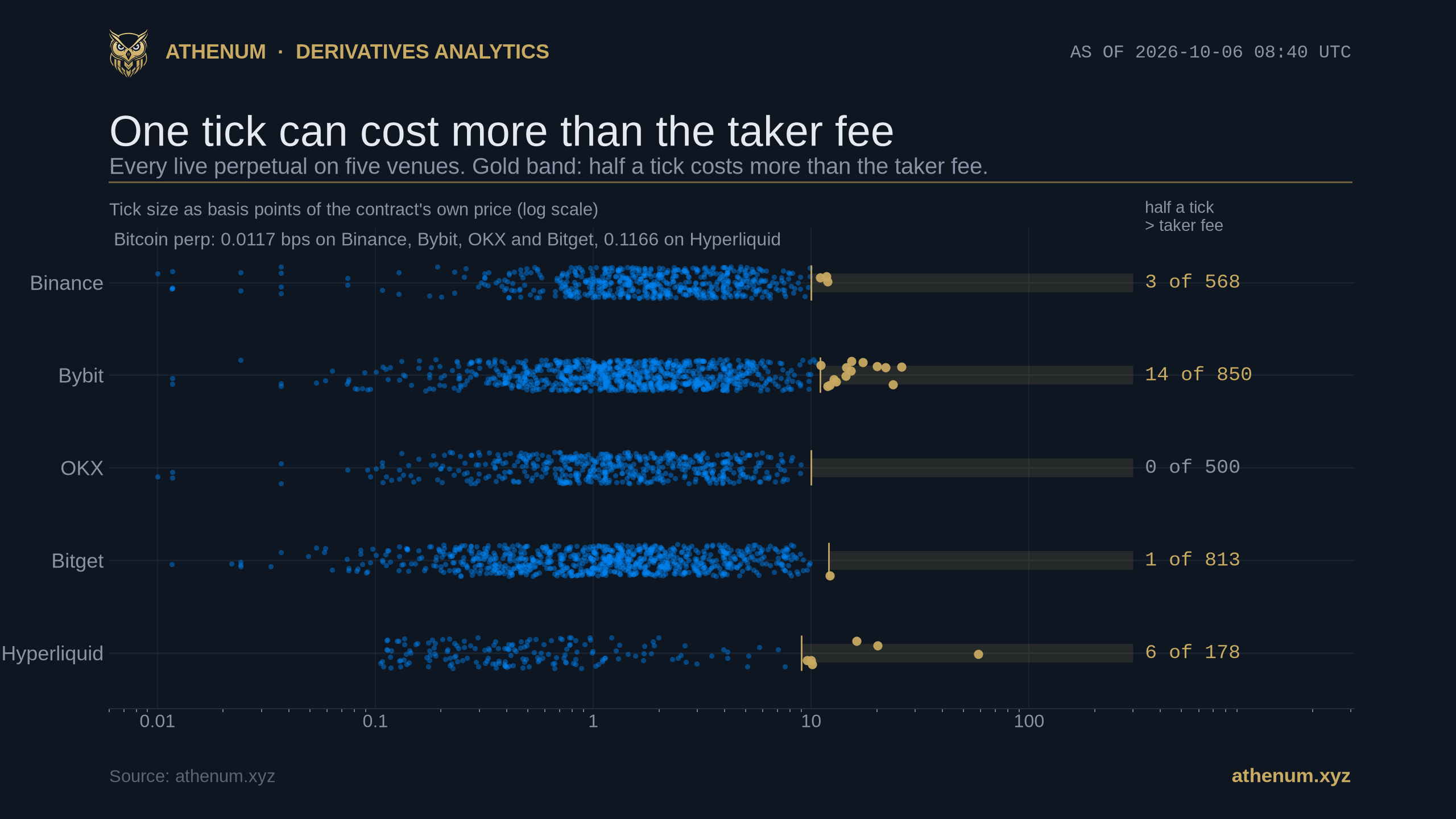
TLDR. On a Bitcoin perpetual the taker fee dwarfs the price grid, and that is the comparison almost everyone generalizes from. Read across every live perpetual on five venues at 08:40 UTC on 2026-10-06, 2,909 contracts in all, it inverts on the long tail. The tick is a fixed number of decimal places set when the contract lists, so on a cheap contract it is a large share of price: on 24 of those 2,909 contracts half a tick is worth more than the venue's own standard taker fee, and on 230 of them it is worth at least half the fee. The extreme is Hyperliquid's HMSTR, where the grid steps 58.48 basis points at a time against a 4.5 basis point taker fee, so half a tick is 6.5 times the fee. The second finding is about where the variation lives. Bitcoin's tick spans a factor of 10 across six venues, 0.0117 basis points on Binance, Bybit, OKX and Bitget, 0.0582 on Deribit and 0.1166 on Hyperliquid, while inside a single board it spans 894 times on OKX and 2,225 times on Bybit. Ranking venues by their tick tells you almost nothing about the contract you are about to trade. Weighted by where Bitcoin open interest actually sits on Athenum's cross exchange view at 08:39 UTC on 2026-10-06, the Bitcoin grid floor is 0.029 basis points, two and a half times the floor on the finest grid.
Can the price grid cost more than the taker fee?
Yes, on 24 of 2,909 live perpetuals. The comparison has to be stated carefully, because the two costs are charged differently. A taker fee applies to the full notional of one fill. Crossing a spread that is pinned at one tick costs half that tick relative to the mid, so the like for like test is half a tick against one taker fee, and that is the test behind every count here. Standard non discounted taker rates were used: 0.05 per cent on Binance, 0.055 per cent on Bybit, 0.05 per cent on OKX, 0.06 per cent on Bitget and 0.045 per cent on Hyperliquid.
Venue | Contract | Tick | Price | Tick in bps | Half tick against the fee |
|---|---|---|---|---|---|
Hyperliquid | HMSTR | 0.000001 | $0.000171 | 58.48 | 6.50x |
Bybit | KUAISHOUUSDT | 0.01 | $3.855 | 25.94 | 2.36x |
Bybit | SHEINUSDT | 0.01 | $4.225 | 23.67 | 2.15x |
Bybit | LONGXIAUSDT | 0.0001 | $0.0457 | 21.88 | 1.99x |
Hyperliquid | NOT | 0.000001 | $0.000495 | 20.20 | 2.24x |
Bybit | LABUSDT | 0.0001 | $0.04975 | 20.10 | 1.83x |
Bybit | CONLUSDT | 0.01 | $5.785 | 17.29 | 1.57x |
Hyperliquid | MEME | 0.000001 | $0.000619 | 16.16 | 1.80x |
Binance | ROBOUSDT | 0.00001 | $0.008435 | 11.86 | 1.19x |
Fourteen of the 24 are on Bybit, six on Hyperliquid, three on Binance, one on Bitget and none at all on OKX. Eight of the fourteen Bybit entries trade between $3.855 and $9.025 on a one cent grid, which is exactly where that grid starts to bite: on a one cent step, any price below about $9.09 puts half a tick above Bybit's 5.5 basis point taker fee. All eight are equity perpetuals by Bybit's own instrument record, which tags five of them symbolType stock (Kuaishou, Shein, Meituan, SMIC and Fluence Energy) and three symbolType ETF (two leveraged short ETFs and one leveraged long COIN ETF), the family whose weekend behaviour we measured in Athenum's measurement of stock perpetuals on a closed Saturday. Loosen the test to the full tick against the fee, which is the right comparison if you think of a round trip rather than one fill, and the count rises to 230 of 2,909, just under 8 per cent of the board.
The point is not that 24 is a large number. It is how narrow the basis for the usual generalization is. Athenum's earlier measurement of the crypto bid ask spread put the taker fee at 32 to 3,192 times the quoted spread, on a $10,000 Bitcoin order at 09:05 UTC on 2026-07-25, across four books. That measurement stands, and it is one asset at one minute. Read across every contract these five venues list, the ordering reverses on the tail. If you are sizing the cost of a fill with the free Athenum slippage calculator, the fee is the number that dominates on a major, and the grid is the one that dominates once half a tick clears it, which on a one cent step means any price under about $9.
How much does the tick vary inside a single venue?
Far more than it varies between venues, and this is the finding that undoes the venue ranking frame. Bitcoin's tick is 0.0117 basis points on four of the six venues in Athenum's feed, 0.0582 on Deribit and 0.1166 on Hyperliquid, a span of 10 times end to end. Inside a single board the span is two to three orders of magnitude larger.

Each venue's whole board at 08:40 UTC on 2026-10-06. The gold diamond is that venue's Bitcoin perpetual, and on every board it sits at or near the fine end of the venue's own range. Bybit's board runs 2,225 times from end to end, which is 222 times the 10x span Bitcoin shows across all six venues.
Venue | Contracts | Median tick, bps | Middle half | Full range | Span inside the board |
|---|---|---|---|---|---|
Binance | 568 | 1.85 | 1.02 to 3.51 | 0.0100 to 11.86 | 1,185x |
Bybit | 850 | 1.45 | 0.75 to 2.97 | 0.0117 to 25.94 | 2,225x |
OKX | 500 | 1.28 | 0.70 to 2.91 | 0.0100 to 8.94 | 894x |
Bitget | 813 | 1.18 | 0.48 to 2.39 | 0.0117 to 12.18 | 1,046x |
Hyperliquid | 178 | 0.43 | 0.23 to 0.90 | 0.1054 to 58.48 | 555x |
Every column above is rounded for reading and the span is computed from the unrounded endpoints, so dividing the two rounded ends of a row lands a few parts in a thousand away from the span beside them.
Hyperliquid is the instructive row, because it inverts twice. Its Bitcoin grid is the coarsest of the six at 0.1166 basis points, ten times Binance's, and its median contract is the finest of the five boards at 0.43 basis points, under a quarter of Binance's 1.85. That is not a contradiction: Hyperliquid sets the grid by a rule rather than a number, allowing at most five significant figures and no more than six decimal places minus the contract's size precision, with whole numbers always permitted, so its tick scales with the price while a fixed decimal tick does not. A rule that is coarse at $85,800 is fine at $1.20, which is where most of a perpetual board lives. The middle halves of all five boards overlap heavily, so this is a statement about typical contracts, not a league table, and no reading of these distributions supports ranking the venues by their medians: the gap between Binance and OKX medians, 1.85 against 1.28, is smaller than the gap between the first and third quartile of either one.
Why do the cheapest contracts carry the coarsest grid?
Because a tick is a count of decimal places that is set when the contract is listed and rarely touched again, while the price moves continuously afterwards. A contract that lists at $1 with a $0.0001 tick carries a 1 basis point grid. If it falls to $0.05 the grid is 20 basis points, and the venue has done nothing.

Each diagonal band is one tick value: every contract on that band shares the same absolute increment, so its cost in basis points falls as its price rises. Correlation between log price and log tick in basis points is -0.48 on Binance (n=568), -0.44 on Bybit (n=850), -0.48 on OKX (n=500) and -0.61 on Bitget (n=813).
The correlation between log price and log tick in basis points is negative on all four fixed grid boards, from -0.44 on Bybit to -0.61 on Bitget, and the bands in the chart are what produces it. Every contract on one band shares an absolute increment, so the band slopes down at exactly minus one in log space, and a venue picks which band a contract joins at listing. The correlation is well short of -1 because that choice is coarse: the same $0.0001 tick is used across more than two decades of price.
This is the price axis twin of a drift we measured on the size axis, where Athenum's measurement of minimum order size found a floor set once and left alone rising in dollar terms with every rally. The two drift in opposite directions. A rally makes a quantity floor more expensive and a price grid cheaper, and a long drawdown does the reverse, which is why the coarse grid entries in the first table are nearly all contracts priced in cents or single dollars. Drift is not the only route there: eight of those entries are equity perpetuals that list at a single digit dollar price by design, so on that part of the table the grid was coarse from the first day rather than made coarse by a fall.
Where does that grid cost sit in Bitcoin open interest today?
Mostly on the fine grids, but not entirely. Read at 08:39 UTC on 2026-10-06, while the 08:00 UTC bar was still filling, Athenum's cross exchange view put Bitcoin at $85,765.08 and Bitcoin perpetual open interest at $8.11B on Binance, $4.87B on Bybit, $3.37B on Hyperliquid, $2.71B on Bitget, $2.48B on OKX and $0.81B on Deribit.

Weighting each venue's Bitcoin tick by its share of the six venue open interest gives 0.029 basis points, which is 2.5 times the 0.0117 that four of the six venues quote, because the 15.1 per cent of open interest on Hyperliquid and the 3.6 per cent on Deribit sit on grids 10 and 5 times coarser.
The 07:00 bar before it is frozen and no longer moves, while this one was still being written, so these are current readings rather than a settled hour. Those six legs sum to $22.35B, while the feed's own aggregate field for the same bar reads $22.51B, 0.73 per cent higher on the unrounded legs, so the named legs and the total do not reconcile and the shares below are taken against the sum of the named venues rather than against that total. Weighting each venue's Bitcoin tick by its share of that sum gives 0.029 basis points, against the 0.0117 that the four finest venues quote. The whole gap comes from two legs: Hyperliquid carries 15.1 per cent of the open interest on a grid ten times coarser, and Deribit 3.6 per cent on a grid five times coarser.
That weighting is only as good as the open interest underneath it, and two of the six legs are documented as counting both sides, as Athenum's measurement of open interest conventions found. Halving the Bybit and Bitget legs on that basis moves the weighted floor from 0.029 to 0.033 basis points, further from the fine grid rather than closer, so the conclusion survives the correction that would most plausibly undo it.
How to check this on your own contract
1. Read the instrument record, not the order book. Binance publishes tickSize inside the PRICE_FILTER of its exchange information endpoint, Bybit publishes priceFilter.tickSize, OKX publishes tickSz, Bitget publishes pricePlace and priceEndStep as a pair, and Hyperliquid publishes a rule plus szDecimals rather than a number. All five are public and none asked for a key.
2. Convert the tick to basis points by dividing it by the contract's current price and multiplying by 10,000. The absolute tick is not comparable across contracts; the relative one is.
3. Halve it. The cost of crossing a one tick spread, measured from the mid, is half a tick, and that is the number that belongs next to a taker fee.
4. Compare it with the fee you actually pay, not the headline rate. Every count in this post uses standard non discounted taker rates, and a VIP tier or a token discount lowers the fee and therefore raises the number of contracts where the grid dominates. The free Athenum profit and loss calculator takes both costs on the same trade so you can see which one is doing the damage.
5. Re-check it after a large move. The tick does not change when the price does, so a contract that was fine when it listed can be sitting a band or two too coarse a year later, and nothing in the venue's interface announces that.
What this measurement does not show
It does not show how often a book actually sits on its floor. Four snapshots spread over the eight minutes from 08:39 to 08:47 UTC on 2026-10-06 put the share of contracts quoting exactly one tick wide at 61.6 to 66.6 per cent on Binance, 23.7 to 24.5 on Bybit and 37.8 to 44.0 on OKX. Among twelve Hyperliquid majors the count one tick wide moved between six and eleven of the twelve from one snapshot to the next, with Bitcoin one tick wide in every one of them at $85,793 bid against $85,794 ask. The three Hyperliquid contracts in the table above were re-read at 09:02 UTC and all three were still exactly one tick wide: HMSTR at $0.000171 against $0.000172, NOT at $0.000494 against $0.000495 and MEME at $0.000619 against $0.000620. Four snapshots over eight minutes is not a time share, and the question of what fraction of the day a given book is pinned is still open.
It is one capture. Instrument records and prices were read between 08:39 and 08:41 UTC on 2026-10-06, and the counts that sit near a threshold move with the price. The 24 is the most fragile number here: twelve of those contracts, half of them, sit within 20 per cent of the cut, so a normal day's move in either direction changes the count. The method is the durable part, not the count.
The Hyperliquid tick is derived, not published per contract. It follows that venue's stated rule of at most five significant figures with whole numbers always allowed, capped at six decimal places minus szDecimals, whichever of the two limits binds tighter, and it was checked against the live top of book on twelve majors, where the implied increment matched the quoted prices on all twelve.
Fees vary by tier, product and payment method, and the fee side of every comparison here is the standard rate. Market maker rebates, VIP tiers and token discounts all move the threshold.
The contract universe is each venue's own live board, 568 Binance perpetuals, 850 Bybit linear perpetuals, 500 OKX swaps, 813 Bitget USDT margined contracts and 178 Hyperliquid perpetuals, which is a comparison of boards as listed rather than of matched contracts. Deribit appears only in the Bitcoin weighting, not in the board comparison. Each board is also charged one fee, its venue's standard taker rate, although the boards mix settlement currencies: 43 of the Binance contracts and 68 of the Bybit ones are margined in something other than USDT, and 15 of the OKX swaps are inverse coin margined. None of those sits among the 24, and exactly one sits among the 230, so the mix does not carry the result.
Every tick, price and quote above was read from venue endpoints that asked for no key, so that half of the measurement is reproducible by anyone. The open interest is Athenum's own cross exchange feed, which normalizes Binance, Bybit, OKX, Bitget, Hyperliquid and Deribit into one series, and the 35 free calculators beside it stay open to everyone: no account, no email, no usage limits. The terminal the cross exchange figures come from opens on a free 7 day Pro+ trial at app.athenum.xyz, which takes no card and ends by itself.
One terminal. All the data.
Liquidations, orderbook depth, whale walls & open interest from 4 exchanges, all real-time, in one place.
No credit card required

Athenum Analytics
Athenum Analytics is our three-person editorial team covering crypto derivatives, market data and macroeconomic context.