Table of Contents8 sections
- What is the smallest order you can place on a Bitcoin perpetual?
- Why is a venue's minimum not the same kind of rule everywhere?
- Which rule binds, and does it change when Bitcoin moves?
- How badly does the published figure actually mislead?
- Is the minimum order the same as the minimum position?
- Where is the size, and what does it cost to get in?
- How do you check this yourself?
- What this post does not claim
Practise with worked lessons
- Round an executable quantity without increasing the risk budget
Check quantity steps, price ticks and minimum notional against a fixed risk budget. Learn when rounding leaves no order that fits the original risk.
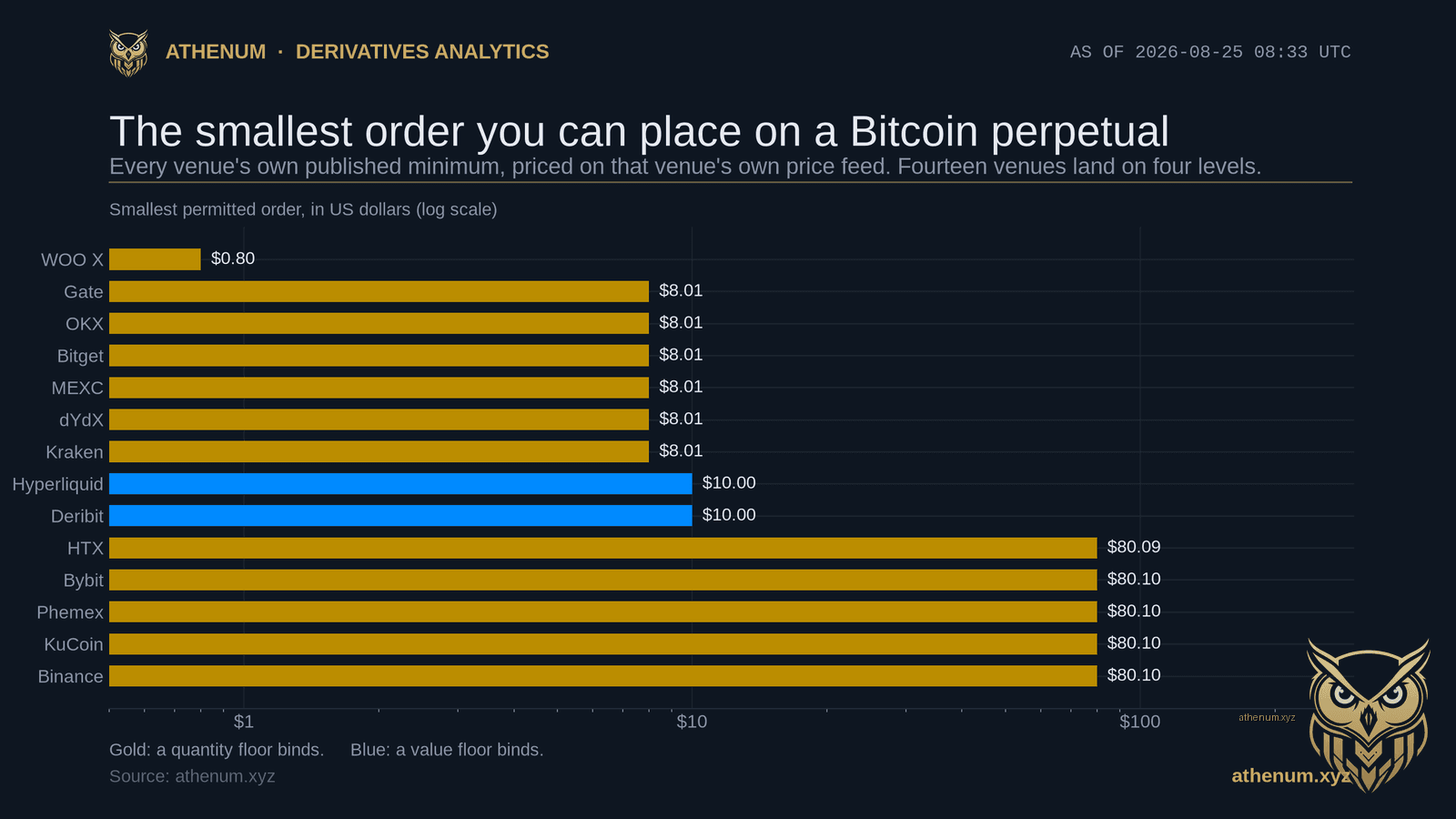
TLDR. Measured on 2026-08-25 at 08:33 UTC across the Bitcoin perpetual on 14 venues, the smallest order you are permitted to place runs from $0.80 on WOO X to $80.10 on Binance, and the fourteen land on just four levels: $0.80, $8.01, $10.00 and about $80.10. That converted table is the answer to the question as asked. The more useful finding is underneath it. The venues are not enforcing the same kind of rule. Twelve of the fourteen stop you at a quantity of Bitcoin, two stop you at a number of dollars, and those two behave completely differently when the market moves: a quantity floor is a dollar amount that drifts with the price, while a dollar floor is fixed. Five venues publish both and enforce whichever is larger, which makes their effective minimum a kinked function with a crossover you can compute. Binance's crossover sits at $50,000, far below today's market, so its $50 minimum notional constrains nothing and the rule that binds is 0.001 BTC. Hyperliquid's crossover sits at $1,000,000, so its $10 floor is what binds and would keep binding through a large rally. And the bare figure each venue prints is not a ranking: sorting the fourteen by it puts 34 of 80 decidable pairs in the wrong order, against 40 for a random shuffle of the same numbers, a difference well inside chance (p = 0.51).
Every figure below was measured by us on 2026-08-25 from each venue's own public endpoints, with no API key, and the cross-venue derivatives feed we run beside them is Athenum. The instrument is the Bitcoin perpetual on each venue: BTCUSDT on Binance USD-M, Bybit, Bitget, MEXC and Phemex, BTC-USDT-SWAP on OKX, BTC_USDT on Gate, BTC-USDT on HTX, XBTUSDTM on KuCoin, PERP_BTC_USDT on WOO X, PF_XBTUSD on Kraken, BTC-USD on dYdX, BTC-PERPETUAL on Deribit, and the BTC perpetual on Hyperliquid. All 14 answered, 0 failures. Because every dollar figure depends on a price, each venue's minimum is priced on that venue's own price feed rather than on one shared price, using its mark where it publishes one and its last trade or index where it does not; the instrument capture is stamped 08:33:50 UTC, and for WOO X and Phemex, whose instrument responses carry no price, the mark came from a second call about five minutes later.
What is the smallest order you can place on a Bitcoin perpetual?
Between $0.80 and $80.10 on 2026-08-25, and the fourteen venues cluster onto four levels rather than spreading evenly. This is the converted table, with the raw field each venue publishes, the unit it is counted in, and what it comes to:
Venue | Field published | Raw value | Unit | In BTC | In USD |
|---|---|---|---|---|---|
WOO X | `base_min` | 0.00001 | BTC | 0.00001 | 0.80 |
Gate | `order_size_min` | 1 | contract | 0.0001 | 8.01 |
OKX | `minSz` | 0.01 | contracts | 0.0001 | 8.01 |
Bitget | `minTradeNum` | 0.0001 | BTC | 0.0001 | 8.01 |
MEXC | `minVol` | 1 | contract | 0.0001 | 8.01 |
dYdX | `stepSize` | 0.0001 | BTC | 0.0001 | 8.01 |
Kraken | `contractValueTradePrecision` | 4 | decimal places | 0.0001 | 8.01 |
Hyperliquid | `szDecimals` | 5 | decimal places | 0.00001 | 10.00 |
Deribit | `min_trade_amount` | 10.0 | USD | n/a | 10.00 |
HTX | `contract_size` | 0.001 | BTC per contract | 0.001 | 80.09 |
Bybit | `lotSizeFilter.minOrderQty` | 0.001 | BTC | 0.001 | 80.10 |
Phemex | `qtyStepSize` | 0.001 | BTC | 0.001 | 80.10 |
KuCoin | `lotSize` | 1 | contract | 0.001 | 80.10 |
Binance | `LOT_SIZE.minQty` | 0.001 | BTC | 0.001 | 80.10 |
Three rows in that table are weaker than the rest and we would rather say so than let them pass. HTX's is ours, not theirs. Its `swap_contract_info` publishes a 0.001 BTC contract size and no minimum-order field, and we could find no minimum order quantity anywhere in HTX's API reference or help centre. Its order parameter `volume` is typed as an integer count of contracts, so one contract is the smallest positive value you can send, and that is the assumption behind $80.09. HTX never states it. (HTX's API reference also calls that field "USDT of one contract" while its help centre says 0.001 BTC per contract; the help centre matches the live payload, so we took BTC.) Hyperliquid's is real but oddly published. The $10 floor appears in Hyperliquid's error tables, as `MinTradeNtl`, "Order must have minimum value of $10", and nowhere as a stated rule; its `meta` response carries only the 5 decimal place step. Phemex publishes a step and no minimum. Its products response carries `qtyStepSize` 0.001 and `qtyPrecision` 3, which corroborate each other, and no minimum order quantity field at all, so its row is the step rather than a stated floor. Phemex announced a move to a 0.0001 BTC step in 2025 that has not taken effect on this contract: the live field still reads 0.001, and every one of the last hundred trades on its own tape is a multiple of it. dYdX looks like the same case and is not: its protocol documentation says the protocol uses the same value for step size and minimum order size, and works the 0.0001 BTC figure out explicitly, so there the step is the minimum by rule.
The $0.80 to $80.10 range is a 100 times spread, and it is a ratio of two single readings, so it deserves the treatment that implies: trim one venue from each end and it collapses to 10.0 times, between Gate at $8.01 and KuCoin at $80.10. The honest summary is the cluster structure rather than the range. One venue at $0.80, six at $8.01, two at $10.00, five at about $80.10. Within that last group Binance, KuCoin, Phemex, Bybit and HTX are all the same 0.001 BTC and differ only by the price each was valued at, so calling any one of them the dearest is a rounding artefact rather than a difference.
That the raw column is not comparable across venues is a thing we have written about twice already and are not going to re-derive here. The short version is that Gate's `1` and OKX's `0.01` are the same 0.0001 BTC because their contracts are worth different amounts, and Kraken's `4` is a count of decimal places rather than a size at all. Our post on order book depth puts the rule as read the contract specification before the number, every time, because the number will not tell you. What follows takes that as settled and asks the question it leaves open, which is what the converted numbers then do.
Why is a venue's minimum not the same kind of rule everywhere?
Because three structurally different rules are all called the minimum, and they behave differently over time rather than merely reading differently today. This is the distinction the unit conversion hides once you have done it, and it is the one that decides whether the number you wrote down is still true next month.
A quantity floor is a smallest number of Bitcoin: Binance's 0.001, Bitget's 0.0001, WOO X's 0.00001. Expressed in dollars it is not a constant. It rises and falls with Bitcoin, one for one, and no announcement is ever made.
A value floor is a smallest number of dollars: Binance's $50 `MIN_NOTIONAL`, Bybit's $5, Bitget's $5, Phemex's $1, Hyperliquid's documented $10. This one is constant in dollars and shrinks in Bitcoin terms as the price rises.
A rounding precision is neither. Kraken publishes `contractValueTradePrecision` of 4 and Hyperliquid `szDecimals` of 5, which say how finely a size may be specified, not how small it may be. Four of the fourteen give only this in the instrument payload, the other two being dYdX and Phemex. Reading a step as a minimum is safe only where nothing sits above it, and at Hyperliquid something does, which is why it appears at $10.00 in the table and not at the $0.80 its five decimal places would imply. Kraken and dYdX are the reassuring cases: Kraken's help centre publishes a Min Lot of 0.0001 matching the precision exactly, and dYdX's protocol documentation states outright that step size and minimum order size take the same value, so at both the step really is the floor.

The same fourteen venues ordered two ways on 2026-08-25. Left: by the bare figure each one publishes. Right: by what that figure costs. Ten of the fourteen move four or more places. Deribit prints the largest figure of all, 10.0, and lands mid-column in ninth; Binance prints 0.001, near the small end, and comes out the dearest venue of the fourteen. WOO X is the one the raw figure happens to get right, first on both sides.
Deribit is the clean case of a rule that is a different kind rather than a different size. Its perpetual is an inverse contract quoted in dollars, so `min_trade_amount` of 10.0 is ten dollars, full stop, at any Bitcoin price. It is the only venue of the fourteen whose minimum is a genuine constant.
Which rule binds, and does it change when Bitcoin moves?
It changes, and on 2026-08-25 the two kinds of rule bind on different venues. Five of the fourteen have both a quantity floor and a non-zero value floor (four publish both in the instrument payload; Hyperliquid's $10 comes from its error tables), and what stops you going smaller is whichever is larger at the current price. (A sixth, WOO X, publishes the value-floor field and sets it to 0, which is the clearest way a venue can say the rule exists and does not apply.) So the effective minimum is a kinked function, and the kink is at a price you can compute by dividing the value floor by the quantity floor.

Effective minimum order against the Bitcoin price for the venues publishing both a quantity floor and a value floor, on 2026-08-25. At today's 80,099 dollars, four of the five are past their kink so the quantity floor binds, and Hyperliquid is still 12.5 times below its own kink so its 10 dollar floor is what binds. Deribit's line is flat everywhere because its contract is denominated in dollars.
Binance's $50 value floor against a 0.001 BTC quantity floor crosses at $50,000. The hourly series on our own feed ran between $64,127 and $80,669 over the 168 hours to 2026-08-25 08:00 UTC, and those are hourly readings rather than intraday extremes, so across that whole window Binance's minimum notional constrained nothing and the binding rule was the quantity, at $80.10 today. Bybit's $5 against the same 0.001 BTC crosses at $5,000, further below the market still. Phemex crosses at $1,000. Bitget crosses at $50,000, and because its quantity floor is ten times finer than Binance's, it sits at $8.01 rather than $80.10 on the same day.
Hyperliquid runs the other way. Its $10 floor against a 0.00001 BTC step crosses at $1,000,000, so at a Bitcoin price near $80,099 it is 12.5 times below its own kink and the dollar floor is what binds, and would keep binding through a large rally. Two of the fourteen are value-bound today and both are at $10.00.
This is why a minimum copied into a comparison table goes stale in a way a fee schedule does not, and it goes stale in two independent ways at once. Nobody at Binance has to change anything for its effective minimum to move. If Bitcoin halved from here to around $40,000, Binance's quantity floor would be worth about $40, the $50 notional floor would take over as the binding rule, and the effective minimum would stop tracking the price at all. Nothing would have been announced, because nothing at Binance would have changed. And the floors themselves also move on purpose. Binance cut the BTCUSDT minimum notional from $100 to $50 with effect from 2026-04-14, so any source written before that April says $100 and is simply out of date. A number that drifts silently with the market and also steps on announcement is about the least copyable figure in a venue's specification.
How badly does the published figure actually mislead?
Enough to be worth quantifying rather than asserting, which is what we did. Of the 91 possible pairs among fourteen venues, 80 are decidable and 11 are tied on one side or the other. Ranking by the bare published figure puts 34 of those 80 in the wrong order, or 42.5%.
On its own that number means nothing, because a ranking has to be compared against what chance produces. Shuffling the same fourteen published figures at random across the same fourteen venues, 200,000 times, puts 50.0% of pairs wrong on average, with the middle 95% of shuffles between 28.7% and 71.3%. The observed 42.5% is inside that band, two-sided p = 0.51. Sorting venues by the number they print is, on this sample, not distinguishable from shuffling them.

The observed 42.5 percent against 200,000 random shuffles of the same fourteen numbers on 2026-08-25. The gold line is not in a tail, which is the finding: sorting venues by the figure they publish is not distinguishable from shuffling them. Dropping any single venue moves it only between 38.6 and 50.7 percent, so no one venue is carrying the result.
Because a rank result on fourteen items can rest on a single outlier, we recomputed it fourteen times with one venue removed each time. It moves between 38.6% and 50.7%, and every one of those values is inside the shuffle band. Dropping WOO X, the cheapest venue and the obvious suspect for driving the effect, moves it to 50.7%, which is worse than the full sample rather than better.
None of that means the published fields are wrong or that anything is being hidden. Every figure in the table except the three flagged above came out of a documented public field on the first request. It means the field is not a cross-venue quantity, and a table that lines those fields up without converting them is presenting a ranking it has not earned.
Is the minimum order the same as the minimum position?
No, and the gap between the two is not documented anywhere. Not one of the fourteen venues publishes a minimum position size. We walked every field of all fourteen instrument payloads: every position-shaped field in them is a ceiling, not a floor. Kraken publishes `maxPositionSize`, Bitget `posLimit` and `maxPositionNum`, OKX `posLmtAmt` and its remaining-quota fields, Binance a `POSITION_RISK_CONTROL` status. Every minimum in those payloads is an order field.
Two venues document, in their own words, the exemption that lets a position end up smaller than the smallest order that could have created it, and a third leaves a fingerprint of it.
- Binance exempts closing orders from the value floor in the text of the rejection itself. Its error -4164 reads that an order's notional must be no smaller than the limit *unless you choose reduce only*. There is no matching exemption from the quantity floor, which on BTCUSDT costs nothing because `minQty` and `stepSize` are both 0.001, so every reachable position is a closable multiple. On a symbol where those two differ it would not be harmless. - Bybit states the asymmetry outright: "Closing orders will not be restricted by the minimum notional value but still be subject to the preset minimum order size." Exempt from the dollar floor, not from the quantity grid. - OKX ships an error, 51132, whose text is that your position amount is negative and less than the minimum trading amount. That is not documentation of the mechanism, it is an inference from the existence of the code: a venue does not need one for a state that cannot occur.
So the number in the table is what you may open. At the venues above, what you may hold is smaller, by an amount none of the fourteen quantifies, and the route into that region is a partial close. If you have ever wondered why a dust-sized perpetual position sits in an account refusing to be tidied away, this is the machinery behind it.
There is a second consequence worth separating out, because it changes what the word minimum even means. At most of these venues the minimum equals the step: Binance 0.001 and 0.001, Bybit 0.001 and 0.001, OKX 0.01 and 0.01, Kraken and dYdX both 0.0001. Where those two coincide there is no floor at all in the ordinary sense, only a grid, and the smallest order is simply one tick of it. A floor that actually sits above the grid, and so constrains something the grid does not, is rarer still: at today's price only Hyperliquid's does, because the other value floors are all below one grid step. Deribit is not one of them: its 10 USD minimum is exactly one contract, so it is a grid too, just a grid denominated in dollars. Bybit is the one venue that writes the resulting arithmetic out in public, defining its minimum order quantity as the larger of the preset minimum order size and the minimum notional divided by the order price. That is the crossover in the chart above, published by a venue as its own formula.
Where is the size, and what does it cost to get in?
The two venues carrying the most open interest on our own cross-venue feed also have the largest minimums, though the pattern does not hold further down. For the hour ending 2026-08-25 07:00 UTC, the venues that feed carries for Bitcoin (Binance, Bybit, Hyperliquid, Bitget, OKX and Deribit) held $21.62B of perpetual open interest between them:

Open interest share on Athenum's cross-venue feed for the hour ending 2026-08-25 07:00 UTC, against each venue's smallest permitted order. Binance carries 40.4 percent of the 21.62 billion dollars and has the joint-largest minimum at 80.10 dollars; OKX carries 10.8 percent and lets you in at 8.01. The newest hour was dropped from this reading because it was still filling.
Binance carries 40.4% of that open interest and has the joint-largest minimum at $80.10. OKX carries 10.8% and lets you in at $8.01, ten times smaller. Across those names the two orderings run broadly together, rank correlation 0.66. That figure is sensitive to how the Hyperliquid and Deribit tie at $10.00 is broken: correcting for the tie gives 0.75, and the other break gives 0.83. We quote the lowest of the three.
We are not going to call that a relationship. A sample of 6 is small enough that a rank correlation of 0.66 turns up by chance often, and there is an obvious confound underneath it: the venues with the most open interest are also the oldest, and a quantity floor set once and left alone rises in dollar terms with every rally, so an old contract will tend to show a larger dollar minimum for reasons that have nothing to do with its size. It is a coincidence worth watching rather than a finding, and we would rather print it labelled that way than either drop it or dress it up. The reading uses the second-newest hour of the feed rather than the newest, because the newest hour is still accumulating while it is read and would understate every venue.
How do you check this yourself?
Every number above comes from an endpoint you can call from a terminal with no account and no key. Four steps, and the third is the one usually skipped.
1. Pull the instrument definition, not the ticker. Binance `fapi/v1/exchangeInfo`, Bybit `v5/market/instruments-info`, OKX `api/v5/public/instruments`, Gate `api/v4/futures/usdt/contracts/BTC_USDT`. The minimum lives in the instrument metadata, never in the price feed. 2. Find the multiplier in the same response. If the unit is contracts, the contract value is almost always in a neighbouring field: `ctVal` at OKX, `quanto_multiplier` at Gate, `contractSize` at MEXC and HTX, `multiplier` at KuCoin. If you cannot find it, the number you are holding is not a size. 3. Check for a second floor. Four of the fourteen publish both a quantity floor and a non-zero value floor in the payload, and a fifth, Hyperliquid, documents its $10 only in its error tables. Search the same payload for a notional or order-value field before concluding the quantity is what binds, then compute the crossover price so you know which side of it you are on. 4. Price it on that venue's own mark, at the same instant, and only then compare. One shared price across venues introduces a difference between venues that is really a difference between books.
If you are sizing a position rather than auditing venues, the arithmetic runs the other way: start from the risk you are willing to take and work back to a size. Our free position size calculator does that from an entry, a stop and a risk budget. It sizes to your risk and does not know any venue's floor, so the number it returns is the one you then check against the table above; the two are complementary steps rather than one. If the size it gives you lands near a floor and you want to see what a position that small actually returns, the PnL calculator takes an entry, an exit, your margin and your leverage, and applies the trading fee on both sides of the round trip, which is the part that hurts most at the bottom of the size range.
Two neighbouring posts cover the same failure mode on different axes. Crypto bid-ask spread and tick size owns the price axis, where a tick is the smallest price increment an order may use and says nothing about size; this post is its size-axis complement. Bitcoin order book depth found that which public route you request moves the depth number about seven times more than which exchange you ask.
What this post does not claim
It does not quantify the minimum position. We established that none of the fourteen publishes one and that three document the exemption that lets a position fall below the order floor, which is enough to say the two are different. It is not enough to say how far below, and nobody publishes that. We also did not establish whether a liquidation or an auto-deleveraging engine can leave a residual off the size grid, and no venue documents it either way.
It does not carry a documented closing exemption for every venue. Binance's and Bybit's are quoted from their own words. Hyperliquid's $10 appears only as an order-rejection error, with nothing said about reduce-only orders, so if you are relying on being able to close a small Hyperliquid position, that is uncited here rather than confirmed.
It does not generalise past Bitcoin. Contract values and floors are set per instrument, and the cheaper the asset, the more often the dollar floor rather than the quantity floor is the binding rule. The 2 of 14 count of value-bound venues is specific to the Bitcoin perpetual at $80,099 and would be larger on a cheaper asset.
It does not claim these figures are stable. They are product settings and they move, and one of them, Binance's effective $80.10, moves with the market rather than with any decision at Binance. A minimum read today is a reading, like a price. The venues whose instrument payload carries a precision rather than an explicit floor, Kraken, Hyperliquid, dYdX and Phemex, are the ones most likely to acquire one without an announcement, though for Kraken and dYdX the published rule already pins the step as the floor.
It does not establish that larger venues charge higher entry floors. That is the rank correlation of 0.66 on 6 venues above, which chance produces often at that sample size, with contract age as the more plausible explanation than size.
It does not settle Hyperliquid's $10 by measurement. That figure is documented rather than served in the `meta` payload, which carries only the 5 decimal place step, so it is the one number in the table that rests on a venue's written rule instead of on a field we pulled. If it is wrong, Hyperliquid belongs at $0.80 and the value-bound count drops from 2 to 1.
What it does say is narrow. The smallest trade you can place on a Bitcoin perpetual is between $0.80 and $80.10 depending on where you place it; the rule that stops you is a quantity at twelve of the fourteen venues and a dollar amount at two; and because those two kinds of rule respond to the Bitcoin price in opposite ways, which one binds is a moving fact rather than a fixed one. The crossover price is the thing worth writing down, because unlike the minimum itself it does not change when the market does.
Every figure above except Hyperliquid's $10, which is documented rather than served, is re-derivable from the same public endpoints we used, without a key or an account, though HTX's row is only as good as the one-contract assumption behind it, which is the strongest claim any measurement can make for itself; only the open interest distribution needs a cross-venue view, and that one comes from our own feed. What a terminal buys is not access to those endpoints but the unit conversion already done and kept current, which is the work behind Athenum. The 34 calculators beside it are free, ask for no account and no email address, and impose no usage limits; the terminal opens on a free 7 day Pro+ trial that does not ask for a card.
One terminal. All the data.
Liquidations, orderbook depth, whale walls & open interest from 4 exchanges, all real-time, in one place.
No credit card required

Athenum Analytics
Athenum Analytics is our three-person editorial team covering crypto derivatives, market data and macroeconomic context.