Table of Contents7 sections
- What is required margin in crypto futures?
- What is maintenance margin and the maintenance margin ratio (MMR)?
- How does margin ratio trigger liquidation?
- Worked example: required margin and liquidation buffer on a 1 BTC long
- Isolated vs cross margin: how each changes your buffer
- Bitcoin margin calculator: a quick checklist before you click buy
- Where margin meets live market structure
Practise with worked lessons
- Separate leverage, margin and liquidation risk
Leverage and margin are different risks. Calculate initial margin for one position at two leverage settings; a maintenance buffer is not a liquidation price.
TLDR: Required (initial) margin is your position notional divided by leverage. Maintenance margin is the notional multiplied by the exchange's maintenance margin ratio (MMR). Your liquidation buffer is the gap between those two: as a position loses value, your margin balance falls toward the maintenance margin, and when the margin ratio (maintenance margin / margin balance) hits 100%, the position is liquidated. Isolated margin caps the loss at the margin assigned to that one trade; cross margin pledges your whole account balance as collateral, which widens the liquidation buffer but puts everything at risk. Use the Athenum leverage and margin calculator to get all four numbers before you open the trade.
A leverage calculator tells you how big a position your collateral can carry and where it gets liquidated. A margin calculator answers a different question: how much capital does the exchange lock up, how much of that can you afford to lose before the position dies, and how does your margin mode change that buffer. This guide is margin-first. If you want the leverage, PnL, and liquidation-price walkthrough instead, read the companion piece, How to Calculate Crypto Leverage, Margin and Liquidation Price.
What is required margin in crypto futures?
Required margin (also called initial margin) is the minimum collateral the exchange locks up to open a leveraged position. It is set entirely by your position size and your chosen leverage, not by how the trade performs afterwards, which means you can know it before you ever click buy. Think of it as the deposit the venue holds against your exposure for as long as the position stays open.
Initial Margin = Position Notional / Leverage
Notional is the full value you control: contract quantity multiplied by entry price. If you open 1 BTC at a $60,000 entry, your notional is $60,000. At 10x leverage the exchange requires $6,000. At 50x it requires $1,200. The leverage you pick is just the inverse of the margin percentage: 10x means 10% margin, 50x means 2% margin. That is the single most important relationship in margin trading, and every major venue (Binance, Bybit, OKX and others) uses the same identity.
What is maintenance margin and the maintenance margin ratio (MMR)?
Maintenance margin is the floor: the minimum equity the exchange demands to keep an existing position open. Drop below it and you are liquidated.
Maintenance Margin = Position Notional x MMR
The maintenance margin ratio (MMR) is a small percentage set by the exchange and is tiered by position size: larger notionals sit in higher risk tiers with higher MMR. Typical first-tier MMR for liquid pairs like BTC and ETH is around 0.4 to 0.5 percent as of June 2026, and it climbs into the low single digits for large or illiquid positions. Exchanges publish a full formula that nets out a maintenance-amount deduction and an estimated closing fee, but the core driver is notional multiplied by MMR.
The gap between your initial margin and the maintenance margin is your liquidation buffer. In the $60,000 / 10x example with a 0.5% MMR, initial margin is $6,000 and maintenance margin is $300. The position can lose up to roughly $5,700 of value before the buffer is exhausted.
How does margin ratio trigger liquidation?
The live health gauge exchanges watch is the margin ratio:
Margin Ratio = Maintenance Margin / Margin Balance
Margin balance is your posted margin plus unrealized PnL. When the margin ratio reaches 100 percent, the maintenance margin has caught up to your remaining equity and the position is liquidated. At entry in the worked example the ratio is 300 / 6,000 = 5 percent, which is healthy. As price falls, unrealized loss shrinks the margin balance, the ratio climbs, and at 100 percent the engine closes you out.
Worked example: required margin and liquidation buffer on a 1 BTC long
A numbered methodology you can repeat for any pair:
1. Notional. Quantity x entry price = 1 x $60,000 = $60,000. 2. Required (initial) margin. Notional / leverage = $60,000 / 10 = $6,000. 3. Maintenance margin. Notional x MMR = $60,000 x 0.005 = $300. 4. Liquidation buffer (value). Initial margin minus maintenance margin = $6,000 - $300 = $5,700. 5. Liquidation price (isolated long, fees ignored). Entry - (buffer / quantity) = $60,000 - ($5,700 / 1) = $54,300. 6. Buffer as a price move. ($60,000 - $54,300) / $60,000 = 9.5 percent. Price can fall 9.5 percent before liquidation. 7. Entry margin ratio. Maintenance margin / margin balance = $300 / $6,000 = 5 percent.
Cut leverage to 5x and the required margin doubles to $12,000, the buffer widens, and the same trade survives a roughly 19 percent drop instead of 9.5 percent. More margin posted equals a deeper buffer. That trade-off is the whole game.
Isolated vs cross margin: how each changes your buffer
Margin mode does not change the initial or maintenance margin formula. It changes which pool of money backs the position, and therefore how far the liquidation price sits and how much you can lose.
Collateral backing the trade. Isolated: only the margin assigned to that one position. Cross: the entire account balance plus unrealized PnL.
Liquidation buffer. Isolated: fixed at the assigned margin. Cross: wider, because it absorbs from free balance and winning positions.
Maximum loss on the trade. Isolated: capped at the position margin. Cross: up to the whole account.
Adding margin. Isolated: a manual top-up moves the liquidation price. Cross: account equity is shared automatically.
Best for. Isolated: sizing a single high-conviction bet with a hard cap. Cross: hedged or correlated books where shared equity prevents avoidable liquidations.
In isolated mode the worst case is losing the $6,000 you assigned, and the liquidation price is fixed unless you manually add margin. In cross mode the same position can draw on your free balance and the unrealized gains of other open trades, so the liquidation price sits further away, but one catastrophic move can drain the entire account, including profit from unrelated positions. Isolated is a circuit breaker; cross is a shock absorber that shares risk across the whole book.
Bitcoin margin calculator: a quick checklist before you click buy
- Confirm the required margin is capital you can lock without touching positions you need elsewhere. - Read the maintenance margin and the resulting liquidation buffer as a percentage move, not a dollar figure. A 9.5 percent buffer on BTC is a normal daily range. - Check which MMR tier your notional lands in. Scaling up size can bump you into a higher MMR and quietly shrink the buffer. - Decide isolated vs cross before entry, not after you are underwater. - Recompute when you add to a winner; averaging up raises your blended entry and can move the liquidation price closer than you expect.

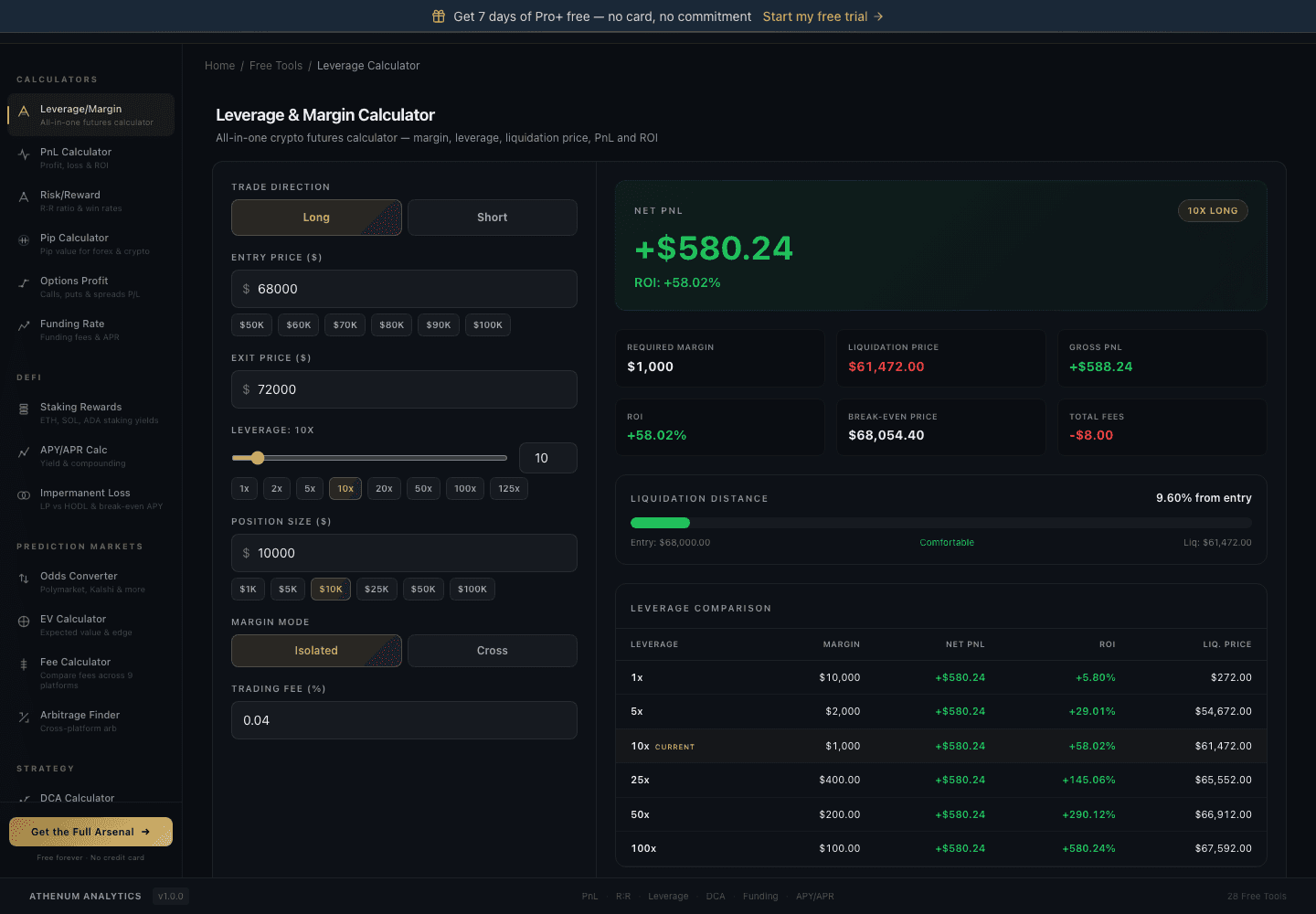
The same trade in Athenum's leverage calculator: $60,000 of notional at 10x needs $6,000 of margin and liquidates at $54,240, which is 9.60% below the entry. The worked example above assumed a 0.5% maintenance margin and arrived at $54,300; the calculator applies 0.4%, and that is the whole of the $60 difference. Maintenance rates differ by venue, so check the one you actually trade on.
A futures margin calculator does all of this in one pass: enter direction, entry, leverage, position size, and margin mode, and it returns required margin, liquidation price, liquidation distance, and a leverage comparison table so you can see the buffer at 5x, 10x, and 25x side by side. Athenum's calculator is one of 28 free tools on the platform, no sign-up required.
Where margin meets live market structure
Margin math is static; the market is not. Maintenance-margin tiers exist because liquidity thins out at size, and cascading liquidations move price faster than your buffer assumes. On Athenum you can watch live liquidation clusters, funding, and open interest across 14 exchanges to see where forced selling is likely to accelerate, then size your margin so your liquidation price sits outside the obvious cascade zones.
See the live data and run the numbers for yourself. Athenum is a live, read-only crypto-derivatives terminal with a free 7-day Pro+ trial, no card required: start here.
One terminal. All the data.
Liquidations, orderbook depth, whale walls & open interest from 4 exchanges, all real-time, in one place.
No credit card required

Athenum Analytics
Athenum Analytics is our three-person editorial team covering crypto derivatives, market data and macroeconomic context.