Table of Contents10 sections
- TLDR
- What does PnL mean in crypto futures?
- How do you calculate profit on a long position?
- How do you calculate loss on a short position?
- What is ROI on margin, and how is it different from PnL?
- How do fees and funding reduce realized PnL?
- Worked example: long BTC with fees and funding
- Worked example: short BTC with fees and funding
- Numbered methodology: calculate any futures trade in seven steps
- Why a calculator beats mental math
Practise with worked lessons
- Partial exits: allocate fees and funding without double counting
Allocate entry fees, funding and exit charges across a partially closed position. Two exits reconcile to 5.99 USDT net without double counting any cost.
TLDR
Crypto futures PnL is just price change times position size, with the sign flipped for shorts. Long PnL = (Exit Price − Entry Price) × Size; Short PnL = (Entry Price − Exit Price) × Size. Leverage never appears in that formula because it changes only your margin, not your dollar profit. To get ROI (often shown as ROE on exchanges), divide net PnL by the margin you posted, which is why a 5% price move can read as 50% ROI at 10x. Realized PnL is always lower than gross PnL once taker fees and accrued funding are subtracted. The Athenum leverage and PnL calculator runs both directions for you, and the worked BTC examples below show every line of the math.
What does PnL mean in crypto futures?
PnL stands for profit and loss: the change in value of an open or closed position. In crypto derivatives there are two flavors. Unrealized PnL is the paper gain or loss on a position you still hold, marked against the current mark price. Realized PnL is what you actually keep after you close, with trading fees and any funding payments already deducted. Beginners track unrealized PnL; survivors track realized PnL, because that is the only number that hits your wallet.
How do you calculate profit on a long position?
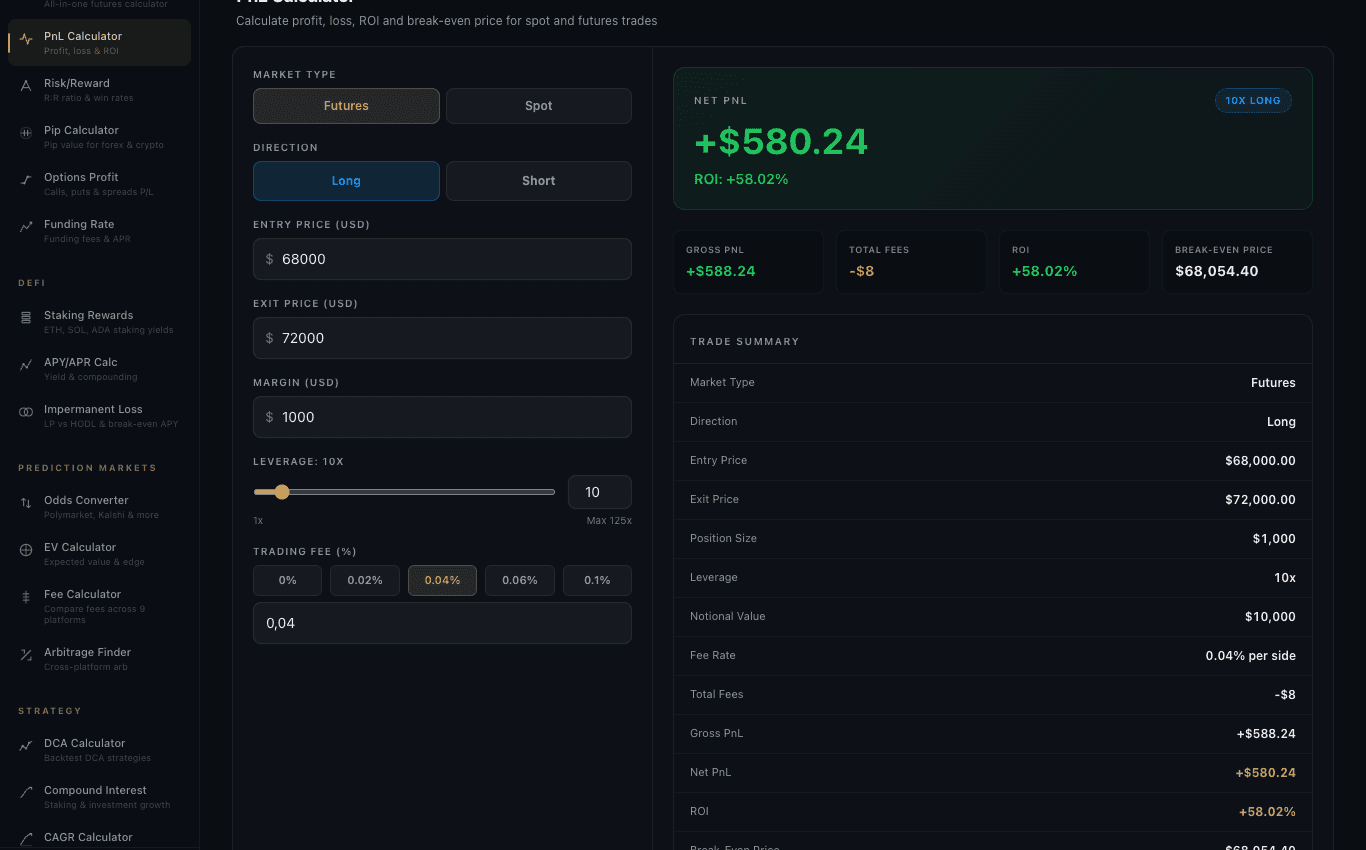
A long profits when price rises. The formula uses the price difference multiplied by the quantity of the asset you control: In the Athenum PnL calculator below, a long from 68,000 to 72,000 dollars at 10x on 1,000 dollars of margin shows a net PnL of +580.24 dollars and an ROI of +58.02% after the 0.04% fee.

Athenum PnL calculator: long 68,000 to 72,000 dollars at 10x, net PnL +580.24 dollars, ROI +58.02%.
Long PnL = (Exit Price − Entry Price) × Position Size (in coins)
If you buy 0.5 BTC at $60,000 and sell at $63,000, the gross PnL is (63,000 − 60,000) × 0.5 = $1,500. Notice that leverage is absent. A 0.5 BTC position generates $1,500 whether you opened it at 1x or 20x. What leverage changes is how much of your own capital was at risk to capture that $1,500.
How do you calculate loss on a short position?
A short profits when price falls, so you reverse the subtraction: In the same Athenum calculator below, flipping that trade to a short from 68,000 to 72,000 dollars at 10x turns it into a net PnL of -596.24 dollars and an ROI of -59.62%, because the short loses as price rises.

Athenum PnL calculator: short 68,000 to 72,000 dollars at 10x, net PnL -596.24 dollars, ROI -59.62%.
Short PnL = (Entry Price − Exit Price) × Position Size (in coins)
Short 0.5 BTC at $63,000 and cover at $60,000, and gross PnL is (63,000 − 60,000) × 0.5 = $1,500. If price instead rose to $66,000, the short would show (63,000 − 66,000) × 0.5 = −$1,500, a loss. The asymmetry that matters for shorts is that losses are theoretically unbounded, since price has no ceiling, while a long can only fall to zero.
What is ROI on margin, and how is it different from PnL?
PnL is a dollar figure. ROI (return on investment, displayed as ROE or return on equity on many exchanges) is a percentage measured against the margin you posted, not against the full notional:
ROI = Net PnL ÷ Initial Margin, where Initial Margin = Notional ÷ Leverage
This is the relationship that confuses new traders. A $30,000 position at 10x leverage requires $3,000 of margin (30,000 ÷ 10). A $1,500 gross profit on that position is a 5% move on notional but a 50% return on margin (1,500 ÷ 3,000). Exchanges report the 50% figure as ROE because initial margin ratio equals 1 ÷ leverage, so the percentage is mechanically scaled by your leverage multiplier. Higher leverage inflates the ROI headline in both directions: the same move that prints 50% at 10x prints 100% at 20x and can also liquidate you twice as fast.
How do fees and funding reduce realized PnL?
Two costs separate gross PnL from realized PnL on a perpetual contract: Funding is the third cost: across 14 exchanges, Athenum reads BTC perpetual funding at +4.81% APR against 2.74 billion dollars of open interest over the last 30 days, which steadily nets against your realized PnL.

Athenum BTC perpetual funding vs open interest, last 30 days: +4.81% APR, open interest 2.74 billion dollars.
- Trading fees are charged on notional at entry and again at exit. A common taker fee is 0.05% (0.0005) per side. On a $30,000 entry that is $15, and you pay again when you close. - Funding payments are exchanged periodically (typically every 8 hours, sometimes hourly) between longs and shorts based on the funding rate times notional. When funding is positive, longs pay shorts; when negative, shorts pay longs. Hold a position across several funding intervals and these payments compound into a real drag or credit.
The full realized formula becomes:
Realized PnL = Gross PnL − Total Trading Fees ± Net Funding
Worked example: long BTC with fees and funding
- Entry: buy 0.5 BTC at $60,000 (notional $30,000) - Leverage: 10x, so initial margin = 30,000 ÷ 10 = $3,000 - Exit: sell at $63,000 - Gross PnL = (63,000 − 60,000) × 0.5 = $1,500 - Taker fees: entry 0.0005 × 30,000 = $15; exit 0.0005 × 31,500 = $15.75; total $30.75 - Funding: one positive 0.01% interval paid as a long = 0.0001 × 30,000 = −$3 - Realized PnL = 1,500 − 30.75 − 3 = $1,466.25 - ROI on margin = 1,466.25 ÷ 3,000 = 48.9%
Gross ROE before costs would have read 50% (1,500 ÷ 3,000). Fees and a single funding payment shaved 1.1 percentage points off the headline. Over a multi-day hold with many funding intervals, that gap widens fast.
Worked example: short BTC with fees and funding
- Entry: short 0.5 BTC at $63,000 (notional $31,500) - Leverage: 10x, so initial margin = 31,500 ÷ 10 = $3,150 - Exit: cover at $60,000 - Gross PnL = (63,000 − 60,000) × 0.5 = $1,500 - Taker fees: entry 0.0005 × 31,500 = $15.75; exit 0.0005 × 30,000 = $15; total $30.75 - Funding: one positive 0.01% interval received as a short = 0.0001 × 31,500 = +$3.15 - Realized PnL = 1,500 − 30.75 + 3.15 = $1,472.40 - ROI on margin = 1,472.40 ÷ 3,150 = 46.7%
The short captured the same $3,000 price move but earned funding instead of paying it, while a slightly larger entry notional meant a larger margin base, so the ROI percentage lands a touch lower than the long. These second-order effects are exactly why a calculator beats mental math.
Numbered methodology: calculate any futures trade in seven steps
1. Convert your size to coins. If you sized in dollars, divide by entry price (a $30,000 long at $60,000 is 0.5 BTC). 2. Compute notional. Size in coins × entry price. 3. Find initial margin. Notional ÷ leverage. This is the denominator for ROI. 4. Compute gross PnL. Long: (exit − entry) × size. Short: (entry − exit) × size. 5. Subtract trading fees. Fee rate × entry notional, plus fee rate × exit notional. 6. Apply net funding. Sum funding payments across every interval you held; longs pay positive funding, shorts receive it. 7. Divide for ROI. Realized PnL ÷ initial margin, expressed as a percentage.
Why a calculator beats mental math
The formulas are simple, but the bookkeeping is not. Entry and exit notionals differ, fees apply twice, funding can flip sign mid-trade, and ROI scales with leverage in a way that is easy to misjudge under pressure. A purpose-built tool removes the arithmetic risk so you can stress-test position sizing before you click buy. Athenum offers 28 free crypto calculators covering PnL, leverage, margin, and liquidation price; run your own numbers with the PnL and leverage calculator or browse the full free tools library. If you want to see how funding actually behaves across venues before you model it, our explainer on how crypto perpetual funding rates are calculated breaks down the index, premium, and interest components.
Athenum is a live, read-only crypto derivatives terminal that aggregates funding, open interest, liquidations, CVD, options max pain, and ETF flows across 14 exchanges. You can explore it on a free 7-day Pro+ trial with no card at app.athenum.xyz/auth.
*Educational content only, not financial advice. Leverage amplifies losses as well as gains.*
One terminal. All the data.
Liquidations, orderbook depth, whale walls & open interest from 4 exchanges, all real-time, in one place.
No credit card required

Athenum Analytics
Athenum Analytics is our three-person editorial team covering crypto derivatives, market data and macroeconomic context.