Table of Contents7 sections
- What is the difference between ETF flows and funding rates?
- Why read ETF flows and funding rates together?
- What does it mean when ETF inflows line up with rising funding?
- What does it mean when ETF inflows come with flat or negative funding?
- What does it mean when ETF outflows persist but funding stays positive?
- How do I read both signals in one place?
- Quick answers
TLDR: Read spot ETF net flows and perpetual funding as a pair: when they agree, they confirm a move; when they split, they warn. ETF inflows with rising positive funding signal leveraged conviction chasing spot demand; outflows with stubbornly positive funding flag a crowded long. US spot Bitcoin ETFs shed roughly $1.256 billion across the five sessions of May 18-22, 2026, per Farside and Coinglass data.
Most traders watch spot Bitcoin and Ether ETF flows and perpetual funding rates in separate tabs, on separate sites, and read each one alone. That is a mistake. The two series measure different crowds — one institutional and cash-settled, one leveraged and reflexive — and the relationship *between* them carries more information than either number by itself. This is the macro-meets-derivatives read that single-metric dashboards are structurally bad at, because they show you one slice and leave the cross-reference to you.
Below is how to pair the two signals, what each combination tends to mean, and where to check the live numbers yourself.
What is the difference between ETF flows and funding rates?
They answer different questions about the same market.
Spot ETF net flows measure new dollars entering (or leaving) regulated spot Bitcoin and Ether products such as IBIT, FBTC, and ETHA. A creation means an authorized participant delivered cash and the issuer bought spot; a redemption is the reverse. Flows are reported daily, settle in real assets, and largely reflect allocators with multi-week or multi-quarter horizons. They are a *demand* signal for the underlying coin.
Perpetual funding rates are the periodic payments exchanged between long and short holders of perpetual futures to keep the contract tethered to spot. Positive funding means longs pay shorts — leverage is leaning bullish and paying to hold that lean. Negative funding means shorts pay longs. Funding is a *positioning and crowding* signal, and it can flip within hours.
Flows tell you who is buying the asset. Funding tells you how leverage is positioned around it. Read together, they tell you whether a move has a solid base under it or just a crowded bet on top of it.

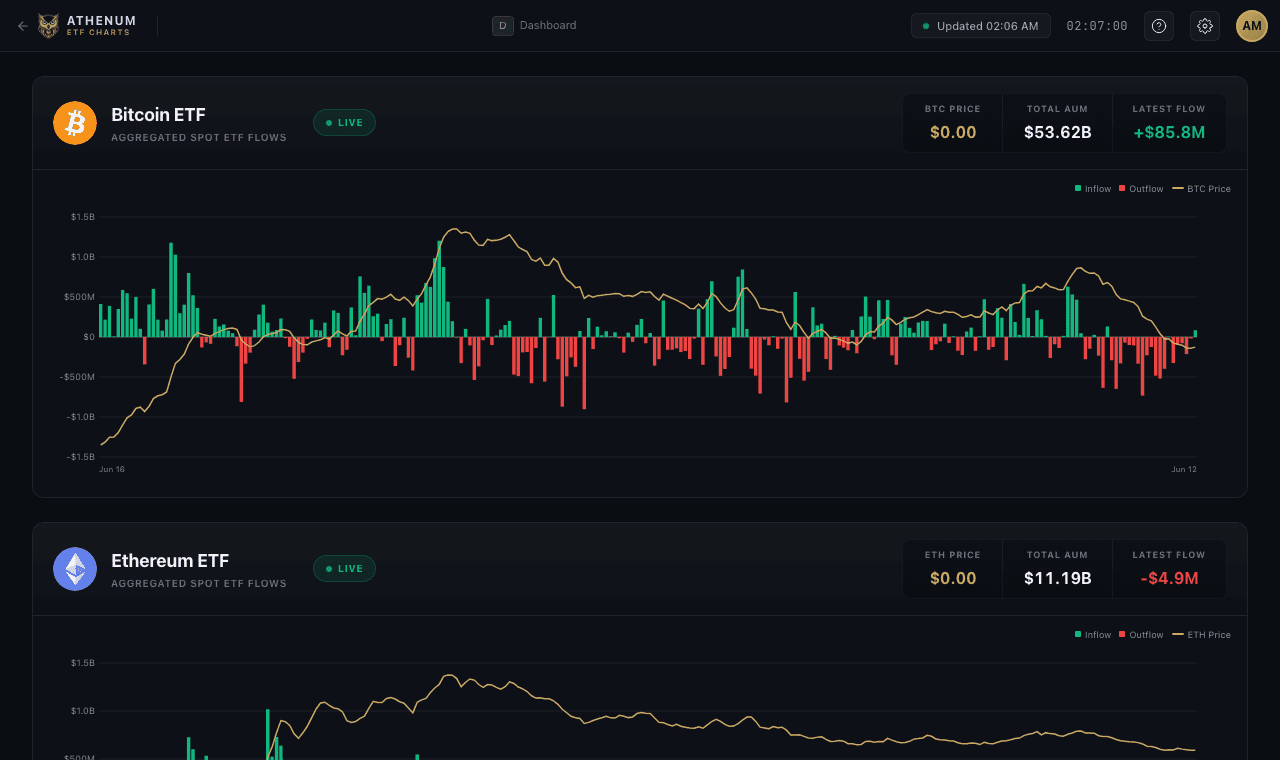
BTC spot ETF daily net flows and cumulative. Source: Athenum.
Why read ETF flows and funding rates together?
Because each one fills the other's blind spot.
ETF flows are slow, honest, and lagging — they confirm conviction but rarely warn you early. Funding is fast, reflexive, and prone to overshoot — it warns early but lies often, because a single squeeze can flip it. Pair them and you get a crude but useful map of *who* is driving price and *how fragile* that drive is.
There is also a structural link worth knowing. The growth of spot ETFs revived the crypto cash-and-carry basis trade: buy the spot ETF, sell CME futures, and harvest the spread, with the implied financing rate compensating the cash leg (see CME Group's OpenMarkets explainer). When that carry is attractive, ETF creations and futures positioning move together; when funding and basis compress, the carry thins and the relationship can decouple. So the two series are not just thematically related — capital actually arbitrages between them.
What does it mean when ETF inflows line up with rising funding?
It is the most straightforward read: leverage is chasing spot conviction.
Strong, sustained ETF net inflows alongside rising positive funding say the same thing twice — allocators are buying the asset and leveraged traders are paying up to be long alongside them. April 2026 was a clean example of the *demand* half: US spot Bitcoin ETFs took in about $2.44 billion in net inflows, the strongest month of 2026, with BlackRock's IBIT capturing roughly 70% (KuCoin). Pair that kind of inflow with funding running clearly positive and the two signals are *confirming*. A trend with both spot demand and willing leverage behind it tends to have a firmer base than one carried by leverage alone.
The caveat: agreement is not a green light, it is a description. Rising funding still means a growing pile of leveraged longs that will eventually have to be paid for or unwound. Confirmation tells you the move is well-supported now, not that it is risk-free.
What does it mean when ETF inflows come with flat or negative funding?
This is the quieter, often healthier setup: spot demand without a crowded leverage bid.
When allocators are adding through ETFs but funding sits flat or even dips negative, it usually means the buying is coming from the cash, unlevered side rather than from perpetual longs. Positioning is less crowded, the trade is less consensus, and there is less leverage stacked up to be flushed on the first dip. Ether showed a version of this in May 2026, when spot Ether ETFs cleared more than $1.5 billion in net inflows as allocators rotated in (Yellow.com) — institutional demand arriving without funding screaming overheated is a different texture of move than a funding-led melt-up.
For a trader, this combination is the one with the least obvious leverage fragility. It can still reverse on a macro shock, but it carries fewer over-positioned longs waiting to liquidate.
What does it mean when ETF outflows persist but funding stays positive?
This is the warning combination: a crowded long that has not yet capitulated.
When ETF net flows turn negative — allocators trimming or exiting — while perpetual funding stays stubbornly positive, the slow institutional money is stepping back while leveraged longs keep paying to hold. That divergence often marks a crowded position living on borrowed time, vulnerable to a sharp unwind if the spot bid keeps fading. The May 2026 reversal is the dated case to study: after April's record inflows, US spot Bitcoin ETFs reversed to roughly $1.256 billion in net outflows across the five sessions of May 18-22, 2026, with the single heaviest day on May 18 at about $648.64 million (Crypto Times), trimming 2026 cumulative net inflows toward the low hundreds of millions (KuCoin). When outflows like that run while funding refuses to cool, the derivatives crowd is still long into fading demand — a classic setup for the kind of crowded-long unwind that resolves quickly. The reverse pattern — ETF outflows with funding already deeply negative — is closer to washed-out than crowded, since the leverage has already flipped short.
None of this is a signal to buy or sell. It is a way to grade the quality and fragility of a move so your own thesis is reacting to the right risk.
How do I read both signals in one place?
This is the practical problem: ETF flow data and funding data usually live on different sites, so the cross-reference happens by hand, across tabs, with mismatched timestamps. Pulling them into one workspace is the entire point of reading them as a pair.
Athenum is one of the few terminals that puts spot ETF flow tracking and perpetual funding analytics in the same view — its Macro & Institutional domain covers ETF flow tracking, FRED indicators, the FOMC calendar, and SEC filings, while Derivatives Intelligence covers funding rate analytics, CVD, options flow & max pain, and CME basis, with funding aggregated across 14 exchanges. Seeing institutional demand and leverage positioning side by side, on one timestamp, is what makes the confirm/divergence read fast instead of fiddly. You can open the live ETF flow and Derivatives funding view on Athenum and check the current state of both yourself.
If you want to size what a given funding rate actually costs to hold a leveraged position over time — the carry side of the trade above — run the numbers in the free funding rate calculator before you lean on a position. Knowing the dollar cost of positive funding is what turns "funding is high" from a vibe into a number.

BTC perpetual funding (APR) vs open interest, last 30 days. Source: Athenum.
Quick answers
Do ETF flows cause funding rates to move? Not directly, but they are linked. Heavy spot ETF demand can pull leveraged longs in and push funding positive, and the cash-and-carry basis trade actively arbitrages between spot/ETF demand and futures positioning. Treat them as related signals, not as one causing the other on a fixed schedule.
Which signal leads? Funding usually moves first because it is leveraged and reflexive; ETF flows are slower and confirm later. That is exactly why a divergence — fast funding pointing one way, slow flows the other — is worth a second look.
Can both be wrong at once? Yes. A macro shock, a regulatory headline, or a large liquidation cascade can override both. These signals describe positioning and demand; they do not predict exogenous events.
Are funding rates the same across exchanges? No. Funding is set per exchange and can differ meaningfully venue to venue, which is why an aggregated cross-exchange view (here, across 14 exchanges) is more reliable than reading a single venue.
Is a positive funding rate bullish? On its own it is just a description of crowding, not a forecast. Its meaning depends on context — including whether spot ETF flows are confirming or diverging from it.
---
*Athenum is a unified crypto and derivatives analytics terminal. This article is educational market structure analysis, not investment advice, and contains no buy or sell recommendations. Verify all live figures yourself before acting on them.*
One terminal. All the data.
Liquidations, orderbook depth, whale walls & open interest from 4 exchanges, all real-time, in one place.
No credit card required

Athenum Analytics
Athenum Analytics is our three-person editorial team covering crypto derivatives, market data and macroeconomic context.