Table of Contents8 sections
- What is a perpetual future?
- Why do perpetual futures have a funding rate?
- How is a perpetual different from a dated future?
- What does it cost to hold a perpetual?
- How do perpetuals get you liquidated?
- How do you read perpetual futures across the market?
- Frequently asked questions
- Do perpetual futures ever expire?
- Is funding a fee paid to the exchange?
- How often is funding charged?
- Are perpetual futures bigger than spot in crypto?
- What moves the funding rate?
- The bottom line
Practise with worked lessons
- Calculate funding payments over your actual holding window
Build a settlement-by-settlement funding ledger from position notional and signed rates. Keep funding separate from margin, trading fees and price P&L.
TLDR: What are perpetual futures? They are derivatives contracts that track an asset like Bitcoin but never expire, so a trader can hold leveraged long or short exposure without ever rolling into a new contract. Because there is no settlement date to pull the price back toward spot, a perpetual is held in line by a recurring payment called funding: when the perp trades above the spot index longs pay shorts, and when it trades below shorts pay longs. On most venues that payment settles every eight hours, at 00:00, 08:00 and 16:00 UTC, and it is the running cost of keeping the position open. Perpetuals are now the dominant crypto derivatives product, more than three quarters of derivatives volume, which is why funding, open interest and liquidation reads across venues sit at the core of any derivatives dashboard. This guide explains what a perp is, why funding exists, what it costs to hold, and how to read it across the whole market.
Most traders learn perpetuals backwards. They watch a funding number without knowing what problem funding solves, or they add leverage without seeing where their liquidation sits. The clean way in is to take the contract first, then the tether that replaces its missing expiry, then the cost that tether charges, and finally the three reads that tell you how crowded the trade already is.
What is a perpetual future?
A perpetual future is a futures contract with no expiry date. A traditional future settles on a fixed date and cash-settles or delivers to spot then, and that scheduled convergence is what keeps its price tied to the underlying. A perpetual removes the date entirely, so the same position can stay open indefinitely, with no roll into the next contract and no expiry gap to manage. That single design choice, introduced on BitMEX in 2016 with the XBTUSD contract, is why perps now dominate crypto derivatives volume, and in 2026 the first fully regulated US crypto perpetual futures were cleared for American traders, extending the product from offshore venues into regulated markets.
Removing the expiry solves one problem and creates another. There is no longer an expiry to roll, but there is also no settlement date to force the contract back to spot. Nothing mechanical stops a never-expiring contract from drifting away from the index it is supposed to track. The funding rate is the mechanism that replaces expiry, and understanding it is the whole game. For the exact arithmetic, see how crypto perpetual funding rates are calculated; the point here is why it has to exist at all.
Why do perpetual futures have a funding rate?
Because a contract with no expiry needs a force to keep it anchored to spot, and funding is that force. Funding is a small payment exchanged directly between longs and shorts, not a fee the exchange keeps. When the perpetual trades at a premium to the spot index the funding rate is positive and longs pay shorts; when it trades at a discount the rate is negative and shorts pay longs. On most major venues it settles three times a day, at 00:00, 08:00 and 16:00 UTC, so the tether is re-applied every eight hours instead of once at a distant expiry. A few venues run hourly funding instead, but the eight hour cycle is the industry default.
The payment does two jobs at once. It compensates whichever side is on the right side of the premium, and it pays traders to push the perp back toward spot. If the perp runs hot above the index, positive funding rewards a trader who is short the perp and long the underlying, an arbitrage that presses the perp price back down. Repeated every funding window, that incentive loop is what keeps a contract with no expiry pinned to the index it tracks. Funding is rarely identical across venues, which is why reading it exchange by exchange, not as a single blended number, is part of the job.

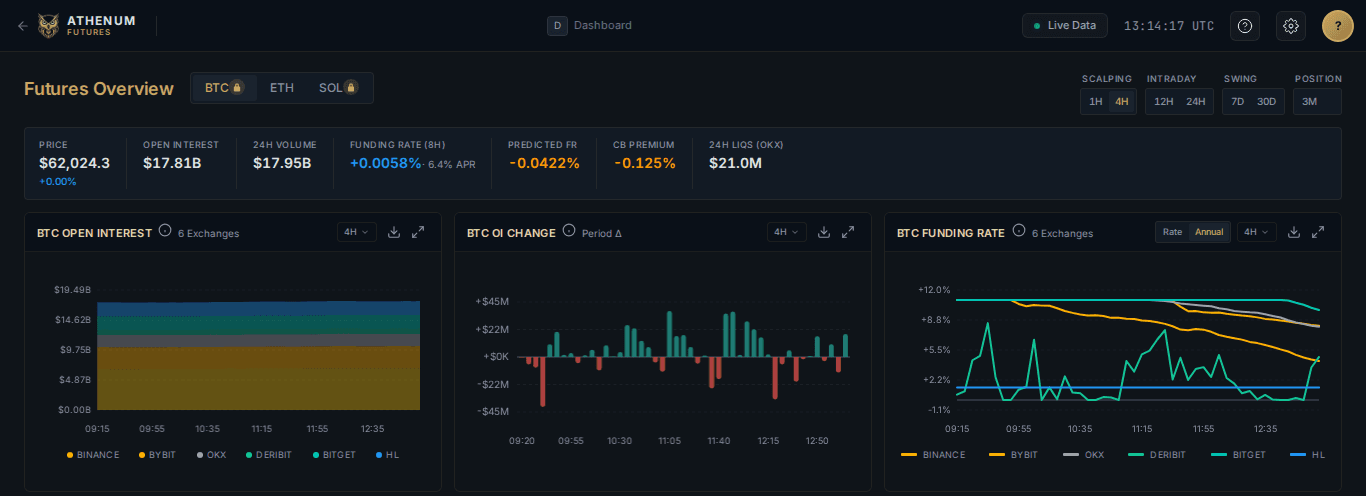
Aggregate BTC perpetual funding read +0.0058% per 8h window, about 6.4% annualized, across 6 exchanges on 2026-07-03.
How is a perpetual different from a dated future?
The expiry, and everything that follows from it. A dated future keeps its price near spot through a basis that shrinks to zero on a set date, so its carry is fixed the moment you enter and amortizes to that date. A perpetual has no such date, so it leans on funding instead, an open-ended payment that re-prices every window. Same exposure on the same asset, two opposite ways to pay for it.
Feature | Perpetual future | Dated (quarterly) future |
|---|---|---|
Expiry | None, held indefinitely | Fixed settlement date |
Tether to spot | Periodic funding payment | Basis converging to zero at expiry |
Carry cost | Variable, re-priced every 8h window | Fixed at entry, amortized to expiry |
Roll needed | No | Yes, into the next contract |
Typical use | Ongoing leveraged exposure | Locking a known carry to a date |
The practical read: a perpetual's carry is open-ended and can spike with sentiment, while a dated future's carry is set when you enter and decays predictably toward zero. For the dated side and how the curve prices time, see basis and contango in crypto futures.
What does it cost to hold a perpetual?
The running funding, and it compounds faster than most traders expect. A funding rate is quoted per window, so a small per-eight-hour number annualizes into a real drag: three windows a day across a year is an annualization factor of 3 x 365, or 1,095, which turns a routine 0.01% per window into roughly 10.95% a year. Positive funding means a long position bleeds that rate continuously for as long as it stays open, on top of any price move, and it is charged only if you hold the position across the settlement timestamp.
Aggregated across the market on 2026-07-03, the live picture was modest and slightly long:
Metric | Reading (BTC, aggregate) | As of |
|---|---|---|
Perpetual funding rate (8h) | +0.0058% per window, about +6.4% annualized | 2026-07-03 13:14 UTC |
Open interest | $17.81B | 2026-07-03 13:14 UTC |
Predicted next funding | -0.0422% | 2026-07-03 13:14 UTC |
24h realized liquidations (long / short) | $112.2M / $102.2M | 2026-07-03 13:14 UTC |
At +0.0058% per eight hours, a long paid roughly 6.4% annualized to stay open, cheap by historical standards, while the predicted next rate of -0.0422% pointed to that premium cooling into the following window. Before sizing a leveraged perp, model the carry: the funding rate calculator turns a per-window rate into an annualized cost for your position size, and the leverage calculator shows the liquidation price and margin for that size before you commit.

Live BTC perp reads on 2026-07-03: funding +0.0058% per 8h window (about 6.4% annualized), open interest $17.81B, predicted next funding -0.0422%.
How do perpetuals get you liquidated?
Through leverage measured against the mark price, not the last traded price. A perpetual position is liquidated when its margin can no longer cover losses, and exchanges measure those losses against a mark price derived from the spot index, specifically so a brief wick on one venue cannot trigger your liquidation unfairly. The higher the leverage, the smaller the adverse move that reaches the liquidation level: a position at 25x is wiped by roughly a 4% move against it, before fees. On 2026-07-03 the market realized $112.2M of long liquidations against $102.2M of shorts, a roughly balanced day, with estimated liquidation clusters stacked by leverage band around a $62,024 mark. For how that reference price is built, see mark price vs index price vs last price, and for what happens when many leveraged perps liquidate at once, see how liquidation cascades happen. Size with the downside first: the P&L calculator and the leverage calculator model both before you enter.

Realized BTC liquidations on 2026-07-03: $112.2M of longs versus $102.2M of shorts, with estimated liquidation clusters by leverage band around a $62,024 mark price. Delayed feed.
How do you read perpetual futures across the market?
You watch three things together: the funding rate, open interest, and how crowded positioning is. Athenum aggregates crypto derivatives data across 14 exchanges, covering funding, open interest, liquidations, volume delta, options and ETF flows on a live self-serve terminal, so you can read the whole perpetual market in one place instead of one venue at a time.
1. Read funding for the cost and the lean: sustained positive funding means crowded, paying longs, while negative funding means paying shorts. 2. Read open interest for conviction: rising open interest into a rising price means new leveraged money is entering, a more fragile setup than a rally built on shorts closing. Aggregate BTC open interest sat at $17.81B on 2026-07-03. 3. Read positioning for the flush risk: a crowded, levered long into calm conditions is the exact setup a single catalyst turns into a cascade. See how to read the long/short ratio.

Aggregate BTC futures open interest of $17.81B across 6 exchanges on 2026-07-03.
Put those three reads on one screen and a perpetual stops being a mystery number and becomes a position you can size. Start a 7 day Pro+ trial with no card and put funding, open interest and liquidations across 14 exchanges in front of you, or open Athenum to see the live terminal first.
Frequently asked questions
Do perpetual futures ever expire?
No. That is the defining feature: a perpetual future has no settlement date, so the position stays open until you close it. The funding payment replaces expiry as the mechanism that keeps its price tied to spot.
Is funding a fee paid to the exchange?
No. Funding is exchanged directly between long and short traders, not collected by the venue. When funding is positive longs pay shorts, and when it is negative shorts pay longs; the exchange only facilitates the transfer at each eight hour settlement.
How often is funding charged?
On most major venues every eight hours, at 00:00, 08:00 and 16:00 UTC, and only if you hold the position at the settlement timestamp. A few venues use hourly funding, so always check the schedule for the specific contract you trade.
Are perpetual futures bigger than spot in crypto?
By trading volume, yes. Perpetual futures are the dominant crypto derivatives product, running well over three quarters of derivatives volume, and derivatives as a whole trade far more than spot on most days.
What moves the funding rate?
The gap between the perpetual price and the spot index, driven by leveraged demand. Crowded longs push the perp to a premium and funding turns positive; crowded shorts push it to a discount and funding turns negative.
The bottom line
A perpetual future is a futures contract with the expiry removed, which is what lets a trader hold leveraged crypto exposure indefinitely. The funding rate is the price of that convenience: it replaces expiry as the force that keeps the perp pinned to spot, it settles every eight hours, and positive funding is a continuous drag on longs that annualizes into real money. Read funding, open interest and positioning together, size against the mark price with the downside modeled first, and a perpetual becomes a tool rather than a trap.
One terminal. All the data.
Liquidations, orderbook depth, whale walls & open interest from 4 exchanges, all real-time, in one place.
No credit card required

Athenum Analytics
Athenum Analytics is our three-person editorial team covering crypto derivatives, market data and macroeconomic context.