Practise with worked lessons
- Build the full ledger for a spot–perpetual basis trade
Calculate both legs, basis change, funding and fees of a spot–perpetual basis trade. Stress a widening basis and margin needs before calling the hedge low risk.
Every futures price is a bet about the future expressed as a gap to the present. That gap is the basis, and it is one of the most direct reads you have on how the market is positioned and how badly traders want leverage. When a future trades above spot, leverage is in demand and the curve is in contango. When it trades below, something is pressuring the market lower and the curve is in backwardation. Read correctly, basis tells you who is paying to hold a position and how stretched that lean has become. This guide covers what basis is, how to annualize it, the cash-and-carry trade that keeps it anchored, what steep, flat, and negative basis signal, and why dated-futures basis on CME is a different instrument from perpetual funding.
What Basis Actually Is
Basis is the difference between a futures price and the spot price of the same asset at the same moment. The simplest form is the absolute basis: futures price minus spot price. If BTC spot is at one level and the quarterly future is trading higher, the basis is positive. If the future is trading lower, the basis is negative.
Raw dollars are hard to compare across assets and dates, so traders normally quote basis as a percentage of spot. A future trading 2 percent above spot has a 2 percent basis. That percentage is the honest unit because it strips out the price level and lets you compare a BTC contract against an ETH contract, or this quarter's expiry against next quarter's, on the same scale.
The key mechanical fact is that basis is bounded by time. A dated future has an expiry, and at expiry the future must converge to spot, because on that date the contract simply becomes a claim on the asset at the prevailing price. The entire basis, whatever it was, decays to zero as the contract approaches settlement. That convergence is what makes basis tradeable and what makes the annualized figure meaningful.
Contango Versus Backwardation
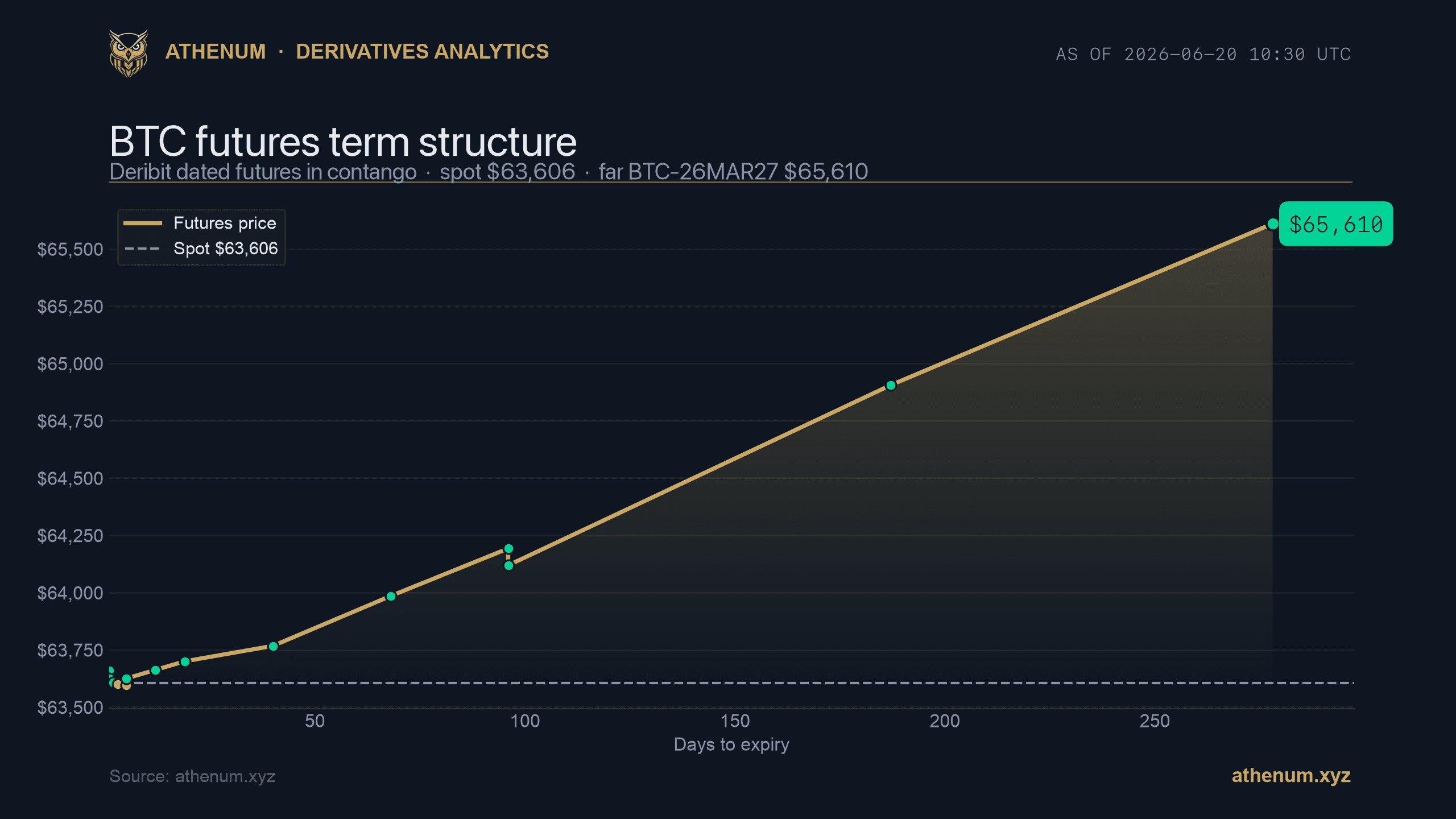
These two words describe the shape of the curve. Contango is the normal state for crypto in a calm or bullish tape: futures trade above spot, and longer-dated contracts trade above nearer-dated ones. The curve slopes upward. It reflects a cost of carry and, in crypto specifically, persistent demand to be long with leverage. Traders will pay a premium today to lock in upside exposure, and that willingness shows up as a positive basis.
Backwardation is the inversion: futures trade below spot, and the curve slopes downward. In traditional commodities this often reflects scarcity of the physical good. In crypto it usually signals stress, deleveraging, or aggressive hedging, where the market is paying to be short or to offload exposure rather than to hold it. Backwardation is less common in crypto and tends to mark moments of fear rather than greed.

BTC futures term structure on Deribit: a contango curve from spot near $63,600 up to about $65,600 at the far expiry. Source: Athenum, 2026-06-20.
How Annualized Basis Is Computed
A 2 percent basis means very little until you know how long you have to wait to collect it. A 2 percent premium on a contract expiring in one week is an enormous rate of return. The same 2 percent on a contract expiring in six months is modest. Annualizing puts every contract on a comparable footing.
The standard calculation is straightforward. Take the percentage basis, then scale it by the number of times that holding period fits into a year:
annualized basis = ((futures price - spot price) / spot price) * (365 / days to expiry)
So a quarterly future roughly 91 days out trading 2 percent above spot annualizes to about 8 percent. The same 2 percent on a contract 30 days from expiry annualizes to roughly 24 percent. This is the number desks actually watch, because it expresses basis as a yield you can compare against funding, against staking, and against the risk-free rate. When you hear someone say the basis is rich, they almost always mean the annualized figure looks high relative to what the carry should pay.
The Cash-and-Carry Trade
Annualized basis is not abstract. It is a harvestable yield, and the trade that harvests it is cash-and-carry. When a dated future trades at a positive basis to spot, you buy the spot asset and simultaneously sell the future against it. You are long spot and short the same size in futures, so you carry no net directional exposure to the asset's price.
What you do carry is the basis. As the contract approaches expiry, the future converges to spot, and that convergence is your profit, locked in at the moment you put the trade on. If the annualized basis was 8 percent when you opened, you have effectively captured an 8 percent annualized yield on a delta-neutral position, regardless of whether the asset rallies or dumps in the meantime.
This trade is the gravity that keeps basis from running away. When annualized basis gets rich, carry desks pile into the trade: buying spot, selling futures, and pressing the basis back down toward a level that reflects real funding costs. When basis goes negative, the reverse trade applies pressure the other way. Basis is therefore not a free signal floating in space. It is the visible residue of an ongoing arbitrage, and its level tells you how much demand for leverage is overwhelming, or being overwhelmed by, that arbitrage capital.
What Steep, Flat, and Negative Basis Signal
A steep, strongly positive basis means traders are paying up to be long. Demand for leveraged upside exposure exceeds the supply of arbitrage capital willing to take the other side. That is a crowded-long condition. It can persist in a healthy trend, but a very rich basis is also fuel: crowded longs unwind violently, and a basis that spikes ahead of price is often a warning that positioning has gotten ahead of conviction.
A flat basis near the cost of carry describes a balanced market. Leverage demand and arbitrage supply are roughly matched, and there is no strong lean to exploit or fear. This is the unremarkable middle, and most calm tapes sit here.
A negative basis, backwardation, is the one that demands attention. It means the market is paying to be short or to hedge, which is unusual in crypto and typically appears during sharp selloffs, forced deleveraging, or risk-off events. Negative basis is a stress reading. It does not tell you to buy or sell, but it tells you the usual carry incentive has flipped and that something is pressing the market hard enough to invert the normal curve.
Perpetual Funding Versus Dated-Futures Basis
Here is the distinction that trips up most traders. Perpetual swaps have no expiry, so they cannot converge to spot through settlement. Instead they use funding, a periodic payment between longs and shorts that mechanically tethers the perpetual to spot. On most major venues the funding interval is published in the exchange's contract specifications. Binance, for example, settles perpetual funding every eight hours. When the perp trades above spot, longs pay shorts, which discourages the long lean and helps pull the premium back down. When it trades below spot, shorts pay longs.
Dated futures, including the cash-settled contracts on CME, work differently. They have a fixed expiry, no funding payments, and their premium to spot is pure basis that decays to zero at settlement. CME also runs as a regulated, cash-settled venue. It historically traded on a scheduled session that paused on weekends, which is why older CME charts show weekend gaps, but CME moved its crypto futures to near 24/7 trading in 2026, so new weekend gaps no longer form. Those legacy gaps and the term-structure basis are a separate read from the around-the-clock funding signal on offshore perps.
Both are reading the same underlying thing, the cost of holding leveraged exposure, but they express it through different mechanisms. Funding is a high-frequency, continuously paid tether. Dated basis is a slower, expiry-anchored premium. Watching both gives you a fuller picture: funding for the immediate, moment-to-moment lean of the perp crowd, and dated basis, especially the CME curve, for how institutional positioning is pricing the asset out to expiry.

BTC perpetual funding (APR) versus open interest over the last 30 days. Source: Athenum, 2026-06-20.
Why You Read Basis Across Venues, Not One Book
Basis on a single exchange is one venue's spot, one venue's future, and one venue's local imbalance. A thin book, a regional premium, or a single large hedger can distort it. The signal you actually want is the market-wide basis, because the cash-and-carry arbitrage operates across venues and the term structure that matters is the aggregate one. Reading basis aggregated across exchanges, and lining the perp funding picture up against the dated CME curve, is how you separate a real positioning shift from one book's noise.
Athenum aggregates derivatives data across 14 exchanges, with funding rate analytics and CME gaps and basis tracking in the Derivatives Intelligence view, plus free tools for the liquidation heatmap, funding, open interest, and whale walls. The free tier is delayed and limited, so for the full real-time read the 7-day Pro+ trial is the honest way to evaluate it: it covers all 14 exchanges with no card required. Start free at https://app.athenum.xyz/auth.
One terminal. All the data.
Liquidations, orderbook depth, whale walls & open interest from 4 exchanges, all real-time, in one place.
No credit card required

Athenum Analytics
Athenum Analytics is our three-person editorial team covering crypto derivatives, market data and macroeconomic context.