TL;DR: The Coinbase Premium Index measures the price gap between Bitcoin on Coinbase (a USD pair) and Bitcoin on Binance (a USDT pair). A positive reading suggests US and institutional spot buyers are paying up; a negative reading suggests offshore venues or selling pressure are setting the price. It is a spot-demand proxy, not a leverage gauge, and it is noisy enough that it should never be read in isolation.
What is the Coinbase Premium Index?
The Coinbase Premium Index is the percentage price difference between BTC traded on Coinbase (the USD pair on what is now Coinbase Advanced Trade, formerly Coinbase Pro) and BTC traded on Binance (the USDT pair). It is usually quoted as a percentage or a normalized index value, and the related raw dollar figure is often called the Coinbase Premium Gap.
The metric was popularized by CryptoQuant and is still tracked there in 2026, alongside Coinglass and TradingView community indicators. CryptoQuant publishes it for both BTC and ETH, plus a smoothed momentum variant.
The logic behind it is venue composition. Coinbase is a US-regulated exchange and a common access point for US retail and institutional flow, including the desks and custodians that sit behind spot Bitcoin ETFs. Binance, by contrast, carries a heavily offshore, USDT-denominated user base. When the same asset prints a higher price on Coinbase than on Binance, the cleanest interpretation is that US-side demand is more aggressive than the global average at that moment.

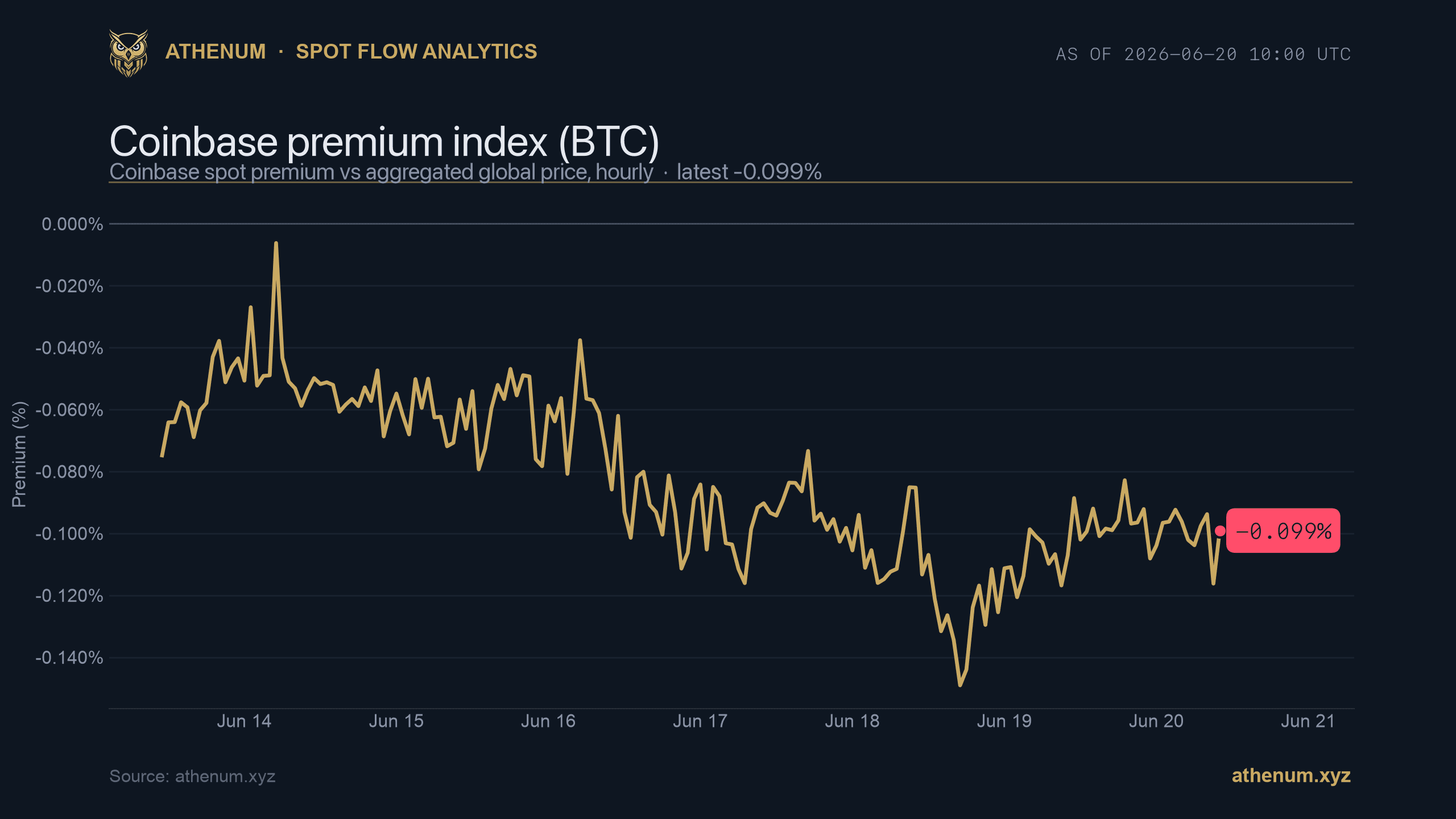
Coinbase premium index for BTC (US spot premium vs global price), hourly. Source: Athenum.
How is it computed, and what does positive vs negative mean?
The calculation is straightforward: take the Coinbase USD price, subtract the Binance USDT price, and express the difference relative to price. Most providers smooth it over a rolling window so a single bad print does not dominate the reading.
A positive premium means Bitcoin is more expensive on Coinbase than on Binance. That points to stronger spot buying pressure (or weaker selling pressure) on the US-facing venue. A negative premium, often called a discount, means Coinbase is trading below Binance, which points to US-side selling or offshore-led buying setting the marginal price.
The 2026 tape illustrated both sides clearly. The Coinbase Premium Gap spent stretches of late 2025 and early 2026 deeply negative, with one early-February 2026 reading near minus 167.8, reported as its lowest level since December 2024, coinciding with US spot ETFs flipping from net buyers in 2025 to net sellers in 2026. By mid-April 2026 the index had turned positive again after roughly fifteen days in discount, which analysts read as a tentative recovery in US demand. None of those readings predicted price by itself, but each one described who was leaning on the order book. Treat specific levels as period snapshots rather than current values; what carries forward is the mechanism, not the number.
How is the premium different from funding rates?
This is the distinction that matters most, because the two are easy to conflate.
The Coinbase Premium Index is a spot-market signal. It compares cash prices on two spot venues and tells you about real, unleveraged buying and selling, the kind of flow that moves coins between custody. ETF creations, corporate treasury purchases, and US institutional accumulation tend to show up here first.
Funding rates are a derivatives signal. They measure the cost of holding a perpetual futures position and tell you about leverage and positioning, not delivered demand. A market can show heavily positive funding (crowded longs on perps) while the Coinbase premium is flat or negative, which is a classic warning that the rally is leverage-driven rather than spot-driven. The reverse setup, a firm spot premium with calm funding, is generally the healthier backdrop. Reading them together separates conviction buying from speculative froth.
Where does the Coinbase Premium Index mislead?
It has real failure modes, and treating it as a standalone signal is the most common mistake.
First, it is noisy. Short-horizon spikes can come from a single large market order, thin liquidity on one side, or latency between venues rather than any durable shift in demand. Smoothing helps but does not remove it.
Second, the USDT leg introduces a confound. Because the Binance side is priced in USDT, any deviation in the USDT-to-USD peg, or stress in stablecoin markets, can move the spread without telling you anything about Bitcoin demand. During stablecoin dislocations the premium can be actively misleading.
Third, the institutional read is an inference, not a measurement. The index does not observe who is trading; it observes a price gap between two venues and attributes it to US versus offshore flow. That attribution usually holds, but it is a heuristic, and venue rebrands, fee changes, or shifts in where ETF desks route can all weaken it over time.
The practical takeaway is to use it as one input in a confluence stack: pair the premium with funding, open interest, ETF flow data, and liquidity depth before drawing a conclusion.
How to use it inside a broader context
The premium is most useful when you can line it up against the rest of the order flow at a glance. That is the reason aggregation matters: a spot-demand proxy means more when you can immediately check it against perp funding, open interest, liquidations, and ETF flows on the same screen.
Athenum aggregates spot and derivatives context across 14 exchanges, bringing funding rates, open interest, liquidations, options skew and IV, order book depth, ETF flows, and macro context into one terminal, so a Coinbase premium reading sits next to the leverage and flow data you need to interpret it. The platform reports what the market is doing and leaves the decision to you. If you want to put the premium in context yourself, the free calculators and a 7-day Pro+ trial (no card) are open.
A spot premium that holds while funding stays calm and ETF flows turn positive is a very different signal than the same premium printing into crowded perp longs. The index does not tell you what happens next. It tells you who is currently willing to pay up, and that is worth knowing precisely because it is so often confused with leverage.
One terminal. All the data.
Liquidations, orderbook depth, whale walls & open interest from 4 exchanges, all real-time, in one place.
No credit card required

Athenum Analytics
Athenum Analytics is our three-person editorial team covering crypto derivatives, market data and macroeconomic context.