Practise with worked lessons
- Calculate cumulative volume delta from a trade tape
Reconstruct CVD from a trade tape: four trades, 0.7 BTC of net aggressive buying. Check side classification, units and reset times before reading a divergence.
Cumulative Volume Delta is one of the more honest order-flow metrics available to a derivatives trader, and one of the easiest to misread. Price tells you where the market cleared. CVD tries to tell you who did the clearing: aggressive buyers lifting offers, or aggressive sellers hitting bids. When the two line up, you have confirmation. When they diverge, you have a clue that the move you are watching is not backed by the flow you assume is behind it. This guide explains how trade delta is calculated from the aggressor side, how CVD accumulates that into a running line, how to read CVD-versus-price divergence for absorption and exhaustion, why spot CVD and perp CVD can disagree, and the real limits of the metric. It is venue dependent and tagging dependent, which is exactly why aggregating across exchanges matters.
What Trade Delta Actually Measures
Every executed trade on a central limit order book has a resting side and an aggressing side. A limit order sits on the book and waits. A market order, or a marketable limit order, crosses the spread and takes liquidity. The trade that crosses is the aggressor, and exchanges publish which side that was. On most public trade feeds this shows up as a flag indicating whether the buyer or the seller was the taker, the field many APIs expose as the maker or taker side of the trade.
Trade delta is the aggressor side turned into a number. Over any window, delta is aggressive buy volume minus aggressive sell volume. If 100 contracts traded with buyers lifting the offer and 60 traded with sellers hitting the bid, delta for that window is +40. A positive delta means takers leaned to the buy side. A negative delta means takers leaned to the sell side. The important word is aggressive. Delta does not count the passive limit orders that absorbed those market orders. It counts only the side that demanded immediacy.
This is not a proprietary calculation. It is built from the public trade tape that every major venue broadcasts, using the same aggressor tagging the exchange itself assigns. The mechanics are the same whether you compute them on Binance, OKX, Bybit, or Coinbase.
CVD Is the Running Sum
Cumulative Volume Delta is simply delta carried forward. You take the per-trade or per-bar delta and keep a running total. Start at zero, add each window's delta, and you get a line that rises when aggressive buying dominates over time and falls when aggressive selling dominates.
Read on its own, the CVD line is a record of net taker pressure. A steadily rising CVD says takers have been net buyers across the period. A falling CVD says takers have been net sellers. Because it accumulates, CVD smooths out the noise of any single print and shows the direction of sustained aggression. The slope matters more than the absolute value, since the zero point is arbitrary and depends on where you started the cumulation.
Reading CVD Against Price: Absorption and Exhaustion
CVD earns its keep when you overlay it on price and look for agreement or disagreement. The base case is confirmation: price makes a higher high and CVD makes a higher high alongside it. Aggressive buyers are pushing price up and the flow agrees with the move. That is a trend with taker conviction behind it, the cleanest version of the read.
Divergence is where the interesting information lives, and there are two patterns worth naming.
Absorption. Price stalls or barely moves while CVD pushes hard in one direction. Say CVD climbs steeply, meaning aggressive buyers are hitting the offer with size, but price refuses to break higher. That tells you a passive seller is sitting on the level and absorbing every market buy with resting limit orders. The aggression is real, but it is being eaten. Absorption often precedes a reversal, because once the aggressive side gives up and the passive wall holds, price tends to fall back toward where the absorbed flow entered.
Exhaustion. Price makes a new high but CVD makes a lower high, or goes flat. The move extended on thinning aggressive participation. Buyers are still nudging price up, but each push is backed by less taker volume than the last. That loss of momentum in the flow, while price still climbs, is a classic exhaustion signature and a warning that the trend is running on fumes rather than fresh aggression.
The mirror images hold on the downside. Price grinding lower while CVD turns up suggests sellers are being absorbed. A new price low on a higher CVD low suggests selling exhaustion. None of these are buy or sell triggers. They are descriptions of the battlefield: who is pressing, who is absorbing, and whether the flow still supports the price.
Spot CVD Versus Perp CVD
Spot and perpetual markets are different populations of participants, and their CVD lines do not have to agree. Spot flow skews toward cash buyers and sellers moving actual coin. Perp flow is dominated by leveraged positioning, hedging, and short-term speculation. When the two diverge, the divergence itself is information.

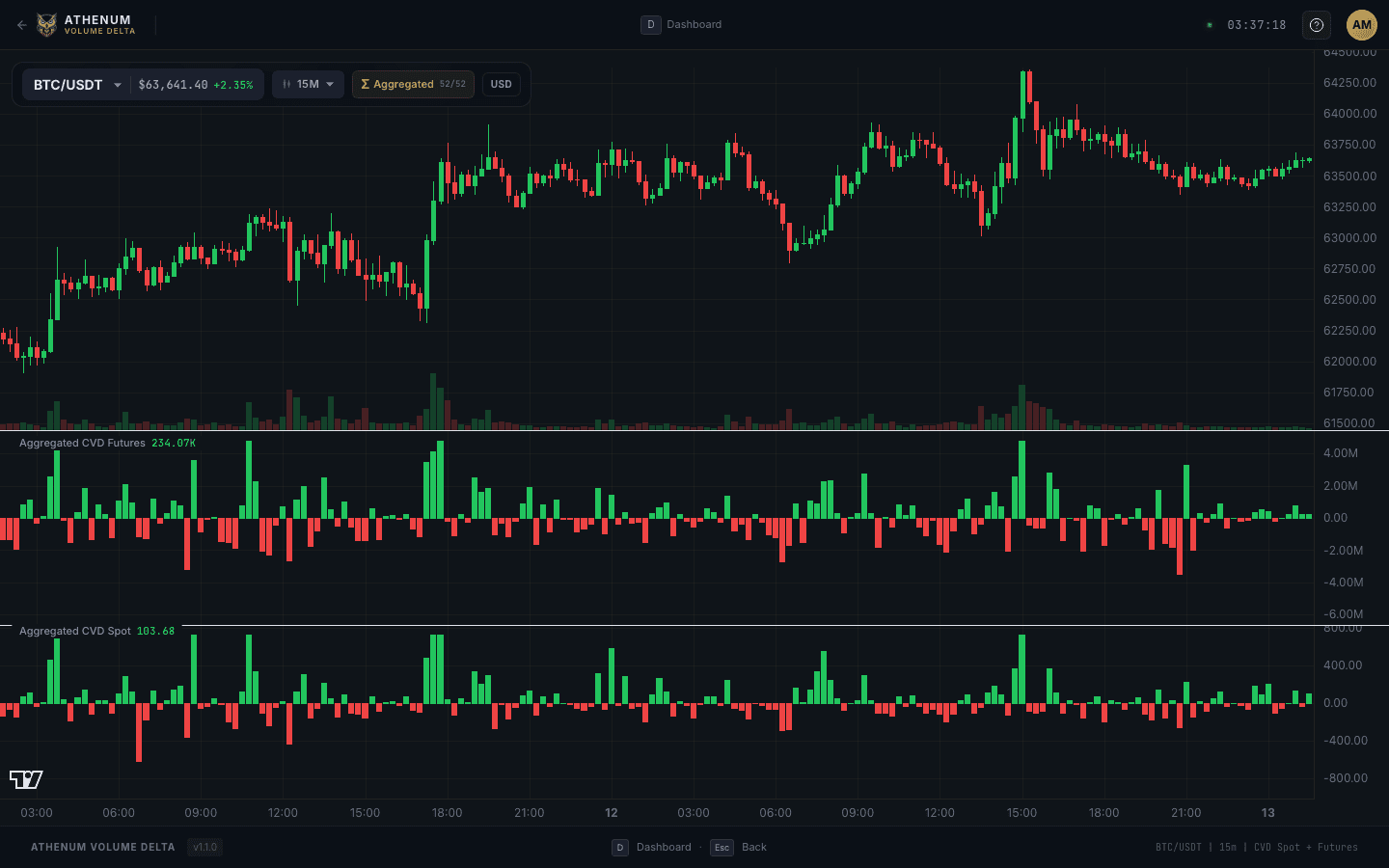
Spot and perpetual CVD on the same 15-minute BTC/USDT series, aggregated across the venues the panel itself reports as 52 of 52: futures CVD at -170.13K against spot CVD at -4.05 while price sat at $62,589.20. The two do not move together, which is the reason for separating them at all.
A common read: price rises while perp CVD climbs but spot CVD stays flat or falls. That describes a rally driven by leveraged longs in the perpetual market without matching demand from spot buyers. A move pushed by perp aggression with no spot bid underneath is more fragile than one where both markets are buying, because leveraged positioning unwinds faster than cash holdings when price turns. The opposite case, spot CVD rising while perp CVD lags, points to cash accumulation that leverage has not yet chased. Comparing the two CVD lines tells you which market is leading the move and how much of the push is borrowed conviction.
The Limits: Venue and Tagging Dependence
CVD is powerful, but it is not ground truth, and treating it as such is the most common mistake.
First, it is venue dependent. CVD measured on a single exchange describes taker flow on that exchange only. Crypto liquidity is fragmented across many venues, and aggressive buying on one book can coincide with aggressive selling on another. A single-venue CVD can rise while the market-wide picture is flat, which produces a confident read that is simply incomplete.
Second, it is tagging dependent. Delta is only as good as the aggressor flag the exchange provides. Venues do not all classify the taker side identically, and edge cases such as self-matches, auction prints, and certain order types can be labeled inconsistently. The metric inherits whatever assumptions the exchange baked into its trade feed. Two venues showing the same nominal delta may have tagged the underlying flow with different rules.
Third, CVD says nothing about the passive side. It measures who crossed the spread, not who provided the liquidity that got crossed. Absorption is visible only because price fails to follow the aggression, not because CVD reports the resting orders directly. Read CVD as one lens on flow, not as a complete account of the book.
Why Aggregating Across Venues Matters
Because CVD is venue and tagging dependent, the single most useful upgrade is to compute it across many exchanges rather than one. An aggregated CVD nets taker flow across the venues where the asset actually trades, so a divergence you see is a property of the market and not an artifact of the one book you happened to load. It also dilutes the tagging quirks of any single venue, since no one exchange's classification dominates the total. For divergence reading in particular, the market-wide line is the one that survives scrutiny, because absorption and exhaustion that show up across venues are far more credible than the same pattern on an isolated feed.
This is the same logic that applies to open interest and liquidations: cascades and flow do not respect venue boundaries, so neither should your measurement. Athenum's range analysis and CVD view is built on public market data aggregated across 14 exchanges, with the spot and perp distinction available so you can compare the two populations rather than guess at them.
See the Read Yourself
CVD only does its job when you can see it aggregated across the whole market, split between spot and perp, and lined up directly against price. Athenum aggregates public market data across 14 exchanges and offers free tools for the liquidation heatmap, funding, open interest, and whale walls. The free tier is delayed and limited, so for the full real-time order-flow read the 7-day Pro+ trial is the honest way to evaluate it: it covers all 14 exchanges with no credit card required. Sign up with email, an Ethereum wallet, or a Solana wallet, no API keys, at https://app.athenum.xyz/auth.
One terminal. All the data.
Liquidations, orderbook depth, whale walls & open interest from 4 exchanges, all real-time, in one place.
No credit card required

Athenum Analytics
Athenum Analytics is our three-person editorial team covering crypto derivatives, market data and macroeconomic context.