When a leveraged position is liquidated, someone has to make the counterparty whole. On a regulated equities desk that backstop is a clearing house. In crypto perpetual futures, the equivalent role is split between two mechanisms most traders never read about until one of them touches their account: the insurance fund and auto-deleveraging (ADL). Both exist to keep the exchange solvent when a liquidation goes badly. Understanding them changes how you size positions, where you place stops, and which contracts you trust with leverage.
What a liquidation actually costs
A position has two reference prices that matter here. The liquidation price is where the exchange's risk engine forcibly closes you, usually triggered by maintenance margin. The bankruptcy price is the worse level where your remaining margin is fully consumed and equity hits zero.
The exchange does not want to close you at the bankruptcy price. It tries to liquidate you a little before that, at the liquidation price, leaving a thin buffer. In calm, liquid markets the liquidation order fills inside that buffer and there is a small surplus. The position closes, the trader is wiped out, and the exchange has lost nothing.
The problem is slippage. In a fast move, a thin book, or a gap, the liquidation order can fill worse than the bankruptcy price. Now the closed position has produced a real shortfall: the losing trader had no equity left to cover it, but the winning trader on the other side is still owed their full profit. That gap has to be filled from somewhere. That somewhere is the insurance fund.
How the insurance fund works
The insurance fund is a pooled reserve each exchange maintains to absorb these shortfalls so that profitable traders get paid in full even when a liquidation closes underwater.
It grows in the ordinary case. When the liquidation order fills *better* than the bankruptcy price, the leftover margin (the surplus between the actual fill price and the bankruptcy price) is swept into the fund rather than returned to the liquidated trader. Across thousands of routine liquidations, those small surpluses accumulate. Major venues publish a live insurance fund balance, and the long-run trend on large-cap perpetuals like BTC and ETH is generally upward, precisely because most liquidations in deep books resolve with a surplus rather than a deficit.
So in steady state the fund is a buffer that quietly fills from the losers and pays the rare deficit. The mechanism only becomes visible to ordinary traders when that buffer is overwhelmed.
When the fund is not enough: auto-deleveraging
Suppose a violent move produces liquidation shortfalls faster than the insurance fund can cover them, or the fund for that specific contract is already depleted. The exchange cannot print money, and it will not let the fund go negative against profitable open positions. At that point it triggers auto-deleveraging (ADL).
ADL force-closes profitable traders on the *opposite* side of the bankrupt position, at the bankruptcy price of the liquidated trader, to net out the deficit. If a large long is liquidated underwater, the engine reaches into the pool of profitable shorts and closes some of them to absorb the loss. The winning trader did nothing wrong. Their thesis was correct, the position was in profit, and the exchange closed it anyway because there was no counterparty left to pay them and no fund left to bridge the gap.
This is the core idea worth internalizing: ADL is a counterparty-risk event that lands on the winners, not the losers. The losers were already liquidated. ADL is what happens to the people who were right.
How the ADL queue ranks you
Exchanges do not pick ADL victims at random. They rank every position on the profitable side by a priority score, and the highest-ranked positions get deleveraged first. The standard ranking combines two factors:
- Profit (or profit percentage): more profitable positions rank higher. - Effective leverage: more highly leveraged positions rank higher.
The common formulation, used by major venues including BitMEX and Binance, ranks by profit percentage multiplied by effective leverage when the position is in profit. A trader who is both deeply in profit *and* running high leverage sits at the front of the queue. A modestly profitable position at low leverage sits at the back and is rarely touched.
The practical takeaway: the more aggressive your winning position, the more exposed you are to having it closed for you. Reducing leverage on a profitable position lowers your ADL ranking, even if it does not change your directional exposure much.
The ADL indicator lights
Because ADL is otherwise invisible until it fires, exchanges show an ADL indicator, usually a row of light bars (commonly five). The lit segments estimate where your position currently sits in the deleveraging queue for that contract.
- One or two bars lit: you are low in the queue, low immediate risk. - Four or five bars lit: you are near the front. If a large opposing liquidation cannot be absorbed by the fund, your position is a candidate to be force-closed.
The indicator is a real-time risk gauge, not a guarantee. The queue reshuffles constantly as positions open, close, and move in and out of profit. But a fully lit ADL meter is a direct signal to consider trimming size or leverage, because the exchange is telling you that you are first in line.
Why thin contracts are far riskier
ADL is rare on BTC and ETH perpetuals and far more common on smaller, illiquid altcoin contracts. The reasons compound:

Aggregated BTC futures open interest stood at $18.0B at 07:00 UTC on 2026-08-03, moving between $17.0B and $18.2B over the eight days shown, a range of about 7%. Note the axis starts at $17.0B, not zero.
1. Thin order books mean worse liquidation fills. A liquidation on an illiquid contract slips further past the bankruptcy price, creating larger deficits per event. 2. Smaller insurance funds. The per-contract reserve on a low-volume altcoin perpetual is a fraction of the BTC fund, so it is exhausted by a single large cascade. 3. Concentrated positioning. Fewer, larger participants mean one blow-up can swamp the entire opposing side.
Stack those together and a single sharp move in a small contract can drain the fund and trigger ADL where the same percentage move in BTC would barely register. If you trade leverage on long-tail listings, treat ADL not as a tail risk but as a live operational risk.
How to read the warning signs
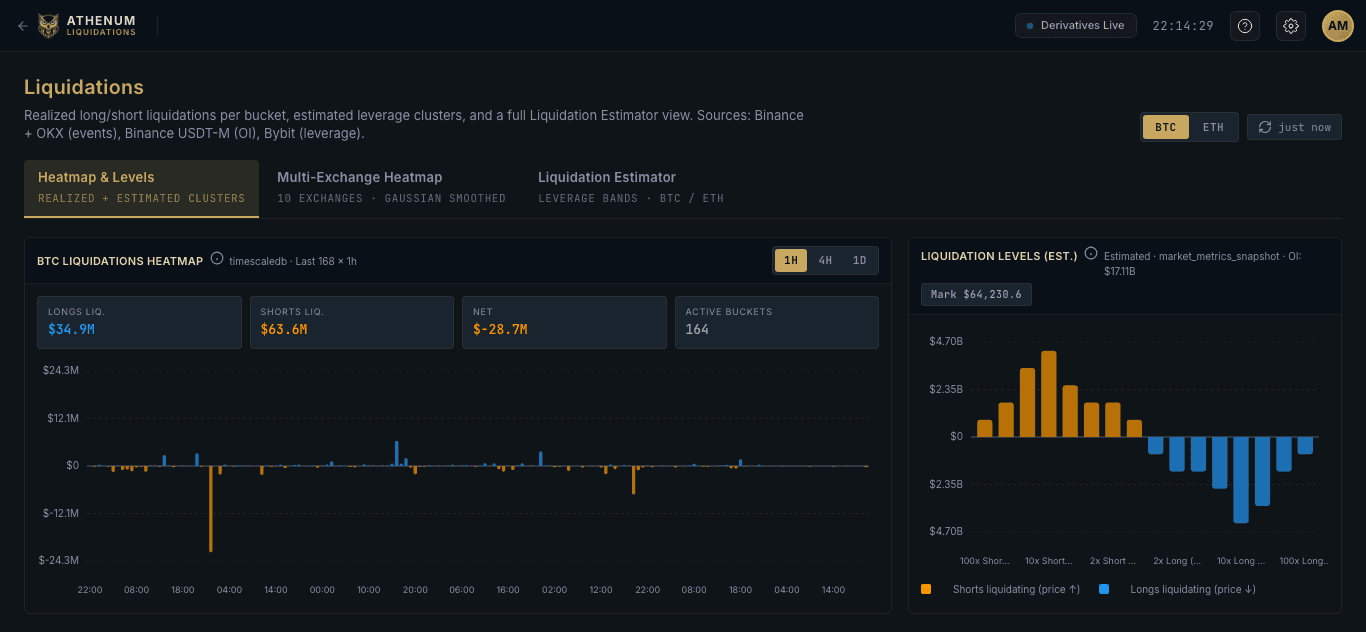
The conditions that precede an ADL event are observable before it happens: clustered liquidations on one side, open interest concentrated in a single direction, and a thinning order book on the contract you are trading. These are exactly the inputs a derivatives terminal is built to surface.
Athenum is a unified crypto and derivatives analytics terminal that aggregates public market data across 14 exchanges into one workspace. Its live order flow and depth tools track aggregated orderbook depth, whale walls, the real-time trade feed, and open interest heatmaps, while the derivatives intelligence suite covers funding rate analytics, range analysis and CVD, and CME gaps and basis tracking. Watching liquidation flow, OI imbalance, and book depth together gives you context on when an opposing-side cascade could be building, before your ADL meter starts lighting up.
You can sign up with email, an Ethereum wallet, or a Solana wallet, with no API keys and no exchange permissions. Start on the free tier or take the 7-day Pro+ free trial with full access and no credit card at https://app.athenum.xyz/auth and watch liquidation and order-flow data side by side.
The insurance fund and ADL only matter once a position passes its liquidation price. You can find that level for any entry and leverage with the Athenum leverage and margin calculator.
One terminal. All the data.
Liquidations, orderbook depth, whale walls & open interest from 4 exchanges, all real-time, in one place.
No credit card required

Athenum Analytics
Athenum Analytics is our three-person editorial team covering crypto derivatives, market data and macroeconomic context.