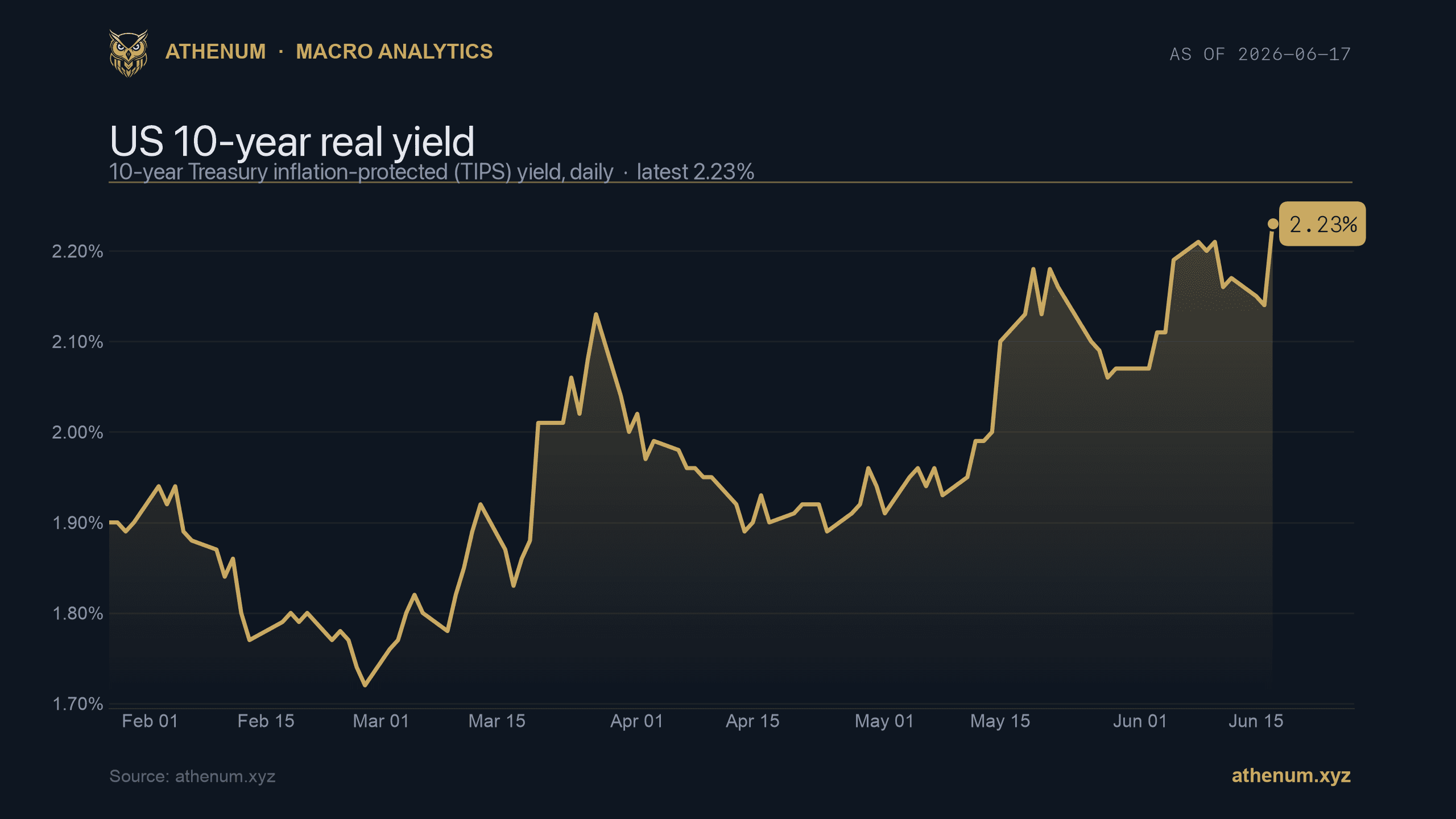
The real yield is the inflation-adjusted return on a safe asset, roughly the nominal Treasury yield minus expected inflation, and you can read it directly off the yield on 10-year TIPS (Treasury Inflation-Protected Securities). When real yields rise, safe money pays a higher real return and the bar for holding a non-yielding, long-duration asset like crypto goes up. When real yields fall, that bar drops. This is a tendency, not a law, and it is distinct from both the Fed funds rate and the dollar. The durable move is to track the real yield as one input and cross-check it against crypto's own positioning data.
What is a real yield, and what are TIPS?
A nominal yield is the headline interest rate on a Treasury bond. A real yield strips out expected inflation, so it represents what you actually earn in purchasing power after prices rise. The simple framing is real yield is approximately the nominal yield minus expected inflation.
You do not have to estimate this yourself. TIPS, or Treasury Inflation-Protected Securities, are U.S. government bonds whose principal adjusts with the Consumer Price Index. Because the inflation component is built into the instrument, the quoted yield on a TIPS is already a real yield. The 10-year TIPS yield is the most-watched version, since it captures a medium-term, inflation-adjusted cost of safe money. When commentators say "real yields are rising," they usually mean this number.
The gap between the nominal 10-year and the 10-year TIPS yield is the breakeven inflation rate, a market-based proxy for expected inflation over that horizon. That decomposition is the whole point: nominal yield equals real yield plus breakeven inflation.
Why do real yields matter for crypto?
The link runs through opportunity cost and discount rates.
The opportunity-cost channel is intuitive. Crypto pays no coupon and no dividend. Its case rests on price appreciation. When the real yield on a safe asset is near zero or negative, the cost of parking capital in a non-yielding asset is low, because the safe alternative barely preserves purchasing power. When real yields climb, that safe alternative now compounds in real terms, and the relative appeal of holding a zero-yield asset weakens.
The discount-rate channel is the same idea in valuation language. Long-duration assets, the ones whose value sits far in the future, are the most sensitive to changes in the rate used to discount future cash or future utility back to today. A higher real rate discounts distant payoffs more heavily, which compresses the present value of long-horizon bets. Crypto behaves like a long-duration risk asset, so it tends to feel rising real yields more than near-term cash-flow assets do.
Put together, falling real yields tend to loosen financial conditions and support risk appetite, while rising real yields tend to tighten them. The mechanism is about the cost of capital and the value of the future, not about any single headline.
How is this different from the Fed funds rate and the dollar?
These three get blended together in market chatter, but they measure different things.
The Fed funds rate is the policy rate, the overnight rate the central bank sets directly. It is a lever, an input. The real yield is a market-determined, inflation-adjusted price of medium-term money, and it reflects growth expectations, inflation expectations, and policy expectations all at once. Policy moves the real yield, but the real yield is the broader signal.
The dollar, often tracked via DXY, measures the relative strength of the dollar against a basket of other currencies. It is a currency comparison, not an inflation-adjusted return. A strong dollar and rising real yields often appear together, since both can reflect tighter conditions, yet they are conceptually separate. The dollar tells you about cross-currency value. The real yield tells you about the inflation-adjusted opportunity cost of holding safe assets at home.
The clean distinction: Fed funds is the policy rate, DXY is relative currency strength, and the 10-year TIPS yield is the inflation-adjusted opportunity cost. For a non-yielding asset, that last one is the most direct discount-rate input.
Is the real-yield and crypto link reliable?
It is a tendency, and it is regime-dependent.
There are long stretches where falling real yields and rising crypto march together cleanly, and the opportunity-cost story explains the tape well. There are also stretches where crypto-specific forces dominate: a major protocol event, an exchange shock, a liquidity squeeze, a shift in funding, or a wave of forced liquidations. In those windows, positioning and order flow drive price far more than the macro backdrop, and the real-yield relationship loosens or inverts for a while.
Correlation is not causation, and the strength of any macro link drifts across regimes. The honest read is that the real yield sets a background condition, the cost-of-capital weather, while the foreground is whatever the crypto market is actually doing with leverage and liquidity right now. Treat it as one persistent input, not a timing signal.
How do you read real yields for a crypto view?
Start with the macro backdrop, then test it against the market's own behavior.
Watch the direction and pace of the 10-year TIPS yield rather than a single daily print. A sustained drift matters more than one tick. Then ask what the breakeven is doing, because a real-yield move driven by falling inflation expectations reads differently than one driven by tighter policy.
The second half is the cross-check. A macro thesis only earns conviction when crypto's own data agrees. Athenum's Macro and Institutional layer puts FRED indicators, the FOMC calendar and its impact, ETF flow tracking, and SEC filings in one place, so the real-yield backdrop sits next to the catalysts that move it. From there you can line the macro picture up against derivatives intelligence in the same unified terminal, reading open interest, funding-rate analytics, and order flow across 14 exchanges to see whether positioning confirms the macro read or fights it. When falling real yields meet rising open interest and supportive funding, the story is coherent. When the macro says one thing and positioning says another, that divergence is the signal worth respecting.

US 10-year real yield (10-year TIPS), daily. Source: Athenum.
Practitioner takeaway
The 10-year TIPS yield is the cleanest single read on the inflation-adjusted opportunity cost of holding non-yielding crypto, distinct from the Fed funds policy rate and from the dollar. Rising real yields raise the discount rate on long-duration risk and tend to cool appetite; falling real yields do the reverse. The link is a regime-dependent tendency, not a rule, so use the real yield as background weather and let crypto's own positioning data be the foreground. Read the macro and the market side by side, and act on the agreement between them, not on either one alone.
One terminal. All the data.
Liquidations, orderbook depth, whale walls & open interest from 4 exchanges, all real-time, in one place.
No credit card required

Athenum Analytics
Athenum Analytics is our three-person editorial team covering crypto derivatives, market data and macroeconomic context.