Liquidation data: audit what a reported event actually measures · 5 / 5
Bound liquidation-feed coverage without inventing a market total
A liquidation total is calculated from the observations that reached a particular dataset. Missing events can arise before transmission, during collection or when an API limits the returned rows. An untruncated query can still represent an incomplete market. To interpret a spike or compare venues, identify the population and the selection process before treating a chart total as exhaustive.
Athenum8 minUpdated:
Audit each boundary independently
Start with provider emission rules, then inspect collector continuity, supported venues, symbol coverage, retention and query limits. A server's truncated=false flag addresses that response's limit; it does not certify earlier collection or provider completeness. The claim that a feed pushes all events likewise does not prove your subscription received and stored every one. Keep reported event time, receipt time and unavailable intervals distinct.
The primary Binance documentation checked on 23 September 2026 contains a specific disagreement. Its current stream reference describes latest-event selection inside a one-second symbol window, while its April change log describes a wording change to largest-event selection. This lesson does not choose which selector operated at a historical moment. Both descriptions involve selecting an observation rather than enumerating every event. The hypothetical selectors below are explicitly defined and do not reconstruct Binance activity.
State the conditions for a lower bound
A sum of a verified, non-overlapping subset of nonnegative event quantities is a lower bound on the sum for a larger population with the same quantity definition. Duplicates, cumulative records, incompatible contract units or changed price bases can break that argument. A bankruptcy-valued sum is not automatically a lower bound on executed value: the target metric itself differs. Define the total being bounded before using lower-bound language.
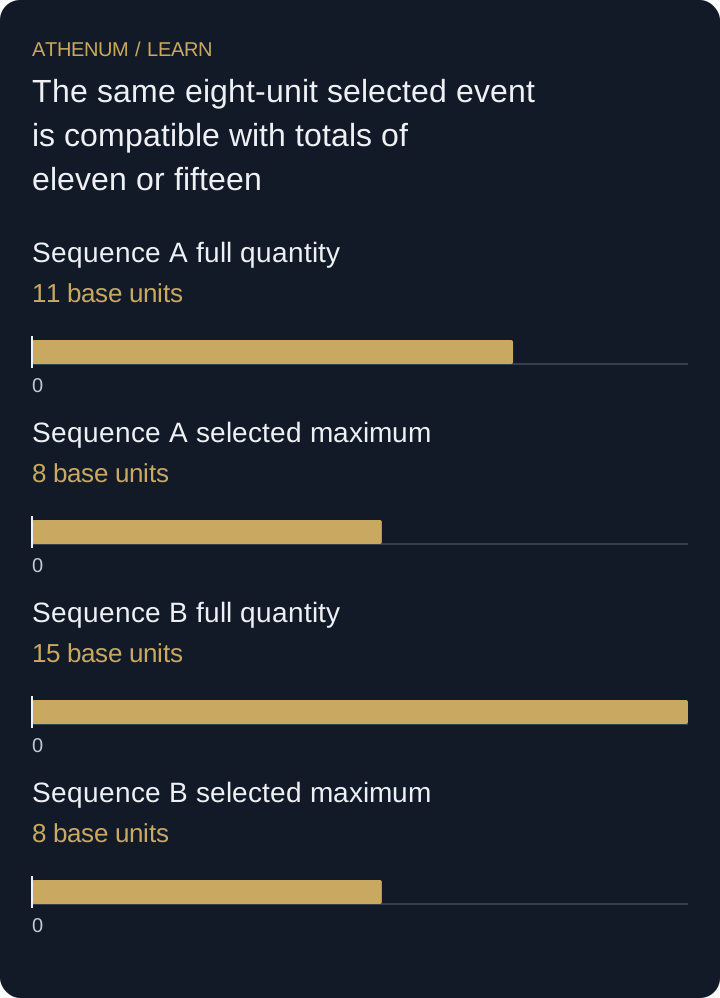
The same eight-unit selected event is compatible with totals of eleven or fifteen
Imagine one instrument and a fixed one-second window. In fictional sequence A, three distinct incremental event quantities arrive chronologically as 1, 8 and 2 units. Total quantity is 11. A latest-only selector returns 2; a largest-by-quantity selector returns 8. In sequence B, quantities are 3, 8 and 4, totaling 15. The largest-by-quantity output is still 8. A reader who sees only that selected output cannot decide whether the window total was 11 or 15.
For these declared three-event sequences, the largest-only retained shares are 8 / 11 = 72.73% and 8 / 15 = 53.33%. Those percentages can be computed only because the exercise supplies the complete populations. A real observer of the selected eight-unit event lacks that denominator. Dividing by a guessed coverage percentage, multiplying by venue market share or multiplying by the number of seconds does not recover a supported total. In a real window with unknown event count, the observed maximum alone gives no finite upper bound on the sum.
| Sequence | Chronological quantities | Full total | Latest-only output | Largest-only output |
|---|---|---|---|---|
| A | 1, 8, 2 | 11 | 2 | 8 |
| B | 3, 8, 4 | 15 | 4 | 8 |
 Open full-size diagram
- Sequence A full quantity: 11 base units
- Sequence A selected maximum: 8 base units
- Sequence B full quantity: 15 base units
- Sequence B selected maximum: 8 base units
Absence can mean no observation, not no liquidation
An empty interval during a disconnected subscription cannot distinguish zero liquidations from unobserved liquidations. Different selection rules can also alter the apparent long/short ratio because selection need not affect both sides equally. Compare a stable, declared panel and label its limits. In Athenum, read the coverage statement for the exact matrix or event list in use; a complete response for one projection does not certify another projection or the whole market.
Before acting
- Declare instrument, venues, window and the measured quantity.
- Review provider selection independently of local query truncation.
- Verify non-overlap and compatible units before calling a sum a lower bound.
- Keep disconnected or unavailable intervals visibly unknown.
- Reject market-total extrapolation without an identified sampling model.
Check your understanding
A fictional window contains quantities 2, 9 and 4. What do latest-only and largest-by-quantity selectors retain? If you later observe only the largest value 9 and do not know the event count, can you recover the total?
Show the explained answer
The supplied complete sequence totals 15 units. Latest-only retains 4 and largest-by-quantity retains 9. Observing only 9 does not recover 15: many populations share that maximum. With valid non-overlapping nonnegative quantities, 9 is a lower bound on the quantity sum, but no finite upper bound follows when the number of events is unknown.