Liquidation data: audit what a reported event actually measures
Reconcile liquidation sides, price bases, quantities, replayed observations and coverage limits using original event ledgers and explained exercises.
What you will practise
Turn raw liquidation observations into a clearly defined statistic without inventing execution prices, account losses or complete market coverage.
Before you start
- Complete the liquidity course and its liquidation-cascade lesson.
- Understand position side, closing-order side, base quantity and quote-currency notional.
Course outline
- 1
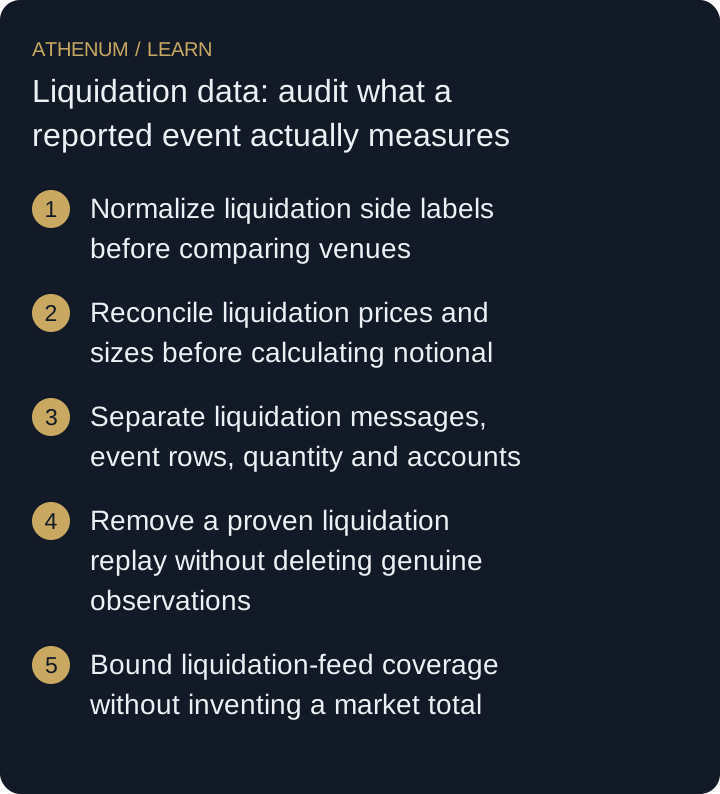
Normalize liquidation side labels before comparing venues
Distinguish the liquidated position from its closing order. Reconcile opposite provider conventions before adding long and short liquidation quantities.
7 min - 2
Reconcile liquidation prices and sizes before calculating notional
Separate original order value, executed notional and bankruptcy-price valuation. Calculate only the quantity a provider's fields actually support.
8 min - 3
Separate liquidation messages, event rows, quantity and accounts
Count batched liquidation observations with an explicit denominator. Explain why event totals cannot identify the number of people liquidated.
7 min - 4
Remove a proven liquidation replay without deleting genuine observations
Distinguish duplicate local processing from equal-valued public events. Use provenance to correct a replay and retain uncertainty when event identity is absent.
8 min - 5
Bound liquidation-feed coverage without inventing a market total
Separate provider selection, collector gaps and result truncation. Test when an observed sum is a lower bound and why coverage cannot be repaired by an arbitrary multiplier.
8 min
 Open full-size diagram
- Normalize liquidation side labels before comparing venues
- Reconcile liquidation prices and sizes before calculating notional
- Separate liquidation messages, event rows, quantity and accounts
- Remove a proven liquidation replay without deleting genuine observations
- Bound liquidation-feed coverage without inventing a market total
Educational material. Examples do not establish a profitable strategy. Trading costs, gaps and liquidation can produce losses beyond a planned stop.