Liquidation data: audit what a reported event actually measures · 2 / 5
Reconcile liquidation prices and sizes before calculating notional
A price multiplied by a quantity always produces a number, but the result is useful only when both fields have the intended meaning and compatible units. An order price is not necessarily an average fill price. An original order size is not necessarily the filled size. A bankruptcy price is not an observed execution. Calling all three products liquidation losses hides different measurements behind the same label.
Athenum8 minUpdated:
Read the pair of fields together
Binance's liquidation-order schema distinguishes original quantity q, price p, average price ap, last filled quantity l and accumulated filled quantity z, alongside order status X. For a declared linear instrument whose quantity is in base units, average execution price times accumulated filled quantity describes the order's accumulated gross executed quote value when those fields are valid. It does not describe just the latest fill. Contract multipliers and inverse instruments require their own unit conversion.
Bybit's liquidation stream defines v as executed size and p as bankruptcy price. After verifying a linear base-unit quantity convention, their product is a bankruptcy-price valuation of the reported size. It cannot be relabelled executed notional merely because the normalized database column is named price. Keep the price basis visible through the calculation, chart and caption.
Validate accumulated values before aggregating
If several records describe successive states of the same order, adding every accumulated filled quantity counts earlier fills again. Reconciliation needs reliable order identity and update semantics. A public message without a stable order identifier may not support that reconstruction. Preserve the limitation instead of assuming nearby records belong to the same order. Missing or invalid average prices also block an execution-value answer; an original limit price is not a neutral replacement.
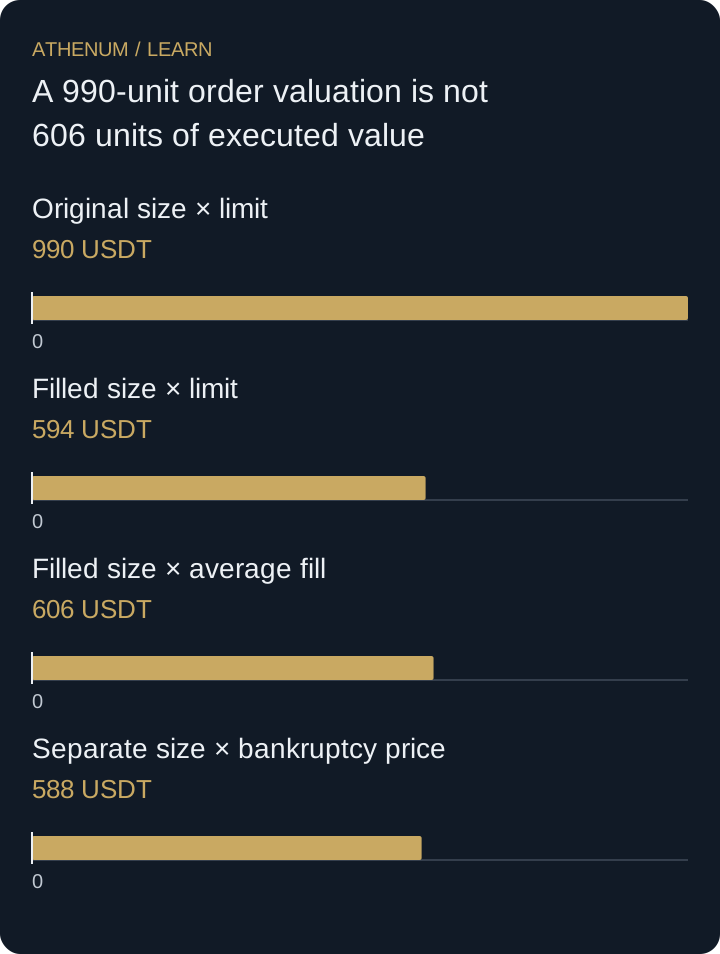
A 990-unit order valuation is not 606 units of executed value
Assume a fictional linear sell order, quantities in base units, prices in USDT per base unit, and independently confirmed terminal cancellation of its unfilled remainder. The original order has q = 10 and limit p = 99. Six units execute at an average ap = 101, so z = 6; the last fill size is l = 2. Selling above the minimum limit is compatible with the declared sell order. Gross executed value is 6 × 101 = 606 USDT. The original limit valuation is 10 × 99 = 990 USDT. Four units did not execute through this order.
A separate fictional bankruptcy-price record reports executed size 6 at bankruptcy price 98. Its reference valuation is 588 USDT. No average fill price is provided, so its gross execution value is unknown. The two records are teaching alternatives, not evidence of the same event on two feeds. The 18-USDT difference between 606 and 588 is not a measured fee, insurance-fund transfer or trader loss. Neither record contains the complete collateral, entry, funding and fee ledger needed to calculate account loss.
| Calculation | Inputs | Result USDT | Meaning |
|---|---|---|---|
| Original limit valuation | 10 × 99 | 990 | Requested size valued at limit |
| Filled size at order limit | 6 × 99 | 594 | Limit-based valuation, not actual fills |
| Accumulated execution value | 6 × 101 | 606 | Gross value supported by average fills |
| Separate bankruptcy valuation | 6 × 98 | 588 | Reference valuation; fills unknown |
 Open full-size diagram
- Original size × limit: 990 USDT
- Filled size × limit: 594 USDT
- Filled size × average fill: 606 USDT
- Separate size × bankruptcy price: 588 USDT
A public notional figure is not a balance-sheet loss
Even a correctly reconstructed executed notional measures exchanged exposure, not equity destroyed. One account can have collateral, partially closed positions, other positions, fees and funding. Do not turn a public liquidation total into the amount individual traders lost. The same caution applies when comparing a reported-event overlay with an estimated liquidation heatmap: the underlying observations and their price bases must remain named.
Before acting
- Identify linear or inverse payoff and the quantity multiplier.
- Distinguish order, average-fill and bankruptcy prices.
- Separate original, last-filled and accumulated-filled size.
- Avoid summing overlapping cumulative order states.
- Label unsupported execution values and account losses as unknown.
Check your understanding
A fictional linear sell order has original quantity 8, limit 198, accumulated filled quantity 5 and valid average fill price 201. A separate record values five units at bankruptcy price 195. What values are supported?
Show the explained answer
The order's original limit valuation is 8 × 198 = 1,584 USDT. Its accumulated gross execution value is 5 × 201 = 1,005 USDT. The separate bankruptcy-price valuation is 5 × 195 = 975 USDT, with its execution value unknown. The 30-USDT difference is not a supported trader-loss or fee estimate.