Liquidation data: audit what a reported event actually measures · 3 / 5
Separate liquidation messages, event rows, quantity and accounts
A stream can deliver several liquidation observations inside one message. One observation can represent a large or small quantity, and several observations can concern the same account. Message count, event-row count, quantity and unique account count answer different questions. A headline that swaps their labels can sound precise while claiming information the public feed never supplied.
Athenum7 minUpdated:
Define the observation unit before the statistic
Write down whether one observation means a received envelope, an item inside its data array, a unique provider event, an execution, an order or an account. These are not interchangeable. A feed example containing a data array establishes a possible batching structure; its exact counting semantics still need the channel definition. A local row identifier identifies your stored record and does not automatically identify a distinct exchange execution.
Choose a denominator matching the question. Average units per recorded event row is total compatible quantity divided by the number of rows retained under the declared replay policy. Average units per message uses a different denominator and changes when the provider batches differently. Neither becomes average loss per trader without an account-level loss dataset.
Keep the population and units fixed
For an event-rate comparison, freeze symbol coverage, observation window, time convention, batching rules and filtering. A jump in rows per minute after adding venues may reflect coverage rather than greater activity. A quote-value comparison additionally needs a consistent valuation basis. Do not compare ten contract units on one instrument with ten base coins on another as though equal quantities implied equal exposure.
Three messages contain six rows and 41 base units
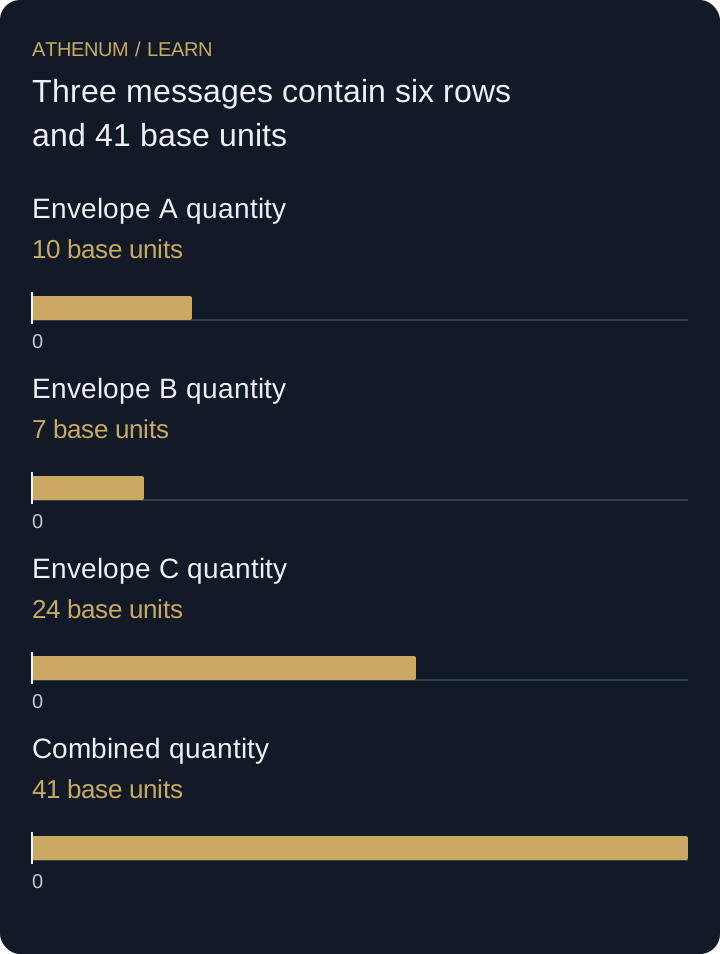
Assume a fictional collector has verified that these six rows are distinct observations, each reporting an incremental executed quantity for the same linear instrument. They arrive in three messages over one fixed minute. Message A contains sizes 2, 3 and 5; message B contains 7; message C contains 11 and 13. There are three envelopes, six event rows and 41 base units. The units-per-row mean is 41 / 6 = 6.8333, while units per envelope is 41 / 3 = 13.6667.
If the provider instead batches exactly these same six observations into one message, row count and total size stay unchanged while envelope count falls to one. Units per envelope rises to 41 without any extra liquidation quantity. The public rows have no account identifiers. Assigning each row to a different account or assigning repeated partial reductions to the same account can fit the observed sizes. The data therefore do not identify a unique-account total, and still less a number of distinct people.
| Envelope | Contained base sizes | Event rows | Base-unit total |
|---|---|---|---|
| A | 2 + 3 + 5 | 3 | 10 |
| B | 7 | 1 | 7 |
| C | 11 + 13 | 2 | 24 |
| Total | All retained rows | 6 | 41 |
 Open full-size diagram
- Envelope A quantity: 10 base units
- Envelope B quantity: 7 base units
- Envelope C quantity: 24 base units
- Combined quantity: 41 base units
An absent account identifier cannot be reconstructed from size
Equal timestamps, equal sizes or repeated round quantities do not establish common account ownership. Different accounts can generate identical public fields; one account can generate different sizes. Do not infer identities or claim an account-level concentration measure from that resemblance. Even a provider's own account statistic would require its published counting method before comparison with public event rows.
Before acting
- Name envelopes, rows, executions and accounts separately.
- Verify whether size is incremental or cumulative.
- Freeze the instrument set and observation window.
- State the denominator in every average or rate.
- Keep account and person counts unknown when identities are absent.
Check your understanding
The same six verified observations totaling 41 units are repackaged into two envelopes. What happens to quantity, event count, units per event and units per envelope?
Show the explained answer
Quantity stays 41 units and event count stays six. Units per event remains 41 / 6, approximately 6.8333. Units per envelope becomes 41 / 2 = 20.5. No change in the number of liquidated accounts or people can be inferred from this rebatching.