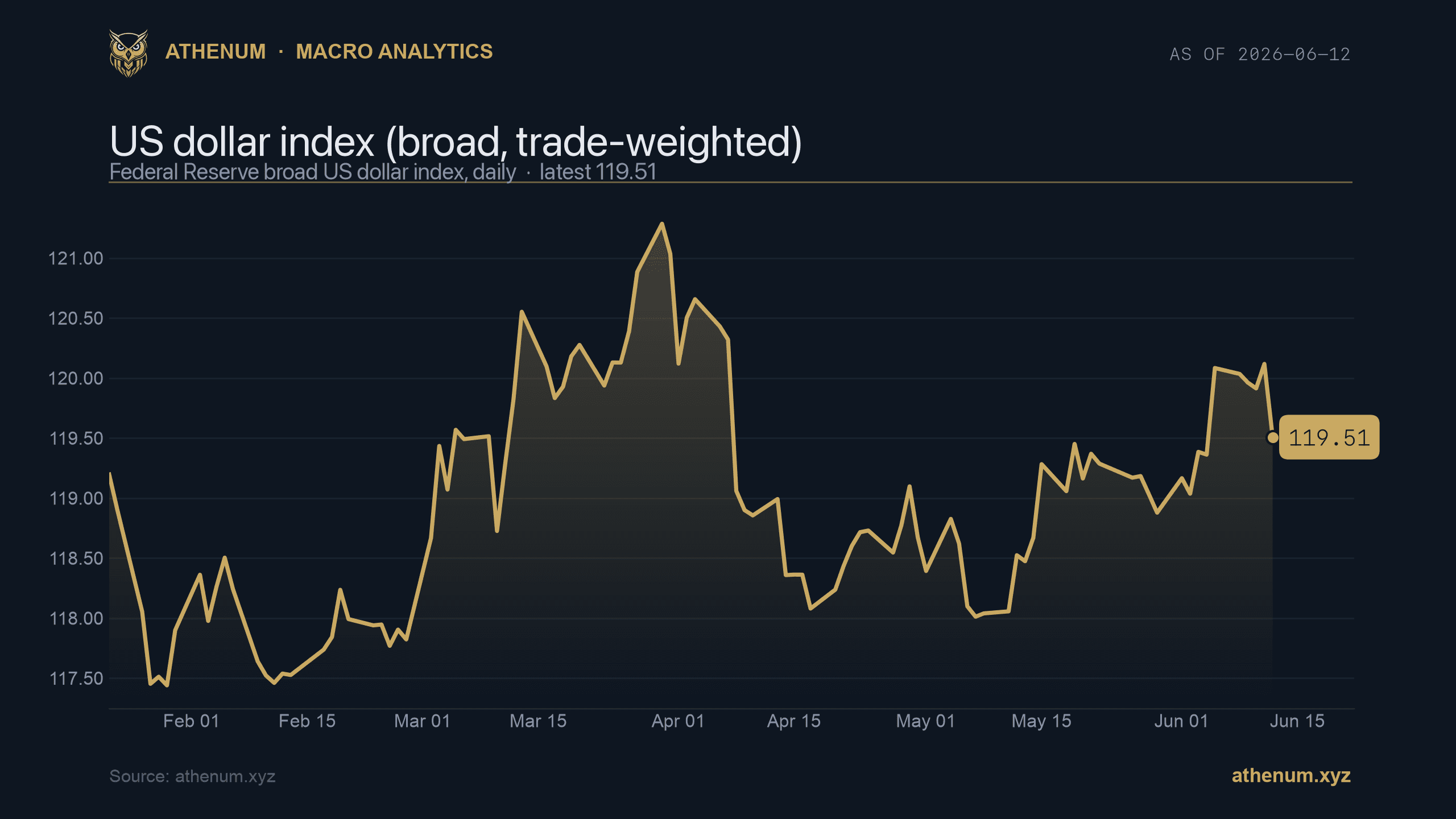
The US Dollar Index (DXY) measures the dollar against a basket of six major currencies, and it has historically tended to move inversely to crypto because a stronger dollar tightens global liquidity and pulls capital toward safety, while a weaker dollar loosens conditions and feeds risk appetite. But that relationship is regime-dependent, not a fixed law: it ran negative through much of 2023-2025, then in early 2026 the correlation repeatedly swung positive, stretches where the dollar and Bitcoin moved together, before reverting negative again later in the period. The practical read is to treat DXY as a financial-conditions backdrop, watch the rate of change rather than the absolute level, and confirm it against on-chain and derivatives signals instead of trading the dollar alone.
What is the US Dollar Index (DXY)?
The DXY is a single number that expresses the value of the US dollar against a fixed basket of six foreign currencies. The basket is heavily weighted toward Europe: the euro alone carries roughly 57.6% of the index, followed by the Japanese yen (~13.6%), British pound (~11.9%), Canadian dollar (~9.1%), Swedish krona (~4.2%), and Swiss franc (~3.6%). The index was created in 1973 with a base value of 100, so a reading above 100 means the dollar has strengthened against that basket since the base period, and a reading below means it has weakened.
Two things follow from the construction. First, because the euro dominates the weighting, the DXY is effectively an inverted EUR/USD chart with a smaller satellite basket attached. It tells you a lot about the dollar versus other developed-market fiat, and almost nothing about emerging-market currencies. Second, the index is a *relative* measure. It rises when the dollar outperforms its basket, not necessarily when the dollar is "strong" in any absolute sense. A DXY move can reflect dollar strength, euro weakness, or both at once.
Why does the dollar move crypto at all?
Crypto has no cash flows, no coupon, and no central bank backstop, so its price is unusually sensitive to the cost and availability of capital. The dollar sits at the base of that cost. Three channels link the two.
The first is the safe-haven channel. The dollar is the world's primary reserve and funding currency. When uncertainty rises, capital rotates toward dollar cash and short-dated Treasuries, the DXY firms, and speculative, long-duration assets like crypto see outflows. When confidence returns, the same flow reverses.
The second is the rate and opportunity-cost channel. Policy that lifts US real yields tends to attract capital into dollar assets and raises the bar for holding a non-yielding asset. When the opportunity cost of holding crypto rises, marginal demand softens; when it falls, risk assets get more room.
The third, and arguably the most important, is the global-liquidity channel. The dollar is the denominator of most cross-border credit. A stronger dollar makes dollar-denominated funding more expensive everywhere, tightening financial conditions well beyond US borders. A weaker dollar does the opposite. Crypto, as one of the highest-beta expressions of global risk appetite, often registers that shift in conditions before slower aggregates like money supply do.
Is the DXY-crypto correlation reliable?
No, and this is the part most explainers get wrong. The inverse relationship is a tendency, not a rule, and its strength swings with the macro regime.
Through much of 2023 to 2025, Bitcoin commonly traded with a moderately-to-strongly negative correlation to the DXY: dollar up, crypto down, and vice versa. But the relationship is not stable through time. In early 2026 the correlation repeatedly swung positive, there were multiple stretches where the dollar and Bitcoin rose and fell together, before reverting to a negative reading later in the period. Part of what blurred the old inverse pattern was structural: as spot Bitcoin ETFs pulled the asset into traditional portfolios held alongside stocks and bonds, Bitcoin began to trade more like a macro risk asset and less like a pure currency hedge. The takeaway is not that the inverse rule died, but that correlation coefficients drift, decay, and occasionally invert, so any specific number is a snapshot of one window, not a permanent setting.
Two nuances matter for practitioners. First, the speed of the move often matters more than the level. A fast, disorderly dollar rally tends to hit risk assets harder than a slow grind to the same level, because abrupt tightening forces deleveraging. Second, liquidity direction can override the headline correlation. There are stretches where global money supply is expanding yet a firming dollar tightens conditions faster than that liquidity can lift prices, so crypto falls even as the longer-term liquidity story looks constructive.
How do you actually read DXY for a crypto view?
Treat the DXY as context, not a trigger. A few habits keep it useful:
- Read the rate of change, not just the print. A DXY that is grinding sideways carries little information; one that is breaking out or breaking down is signaling a shift in financial conditions. - Check what is driving the move. Because the euro dominates the index, a DXY spike can be a euro story rather than a US story. The macro implication for crypto differs depending on the source. - Confirm, don't substitute. The dollar is one input. Pair it with rate expectations and the broader macro calendar before drawing a conclusion. - Cross-check against the market's own positioning. Derivatives data, funding rates, open interest, and basis, tells you how leveraged and how one-sided the crypto market already is. A dollar headwind landing on crowded, over-leveraged longs is a very different setup from the same headwind hitting clean positioning.
This is where a unified view earns its keep. Watching the DXY and rate expectations on one screen and crypto order flow, open interest, and funding on another invites you to miss the moment they diverge. Athenum's Macro & Institutional layer puts FRED indicators, the FOMC calendar, and ETF-flow tracking alongside live order flow and derivatives intelligence, so the macro backdrop and the market's actual positioning sit in the same workspace rather than in two browser tabs that never reconcile.

Broad trade-weighted US dollar index, daily. Source: Athenum.
Why does this matter for positioning?
Because the dollar tells you about the *environment*, and crypto's own data tells you about the *positioning* inside that environment. The DXY can frame whether financial conditions are loosening or tightening, but it cannot tell you whether the crypto market is leaning long into a tightening dollar or short into a loosening one. Those two pieces together are far more informative than either alone, and they regularly disagree, which is exactly when the read is most valuable.
Practitioner takeaway
The DXY is best used as a financial-conditions dashboard, not a crypto buy/sell signal. Watch its direction and speed, know that the euro drives most of the index, and respect that the inverse correlation with crypto is regime-dependent and can invert, as it repeatedly did in early 2026. Then confirm whatever the dollar implies against the crypto market's own funding, open interest, and order flow before you act. The dollar sets the weather; the derivatives book tells you who is dressed for it.
One terminal. All the data.
Liquidations, orderbook depth, whale walls & open interest from 4 exchanges, all real-time, in one place.
No credit card required

Athenum Analytics
Athenum Analytics is our three-person editorial team covering crypto derivatives, market data and macroeconomic context.