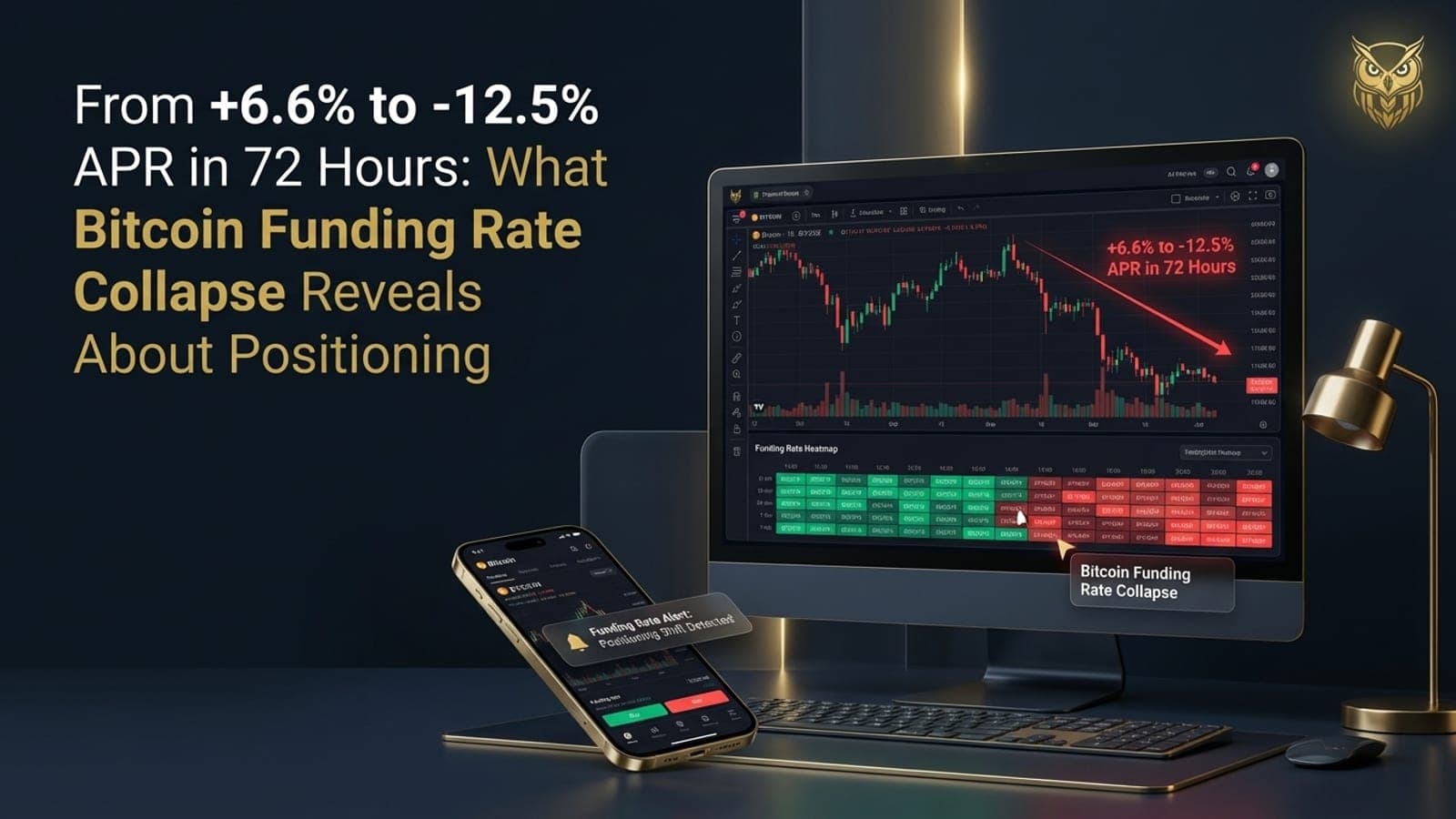

Bitcoin funding rates on Binance collapsed from +6.6% APR to -12.5% APR between March 25 and March 28, the sharpest three-day reversal since the February liquidation cascade. The swing did not happen in isolation. It coincided with a VIX surge to 27.44, a NASDAQ drawdown of 12.2%, and an orderbook microstructure that Athenum's live analytics flagged as a textbook positioning phase. The question is not whether shorts are aggressive. They clearly are. The question is whether the funding signal is telling you what you think it is, or whether cross-exchange divergence is masking a more complex structural story.
The Funding Reversal on Binance
Binance perpetual futures funding for BTCUSDT followed a clear arc over the past seven days. Rates started the week positive, with longs paying shorts at 4.0% to 6.6% APR as BTC traded above $70,000. By March 27, rates had flipped negative to -9.2% APR. On March 28, they hit -12.5% APR, the deepest negative print since early February.
The table below shows the full funding rate timeline from Athenum's live data.
Date | Time (UTC) | Funding Rate (APR) | Mark Price | OI (USD) | Net Payment |
|---|---|---|---|---|---|
Mar 25 | 17:00 | +6.59% | $70,882 | $6.20B | Longs pay |
Mar 26 | 01:00 | +0.95% | $71,237 | $6.16B | Neutral |
Mar 26 | 09:00 | -0.63% | $69,471 | $6.03B | Neutral |
Mar 26 | 17:00 | +3.20% | $68,929 | $5.99B | Longs pay |
Mar 27 | 09:00 | -9.24% | $67,706 | $6.09B | Shorts pay |
Mar 27 | 17:00 | -2.72% | $65,668 | $6.21B | Shorts pay |
Mar 28 | 01:00 | -12.53% | $66,094 | $6.28B | Shorts pay |
Mar 28 | 09:00 | -8.66% | $66,258 | $6.33B | Shorts pay |
Mar 28 | 17:00 | +1.73% | $66,777 | $6.33B | Longs pay |
Mar 29 | 01:00 | -4.99% | $66,444 | $6.24B | Shorts pay |
Mar 29 | 09:00 | +0.002% | $66,552 | $6.34B | Neutral |
Two features of this sequence matter. First, open interest did not collapse during the negative funding period. OI actually rose from $6.03B on March 26 to $6.34B on March 29, suggesting traders opened new short positions rather than liquidating existing longs. Second, the rate oscillated between deeply negative and briefly positive multiple times, which signals an active repositioning war rather than a one-directional flush.
Hyperliquid Tells a Different Story
Cross-exchange funding divergence is one of the most underused signals in crypto derivatives. Binance and Hyperliquid serve structurally different trader bases, and when their funding rates decouple, the divergence reveals which participant class is driving the positioning shift.
On Hyperliquid, funding rates were capped at +10.95% APR from March 24 through March 26, the protocol's maximum rate. This means longs on Hyperliquid were paying the ceiling rate for over 48 hours straight, even as Binance rates were already trending toward negative territory.
The divergence is stark. Binance shorts collected -12.5% APR on March 28, while Hyperliquid had already printed -7.24% APR on March 23 before swinging back to the +10.95% cap. This sequence suggests that Hyperliquid's native trader base, which skews toward more aggressive leveraged participants, was positioned long through the initial correction and only began unwinding after Binance shorts had already established dominance.
What the Divergence Signals
When Binance funding turns deeply negative while Hyperliquid remains at or near its positive cap, the market is split. Institutional and algorithmic flow on Binance is pressing short. Retail-adjacent leverage on Hyperliquid is still positioned long. Historically, this divergence resolves violently. Either the longs capitulate and funding converges negative across venues, or the shorts on Binance get squeezed and both venues reset to neutral. The current convergence toward zero on both exchanges, with Binance at +0.002% APR on March 29, suggests the market has reached a temporary equilibrium, but the structural split has not fully resolved.
The Macro Regime Behind the Flip
Funding rates do not flip in a vacuum. A macro regime shock triggered the March 25 to 28 reversal, and Athenum's composite model flagged it as a critical confidence collapse.
Athenum's macro regime engine currently reads "neutral" with a confidence score of 0.25, the lowest reading that still qualifies as neutral before tipping into risk-off. A confidence of 0.25 means the underlying indicators are almost evenly split between risk-on and risk-off signals, creating a fragile equilibrium.
Indicator | Value | Signal | Weight |
|---|---|---|---|
VIX (CBOE Volatility Index) | 27.44 | Risk-off | 0.30 |
ICE BofA HY Spread | 3.21% | Neutral | 0.25 |
10Y-2Y Spread | 0.56% | Risk-on | 0.20 |
USD Index (Broad) | 120.28 | Risk-off | 0.15 |
Fed Funds Rate | 3.64% | Neutral | 0.10 |
The VIX surged from 16.35 to 27.44, a 67.8% increase, per CBOE data. This is not a minor uptick. A VIX reading above 25 has historically correlated with BTC drawdowns of 8% or more within the same 14-day window. The NASDAQ dropped 12.2% and the S&P 500 fell 8.7% in the same period, confirming that the risk-off move was broad and equity-driven, not crypto-specific.
Oil and Rate Fears as Catalysts
CoinDesk reported on March 26 that oil climbing back above $100 per barrel, combined with weaker equities and gold signaling risk aversion, triggered a derivatives unwind across major cryptocurrencies. The FOMC's upgraded inflation forecast to 2.7% on March 18 laid the groundwork for a hawkish repricing, and the oil spike compressed the timeline for that repricing to reach crypto positioning. Bitcoin's 5% decline from $70,882 to $65,668 between March 25 and March 27 was the direct expression of this macro transmission mechanism.
The Orderbook Confirms a Positioning Phase
Athenum's live orderbook imbalance data for BTCUSDT on Binance Futures shows the L5 metric oscillating between extremes with unusual frequency. Over the most recent 100 five-minute intervals, the L5 signal alternated between "strong_bullish" and "strong_bearish" in rapid succession, with values swinging from +0.98 to -0.99 within a single hour.
This pattern is the definition of a positioning phase. Neither buyers nor sellers are establishing sustained control of the top-of-book. Instead, large participants are probing both sides, placing and canceling walls to test depth before committing directional capital. Athenum's whale wall lifespan data confirms this interpretation. The median wall lifetime is 9 seconds, with 77.3% of all walls classified as spoof suspects per Athenum's proprietary detection model. Only 18.9% of walls qualify as conviction orders, those that remain on the book long enough to absorb flow.
Lifespan Bucket | Count | % of Total | Avg USD Size | Fill Rate |
|---|---|---|---|---|
0-30 seconds | 126,144 | 74.4% | $2.76M | 0.07% |
30-60 seconds | 4,822 | 2.8% | $2.44M | 0.02% |
1-5 minutes | 6,427 | 3.8% | $2.13M | 0.06% |
5-15 minutes | 28,784 | 17.0% | $3.42M | 0.01% |
15+ minutes | 3,309 | 2.0% | $3.55M | 0.15% |
The spoof score on Binance Futures sits at 62 (moderate), while Hyperliquid registers 68, approaching the high-activity threshold of 70. On Hyperliquid, 99.8% of walls are short-lived, per Athenum data. This cross-venue spoofing pattern aligns with the funding rate divergence: different participant classes are jockeying for position on different venues, and neither has established dominance.
ETF Flows: The Institutional Counterweight
While derivatives traders were aggressively shorting, spot Bitcoin ETF flows told a different story. The most recent weekly ETF data shows net inflows persisting through much of March, despite the macro deterioration.
From March 9 through March 13, BTC ETFs recorded five consecutive days of net inflows totaling approximately $767M. The buying continued into mid-March with $202M on March 16 and $199M on March 17. Outflows only appeared on March 18 ($163.5M) and March 19 ($90.2M), directly following the FOMC inflation forecast revision. Cumulative BTC ETF inflows stood at approximately $56.3B as of March 19 per Athenum data, consistent with SoSoValue's tracker which reported cumulative net inflows in the same range for U.S. spot Bitcoin ETFs.
This is the classic institutional divergence pattern: derivatives positioning turns bearish while spot accumulation continues at a structural level. The divergence does not guarantee a squeeze, but it does indicate that leveraged futures participants, not longer-duration capital, are driving the negative funding rate. The February 28 short squeeze, which produced an 11.2% BTC rally in under 72 hours, originated from a similar setup where negative funding coincided with persistent ETF inflows.
The Open CME Gap as a Structural Anchor
One additional structural factor anchors the current price action. The CME gap from February 27 remains open after 660 hours. The gap sits between $65,880 (Friday close) and $66,355 (Sunday open), and BTC is currently trading at approximately $66,508, just $153 above the top of the gap window.
Athenum's CME gap statistics show that over the past year, 76.7% of all gaps have been filled, with up gaps filling at a 95.8% rate and down gaps at 52.6%. This particular gap is an up gap, meaning it fills when price drops below $65,880. With BTC hovering just above the gap ceiling, the probability of a wick down to fill is elevated, particularly given the aggressive short positioning visible in funding rates.
The average time to fill for gaps in the past year is 2,367 hours, with a median of 1,817 hours, per Athenum's CME gap statistics. At 660 hours open, this gap is still well within the normal fill window. A fill would represent a 0.9% decline from current levels, a move that could easily occur on a single negative funding spike.
Gap analysis also reveals a structural asymmetry worth noting. Up gaps (where Sunday opens above Friday close) fill at a 95.8% rate. Down gaps fill at only 52.6%. The February 27 gap is an up gap, placing it firmly in the high-probability fill category. Combined with BTC's current proximity to the gap ceiling and the aggressive short positioning in perpetual futures, the gap acts less as a prediction and more as a structural attractor, a price level that the market tends to revisit given sufficient time and volatility. For a deeper breakdown of how CME gaps interact with weekend positioning, see Athenum's analysis of the $65,880 CME gap and its relationship to the recent quarterly expiry.
What the Data Says
The funding rate collapse from +6.6% to -12.5% APR was not a sentiment tantrum. It was the derivatives market repricing macro risk into crypto positioning, with different exchanges absorbing that repricing at different speeds and through different participant classes.
The confluence of signals paints a specific picture. The macro regime is fragile neutral with 0.25 confidence, one indicator flip away from tipping to risk-off. Funding has reset to near zero on Binance, but the structural short bias has not been fully unwound. The orderbook is in a positioning phase, with 77.3% spoof-suspect walls and a 9-second median lifetime, per Athenum's live analytics. ETF flows remain net positive, providing a structural floor that limits the downside severity of any short-driven flush. And the February 27 CME gap at $65,880 sits $628 below spot, acting as a gravitational target.
The forces are not aligned. They are opposed. Leveraged shorts versus spot ETF inflows. Fragile neutral macro versus persistent accumulation. Spoofed orderbooks versus real positioning. When these forces resolve, the move will be fast. The data does not say which direction, but it does map where the pressure is, and right now, it is everywhere.
Access the full signal set, including live funding rate comparisons, orderbook depth, and spoof detection, on the Athenum analytics platform.
Sources
- Athenum API, live data as of March 29, 2026 (funding rates, orderbook imbalance, macro regime, whale walls, CME gaps, ETF flows, options max pain)
- Bitcoin Bearish Positioning Persists As Funding Rates Hold Negative, NewsBTC, March 2026
- Crypto Slides as Oil Spike, Macro Jitters Trigger Derivatives Unwind, CoinDesk, March 26, 2026
- Bitcoin Breaking Down as VIX Signals March Volatility, Investing.com, 2026
- Bitcoin Funding Rate Drops to -6%, Short Squeeze Possible, Phemex News, 2026
- CBOE VIX data via FRED (VIXCLS), March 26, 2026
- CoinGlass, BTC Funding Rate historical data
- SoSoValue, U.S. Spot Bitcoin ETF cumulative net inflow tracker