Bitcoin Liquidity Analysis: Understanding Orderbook Dynamics in 2026
Most traders watch price. Smart traders watch liquidity. Here's everything you need to know about Bitcoin orderbook dynamics in 2026 and why it matters more than ever for protecting your capital.
The Bitcoin market in 2026 looks nothing like the retail driven speculation of previous cycles. After reaching an all time high above $126,000 in October 2025, Bitcoin has entered a volatile correction phase, briefly dropping below $61,000 in early February 2026 during one of the fastest selloffs in crypto history. What made this crash particularly brutal wasn't just the price drop itself. It was how quickly liquidity evaporated from the orderbook, turning what could have been a controlled pullback into a cascading liquidation event.
Understanding liquidity and orderbook dynamics isn't just academic theory reserved for quant traders at Jane Street. It's the difference between executing a trade at a fair price and getting absolutely destroyed by slippage during the exact moments you need to act. Whether you're a beginner getting into crypto or an intermediate trader looking to sharpen your edge, this guide breaks down how Bitcoin liquidity actually works, what's changed in 2026, and how to use this knowledge to trade smarter.
What Is Liquidity (And Why Should You Care)?
At its core, liquidity measures how easily you can buy or sell Bitcoin without significantly moving the price. A liquid market means you can execute a trade quickly, at a price close to what you see on the screen, without your own order pushing the market against you.
Think of it like selling a house. In a hot housing market with lots of buyers (high liquidity), you can sell quickly at or near your asking price. In a cold market with few buyers (low liquidity), you either wait forever or accept a much lower price. Bitcoin orderbooks work the same way, just at millisecond speed.
This matters because liquidity isn't constant. It changes throughout the day, reacts to news events, and can vanish entirely during panic. The January 2026 stress episode showed exactly this: as Bitcoin dropped from $88,000 toward $74,500, roughly $7 billion in positions were liquidated. The orderbook thinned out so aggressively that each additional dollar of selling had outsized price impact. Traders who didn't understand liquidity dynamics got caught in a feedback loop where thin books amplified the selloff.
The Orderbook: Your Window Into Market Reality
Every major crypto exchange like Binance, Bybit, and OKX operates what's called a central limit orderbook, or CLOB. This is simply a list of all outstanding buy orders (bids) and sell orders (asks) organized by price.
When you place a limit order to buy Bitcoin at $65,000, your order sits on the bid side of the book, waiting to be matched. When someone else wants to sell at that price or lower, your orders match and a trade happens. Market orders, by contrast, execute immediately by "walking the book," consuming resting limit orders starting from the best available price.
The gap between the highest resting bid and the lowest resting ask is called the bid ask spread. This is your most immediate trading cost. If the best bid is $65,000 and the best ask is $65,010, the spread is $10. Cross the spread with a market order, and you're already $10 in the hole before the trade even moves in your favor.
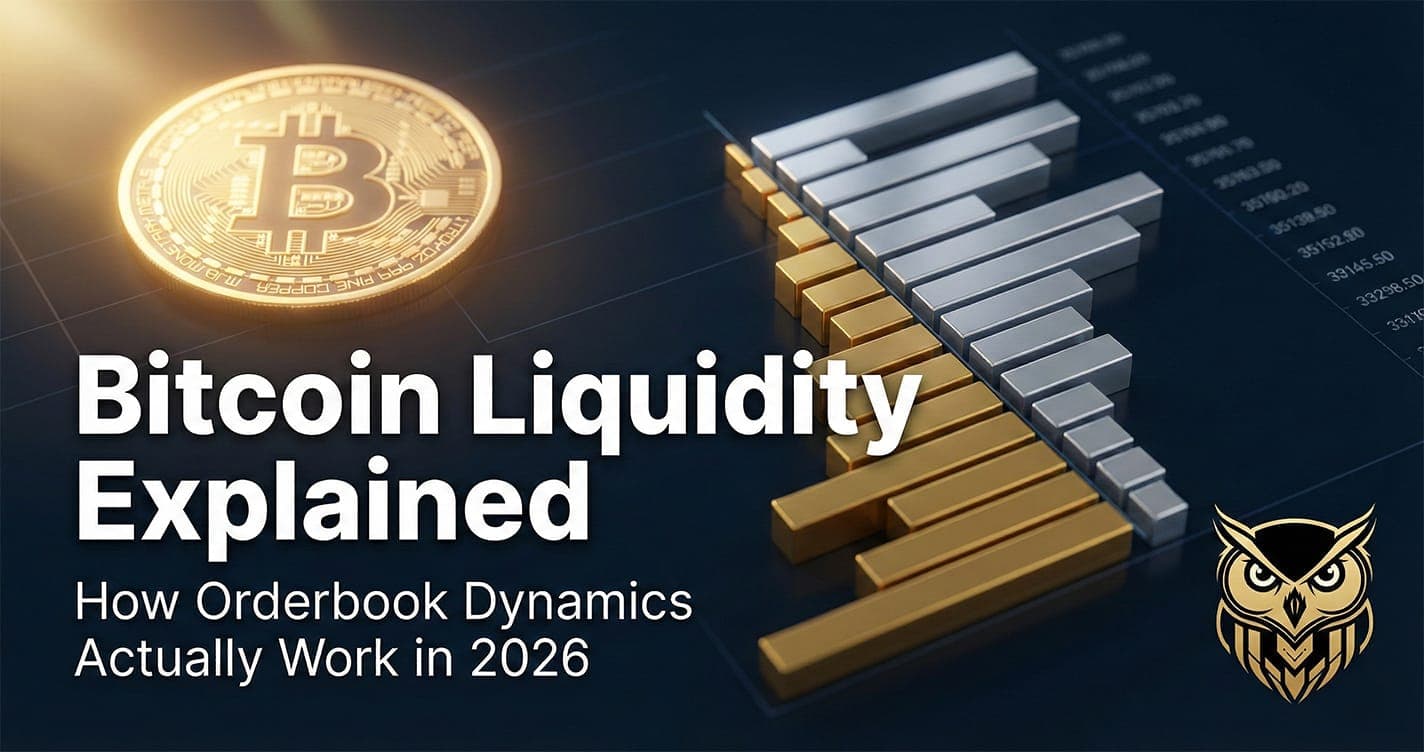
Here's a simple way to visualize this. Imagine the orderbook as a wall of bricks on each side of the current price. The bid side (buyers) stacks bricks below the price. The ask side (sellers) stacks bricks above. Each brick represents some quantity of Bitcoin someone wants to buy or sell at that specific price. A tall, thick wall of bricks means lots of liquidity. Traders would need to throw serious volume at those walls to move through them. A thin wall with gaps means even a modest sized order can punch through, causing the price to jump.
Most exchanges use price time priority for matching orders: better prices fill first, and at the same price, earlier orders fill before later ones. This creates queues at each price level. Being a few ticks inside the spread or earlier in time can dramatically change your fill probability, which is why sophisticated market makers obsess over queue position.
But the spread alone doesn't tell you the full story. What matters equally is how much size sits at and near those best prices. That's where depth comes in.
The Five Dimensions of Bitcoin Liquidity
Professional traders and market makers evaluate liquidity across multiple dimensions, not just a single number. Here are the five that matter most:
Tightness (the spread). This is your first order cost of trading. In calm markets on Binance's BTC/USDT pair, the spread might be just a few dollars. During stress events? It can blow out to $50 or more. The CoinGecko 2025 liquidity report confirmed that Binance maintained the tightest BTC spreads among major exchanges, but even Binance saw meaningful spread widening during the January 2026 volatility.
Depth (size near the price). This measures how much Bitcoin you can buy or sell near the current price without moving it. According to CoinGecko's cross exchange analysis, Binance leads with approximately $8 million of orderbook depth on both sides within just $100 of the market price. That's roughly 32% of all visible BTC liquidity across the eight largest exchanges. Bitget follows at around $4.6 million, with OKX at $3.7 million. Meanwhile, some exchanges like HTX and Kraken show comparatively thin BTC books.
This matters because if you're trying to execute a $500,000 trade and only $200,000 of depth sits at the best price level, your order will "walk" through multiple price levels, and each level consumed means worse execution. This is slippage.
Breadth (depth away from the touch). While top of book depth tells you about small orders, breadth measures how much liquidity exists at wider price ranges. An orderbook might look healthy at the best bid and ask, but if depth drops off a cliff just 0.5% away from the midprice, any moderately sized order will punch through those levels fast. Research from Amberdata found that BTC orderbook depth on Binance can vary by as much as 87% throughout a 24 hour cycle, with peak liquidity around 11:00 UTC and troughs around 21:00 UTC.
Resilience (how fast the book recovers). After a large market order sweeps through several price levels, how quickly do market makers replenish those levels? A resilient orderbook snaps back to normal within seconds. A fragile one stays thin for minutes or longer, leaving the market vulnerable to cascading moves. Kaiko's exchange level analysis showed that Kraken's liquidity tended to rebound faster than other exchanges during stress events, while Coinbase and Binance also performed relatively well.
Immediacy (speed of execution). Can you get filled right now, at a reasonable price? In a deep, tight book, the answer is usually yes. In a thin book with wide spreads, you might need to wait for liquidity to arrive or accept significantly worse execution.
How ETFs Transformed Bitcoin's Liquidity Landscape
The single biggest structural change to Bitcoin's liquidity in this cycle has been the explosive growth of US spot Bitcoin ETFs since their approval in January 2024. By the end of 2025, these products collectively held over $114 billion in assets, with BlackRock's iShares Bitcoin Trust (IBIT) alone accounting for roughly 60% of that.
This has fundamentally altered where, when, and how Bitcoin liquidity shows up.
Liquidity has shifted toward US hours. Kaiko's microstructure research documented that after ETF approval, the share of global BTC market depth on US exchanges rose from about 35% to roughly 45%. Liquidity now concentrates most heavily around the US equity market close (3 to 4 PM New York time), when ETF net asset values are calculated. If you're a trader in Asia or Europe, this means your local trading session often has thinner orderbooks than what American traders experience.
Authorized participants inject professional liquidity. ETF issuers rely on large trading firms like Jane Street, JP Morgan, and DRW to arbitrage price differences between ETF shares and the underlying Bitcoin. This arbitrage activity has tightened spreads and deepened orderbooks on benchmark constituent exchanges. The net effect is more efficient price discovery, though these benefits are strongest on regulated, US facing venues.
But ETFs create new fragility too. The flip side of ETF driven liquidity became painfully clear in late 2025 and early 2026. In November 2025 alone, spot Bitcoin ETFs saw $3.48 billion in net outflows. December added another $1.09 billion. When institutional holders redeem ETF shares, authorized participants must sell the underlying Bitcoin into spot markets. When those spot markets are already thinning out due to risk aversion, you get exactly the feedback loop we saw: ETF outflows trigger selling into a thinner book, which amplifies the price drop, which triggers more redemptions.
Some analysts have called this a "liquidity illusion." ETF shares may look highly liquid on traditional stock exchanges, but the underlying crypto spot markets that back those shares can run surprisingly thin during synchronized selling. Understanding this disconnect is critical for anyone trading Bitcoin in 2026.
The Fragmentation Problem: Not All Liquidity Is Equal
Bitcoin trades across dozens of venues simultaneously: Binance, Coinbase, Bybit, OKX, Kraken, and many more. Each has its own orderbook, its own depth profile, and its own fee structure. Aggregate volume across all venues can look healthy while any single exchange's orderbook is actually quite thin.
This fragmentation creates real execution challenges:
Venue selection is a liquidity decision. The CoinGecko report makes this clear: the difference between executing a large BTC order on Binance versus a smaller exchange can mean dramatically different fill quality. Binance was the only exchange maintaining more than $1 million of BTC depth within just $10 of the midprice, making it the clear choice for traders who need ultra tight execution.
USDT pairs are more liquid than USD pairs. A consistent finding across multiple data providers is that BTC/USDT pairs offer tighter spreads and deeper books than BTC/USD pairs. Much of this USDT liquidity is provided during non US trading hours, which means traders restricted to USD denominated pairs face a structural disadvantage.
Perpetual futures often have deeper liquidity than spot. Offshore perpetual swap markets on Binance and Bybit regularly offer execution costs up to 50% lower than equivalent spot market orders. This is why a growing share of price sensitive flow routes through derivatives rather than spot orderbooks, and why perpetual futures have become central to short horizon price discovery.
Smart order routing matters. Institutional traders increasingly use aggregated orderbook feeds that merge multiple venues into a single synthetic book. By splitting a large order across exchanges and timing execution to when depth is deepest, they can significantly reduce slippage and total execution cost. Retail traders who fire off market orders on a single exchange are leaving money on the table.
What Orderbook Dynamics Tell You About Market Direction
Beyond execution quality, orderbook data contains real signals about where price might go next.
Order flow imbalance measures the net difference between aggressive buying and selling volume. When the bid side of the book is significantly heavier than the ask side (positive depth imbalance), it often predicts short term upward price pressure. Academic research from 2025 confirmed that this relationship holds for Bitcoin: when the spot orderbook skews heavily to the bid side, BTC futures prices tend to trade toward the upper bound of the spot spread.
This isn't a magic indicator; it's a reflection of supply and demand playing out in real time. Heavy resting bids signal that buyers are willing to absorb selling at current levels, which provides a floor. Heavy resting asks signal sellers are eager to unload, creating a ceiling.
Market depth changes also serve as early warning signals. When market makers start pulling their quotes (reducing depth), it often precedes large moves. This happened visibly during the January 2026 pullback: orderbook depth contracted by over 7% as market makers reduced exposure to avoid getting run over by toxic flow during elevated volatility. The bid/ask split, however, remained near a perfect 50/50 balance, indicating that market makers weren't positioning directionally. They were simply providing less depth overall.
Liquidation cascades and orderbook thinning form a vicious cycle. In leveraged markets, a price drop triggers stop losses and forced liquidations, which generate market sell orders that walk down through already thin orderbooks. Each level consumed makes the next liquidation trigger closer, creating a cascade. Understanding where liquidity clusters sit in the orderbook, and more importantly where they don't, helps traders anticipate these acceleration zones.
Practical Takeaways: How to Use Liquidity Data in Your Trading
Understanding liquidity theory is useful. Applying it to actual trading decisions is where the edge lives. Here's how to translate orderbook dynamics into better outcomes:
Time your execution. Liquidity follows predictable daily rhythms. BTC orderbooks are deepest during the overlap of European and US trading sessions (roughly 13:00 to 17:00 UTC) and thinnest during late night US hours (21:00 to 04:00 UTC). If you're placing a large order, executing during peak depth windows reduces your slippage. Counterintuitively, weekends often show slightly better average depth than weekdays because market makers pre position resting orders that sit unmanaged until Monday.
Choose your venue wisely. For BTC, Binance consistently offers the deepest orderbooks across all depth levels. But "deepest" doesn't always mean "best for you." If you're trading in USD, Coinbase and Kraken may offer competitive execution at narrow spreads. If you're using USDT, Binance and Bybit are typically your best options. Check the depth at your intended trade size, not just the headline spread.
Watch depth, not just price. Most charting platforms show you price candles. Far fewer show you what's happening underneath: how much size sits at nearby levels, how fast depth recovers after trades, and whether the book is getting thinner or thicker. These signals often lead price. When depth quietly drains while price appears stable, it's a warning sign that the market is more fragile than it looks.
Treat visible depth as a lower bound. Major exchanges like Binance and Bybit exclude certain order types (like Retail Price Improvement orders) from their public orderbook feeds. Kraken's most granular feed excludes hidden iceberg order quantity. This means the visible orderbook systematically understates the actual executable liquidity. Your slippage might be better than expected, but you can't count on it.
Understand the ETF flow calendar. In 2026, ETF flows have become one of the strongest drivers of day to day liquidity conditions. Days with significant ETF inflows tend to see deeper orderbooks and tighter spreads. Net outflow days see the opposite. Monitoring ETF flow data (available from providers like SoSoValue and Coinglass) gives you a macro overlay on top of the orderbook microstructure.
Where to Start: Tools and Resources for Monitoring Liquidity
If you're new to orderbook analysis, you don't need a Bloomberg Terminal or a Python pipeline to start building intuition. Here are practical starting points:
Free aggregated data. Coinglass offers free combined orderbook views for BTC across major futures platforms. You can see bid and ask depth side by side across Binance, Bybit, OKX, and others in a single view. This is a great way to understand how fragmented liquidity really is and which venues dominate at any given moment.
Liquidation heatmaps. These visualizations overlay estimated liquidation levels on top of price charts, showing you where clusters of leveraged positions are likely to get forcefully closed. When price approaches a dense liquidation zone and the orderbook is thin, you can anticipate acceleration. This is one of the most actionable overlaps between liquidity analysis and price action.
Exchange native depth charts. Most exchanges offer a basic depth chart showing cumulative bid and ask volume by price level. While these only show a single venue, they're useful for getting comfortable reading how the book thins out at various distances from the current price. Start paying attention to the shape: is it symmetrical? Does one side drop off faster? Is the curve steep (thin near the price) or flat (deep)?
ETF flow trackers. SoSoValue, Coinglass, and Farside Investors all publish daily spot Bitcoin ETF net flow data. Cross referencing these flows with same day orderbook conditions will train your eye for how macro capital movements translate into microstructure changes.
Funding rate monitors. While not strictly an orderbook metric, funding rates on perpetual futures tell you about positioning. Extremely positive funding (longs paying shorts) often coincides with crowded long positions that are vulnerable to a liquidation cascade if price dips into a thin orderbook zone. Extremely negative funding can signal the opposite.
The key habit to build is looking beyond the price chart. Every candle on your screen is the result of thousands of interactions between orders, depth, and liquidity. The more you understand what's happening underneath, the fewer times you'll be on the wrong side of a liquidity driven move.
The Bottom Line: Liquidity Is Your First Line of Defense
Price gets all the attention. Liquidity determines whether you survive to see the next trade.
In 2026's market, where institutional ETF flows can inject or drain billions from the underlying spot market, where orderbook depth can contract 30% or more during stress events, and where the fastest crash in BTC history happened just weeks ago, understanding liquidity isn't optional. It's the foundation of capital preservation.
The traders who consistently come out ahead aren't the ones with the best price predictions. They're the ones who understand the invisible battlefield beneath the price: the orderbook. They know when depth is thin and caution is warranted. They know when resilience is high and aggressive execution is rewarded. They know that a 50/50 bid ask balance combined with shrinking total depth is a warning, not a comfort.
At Athenum, we're building the tools to make these dynamics visible, actionable, and accessible. Because in a market designed to extract value from the uninformed, wisdom isn't just an advantage. It's survival.
Wisdom Over Chaos.
Want to stay ahead of liquidity shifts and orderbook dynamics? Sign up for early access at athenum.xyz and join the traders who refuse to fight blind.
Orderbook Intel
97,890
97,878
97,866
97,854
97,842
97,830
97,818
97,806
97,794
97,782
97,770
WHALE WALL DETECTED AT 97,818
See the walls before the move
Real-time whale wall detection across 4 exchanges. Spot large orders that signal support and resistance.
View Live OrderbookSetup in under 60 seconds
