Table of Contents10 sections
- Is the same Bitcoin option the same price on every exchange?
- Why is the USDT settled board dearer on calls and cheaper on puts?
- Why can a delta not reconcile the two prices?
- Is the gap an arbitrage?
- Is the disagreement in vol points or in dollars?
- Which board quotes the tightest, and does the answer survive its unit?
- Where does the derivatives liquidity actually sit?
- Is this new, or has it been measured before?
- How do you check this yourself?
- What this does not show
The decision before the data
The bitcoin option price across exchanges is not one price. Three venues list Bitcoin options on almost the same calendar, and the same strike and expiry does not cost the same on them. Measured at 2026-10-19 08:52:26 UTC from one concurrent read of all three boards, 1.21 seconds end to end: Deribit listed 882 contracts, OKX 704 coin settled contracts and Bybit 676 USDT settled ones, 414 of which exist on all three, and 394 of those carried a two sided quote everywhere at that instant.
| Your question | What to compare | What this cannot establish |
|---|---|---|
| Which option is comparable? | Match underlying, strike, expiry, settlement currency and contract multiplier. | Two quotes with the same strike can still describe different contracts. |
| What does entry and exit cost? | Use executable ask/bid prices and fees; express costs relative to the premium as well as notional. | A mark or midpoint is not an executable quote; implied volatility is model-dependent. |
| Does positioning predict expiry? | Compare open interest with the full strike distribution and the time of the observation. | Open interest and max pain do not identify holders' hedges or guarantee a future price. |
Reviewed 2026-10-24. Every number in the four chart descriptions was checked against the charts where they show it, the text and arithmetic on the published counts; the 2026-10-19 snapshot itself cannot be re-read, so measured values stand as published. Changed: the scatter's median edge is stated per 1 BTC of underlying, as its axis shows; the vol point versus dollar chart covers 363 of the 394 contracts and compares mark implied volatility with mid premium, which the text now says; the tick ratio is stated as up to about eight; the quoted width chart is cropped, and its description now says which values only the text gives; a public re-read on 2026-10-24 showed that OKX also lists USD margined Bitcoin options (BTC-USD_UM) under the same uly=BTC-USD query, so the census and the how-to now name the coin settled board explicitly, and the delta section now explains OKX's unbounded delta from its own deltaBS and mark price fields. Not independently verifiable: the 77,289 dollar set value, the per contract medians and the 24 hour trade counts, which come from the original snapshot, and the 12.5 and 7 percent fee caps and Bybit's 0.03 percent taker rate, which no key-less endpoint publishes. Review evidence
TLDR. The bitcoin option price across exchanges is not one price. Three venues list Bitcoin options on almost the same calendar, and the same strike and expiry does not cost the same on them. Measured at 2026-10-19 08:52:26 UTC from one concurrent read of all three boards, 1.21 seconds end to end: Deribit listed 882 contracts, OKX 704 coin settled contracts and Bybit 676 USDT settled ones, 414 of which exist on all three, and 394 of those carried a two sided quote everywhere at that instant. On those 394 the dearest venue's mid premium sits 61.93 dollars above the cheapest, which is 2.72 percent of the contract's own premium at the median, with the middle half running from 1.24 to 5.35 percent. In 132 of the 394 a bid on one venue was above another venue's ask, which looks like free money and is not. One mechanism accounts for about half of it: the three boards price different forwards for the same expiry, and Bybit's USDT settled forward sits above Deribit's on 11 of 11 expiries, by 54.9 to 168.3 dollars, which is why Bybit holds the dearest call on 178 of 198 calls and the cheapest put on 103 of 196 puts. Restating every quote on one common forward takes the median gap from 61.93 to 31.36 dollars and leaves the rest unexplained, and even that is a property of the summary rather than of the contracts: the median contract keeps 85.3 percent of its gap. The second thing in the way is not a second explanation but a trap, and it is the reason that restatement is a demonstration rather than a result: a coin settled board reports a coin delta, which on the deep put wing reaches -2.391 on OKX where Bybit's linear delta reaches -1.000, so it cannot be multiplied by a dollar price difference even though the two contracts pay the same dollars at expiry. Of the 69 Deribit against Bybit crossings re-read at 08:53:43 UTC, 36 still clear both venues' published fees, worth 77,289 dollars in total at top of book size, and 31 of those 36 had no trade on Deribit in 24 hours and 33 had none on Bybit. The arbitrage is concentrated exactly where nobody is trading.
Is the same Bitcoin option the same price on every exchange?
No. At 2026-10-19 08:52:26 UTC the same strike, expiry and type cost 61.93 dollars more on the dearest of the three boards than on the cheapest, at the median of 394 contracts. Measured per contract as a share of that contract's own mid premium, the median gap is 2.72 percent with the middle half running from 1.24 to 5.35 percent. Those are two separate medians over the same 394 contracts and not a ratio of one another: 61.93 dollars over the set's median premium of 2,523.58 dollars would be 2.45 percent.
The census behind that sentence, all from one concurrent read with 1.21 seconds between the first request leaving and the last response arriving:
- Deribit listed 882 BTC option contracts, OKX 704 coin settled ones on its BTC-USD board, Bybit 676 USDT settled ones. OKX also runs a separate USD margined Bitcoin options board, listed as BTC-USD_UM, which this comparison leaves out. 414 contracts exist on all three; 224 exist only on Deribit.
- On those 414, a two sided quote was present on 397 Deribit contracts, 394 OKX contracts and 405 Bybit contracts. 394 had one everywhere at the same instant, and every number in this post is measured on those 394 unless it says otherwise. That is 44.7 percent of Deribit's 882 listed contracts, so this is a measurement of the shared board rather than of any one venue's full board.
- The three venues did not even agree on spot: the index was 82,740.19 on Deribit, 82,744.50 on OKX and 82,824.32 on Bybit, a spread of 84.13 dollars, while Deribit's own perpetual quoted 82,765.50 bid against 82,766.00 ask.
- The expiry calendars nearly match. All three list 2026-10-20, 10-21, 10-22, 10-23, 10-30, 11-06, 11-27, 12-25, and 2027-03-26, 06-25 and 09-24. OKX additionally lists 2026-11-13 and 2027-01-29, which no comparison can use.
The result replicates. Five board snapshots taken at 08:48:42, 08:50:15, 08:52:26, 08:53:43 and 09:05:11 UTC gave median gaps of 64.98, 61.96, 61.93, 62.07 and 68.72 dollars, which is 2.86, 2.81, 2.72, 2.77 and 2.86 percent of premium, with crossed-quote counts of 128, 136, 132, 141 and 144 and the comparable set at exactly 394 contracts every time. Those stamps span 16 and a half minutes, so they establish that the reading is not a single-instant artifact; they do not establish how the number behaves across a day or a week, and this post does not claim that.
The gap is also not monotone in maturity, which matters for anyone who assumes the short dated board is the clean one. Measured in percent of premium it is 8.13 percent on the expiry one day out, falls to a minimum of 1.06 percent at 39 days and climbs back to 6.39 percent at 340 days. The left arm of that U is the vanishing premium of an option about to expire, where a few dollars of disagreement is a large share of very little; the right arm is a real widening, because the long dated contracts are the ones whose forwards the three boards disagree about most. In dollars the same set is shallower on the left and far steeper on the right: a median 65.91 at one day, a trough of 37.96 at 18 days, then 180.71, 435.25 and 778.05 at 158, 249 and 340 days.

The gap measured in the only unit a buyer feels, a share of the premium being paid, and the shape is a U rather than a slope. It is 8.13 percent on the expiry one day out, bottoms at 1.06 percent at 39 days, and climbs back to 6.39 percent at 340 days. In dollars the ordering is different again, 65.91 at one day against 778.05 at 340 days, because a long dated option costs far more to begin with. Each expiry bar is the interquartile range of its own contracts, and n is printed under each.
Why is the USDT settled board dearer on calls and cheaper on puts?
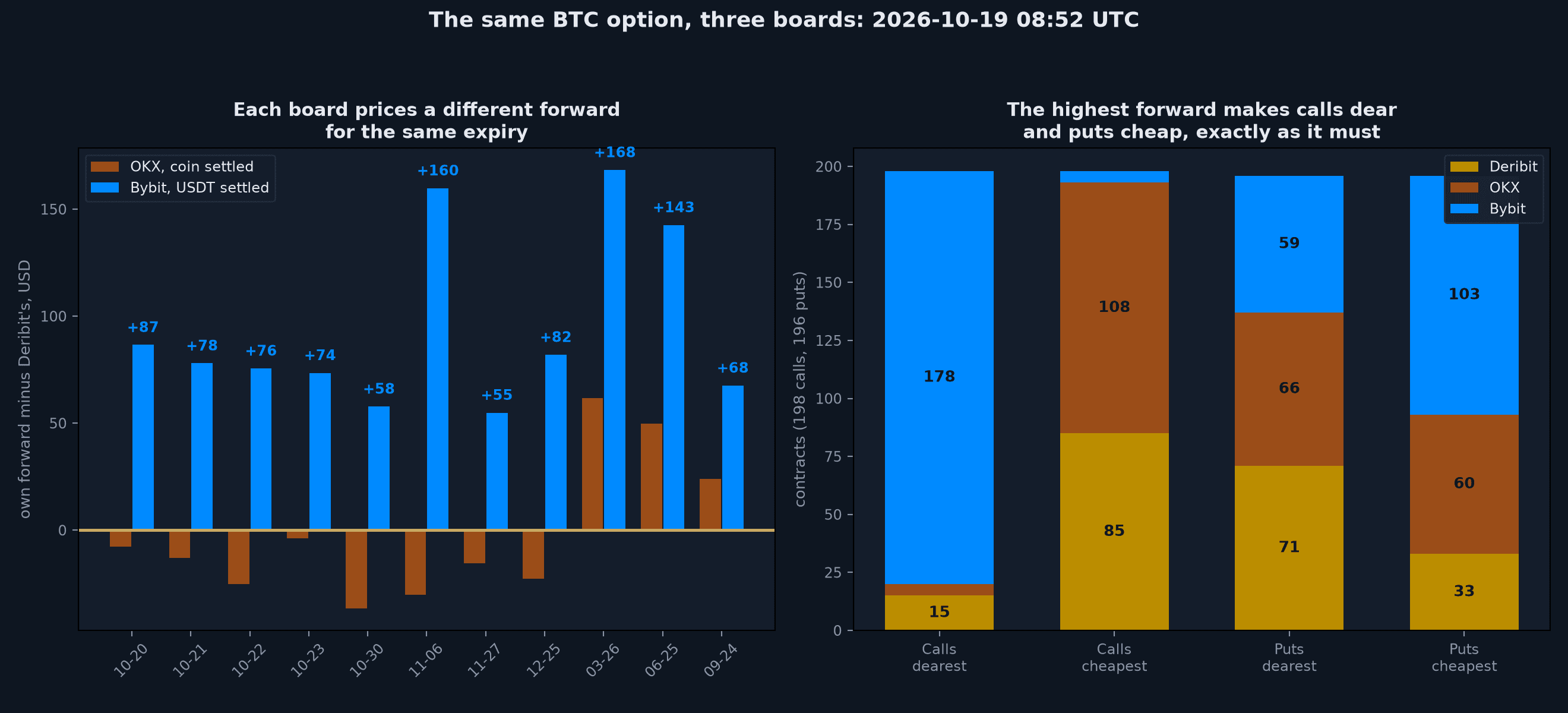
Because it is pricing a different forward, and a forward difference moves calls and puts in opposite directions. Each board publishes its own forward for each expiry, and at 08:52:26 UTC Bybit's sat above Deribit's on all 11 shared expiries, from 54.9 dollars on 2026-11-27 to 168.3 dollars on 2027-03-26. OKX's sat below Deribit's on 8 of the 11, by as much as 36.6 dollars.
Seven of the 11 shared expiries, chosen to span the curve; the cover chart above plots all 11. The largest Bybit premium, 168.3 dollars at 2027-03-26, is in the table; the two largest among the four expiries not shown are 2026-11-06 at 159.8 and 2027-06-25 at 142.6.
Expiry | Days | Contracts | Deribit forward | OKX minus Deribit | Bybit minus Deribit |
|---|---|---|---|---|---|
2026-10-20 | 1 | 31 | 82,749.1 | -7.8 | +86.6 |
2026-10-23 | 4 | 40 | 82,797.9 | -3.8 | +73.5 |
2026-10-30 | 11 | 56 | 82,914.2 | -36.6 | +57.8 |
2026-11-27 | 39 | 34 | 83,242.6 | -15.5 | +54.9 |
2026-12-25 | 67 | 54 | 83,581.2 | -22.7 | +82.0 |
2027-03-26 | 158 | 32 | 84,622.0 | +61.7 | +168.3 |
2027-09-24 | 340 | 26 | 86,871.9 | +24.0 | +67.6 |
A higher forward makes every call worth more and every put worth less, and that is exactly the pattern in the quotes: Bybit held the dearest call on 178 of 198 calls and the dearest put on only 59 of 196, while holding the cheapest put on 103 of 196. On puts the dearest venue is close to a three way split, 71 Deribit, 66 OKX, 59 Bybit, because there the forward advantage works against the USDT board and cancels whatever else is going on.
It is tempting to finish the job: shift every quote to a common forward using each contract's delta and report the residual. Doing that takes the median gap from 61.93 to 31.36 dollars, about half, and cuts the crossings from 132 to 103. Read per contract instead of on the summary it is much weaker: the median contract keeps 85.3 percent of its gap, and 142 of the 394 come out wider rather than narrower, so the adjustment is not a correction that cleans the board. It is also the trap this post is about, because it multiplies an inverse board's coin delta by a dollar price difference, and the next section measures why those two objects do not belong in the same expression.
Why can a delta not reconcile the two prices?
Not because the contracts pay differently. A Deribit or OKX inverse option settles in coin, paying the intrinsic value divided by the settlement price, so in dollars it pays the same max of spot minus strike and zero that Bybit's USDT settled contract pays, up to the USDT peg. What differs is the numeraire: the premium is quoted and the collateral is posted in BTC on one board and in USDT on the other, and the risk numbers each board derives from its own price are therefore derivatives of different functions.
The boards' own fields show it rather than assert it. Across the 394 compared contracts OKX's reported delta ranges from -2.391 to +0.946 and 45 of the 394 sit below -1, while on its full 704 contract coin settled BTC-USD board it reaches -2.8709 with 89 contracts below -1. Bybit's ranges from -1.000 to +1.000 and not one contract leaves that interval. On the 2026-12-25 200,000 strike put, OKX reports -2.391 and Bybit reports -1.000 for what the ticker symbols present as the same option. A delta below -1 is impossible for the dollar price of a vanilla put, so the two boards are not reporting the same quantity in the same units. OKX's own row shows why. It also carries deltaBS, which OKX documents as the Black-Scholes delta in dollars. In our re-read on 2026-10-24 it stayed between -1 and +1 on every coin settled contract, while delta reached -2.99. On all 792 of those contracts, delta equalled deltaBS minus the mark premium in BTC, to within 0.0005: it is the delta of a price measured in coin, and it falls below -1 whenever that premium exceeds one plus deltaBS, which on a deep in the money put happens at a premium of a few hundredths of a coin. The boards are not pricing different options; OKX's delta field uses a different numeraire, and its deltaBS is the field comparable with Bybit's.
So the practical rule is narrow and it is the one most screeners break: you may compare the two boards' dollar prices, and you may not use a coin board's delta, vega or gamma to adjust them. That is a unit error, not a modelling preference, and it is why the forward restatement above is shown as a demonstration rather than offered as a result.
Is the gap an arbitrage?
Mostly not, and the way it fails is specific. Taking Deribit against Bybit, the pair where the settlement currencies differ, the snapshot at 08:53:43 UTC showed 69 crossed legs. Deribit's own API publishes its option commission as 0.0003 BTC per contract, maker and taker alike, and its published fee schedule caps that at 12.5 percent of the premium; Bybit's help centre publishes 0.03 percent of the index for a taker, with the fee capped at 7 percent of the option price. Charging both legs at those published rates, the median crossing is 61.52 dollars gross against 49.66 dollars of fees, and 36 of the 69 still clear.

The 36 crossings that survive both venues published fees, with marker area showing the size available on the smaller of the two legs, median 3.40 BTC. They are not spread across the board: 31 of the 36 had no trade on Deribit in the previous 24 hours and 33 had none on Bybit, 13 of the 36 sit beyond 0.9 in absolute delta, and the largest sit on 160,000 and 150,000 strike puts 340 and 249 days out. An edge that only exists where nobody trades is a quote staleness reading, not a strategy.
Then look at where they are. Of those 36, 31 had no trade on Deribit in the previous 24 hours and 33 had none on Bybit. 13 of the 36 sit beyond 0.9 in absolute delta, measured on the average of the two boards' own delta fields and therefore carrying the scaling problem above, deep in the money, which is where the premium is largest and where a quote that nobody has refreshed is worth the most dollars. The top of book size on the smaller leg was 3.40 BTC at the median, with Bybit's sizes from that 08:53:43 UTC board read and Deribit's from a per instrument ticker sweep that finished 08:53:47 UTC, four seconds later because the board summary publishes no size, so the whole set was worth 77,289 dollars with a median of 1,119 dollars per contract and a maximum of 8,732 dollars, and the three largest entries are 160,000 and 150,000 strike puts expiring in 340 and 249 days.
So the honest statement is narrow. Three things would each have to be true before any of this is tradable, and this post verifies none of them: that both legs fill at the quoted price and size, that a BTC settled short against a USDT settled long is a position a risk desk will carry rather than a currency mismatch, and that the quote on the dormant side is still there a second later. What the measurement does establish is that 132 of 394 contracts cross, that the crossings concentrate in the dormant deep wings, and that a screener comparing boards on strike and expiry alone will surface these first and loudest.
Is the disagreement in vol points or in dollars?
Both, and they point at opposite ends of the board, which is why one number alone is misleading. The mark implied volatility gap across the three venues has a median of 0.690 points, a middle half from 0.296 to 2.193 and a maximum of 20.186. Read in volatility, the disagreement is worst on the deep out of the money wing: 2.119 points at the median for the 80 contracts under 0.1 in absolute delta, against 0.465 points on the 63 contracts near the money. The buckets are wide enough that this is a central tendency and not a rule: the wing bucket's middle half runs from 0.783 to 4.118 points and the near the money bucket's from 0.200 to 0.760. Read in dollars, those same wing contracts are the most agreed upon on the board at 7.26 dollars, because a contract worth almost nothing cannot disagree by much.

363 of the same 394 contracts, two measures, opposite conclusions: the bars set the cross venue gap in mark implied volatility against the cross venue gap in quoted mid premium, so they differ in price field as well as in unit. The deep out of the money wing disagrees by 2.12 vol points and 7.26 dollars; near the money it is 0.47 points and 42.51 dollars, and the widest dollar gap is one bucket further in, 97.91 dollars on the 106 contracts between 0.65 and 0.9. Neither reading is wrong and a post that quotes only one of them is choosing its own headline. Counts per bucket are printed under the axis, and they sum to 363 rather than 394: the 31 contracts whose averaged delta sits beyond 1.01 in absolute value fall outside the five buckets and are excluded here, which is the same coin delta artifact the section above is about. The thinnest bucket is the deep in the money one at 38 contracts.
Which board quotes the tightest, and does the answer survive its unit?
It does not, which is the most useful thing in this post for anyone choosing a venue. Measured as a share of the mid premium, Bybit is tightest at 2.11 percent, OKX second at 3.28 percent and Deribit widest at 5.32 percent. Measured in multiples of each venue's own minimum price increment, the order reverses: Deribit's median quote is 3.0 ticks wide, OKX's 10.0 and Bybit's 11.5.
The marginal quartiles overlap heavily, so the ranking rests on the paired comparison rather than on those medians: contract by contract on the same 394, Bybit's quote was tighter than Deribit's on 301 of 394, OKX's was tighter than Deribit's on 273, and Bybit's was tighter than OKX's on 241. Both readings are true because the tick sizes differ by up to a factor of about eight, Deribit's coarse step against Bybit's. From each venue's own instrument endpoint: Deribit quotes BTC options in 0.0001 BTC steps and 0.0005 BTC steps above a premium of 0.005 BTC, which at this index is 8.27 and 41.37 dollars; OKX quotes in 0.0001 BTC, which is 8.27 dollars; Bybit quotes in 5 USDT. Deribit's percentage width is largely its coarse tick: at 41.37 dollars a tick, a three tick quote cannot be narrow in percentage terms. The same mechanism showed up on a different instrument class in Athenum's measurement of tick size against taker fee on perpetuals.

One set of quotes, two units, two different winners. In percent of premium Bybit is tightest at 2.11 against Deribit's 5.32; in ticks Deribit is tightest at 3.0 against Bybit's 11.5, because Deribit's tick above a 0.005 BTC premium is 41.37 dollars where Bybit's is 5.00. The bands are interquartile ranges: Bybit's ticks run from 1.0 to 43.25, so its quoting is far less uniform than its median suggests.
Width is also not the whole of execution. 112 of Bybit's 394 quotes sat at exactly one tick against 43 on Deribit, and the quoted depth behind a quote is a separate question from its width, which our earlier round trip cost measurement on the Deribit board treats in detail for a single venue.
Where does the derivatives liquidity actually sit?
Not on the options boards. Athenum's own cross exchange feed, read for the 2026-10-19 08:00 UTC bar, puts aggregate BTC perpetual open interest at 22.17 billion dollars across the six venues it names individually: Binance 7.86 billion, Bybit 4.80 billion, Hyperliquid 3.31 billion, Bitget 2.83 billion, OKX 2.53 billion and Deribit 0.84 billion. Deribit, the venue holding 227,112 BTC of option open interest on the 394 contracts compared here against Bybit's 12,605, is 3.8 percent of the perpetual pool. The feed's own aggregate field reads 22.34 billion, 0.78 percent above the sum of the six it names, so the shares above are computed against the named sum rather than the aggregate. Only the open interest fields of that bar are used here: the same row carries a zero in several of its volume and flow fields, which is a gap in the bar rather than a reading about those venues.
Activity on the compared set tells the same story twice over. Over 24 hours the 394 contracts turned over 14,451 BTC on Deribit against 4,697 on Bybit, and 188 of the 394 had no Deribit trade at all while 172 had no Bybit trade. Counting the contracts silent on BOTH boards rather than on either, 136 of the 394, about a third, did not trade anywhere in 24 hours.
If you want to price one of these contracts yourself rather than take a board's mark, the free Black Scholes calculator takes a forward, a strike and a volatility, and the options profit calculator shows the payoff you would actually be holding. Both are free, and the forward each board publishes is the input most people get wrong.
Is this new, or has it been measured before?
Parts of it are old and the measurement is not. The pricing and hedging of inverse options against direct ones, including their greeks and the sources of market incompleteness in each, is set out in the Black-Scholes setting by Alexander, Chen and Imeraj, "Inverse and Quanto Inverse Options in a Black-Scholes World" (arXiv:2107.12041), which also distinguishes the plain inverse put, whose delta keeps the usual monotonic shape, from the quanto inverse put, whose delta has no lower bound. And the short maturity behaviour of at the money implied volatility and skew for inverse European options under general stochastic volatility models, with an empirical application to Deribit BTC options, is in Alos, Nualart and Pravosud, "On the implied volatility of Inverse options under stochastic volatility models" (arXiv:2401.00539, December 2023). The question of whether an apparent pricing violation in a crypto option market survives transaction costs has also been asked directly, on a single venue, in Felfoldi-Szucs, Kralik and Varadi, "Put-call parity in a crypto option market, evidence from Binance", Finance Research Letters (2024).
What we could not find anywhere in that record is the measurement in this post: the per contract dispersion of the same strike, expiry and type across Deribit, OKX and Bybit read at one instant, with the shared board counted (414 listed on all three, 394 quoted on all three), the gap sized in the contract's own premium (2.72 percent at the median), the crossings counted (132 of 394) and the forward difference established in the same read (above on 11 of 11 expiries). The theory above explains why our delta adjustment is invalid; it does not contain these numbers.
How do you check this yourself?
1. Read all three boards at once, not in sequence. Deribit's get_book_summary_by_currency with kind=option, OKX's market/tickers plus public/opt-summary for uly=BTC-USD, Bybit's v5/market/tickers with category=option. Record the skew between the first request and the last response; ours was 1.21 seconds.
2. Check the body of each response before parsing it. OKX returns code and Bybit returns retCode inside an HTTP 200, so a failed read can arrive looking like a successful one.
3. Key every contract on expiry date, strike and type rather than on its symbol. The three venues write the same contract as BTC-30OCT26-83000-C, BTC-USD-261030-83000-C and BTC-30OCT26-83000-C-USDT.
4. Convert to one currency using each venue's own index. Deribit and OKX quote premium in BTC per 1 BTC of underlying; Bybit quotes in USDT.
5. Drop the one sided quotes before comparing, and report how many you dropped. We compared 394 of 414 shared contracts.
6. Pull each venue's forward for each expiry, and expect them to differ. Do not reconcile the boards with a delta adjustment across settlement conventions: check the reported deltas first, and if any sits beyond 1 in absolute value you are looking at an inverse payoff.
7. Charge both legs at the venues' published fees before calling anything a crossing, and check the 24 hour volume of each leg. Ours were dormant.
What this does not show
The measurement is five snapshots inside 16 and a half minutes on one morning, so it says nothing about how these gaps behave across a day, a week or a volatility regime. It compares top of book only, with no depth beyond the best quote and no attempt to fill anything. The fee arithmetic uses each venue's published entry tier, so any trader with a maker rebate, a VIP tier or a market maker agreement faces different economics, and OKX's crossings are reported without a fee verdict because its options fee schedule is the one rate here we could not pull from a primary endpoint today. Quote size is reported differently by each venue and we only measured it in part: across the 394 contracts Bybit's top of book bid carried a median 6.65 BTC across 220 distinct sizes, with bid size equal to ask size on 136 of the 394, and OKX's carried a median 9.75 BTC, while Deribit publishes no size in its board summary at all, so its depth enters this post only through the crossed subset, where the smaller leg held a median 3.40 BTC. None of that is the depth behind the quote, which no venue shows at top of book. The 24 hour volume fields come from each venue's own ticker and are not independently audited. Finally, the inverse against linear argument above is a payoff and convention argument supported by the venues' own published deltas; it is not a replication of the pricing literature, and the cited papers cover the theory of inverse options and put-call parity on a single venue rather than the cross venue comparison measured here.
Every number above comes from Athenum's live cross exchange view, one normalized feed across the venues we cover, and the 37 calculators sitting next to it stay free: no account, no email, no usage limits. Start a free 7 day Pro+ trial if you want the cross venue view on your own screen.
One terminal. All the data.
Liquidations, orderbook depth, whale walls & open interest, all real-time, in one place. 29 supported exchanges; coverage differs by tool.
No credit card required

Athenum Analytics
Athenum Analytics is our three-person editorial team covering crypto derivatives, market data and macroeconomic context.