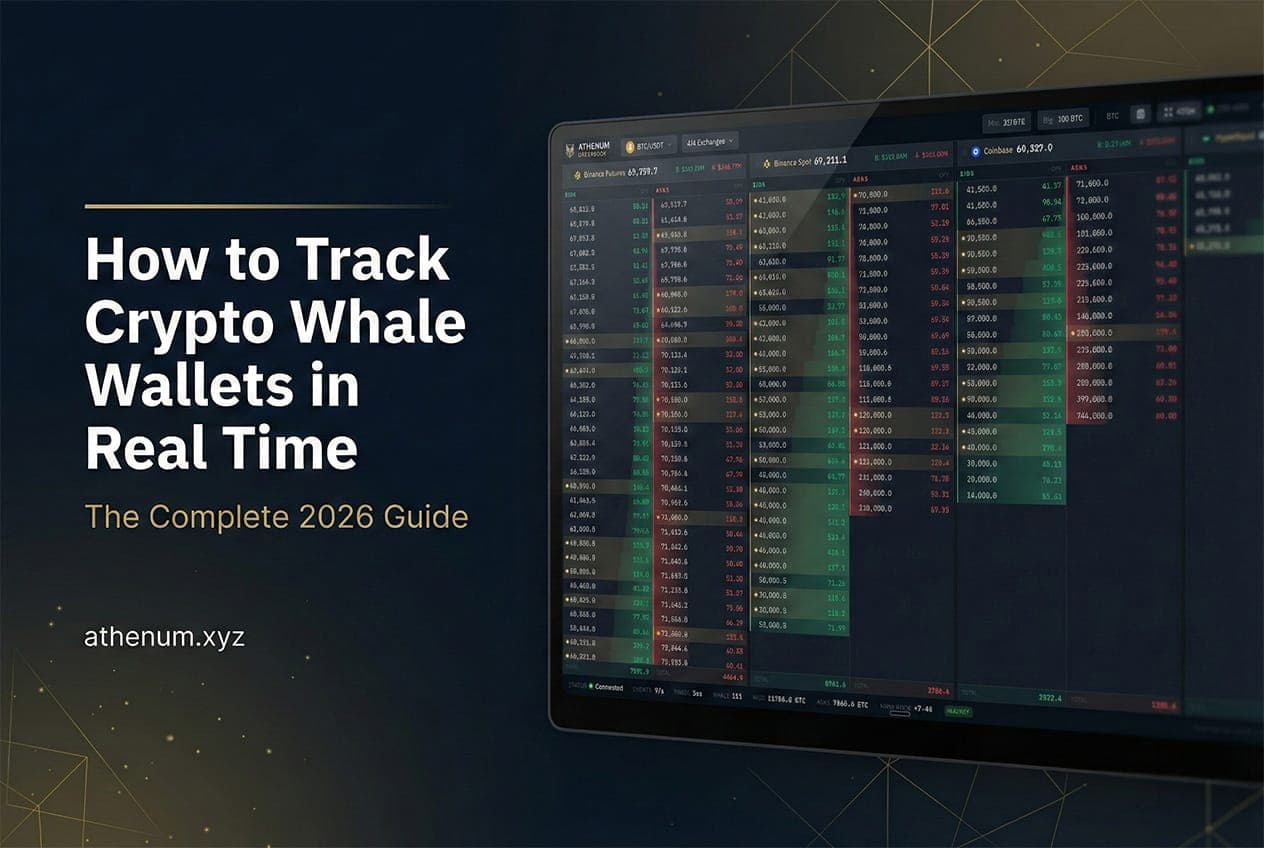
How to Track Crypto Whale Wallets in Real Time: The Complete 2026 Guide
Crypto whales are the single most powerful force in digital asset markets. A whale is any wallet or entity holding enough of a token's supply to meaningfully shift price when they buy or sell, typically defined as holding 0.1% or more of circulating supply or moving $1 million+ per transaction. Their trades reshape order books, trigger cascading liquidations, and create the volatility that wipes out unprepared traders.
The good news: most major blockchains are public ledgers. Every transaction a whale makes is recorded permanently. The challenge is seeing it fast enough to act on it, and understanding what it actually means for price.
This guide breaks down the complete whale tracking pipeline, from raw blockchain data to real time order book monitoring, so you can stop trading blind and start reading the market the way institutions do.
Why Whale Tracking Is a Financial Imperative, Not a Nice to Have
The data on whale influence is unambiguous. Academic research using agent based models finds that increasing whale representation in simulated Bitcoin markets from just 1% to 6% more than doubles daily volatility. Separate studies clustering over 35,000 Bitcoin whale addresses show that their large accumulation or distribution episodes consistently coincide with significant price swings through supply and demand shocks.
The asymmetry between whales and retail traders runs deeper than most people realize. Empirical analysis of Ethereum transactions between 2018 and 2023 reveals a consistent pattern: large holders strategically increase their positions directly before statistically significant price appreciations, while retail holders systematically reduce their holdings immediately before those same moves. Retail traders are, in effect, providing exit liquidity for institutional distribution without even knowing it.
During the FTX collapse in November 2022, the largest wallet cohorts navigated the extreme volatility through sophisticated hedging or precisely timed automated exits. Retail investors holding less than $10,000 in ETH absorbed the vast majority of the total capital depreciation. The pattern repeats across every major market event.
Here is how whale behavior breaks down by wallet tier:
| Wallet Tier | Holdings (USD) | Typical Behavior |
|---|---|---|
| Apex Whales | > $1,000,000 | Strategic accumulation before price moves; extended cold storage holding; supply constriction |
| Institutional | $100,000 to $1,000,000 | Coordinated algorithmic trading; liquidity mining; high frequency execution |
| Mid Market | $10,000 to $100,000 | Reactive trading; trailing institutional moves; sentiment driven |
| Retail | < $10,000 | High transaction velocity; panic selling during shocks; systematically providing exit liquidity |
Understanding which tier is moving, and when, is the difference between being the one who sees the play and the one who funds it.
The Three Data Layers Every Whale Tracker Needs
Effective whale monitoring rests on three distinct data sources. Missing any one of them leaves critical blind spots.

Layer 1: On Chain Ledger Data
Every blockchain transfer records the sender address, receiver address, token type, transaction size, and timestamp. This is the foundation. By tracking unusually large transactions and building time series of holdings per address, you can detect when whales are accumulating, distributing, or repositioning.
The raw data alone is noisy, though. Address clustering and entity labeling techniques are what transform a wall of anonymous transactions into actionable intelligence. Platforms like Nansen and Arkham Intelligence group addresses controlled by the same entity, labeling them as exchange hot wallets, known funds, DeFi protocols, or identified whale addresses.
On Bitcoin specifically, this is done through two primary blockchain heuristics:
The multi input heuristic is the most reliable clustering method. When a Bitcoin transaction uses multiple input addresses to fund a single output, all those inputs must belong to the same entity because only the holder of the corresponding private keys could authorize their simultaneous expenditure. Recursive application of union find algorithms can group massive webs of seemingly unrelated addresses into single operational clusters in near linear time.
The change address heuristic identifies which output in a multi output transaction is returning excess funds to the original sender. Modern HD wallets generate new addresses for change, and algorithms detect these by looking for outputs that have never appeared on chain before, or that retain the decimal precision anomalies of the original input. This method carries higher risk of false positives, so professional analysts typically filter out any cluster containing over 500 unique addresses, as these likely represent service providers rather than individual whales.
| Heuristic | How It Works | Key Risk | Mitigation |
|---|---|---|---|
| Multi Input (Co Spend) | Groups addresses used as inputs in one transaction | Under clustering: misses segregated wallets | Supplement with off chain data |
| Change Address | Identifies new output returning excess to sender | Over clustering: merges distinct entities | Exclude clusters with 500+ addresses |
| Drip Spending | Tracks systematic small movements from large wallets | Requires extended observation | Real time threshold alerts |
Layer 2: Exchange and Mempool Data
On chain data tells you what happened. Exchange and mempool data tells you what is about to happen.
The mempool is the decentralized waiting room where unconfirmed transactions sit after being broadcast but before being mined into a block. Bitcoin has roughly 10 minute block times. Ethereum runs at about 12 seconds. By the time a block is confirmed and parsed, the market has already reacted. True real time tracking means parsing the mempool directly, catching whale transfers to exchange deposit addresses before they even settle.
On the exchange side, order book data exposes whale intent before any on chain transfer occurs. Large visible limit orders, sudden depth changes, and cross exchange imbalances reveal where big players are positioned. This is especially critical for derivatives and perpetual futures venues where whale activity happens entirely off chain.
Layer 3: Analytics and Alerting
The final layer aggregates multi chain and multi exchange data into unified dashboards with threshold based alerts. This is where raw signal becomes tradable intelligence. Configure alerts by transaction size, token, and direction (exchange inflow versus outflow) routed to Telegram, email, or webhooks so you catch time sensitive events as they happen.
The critical distinction here: most whale alert services only tell you that a large transfer occurred. They don't show you how that transfer interacts with current order book liquidity, where liquidation clusters sit, or whether the move is being absorbed or amplified. That context is what separates reactive tracking from predictive analysis.
How Whales Actually Move Markets: The Manipulation Playbook
Knowing what whales do is only useful if you understand how they do it. Crypto markets lack the coordinated circuit breakers and unified regulatory oversight of traditional exchanges, which creates a low risk environment for several documented manipulation strategies.
Spoofing and Order Book Manipulation
Spoofing is when a whale places massive buy or sell limit orders they never intend to execute. These artificial "walls" project false supply or demand. Retail traders and unsophisticated algorithms interpret them as insurmountable resistance or support, and trade accordingly. Once price moves to the whale's desired level, the spoofed order is cancelled and a genuine trade executes in the opposite direction.
Detecting spoofing requires real time order book monitoring that tracks both the placement and cancellation patterns of large orders. Historical behavior analysis of the placing wallet helps distinguish genuine institutional positioning from manipulative intent.
Cascading Liquidation Exploitation
This is arguably the most destructive whale strategy, and the one that creates the biggest opportunities for prepared traders. A whale executes a large spot sell off, intentionally driving price below key technical levels. This triggers the automated liquidation engines on leveraged long positions. As exchanges forcefully sell the collateral of liquidated traders, price drops further, triggering deeper liquidation cascades.
Once the cascade exhausts retail leverage, the whale re accumulates at the artificially depressed price. The whale profits from the round trip while thousands of retail positions are destroyed.
Understanding where liquidation clusters sit is therefore not just useful. It is predictive. If you can see where concentrated leverage is stacked, you can anticipate where whales will attempt to drive price.
Wash Trading and Volume Fabrication
Whales and sometimes exchanges themselves trade back and forth between their own wallets to manufacture artificial volume. No actual change in ownership occurs, but the blockchain records massive activity. This inflates rankings on data aggregators like CoinMarketCap, drawing unsuspecting retail investors into what appears to be a highly liquid market.
The South Korean Case Study: Concentration in Practice
Data from the South Korean Financial Supervisory Service provides a striking illustration of whale concentration. On Bithumb, the top 10% of users account for 97.97% of total trading volume. On Upbit, the figure is 89.36%. The remaining 90% of users contribute statistically insignificant liquidity.
| Exchange | Top 10% Volume Share | Remaining 90% Volume Share |
|---|---|---|
| Bithumb | 97.97% | ~2.03% |
| Upbit | 89.36% | ~10.64% |
This concentration fuels the "listing effect" phenomenon: when new tokens list on Korean exchanges, the vertical price spikes are not retail FOMO. They are coordinated whale buying designed to establish rapid markups for distribution into retail liquidity. The FSS is responding with AI powered surveillance systems scheduled for full deployment in 2026, specifically targeting abnormal order book patterns and coordinated trading.
The Real Time Whale Tracking Workflow
Here is the practical workflow for building a whale tracking setup that connects raw signals to trading decisions.
Step 1: Define Your Whale Thresholds and Watchlists
Start by defining what counts as a whale for your specific strategy. For Bitcoin, 1,000 BTC or equivalent is a common threshold. For Ethereum, 10,000 ETH. For altcoins, percentage of circulating supply matters more than absolute size.
Use analytics platforms to identify and label key entities: major exchange hot wallets, known funds, smart money addresses, and large DeFi liquidity providers. Group them into watchlists. Bootstrap these lists using public labels from Nansen or Arkham, then supplement with your own clustering based on deposit address patterns.
Step 2: Set Up On Chain Alerting
Configure a whale alert service to notify you whenever a transaction above your threshold involves addresses on your watchlist or moves between unknown large wallets and exchanges. Route alerts to channels you monitor continuously.
The most informative signals are not every minor transfer. Academic research confirms that many whale addresses behave as long term holders. The rare, large reallocations, specifically mass deposits to exchanges (potential sell pressure) or major outflows to cold storage (accumulation), are what coincide with regime changes in volatility and trend.
Step 3: Overlay Real Time Order Book Data
This is where most whale tracking setups fall short. Knowing a whale moved 50,000 ETH to Binance is useful. Seeing how that deposit reshapes the order book in real time is actionable.
Professional order book analytics aggregate depth data across multiple exchanges into a unified view, highlighting large orders through automated whale wall detection and emphasizing cross exchange imbalances. When a thick ask wall appears on one venue while another remains thin, that asymmetry signals where price pressure will concentrate.
For example, if a whale deposit alert fires simultaneously with a sudden appearance of a massive ask wall at or just above market price, you are looking at probable distribution. The whale's sell intent is visible in the order book before it fully executes.
Conversely, emerging bid walls far below current price often indicate whales preparing to accumulate on engineered dips. Disappearing liquidity, where walls are pulled just before sharp price moves, is a classic signal of informed traders avoiding adverse selection.
Step 4: Map Liquidation Clusters
Standard market trackers list isolated liquidation events after they occur. That is forensics, not trading intelligence.
Advanced analytics use density based clustering algorithms to proactively map where concentrated leverage is stacked. The visual output is a heatmap showing liquidation nodes: dense clusters of capital where a minor price drop triggers cascading forced selling.
By visualizing these nodes in real time alongside whale order book activity, you can see the full picture. The whale wall shows where institutional capital is positioned. The liquidation heatmap shows where retail capital is vulnerable. When the two converge, the trade thesis writes itself.
Step 5: Integrate DeFi and Cross Chain Activity
Whale strategies increasingly span multiple chains and protocols. Large withdrawals from Ethereum liquidity pools to a bridge, followed by increased bid depth on a perpetual exchange, may signal a whale moving spot inventory to use as margin for leveraged longs. Tracking these cross chain flows alongside centralized order book changes gives you the combined explanatory power of both data sources.
Step 6: Log, Measure, and Refine
For each whale alert, record transaction size, direction, entities involved, and order book state at the time. Track forward returns and realized volatility over multiple horizons: 5 minutes, 1 hour, 1 day. Over time, fit statistical models to quantify how much incremental predictive power whale features add beyond standard technical indicators.
This is how you move from anecdotal whale following to systematic, evidence based edge.
Why Order Book Analytics Are the Missing Piece

Traditional whale trackers excel at telling you that a big transfer happened. They fail at showing you how it interacts with current liquidity, slippage, and leverage. In fragmented crypto markets where the same asset trades on dozens of venues simultaneously, the order book is where whale intent becomes visible before it becomes price.
The key capabilities that differentiate professional order book analytics from basic whale alerts:
Multi exchange depth aggregation shows the full picture of where liquidity sits across venues, not just one exchange in isolation. A whale wall on Binance Futures means something different when Coinbase spot is thin above price versus when it is well defended.
Real time whale wall detection automatically isolates anomalous large orders and tracks their placement, modification, and cancellation patterns. Combined with historical wallet behavior data, this enables probabilistic assessment of spoofing versus genuine positioning.
Liquidation cluster mapping visualizes where leveraged positions are concentrated, revealing the structural vulnerabilities that whales exploit for cascading liquidation plays.
Sub 100ms update latency ensures you see order book changes as they happen, not seconds or minutes later when the opportunity has already priced in.
Limitations and Best Practices
Whale tracking is powerful, but it is one component of a complex market system that also includes ETF flows, macro news, and crowd behavior. Recent analysis highlights cases where ETF inflows and outflows overshadow direct whale activity in driving price.
Whales can also deliberately obfuscate their actions through OTC desks, order splitting, and cross venue routing. Any whale based signal must be treated probabilistically, not as deterministic prophecy.
Best practice: treat whale tracking as a complementary layer on top of robust risk management. Use it to size positions relative to liquidity, avoid trading into obvious walls, and recognize environments prone to volatility spikes. Scientific studies and real world data both support this approach: whales meaningfully shape volatility and microstructure, but consistent edge comes from integrating their behavior into a disciplined, data driven framework rather than chasing every splash.
What Comes Next: The 2026 Regulatory and Technology Landscape
The baseline for participating in crypto markets is rising fast. As regulators like the South Korean FSS deploy AI powered surveillance to combat manipulation, and as institutional players bring increasingly sophisticated execution strategies, access to professional grade analytics is shifting from advantage to prerequisite.
The transition from historical forensic analysis to real time, predictive infrastructure is the defining shift in modern market intelligence. Systems relying on API polling and standard block indexing are being replaced by architectures using millisecond mempool parsing, event driven webhooks, and graph database relationship mapping.
For traders serious about surviving the next cycle, the question is no longer whether to track whales. It is whether your tools show you enough context to actually act on what the whales are doing.
About Athenum
Athenum is a professional crypto derivatives analytics platform that aggregates real time order book data across Binance, Coinbase, and Hyperliquid into a unified dashboard. Core features include sub-100ms synchronized updates, whale wall detection, liquidation heatmap analysis, and cross exchange depth visualization. Built for serious traders who need to see where institutional capital is positioned before price moves. Learn more at athenum.xyz.
Orderbook Intel
97,890
97,878
97,866
97,854
97,842
97,830
97,818
97,806
97,794
97,782
97,770
WHALE WALL DETECTED AT 97,818
See the walls before the move
Real-time whale wall detection across 4 exchanges. Spot large orders that signal support and resistance.
View Live OrderbookSetup in under 60 seconds
