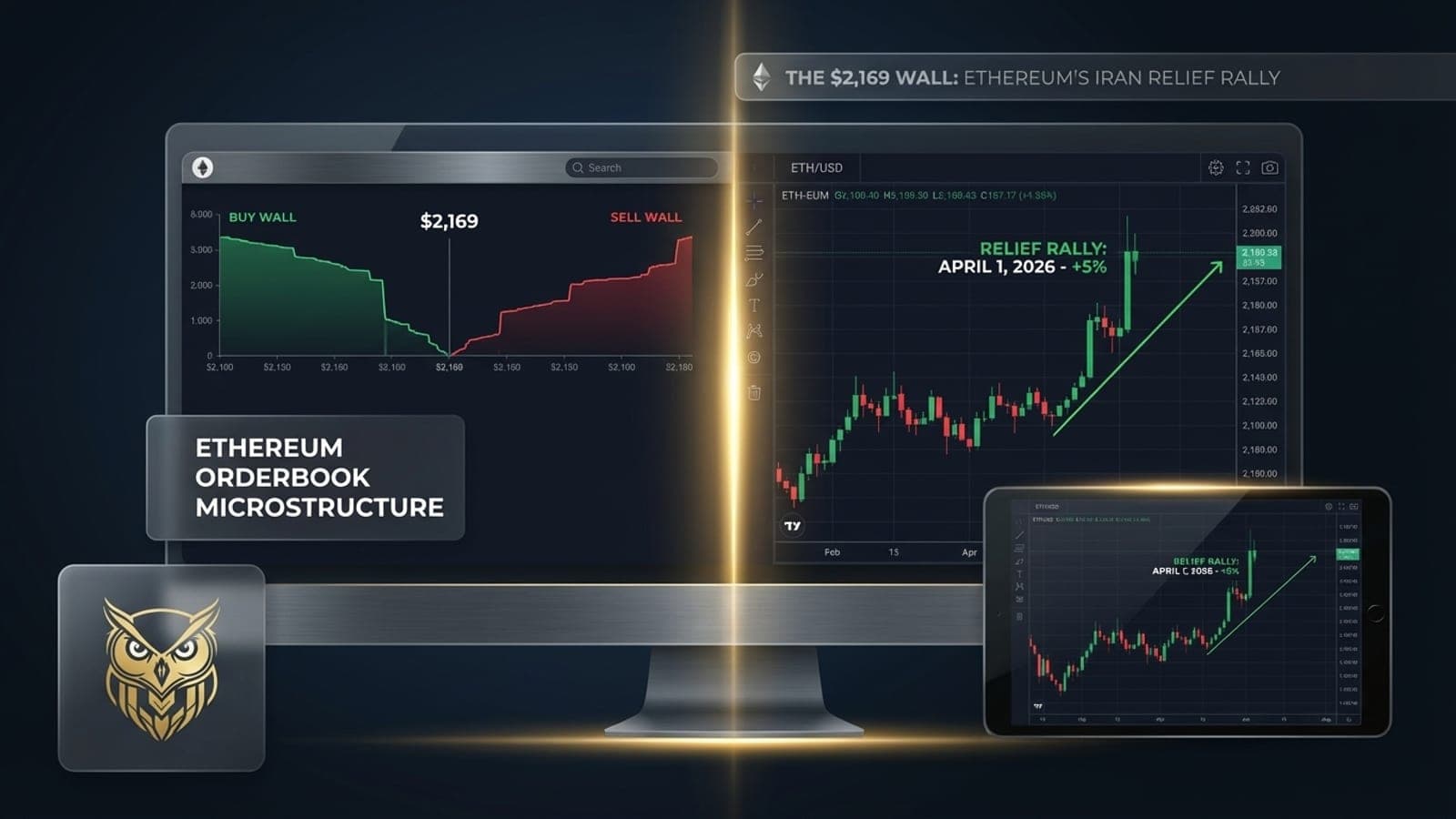

Ethereum gained roughly 5% on April 1, 2026, while Bitcoin advanced approximately 3% during the same session. Both moves were driven by the same catalyst: Iranian President Masoud Pezeshkian's statement that Tehran was prepared to end its conflict with the United States, followed by President Trump indicating the US would be "finished" with the Iran situation within two to three weeks. The relief across risk assets was immediate and broad. Oil fell 5%, the S&P 500 added 2.5%, and more than $1 trillion in global market value shifted within minutes of the announcement. But ETH's larger percentage move compared to BTC raises a structural question: was this fresh institutional buying, or were shorts covering a crowded position? Athenum's live orderbook data captures exactly which side of that debate the microstructure supports.
The Geopolitical Pressure That Built the Spring
The US-Iran conflict that began in early March 2026 triggered a sustained risk-off period across global markets. The VIX, which had traded at 17.44 before the escalation began, reached 30.61 by March 30, representing a 75.5% spike and crossing well above the 25 threshold that Athenum's macro model classifies as a risk-off signal. Per Athenum's live macro analytics, the VIX reading of 30.61 is flagged as "extreme," its highest classification tier.
The broader macro picture reflects the pressure. The NASDAQ Composite fell 7.97% from 23,461 to 21,590 between the most recent reference point and March 31. The S&P 500 declined 5.91% over the same period. Investment-grade credit spreads moved less dramatically, with the ICE BofA High Yield Index Option-Adjusted Spread widening from 2.88% to 3.46%, a 20.1% change that Athenum classifies as a neutral signal. The 10-Year minus 2-Year Treasury spread sits at 0.51, marginally above the 0.5 threshold that separates normal from inverted yield curve territory.
The composite result: Athenum's macro regime model classifies the current environment as "neutral" with a confidence score of 0.25. Confidence below 0.5 indicates a fragile regime where no strong directional signal dominates. The April 1 relief rally is happening inside a macro environment that has not confirmed a risk-on regime, only briefly retreated from the edge of risk-off. Per Athenum's live macro analytics as of the April 1 snapshot, the NASDAQ sits at 21,590 (down 7.97% from its recent reference level), the S&P 500 at 6,528 (down 5.91%), the HY spread at 3.46% (up 20% from 2.88%), and the 10Y-2Y spread at 0.51 bps, marginally above the inversion boundary.
The Athenum Angle: What the ETHUSDT Orderbook Shows
Orderbook microstructure reveals how participants are positioning in real time, independent of the price action visible on a candlestick chart. Athenum's L5 imbalance metric measures the ratio of bid-to-ask depth across the top 5 price levels on the Binance Futures orderbook, expressed on a scale from -1 (fully ask-dominated, no meaningful bid depth) to +1 (fully bid-dominated, no meaningful ask depth). Values oscillating rapidly between extremes signal a positioning phase: large participants are testing depth on both sides before committing directional capital, rather than steadily accumulating or distributing.
Over the eight-hour window from 10:00 UTC to 18:10 UTC on April 1, Athenum's live data captures the full arc of ETH's relief trade. The session opened with modest bearish pressure at -0.417 strong_bearish, consistent with carry-over selling from the prior session. Then, as the Iran peace signals emerged and broke into news feeds between 11:00 and 12:00 UTC, the orderbook shifted sharply.
Time (UTC) | L5 Imbalance | Signal |
|---|---|---|
10:00 | -0.417 | strong_bearish |
10:30 | +0.539 | strong_bullish |
11:30 | -0.840 | strong_bearish |
12:30 | +0.929 | strong_bullish |
13:30 | +0.986 | strong_bullish |
14:30 | +0.985 | strong_bullish |
15:30 | +0.706 | strong_bullish |
15:40 | +0.995 | strong_bullish |
16:00 | +0.892 | strong_bullish |
16:20 | +0.943 | strong_bullish |
17:00 | +0.581 | strong_bullish |
17:10 | +0.648 | strong_bullish |
17:20 | -0.015 | neutral |
17:25 | -0.996 | strong_bearish |
17:35 | -0.989 | strong_bearish |
17:50 | +0.550 | strong_bullish |
18:05 | -0.587 | strong_bearish |
18:10 | -0.366 | strong_bearish |
Athenum live orderbook data, ETHUSDT on Binance Futures, 5-minute interval. April 1, 2026.

The pattern splits into three phases. From 12:30 through 17:10 UTC, the L5 imbalance held near the +0.90 to +0.99 range almost continuously, with only brief interruptions. This is consistent with active accumulation during the Iran news window: bids dominated the top 5 price levels, ask depth was being consumed, and the rally had sustained orderbook support. At 17:20 UTC, the imbalance crossed into neutral (-0.015), and by 17:25 it collapsed to -0.996, a near-total inversion. The ask side of the book had become overwhelmingly dominant.
The practical implication: the buying pressure that drove ETH's 5% advance was real during the 12:30-17:10 window, supported by bid-heavy depth across the top 5 levels. But at approximately 17:20-17:25 UTC, that structure flipped entirely, which either reflects heavy new ask orders entering or the bid side being absorbed and withdrawn.
The Flash Wall at $2,169
The whale wall activity feed provides a more specific data point. At 18:11 UTC, Athenum logged a sudden cancellation of a Mega-tier ask wall on Binance Futures: price $2,169.76, USD value $3,684,100 (approximately $3.7 million), ask side, lifetime 2 seconds, fill percentage 0%.
A Mega-tier whale wall is defined by Athenum as a large-notional order that registers as a distinct structural level in the orderbook depth. This particular wall was placed and cancelled within 2 seconds with zero fills. That behavior has two possible explanations: a participant briefly tested the $2,170 level to read how the market would respond to visible ask supply, then pulled the order before it could be hit. Or the order was placed algorithmically as a momentary spoofing probe to suppress visible upward momentum. Either reading points to the same conclusion: significant selling interest was positioned at $2,169-$2,170, and that supply was not willing to be filled at prevailing demand.
A second Mega-equivalent cancellation on Binance Futures appeared simultaneously: a Large-tier ask at $2,134.73 ($812,745) cancelled after 2 seconds, also with 0% fill. The $2,130-$2,170 range held multiple short-lived ask walls in the same window that the L5 imbalance was flipping to extreme bearish.
The combined read: ETH's rally found structural resistance between $2,130 and $2,170, with large participants testing but not holding ask supply. The oscillation in L5 imbalance from the afternoon session reflects genuine positioning activity rather than a clean directional breakout.
The Deeper Layer: Macro Regime Fragility
The macro regime score of 0.25 deserves attention here. Athenum's composite macro signal integrates five independent indicators: VIX, high yield spreads, the yield curve, the federal funds rate, and a broad USD index. A score of 0.25 means that no single consistent directional signal is dominating, and the balance of evidence sits closer to risk-off than risk-on, despite the Iran de-escalation catalyst.
Specifically, VIX at 30.61 is still registering as a risk-off input (above the 25 threshold) even after the relief bounce. High yield spreads are at 3.46%, which is tighter than the 4.0% risk-off threshold but meaningfully wider than the 2.88% level from a few weeks ago. The NASDAQ at 21,590 is 7.97% below its recent reference level. One relief rally day does not reset macro regime scores that were built over weeks of deteriorating conditions.
The geopolitical catalyst that triggered April 1's move was also specific: Trump said the US would be "finished with Iran" within two to three weeks, and Iran signaled readiness for talks. This is different from a resolved conflict. The market traded the de-escalation signal as if the risk were removed. The macro regime model, drawing on slower-moving indicators like treasury spreads and credit, has not yet confirmed the same view.
This distinction matters for interpreting the orderbook data above. The rapid oscillation in L5 imbalance during the 17:20-18:10 period is consistent with a market testing whether the rally holds on a regime that hasn't yet flipped. When participants are uncertain whether the underlying environment has changed, they tend to probe both directions frequently rather than maintaining a committed directional position. Athenum's analysis of BTC's funding rate collapse from +6.6% to -12.5% APR showed how a fragile macro backdrop amplified positioning extremes in derivatives; the same dynamic is visible here in the orderbook.
How to Read a Positioning Phase in the Orderbook
Positioning Phase vs. Confirmed Breakout
The ETH orderbook session on April 1 provides a case study in distinguishing between a positioning phase and a confirmed breakout. In a confirmed breakout, the L5 imbalance would hold above +0.5 or +0.6 continuously as new capital enters from one direction, with the mid-price steadily rising. Short dips in imbalance would be shallow and brief, not approaching -0.9 or -1.0.
In a positioning phase, the pattern looks exactly like what Athenum's data shows above: the L5 swings between extreme bullish and extreme bearish values within short windows, even as the mid-price moves directionally. Large bid walls form, hold briefly, attract price, and then are cancelled. Large ask walls appear at round-number or technically significant levels, probe the market's depth, and are pulled. The mid-price trend is real, but neither side is holding its position with conviction.
The trigger for exiting a positioning phase is typically a catalyst that resolves the uncertainty driving the oscillation. In this context, that might be Trump's address on Iran resolving cleanly, or a sustained two-to-three-day follow-through in equities that shifts the macro regime score above 0.5 confidence. Until then, the 17:25 L5 inversion to -0.996 is as meaningful a data point as the sustained +0.99 readings from earlier in the session.
The whale wall behavior at $2,169-$2,170 adds a second reusable pattern: flash walls at structural levels are a tell that large participants are active but not committed. When a multi-million dollar order is placed and pulled in 2 seconds with zero fills, the participant was not trying to transact. They were reading the market's response to the visible supply. Seeing this pattern consistently at a specific price level identifies that level as contested, not broken.

Options Context: The $312 Million April 3 Expiry
ETH options provide a secondary data layer. Per Athenum's live options analytics, the April 3 expiry carries $312.5 million in notional with a put-to-call ratio of 0.76, meaning calls outnumber puts on this specific expiry. The max pain level for April 3 is $2,100. ETH spot at $2,130 is trading approximately $30 (1.4%) above this level. An open ETH CME gap at $1,989 also persists from the March 27 open, as analyzed in detail in Athenum's prior post on the subject. That downside CME anchor at $1,989 sits 6.7% below current levels and represents a structural force independent of the options expiry calendar.
Max pain, as measured by Athenum's model, is the strike price at which the aggregate notional loss for all open options contracts is minimized at expiry. When spot is above max pain, call holders are in-the-money and the mechanical pressure of gamma exposure tends to attract price back toward that level as the expiry approaches. The $30 gap between spot ($2,130) and max pain ($2,100) is not large enough to be a dominant force on its own, but it is directionally consistent with the ask-side pressure visible in the orderbook. The market structure from multiple angles converges on the $2,100-$2,130 range as a contested zone.
For comparison, BTC's April 3 max pain is $68,500 against a spot price of approximately $68,015, meaning BTC is currently trading $485 (0.7%) below its max pain level. The two assets are in opposite positions relative to their near-term max pain anchors: ETH sits 1.4% above its $2,100 level facing modest downward gravity, while BTC sits 0.7% below its $68,500 level facing upward gravity. The notional scale difference is also significant: BTC's April 3 expiry carries $1.84B versus ETH's $312.5M, roughly 6x the options pressure. The max pain dynamics for Friday's close are primarily a BTC story, with ETH as a secondary participant.
ETH at $2,130: The Forces in Play
ETH's 5% advance on April 1 reflects genuine buying: the L5 imbalance ran near the bullish extreme for over four hours, from 12:30 through 17:10 UTC. That is a real signal, not noise. But the same data shows that buying exhausted itself at approximately $2,135-$2,170, where a $3.7 million Mega ask wall tested resistance and was pulled in 2 seconds, and the L5 imbalance collapsed to -0.996 within 15 minutes of the buying wave's end. The move was real. The breakout confirmation is not there yet.
The macro regime sits at 0.25 confidence with VIX still at 30.61, a 75.5% increase from the 17.44 level recorded before the Iran escalation began. The S&P 500 and NASDAQ are still well below their recent reference levels. One session of de-escalation news moves risk assets, but it does not move the slower-moving indicators that drive the composite regime score. Until that score crosses 0.5, the "neutral" label reflects genuine ambiguity, not a transitional state on the way to risk-on.
The options structure adds a modest overlay: ETH faces $30 of downward max pain gravity into the April 3 expiry, against $312.5M in notional. BTC faces $485 of upward gravity into a $1.84B expiry. These are not dominant forces but they are additional inputs that align with the orderbook's reading of $2,100-$2,130 as a contested range, not a broken-out level.
What the confluence of signals says: ETH ran hard on a geopolitical catalyst, found structural resistance at $2,169-$2,170, and the orderbook shifted to net ask-dominated within 15 minutes. The macro regime remains fragile. The relief trade was real. Whether it extends depends on whether the Iran diplomatic process holds, and whether equities sustain the April 1 recovery through a regime score revision. Athenum's live analytics track that regime score in real time. Access the full macro and orderbook signal set at Athenum's analytics platform.
---
Sources
- CryptoRank.io. "Bitcoin, stocks rally because of chatter that Iran is ready to 'end the war' as Dollar Index sinks below 100." April 1, 2026. https://cryptorank.io/news/feed/c7116-bitcoin-stocks-rally-because-of-chatter-that-iran-is-ready-to-end-the-war-as-dollar-index-sinks-below-100
- Yahoo Finance. "Bitcoin and ethereum price today, Wednesday, April 1, 2026: Prices strengthen on news that Iran war may end in weeks." April 1, 2026. https://finance.yahoo.com/personal-finance/investing/article/bitcoin-and-ethereum-price-today-wednesday-april-1-2026-prices-strengthen-on-news-that-iran-war-may-end-in-weeks-120045601.html
- The Daily Hodl. "Bitcoin and Ethereum React As Trump Again Claims 'Great Progress' in Talks With Iran." March 31, 2026. https://dailyhodl.com/2026/03/31/bitcoin-and-ethereum-react-as-trump-again-claims-great-progress-in-talks-with-iran/
- 247 Wall St. "Why Is Crypto Crashing? Bitcoin, XRP, Ethereum, and Solana All Down This Week." March 28, 2026. https://247wallst.com/investing/2026/03/28/why-is-crypto-crashing-bitcoin-xrp-ethereum-and-solana-all-down-this-week/
- Athenum Analytics. Live orderbook imbalance, ETHUSDT, Binance Futures. Snapshot April 1, 2026, 18:10 UTC.
- Athenum Analytics. Whale wall activity feed, ETHUSDT. Snapshot April 1, 2026, 18:11 UTC.
- Athenum Analytics. Macro regime and indicators. Snapshot April 1, 2026, 18:10 UTC.
- Athenum Analytics. ETH options max pain data. Snapshot April 1, 2026, 18:11 UTC.
- CoinPedia. "What Will Happen to Bitcoin, Ethereum, Solana, and LINK as the US-Iran Warns Rests?" April 2026. https://coinpedia.org/price-analysis/what-will-happen-to-bitcoin-ethereum-solana-and-link-as-the-us-iran-warns-rests/