Compare liquidation and trading tools · Reviewed
Athenum vs Hyblock Capital
Athenum and Hyblock Capital compared on liquidation heatmaps and levels, free plans, alerts, API, trials and regular prices, with dated sources.
Published by Athenum Analytics, the maker of Athenum. This is our assessment of workflow fit, based on the linked documentation and our product. It is not an independent benchmark or a measured performance ranking. Read more about Athenum and its pricing.
Which fits your task?
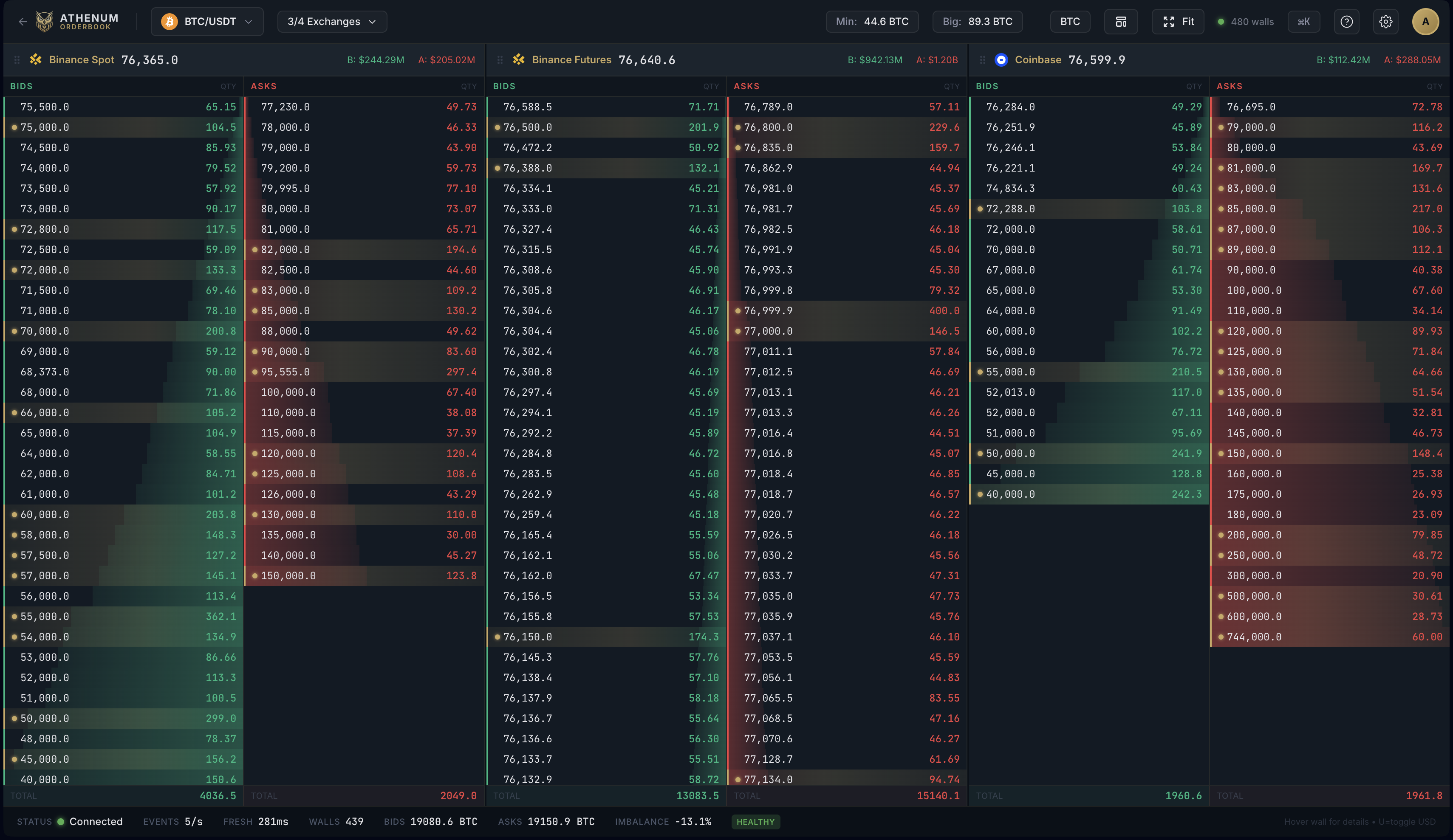
Choose Athenum when you want the liquidation heatmap and a Liquidation Map beside Whale Walls, Volume Delta, public funding and open interest pages and macro and TradeFi areas, with a published heatmap model and a Pro+ trial that needs no credit card.
Choose Hyblock Capital when you want an API key, an MCP connection and alerts on a free plan, a backtesting lab or live Hyperliquid strategies. Its liquidation heatmap, liquidation levels and OI heatmap start with the paid Advanced plan. [1]
| Task | Athenum | Hyblock Capital |
|---|---|---|
| Liquidation heatmap | Time-by-price liquidation heatmap for BTC, ETH and SOL, estimated from open-interest growth, with a Liquidation Levels view and a realized-liquidation overlay. It refreshes every 120 seconds. | Liquidation Heatmap and OI Heatmap from the Advanced plan. [1] |
| Liquidation map / levels | Liquidation Map for BTC, ETH and SOL: estimated liquidation levels by price for one exchange split by leverage tier (10x, 25x, 50x, 100x) or stacked across exchanges, over 1, 7 or 30 days. | Liquidation Levels from the Advanced plan. [1] |
| Order book | Whale Walls follows large resting orders and their lifecycle on 4 markets: Binance Futures, Binance Spot, Coinbase and Hyperliquid. | Orderbook depth and bid and ask liquidity data; on Hyperliquid also resting take-profit and stop-loss size. [4] [5] |
| Volume Delta / CVD | Volume Delta (CVD) covers 52 spot and futures instruments on 29 exchanges. Binance markets report taker volume directly; most other instruments are signed with a tick-rule estimate. | Volume Delta and anchored CVD endpoints in its API documentation. [5] |
| Free plan | Free plan: 1 analysis domain; Delayed data, no real-time entitlement; 1 venue per feature; Up to 24 hours of history; ETHUSDT, 1h, 4h and 1d intervals; No alerts. Start with 7 days of Pro+. No credit card required. | Free forever, no card needed: Tier 1 indicators, 1 saved alert, an API key with Tier 1 endpoints, 10 days of history and 60 requests per minute, and MCP with 200 calls per day. [1] |
| Trial | One 7-day trial per user, after email verification. No API keys during the trial. It ends without an automatic charge; you can then choose a paid plan or continue with Free. | No trials at the moment, according to its FAQ. [2] |
| Alerts | Macro alerts from Pro. Free has no alerts; whale notifications are planned. | 1, 5 or 20 saved alerts (Free, Advanced, Professional) by popup, email, webhook or Telegram. [1] |
| API | The Athenum API is in development and planned for Pro+. It is not available yet. | On every plan: Tier 1 endpoints and 10 days of history on Free; all endpoints, 600 requests per minute and up to 3 years of history on Professional. [1] |
| Regular price | Free plan at no cost. Lite $27, Pro $97, Pro+ $297 per month billed monthly; Lite $297, Pro $970 and Pro+ $2,673 per year billed yearly (USD). A founder offer on Pro+ Monthly is running. Current offer and terms | Free $0. Advanced $99 and Professional $499 per month at the regular monthly price; annual billing costs less. As of 2026-11-19. [1] |
On the review day Hyblock ran a Black Friday sale on Advanced and Professional, announced to end on 5 December 2026. Sale prices are not listed here. [1]
Where Hyblock Capital is stronger
- Every plan, Free included, comes with the terminal, alerts, an API key and MCP access. Free has Tier 1 endpoints with 10 days of API history and 1 saved alert by popup, email, webhook or Telegram. [1]
- A Backtesting Lab and live Hyperliquid strategies with portfolio analytics. [1]
- Up to 3 years of API history on Professional with annual billing. [1]
- Its plan page names 2,300+ tickers and 30+ exchanges for the whole product. [1]
What Athenum adds
- Time-by-price liquidation heatmap for BTC, ETH and SOL, estimated from open-interest growth, with a Liquidation Levels view and a realized-liquidation overlay. It refreshes every 120 seconds. How the heatmap works
- Liquidation Map for BTC, ETH and SOL: estimated liquidation levels by price for one exchange split by leverage tier (10x, 25x, 50x, 100x) or stacked across exchanges, over 1, 7 or 30 days.
- Whale Walls follows large resting orders and their lifecycle on 4 markets: Binance Futures, Binance Spot, Coinbase and Hyperliquid. Live Whale Walls Whale Walls documentation
- Volume Delta (CVD) covers 52 spot and futures instruments on 29 exchanges. Binance markets report taker volume directly; most other instruments are signed with a tick-rule estimate.
- Public live pages without an account: BTC and ETH funding on Binance, Bybit, OKX and Hyperliquid, and open interest on Binance, Bybit, OKX, Deribit, Bitget, Hyperliquid, Gate and HTX. Funding rates Open interest
- Macro, economic data and TradeFi areas sit in the same workspace. Pro: Order Flow + Derivatives, plus one of: Macro & Data, Macro Intelligence or TradeFi. Pro+: Order Flow, Derivatives, Macro & Data, Macro Intelligence and TradeFi. Individual module releases still apply. Plans and domains
- 37 free calculators that work without an account. Free calculators
- Published methods: the research studies come with downloadable data and calculation code, and the methodology page names the data sources.
How each tool estimates liquidations
Hyblock Capital: Hyblock says the heatmap calculates liquidation levels from market data and different leverage amounts and predicts where levels are opening but not closing, so actual liquidations will be lower. It asks readers to read the size as a relative number. [3]
Athenum: The estimated surface starts from each venue's open-interest growth, splits it into longs and shorts with a funding signal (the long share stays between 30 and 70 percent) and spreads it over a ladder of 49 leverage steps from 5x to 125x. Steps above a venue's own maximum leverage (50x on Hyperliquid, for example) are computed at that maximum, and each venue's maintenance margin sets the liquidation price. Intensity is relative, not dollars. Realized liquidations from Binance and Bybit are drawn as a separate overlay and count as a lower bound. The full model is published in the documentation. Read the liquidation heatmap documentation.
Both are estimates of where leveraged positions could be liquidated, not reported liquidations. Reported liquidation events are a separate data set and a lower bound, because exchange feeds limit what they publish.
Is a free plan with an API better than a free trial?
They answer different questions. A free plan shows whether the free limits are enough for a routine you keep running. A trial shows the full product for a short time. Compare the exact tier that holds the feature you need: on Hyblock the liquidation heatmap starts with Advanced, on Athenum the Free plan has one analysis domain and delayed data. [1]
A practical comparison you can repeat
Pick BTC and one lookback, then write down which plan each tool needs for the liquidation view you use. Compare the price levels where both tools show the densest estimated liquidations, note each model's leverage assumptions, and keep realized liquidations as a separate check.
Evidence and limits
Our Bitcoin perp holding-cost audit compares funding with fees in a stated historical sample. For visible liquidity, read Whale Walls behavior and limitations and the heatmap interpretation checklist. Prices, entitlements and feed coverage can change; verify the exact edition and market before paying or migrating.
Sources checked for this comparison
- Hyblock Capital: plans and pricing, checked
- Hyblock Capital: FAQ, trials, checked
- Hyblock Academy: liquidation heatmap, checked
- Hyblock Capital: home page, checked
- Hyblock API documentation: Volume Delta and order book, checked
Other comparisons
- Athenum vs CoinGlass
- Athenum vs The Kingfisher
- Athenum vs Bookmap
- Athenum vs Exocharts
- Athenum vs TradingView
- Athenum vs Velo
For a broader shortlist, see the CoinGlass alternatives guide. For the side-by-side table of liquidation tools, visit the comparison overview.
Send a correction with the product edition, source URL and date.