Trading journal: costs, decisions and honest performance
Allocate partial-exit costs, review rule adherence, preserve thesis revisions and separate external cash flows from trading returns.
What you will practise
Build a journal that reconciles money and decisions without rewriting unsuccessful trades or confusing deposits with profits.
Before you start
- Reconcile actual fills and net linear P&L.
- Understand trade-level R, equity and the original risk plan.
Course outline
- 1
Partial exits: allocate fees and funding without double counting
Reconcile entry fees, funding and exit charges across a partially closed position. Keep analytical cost allocation separate from actual cash timing.
7 min - 2
Trading journal review: separate rule adherence from profit
Build a process-versus-outcome review using rules recorded before entry. Avoid rewarding a profitable violation or declaring every compliant loss a mistake.
7 min - 3
Trade thesis changes: preserve the original plan and its revisions
Record a changing trading hypothesis without overwriting the entry rationale. Separate newly available evidence, risk changes and retrospective explanations.
7 min - 4
Trading account returns: remove deposits and withdrawals from performance
Calculate linked subperiod returns around external cash flows. Separate account growth, net trading P&L and time-weighted investment return.
7 min
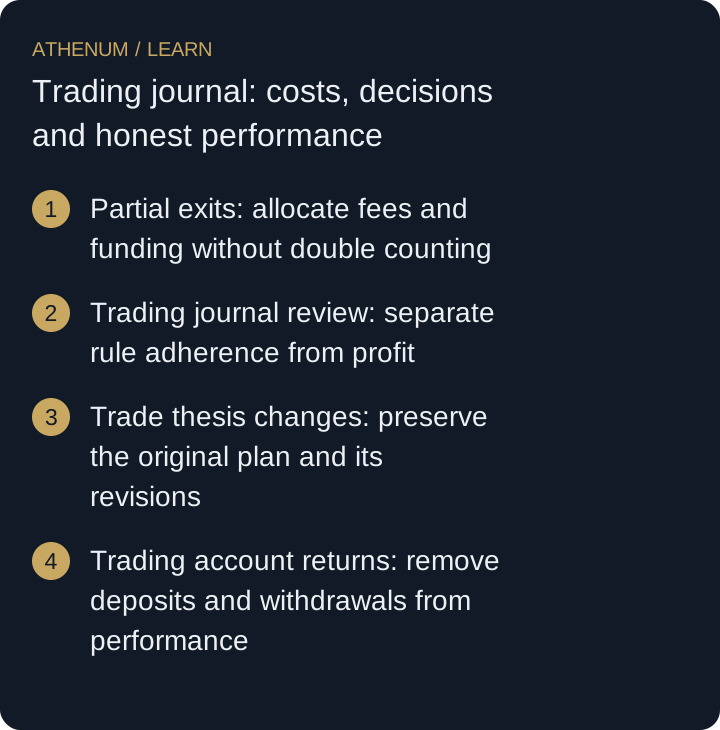 Open full-size diagram
- Partial exits: allocate fees and funding without double counting
- Trading journal review: separate rule adherence from profit
- Trade thesis changes: preserve the original plan and its revisions
- Trading account returns: remove deposits and withdrawals from performance
Educational material. Examples do not establish a profitable strategy. Trading costs, gaps and liquidation can produce losses beyond a planned stop.