Trading journal: costs, decisions and honest performance · 1 / 4
Partial exits: allocate fees and funding without double counting
A partial exit can look more profitable if all entry costs are left with the remaining position, or less profitable if the full entry fee is charged again on every exit. Pick an allocation convention, preserve the cash ledger and make the completed trade reconcile.
Athenum7 minUpdated:
Separate attribution from the exchange cash ledger
An exchange debits a fee or funding payment at an actual time. An analytical journal can allocate that cost across position units to compare exit tranches. Allocation does not move the cash payment in time or change account equity. Keep the original debit and the attribution ledger as separate views of the same cost.
This lesson uses proportional allocation by original quantity for costs incurred while the full position was open. A fee of 1 USDT on ten units allocates 0.10 per unit. If funding is charged after some units have closed, allocate it only to the position exposed at that settlement under the venue’s actual rules, not automatically to all original units.
Reconcile the remaining cost balance
For each partial exit, attribute its share of eligible entry and holding costs, then add the actual exit fee. Carry the unallocated balance with the remaining units. The sum of attributed and remaining costs must equal the original cost ledger at every step.
If fees are charged in another asset, retain the quantity and conversion convention. Rounding should not create or erase costs: assign any final rounding residual explicitly. Adding to a position, inverse payoffs and changes in funding exposure require a richer lot ledger than the one-entry linear example below.
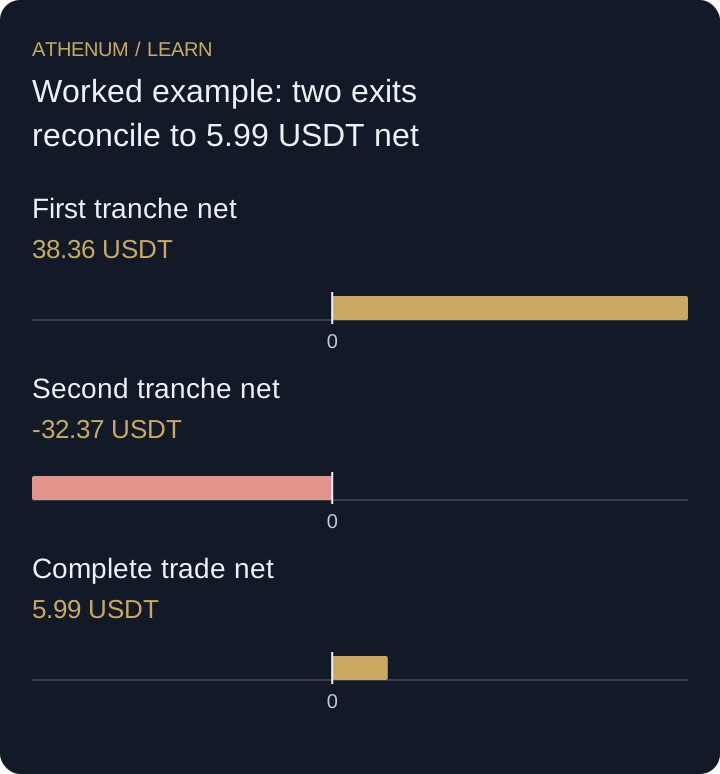
Worked example: two exits reconcile to 5.99 USDT net
Buy ten hypothetical linear units at 100. The entry fee is 1 USDT and a funding charge of 2 occurs while all ten units remain open. Four units exit at 110 with a 0.44 exit fee. Allocate 0.40 of entry fee and 0.80 of funding to them: their attributed net P&L is 40 − 0.40 − 0.80 − 0.44 = 38.36.
The remaining six units later exit at 95, with no further funding and a 0.57 exit fee. Their gross P&L is −30; remaining entry and funding costs are 0.60 and 1.20. Attributed net is −32.37. Together the tranches earn 5.99, matching gross 10 minus entry fee 1, exit fees 1.01 and funding 2. All rates and fills are constructed assumptions.
| Exit | Gross P&L | Entry fee allocated | Funding allocated | Exit fee | Attributed net |
|---|---|---|---|---|---|
| 4 units at 110 | 40 | 0.40 | 0.80 | 0.44 | 38.36 |
| 6 units at 95 | −30 | 0.60 | 1.20 | 0.57 | −32.37 |
| Complete trade | 10 | 1.00 | 2.00 | 1.01 | 5.99 |
 Open full-size diagram
- First tranche net: 38.36 USDT
- Second tranche net: -32.37 USDT
- Complete trade net: 5.99 USDT
Attributed realized P&L is not the cash balance
After the first exit, the actual booked cash change from the listed events is 40 − 1 − 2 − 0.44 = 36.56 USDT, excluding unrealized P&L. The first tranche’s attributed net is 38.36 because 1.80 of already paid costs remains analytically assigned to the open six units. Calling 38.36 the account’s cash gain would confuse two valid but different ledgers.
Before acting
- Keep actual fee and funding timestamps.
- Declare which units each cost belongs to.
- Reconcile allocated plus remaining costs after every exit.
- Distinguish tranche attribution, booked cash and marked equity.
Check your understanding
Ten units incur a 1.50-USDT entry fee and 2.50 of funding before any exit. Three units then close for 18 gross with a 0.30 exit fee. What is their attributed net under proportional allocation, and what cost remains assigned to the seven units?
Show the explained answer
The first three units receive 30% of 4 USDT, or 1.20, in shared costs. Their attributed net is 18 − 1.20 − 0.30 = 16.50. The remaining analytical cost balance is 2.80 USDT. The actual 4-USDT cash debit has already occurred and must not be charged again when the remaining units close.