Trade management: reconcile exits, exposure and time · 1 / 5
Calculate realized R after partial profit taking
A replay can show price reaching a 2R target while the complete trade earns much less. The result depends on how much remained at each exit and what happened to the rest. Reconcile the filled quantities before assigning a reward multiple.
Athenum8 minUpdated:
Freeze the denominator before reducing the position
In this lesson, 1R is the original planned price-risk amount before fees: initial quantity multiplied by entry-to-stop distance. Keep this denominator for every partial exit of the same trade. Other journals include costs in initial R; that is a different declared convention. Reducing the open quantity does not retrospectively reduce the denominator used to report the original trade.
For a fully closed linear long with one entry price E, gross P&L is the sum of q_i × (P_i − E) over the confirmed exits. Divide that sum by original R. Equivalently, multiply each exit’s per-unit R multiple by its fraction of initial quantity, then add the contributions. The fractions sum to one only when the original position has completely closed without further additions.
Follow quantities through the exit plan
Write both the requested allocation and the filled allocation. “Sell half” must specify half of the initial position or half of the currently remaining position: sequential halves of the remainder leave one quarter open after two exits. Track remaining quantity after each fill, and reconcile other working exits against it under the venue’s cancellation and reduce-only rules.
A candle touching an order price does not establish a fill. Use the execution ledger, including price, quantity and fee currency. The constructed example assumes the listed quantities really filled at the listed prices and that fees are paid in USDT. It uses a linear payoff of one USDT per unit per price-unit move, with no funding or additional charges. The illustrative 0.05% execution fee is not a current exchange tariff.
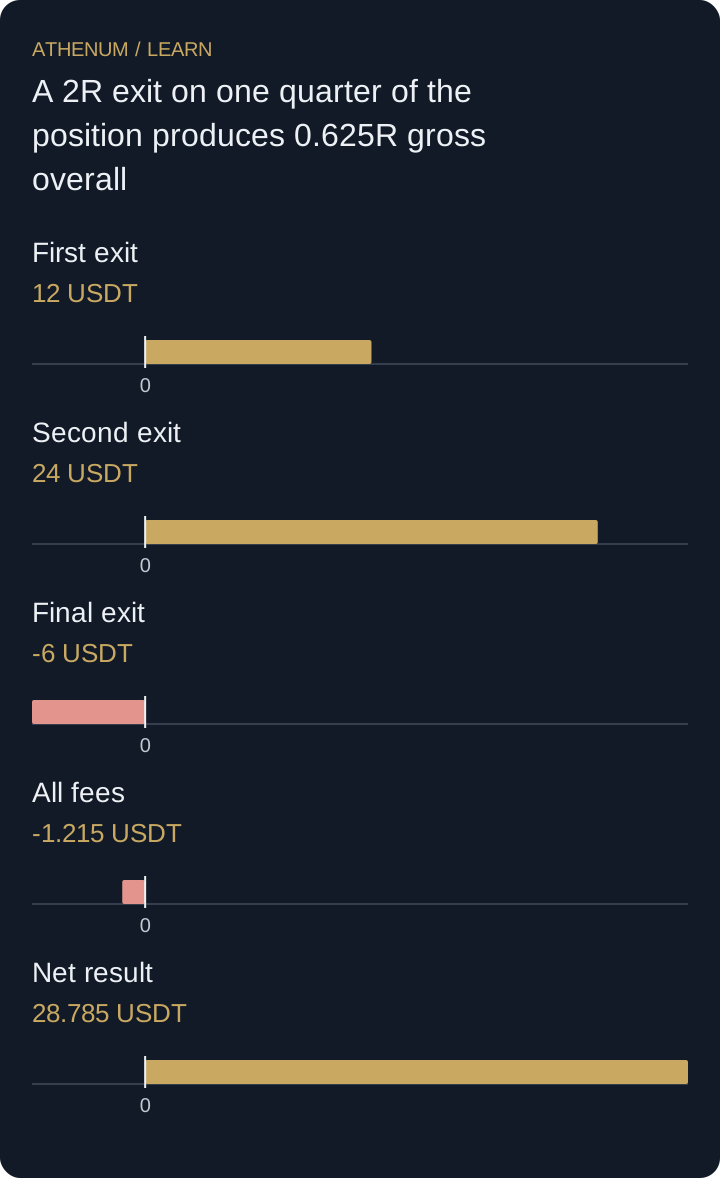
A 2R exit on one quarter of the position produces 0.625R gross overall
Buy 12 units at 100 with an initial stop reference of 96. Original price risk is 12 × 4 = 48 USDT, defined as 1R. Sell three units at 104, another three at 108 and the final six at 99. The exits contribute 12, 24 and −6 USDT, totaling 30. Their weighted R contributions are 0.25 × 1 + 0.25 × 2 + 0.50 × (−0.25) = 0.625R.
The entry fee is 1,200 × 0.0005 = 0.60 USDT. Exit fees total (312 + 324 + 594) × 0.0005 = 0.615. Net P&L is 30 − 1.215 = 28.785 USDT, or 0.5996875R. The best filled exit was 2R per unit; reporting the whole trade as +2R would imply 96 USDT gross instead of the actual 30.
The first two exits together sold only half the original position. The final six units still matter even if the chart screenshot emphasizes the earlier target. If those six units remain open, report realized P&L and remaining exposure separately instead of pretending the trade already has a final R outcome.
| Execution | Quantity | Price | Gross P&L | Fee | Units remaining |
|---|---|---|---|---|---|
| Entry | 12 | 100 | 0 | 0.600 | 12 |
| First exit | 3 | 104 | 12 | 0.156 | 9 |
| Second exit | 3 | 108 | 24 | 0.162 | 6 |
| Final exit | 6 | 99 | −6 | 0.297 | 0 |
| Complete trade | 12 closed | — | 30 | 1.215 | 0 |
 Open full-size diagram
- First exit: 12 USDT
- Second exit: 24 USDT
- Final exit: -6 USDT
- All fees: -1.215 USDT
- Net result: 28.785 USDT
Do not promote the best target into an account result
Dividing the 24-USDT second-exit profit by that tranche’s 12-USDT initial price risk correctly gives 2R for those three units. It does not give 2R for all twelve. Likewise, dividing total profit by a smaller risk figure calculated after taking partial profits changes the denominator after the outcome. Preserve the original trade-level definition and use separate tranche statistics when needed.
Before acting
- Freeze the original gross or net R convention.
- Express every planned partial exit in explicit quantities.
- Reconcile confirmed fills and remaining exposure.
- Deduct entry and exit fees exactly once.
- Keep the best target, tranche result and whole-trade result distinct.
Check your understanding
Keep the 12-unit entry at 100, original stop reference 96 and 0.05% fee per fill. Instead sell six units at 104, three at 108 and three at 96. What are gross and net R?
Show the explained answer
Gross P&L is 6 × 4 + 3 × 8 + 3 × (−4) = 36 USDT, or 0.75R using the unchanged 48-USDT denominator. Entry and exit notionals total 1,200 + 624 + 324 + 288 = 2,436, so fees are 1.218. Net P&L is 34.782 USDT, or 0.724625R. Every original unit is now closed.