Trade management: reconcile exits, exposure and time · 2 / 5
Calculate break-even after a partial exit
Moving a stop to the original entry price defines a price instruction. After a partial exit, it does not by itself describe whether the remaining units or the entire trade will break even. Those are different accounting questions.
Athenum9 minUpdated:
Name which result must equal zero
An entry-price stop uses the original entry price as its trigger. Residual-position break-even asks which exit price offsets the remaining units’ own allocated entry costs and future holding and exit costs. Whole-trade break-even also includes the profit or loss already realized by the earlier partial exit. Declare the allocation and accounting boundary before calculating a level.
For a linear long, let Q be original quantity, E its entry price, q the remaining quantity and G the gross P&L already realized. If all entry fees F_entry and earlier exit fees F_partial are counted once, future signed costs are C, and the remaining exit fee is f × q × x, then whole-trade net P&L at exit x is G + q × (x − E) − F_entry − F_partial − C − f × q × x. This is an exit-price equation, not a guarantee about a stop trigger.
Separate the solved price from executable protection
Solve with a stated fee basis and holding window. Here costs are charged in quote currency, the future cost is a fixed payment, and no further fills or additions occur before the final exit. A funding receipt would enter with the opposite sign. If fees depend on the exit notional, treating all costs as a fixed price increment can miss part of the calculation.
Tick rounding can turn an exact zero into a small positive or negative amount. For this long-position example, rounding the required exit price upward preserves a nonnegative planned result under the same assumptions. But a stop-market trigger does not guarantee that exit price, and a stop-limit can remain unfilled. Confirm the remaining quantity and accepted protection after the partial exit; a calculated level is not evidence that an order is active.
Three meanings of break-even produce three different prices
Buy ten hypothetical linear units at 100, paying a 0.1% fee of 1 USDT. Sell four at 103: gross realized P&L is 12 and the exit fee is 0.412. Six units remain. Reserve a further 0.60-USDT funding payment for the stated remaining holding window, and assume a 0.1% fee on the final exit notional. No other costs apply. These are invented inputs, not exchange rates or a prediction of funding.
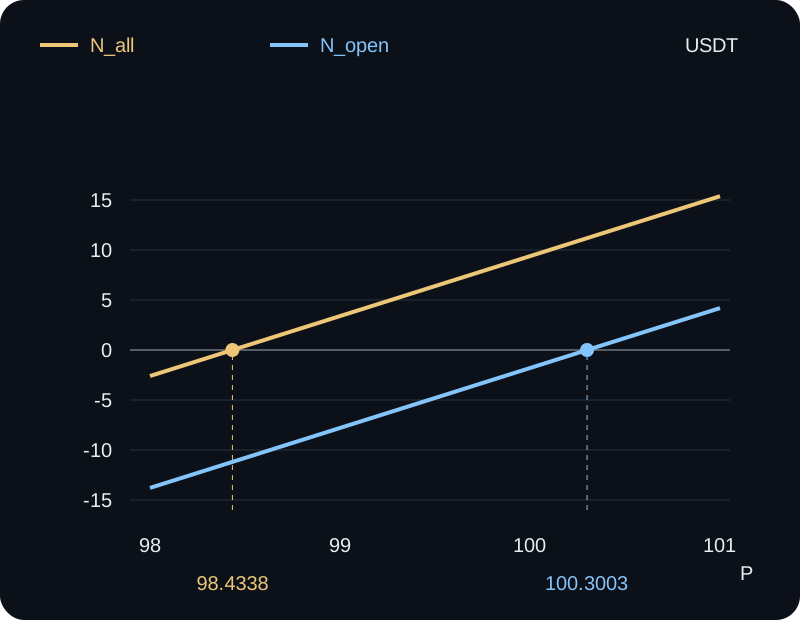
For the complete trade, N(x) = 12 + 6 × (x − 100) − 1 − 0.412 − 0.60 − 0.006x = 5.994x − 590.012. Setting N(x) to zero gives x = 98.4337671. With a 0.01 tick, an assumed full fill at 98.44 leaves +0.03736 USDT for the complete trade. Earlier partial profit allows this conditional whole-trade break-even price to sit below entry.
For the six residual units alone, allocate 6/10 of the original entry fee to them: 0.60 USDT. Their net result is 6 × (x − 100) − 0.60 − 0.60 − 0.006x = 5.994x − 601.20. This reaches zero at 100.3003003, or 100.31 after upward tick rounding. The earlier four-unit tranche retained net profit of 12 − 0.40 − 0.412 = 11.188 after its own entry-fee allocation. Adding that to the residual result always reproduces the whole-trade result.
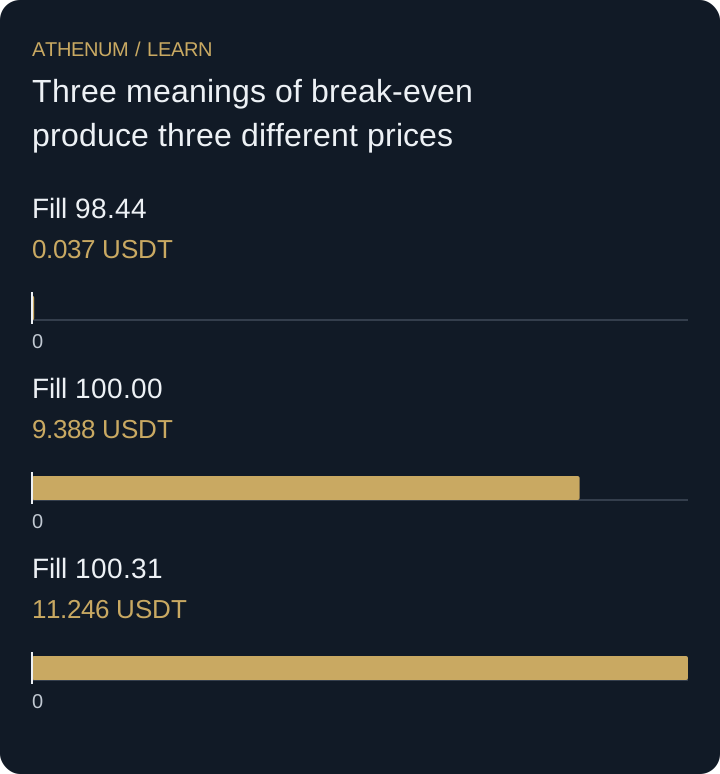
At an assumed final fill exactly at entry, 100, the residual units lose 1.80 after their allocated costs while the complete trade earns 9.388. Neither result is zero. The figure compares the whole-trade results at the three rounded or nominal price choices, keeping the denominator and fee treatment unchanged.
| Final fill price | Meaning of price | Residual net USDT | Whole-trade net USDT |
|---|---|---|---|
| 98.44 | Rounded whole-trade break-even | −11.15064 | 0.03736 |
| 100.00 | Original entry price | −1.80000 | 9.38800 |
| 100.31 | Rounded residual break-even | 0.05814 | 11.24614 |
 Open full-size diagram
- Fill 98.44: 0.037 USDT
- Fill 100.00: 9.388 USDT
- Fill 100.31: 11.246 USDT
Hypothetical final fills; residual and whole-trade net results use consistent fee allocation.
Gold N_all is the complete trade; blue N_open is the six remaining units with their allocated costs. P is the assumed final fill price. Zero crossings are shown to four decimals before tick rounding. Both lines use the same USDT scale and the table's fee assumptions; they do not guarantee a stop fill.
A gap can invalidate the planned zero
If a trigger is set at 98.44 but the six units actually fill at 98.40, whole-trade net P&L is 5.994 × 98.40 − 590.012 = −0.20240 USDT. Calling the trade “risk-free” after a partial sale would hide this execution dependence and any unmodeled costs. Also avoid subtracting the full entry fee again after allocating it across both tranches; either bookkeeping route must reconcile to the same total.
Before acting
- Specify entry-price, residual-position or whole-trade break-even.
- Keep realized partial P&L and all fees in the same ledger.
- Include exit-notional fees and the declared future holding cost.
- Round the solved exit price according to the intended constraint.
- Treat an active trigger and an actual fill as separate evidence.
Check your understanding
Keep the example’s past fills, paid fees and future 0.60-USDT funding payment. Only the future exit fee changes to 0.2%. What final fill price makes the whole trade break even, and what 0.01-tick price preserves a nonnegative planned result?
Show the explained answer
The final exit fee becomes 0.012x, giving N(x) = 5.988x − 590.012. Exact break-even is 98.5323981. Round upward to 98.54, at which N(x) = 0.04552 USDT. Do not recompute already paid fees at the new rate. The result remains conditional on that final fill and the stated costs.