Trading journal: costs, decisions and honest performance
Allocate partial-exit costs, review rule adherence, preserve thesis revisions and separate external cash flows from trading returns.
What you will practise
Build a journal that reconciles money and decisions without rewriting unsuccessful trades or confusing deposits with profits.
Before you start
- Reconcile actual fills and net linear P&L.
- Understand trade-level R, equity and the original risk plan.
Course outline
- 1
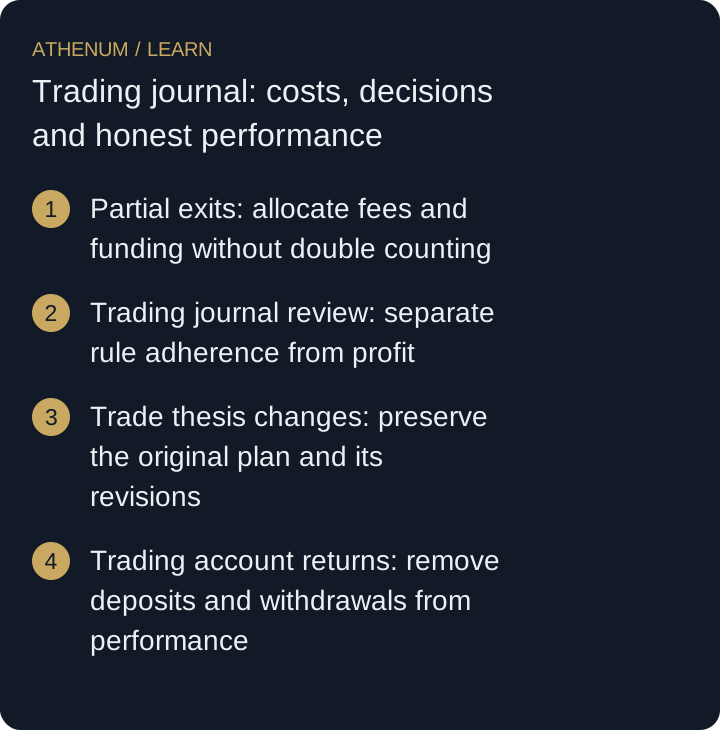
Partial exits: allocate fees and funding without double counting
Allocate entry fees, funding and exit charges across a partially closed position. Two exits reconcile to 5.99 USDT net without double counting any cost.
7 minIn short: Allocate costs incurred while the full position was open by each exit’s share of the original quantity, add that exit’s own fee, and carry the rest with the open units. Attributed and remaining costs must always equal the cost ledger; in the example, exits netting 38.36 and −32.37 reconcile to 5.99 USDT.
- 2
Trading journal review: separate rule adherence from profit
Review trades against rules recorded before entry. Do not reward a profitable rule violation or call every compliant loss a mistake.
7 minIn short: Score each trade on two separate axes: whether it followed rules recorded before entry, and what it earned. A profitable rule violation is still a violation, and a compliant loss is not automatically a mistake. Rule adherence alone does not prove the strategy has an edge.
- 3
Trade thesis changes: preserve the original plan and its revisions
Record a changing trade thesis without overwriting the original plan. A wider stop moved risk from 40 to 70, so each revision needs its own evidence and time.
7 minIn short: Freeze the thesis, data, size and exit rule at entry, then append each change as a new version with its evidence and time instead of overwriting the plan. A wider stop is a new risk decision: moving it from 96 to 93 on ten units raises risk from 40 to 70 USDT before costs.
- 4
Trading account returns: remove deposits and withdrawals from performance
A growing account can hide a losing strategy. Split returns at deposits and withdrawals, link the subperiods and report time-weighted return apart from P&L.
7 minIn short: Split the period at every deposit and withdrawal, calculate each subperiod’s return excluding that flow, then multiply the factors and subtract one. In the example, the balance grows 44% with a 5,000 USDT deposit, but the linked time-weighted return is 1.10 × 0.90 − 1 = −1%. Trading fees stay in the return.
Calculators used in this course
Related courses
- Trade management: partial exits, MFE/MAE and time stopsCalculate partial-exit R, cost-adjusted break-even, observed MFE and MAE, add-on risk and time stops using complete hypothetical trading ledgers.
- Backtest statistics: test what a trading result really saysInterpret compounding, profit factor, overlapping trades, net benchmarks and bootstrap assumptions with independently calculated examples.
- Position sizing and leverage: risk, stops and feesSize a position from invalidation, distinguish leverage from exposure and test whether a setup survives real trading costs.
 Open full-size diagram
- Partial exits: allocate fees and funding without double counting
- Trading journal review: separate rule adherence from profit
- Trade thesis changes: preserve the original plan and its revisions
- Trading account returns: remove deposits and withdrawals from performance
Educational material. Examples do not establish a profitable strategy. Trading costs, gaps and liquidation can produce losses beyond a planned stop.