Reconcile margin, collateral and account exposure · 4 / 5
Maintenance margin tiers: apply the rate and deduction
A higher marginal maintenance rate does not automatically apply to every unit of the position. Omitting a required deduction can manufacture a jump that the stated schedule does not contain.
Athenum7 minUpdated:
Translate a progressive schedule into two equivalent forms
Use an invented schedule for positive marked notional N up to 20,000 USDT. The first 10,000 requires 1%; the portion above 10,000 through 20,000 requires 2%. Exactly 10,000 belongs to the first tier. There are no open orders or estimated closing-fee reserves in this model.
For 10,000 < N ≤ 20,000, calculate 10,000 × 0.01 + (N − 10,000) × 0.02. Expanding gives 0.02N − 100. The 100 deduction preserves the first slice's lower rate; it is not an optional discount or additional collateral.
Revalue notional even when quantity is unchanged
Hold quantity at 100 units while the mark moves from 99 to 101 USDT per unit. Notional moves from 9,900 to 10,100 without another trade. Under this schedule, maintenance rises from 99 to 102. A tier transition can therefore occur through valuation alone.
This does not establish that the account became less safe. Position P&L, collateral value and other requirements may also change. Real venues have product-specific notional definitions, order reserves, fee treatment and rounding. The example's output is one component, not a complete liquidation threshold.
Check the boundary before trusting the shortcut
At notional 10,000, requirement is 100. At 10,100, it is 100 plus 2 on the additional 100, giving 102. Applying 2% to everything would give 202, an overstatement of 100.
At 15,000, the first slice requires 100 and the extra 5,000 requires another 100. The shortcut agrees: 15,000 × 0.02 − 100 = 200. An independent slice calculation is a useful review of a rate-and-deduction table.
| Marked notional | Progressive requirement | Equivalent calculation |
|---|---|---|
| 9,900 | 99 | 9,900 × 1% |
| 10,000 | 100 | 10,000 × 1% |
| 10,100 | 102 | 10,100 × 2% − 100 |
| 15,000 | 200 | 15,000 × 2% − 100 |
 Open full-size diagram
- Mark quantity into notional
- Locate inclusive tier boundary
- Apply rate and deduction
- Verify with marginal slices
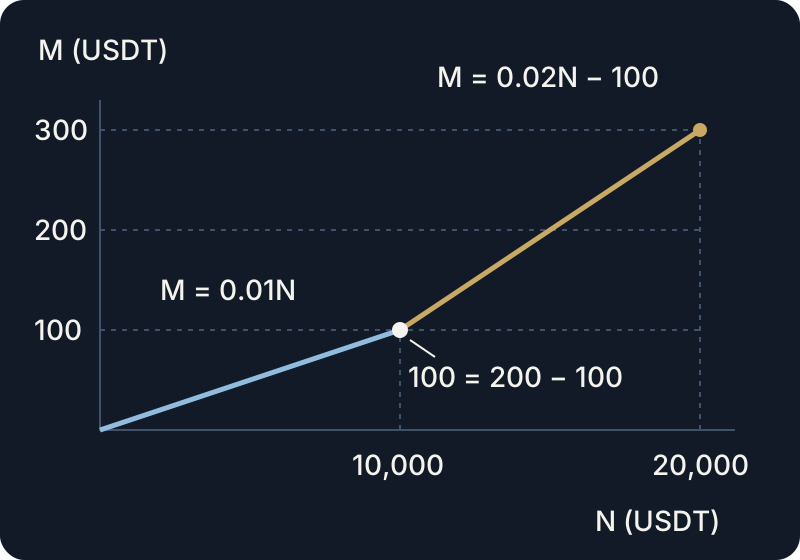
Original schedule; requirements in USDT; no extrapolation above 20,000. Check a position requirement; pending-order rules may differ.
N: Marked notional. M: Progressive requirement.
A venue label does not specify a universal formula
Do not copy a position-maintenance formula into an order requirement or assume another venue uses the same boundaries. Record product, account mode, effective rule version and omitted costs before using real settings. Our invented 1% and 2% rates are not current symbol parameters.
Before acting
- Use the specified marked-notional definition.
- Check inclusive and exclusive boundaries.
- Reconcile slices with the deduction formula.
- Keep order and closing-fee requirements separate.
- Compare full account equity before making a risk conclusion.
Check your understanding
At marked notional 12,500, what is maintenance under the exercise schedule? Explain why 250 is wrong.
Show the explained answer
The first 10,000 requires 100 and the remaining 2,500 requires 50, so the result is 150 USDT. The equivalent shortcut is 12,500 × 2% − 100 = 150. A result of 250 incorrectly applies the second slice's rate to the entire position.