Reconcile margin, collateral and account exposure · 3 / 5
Margin top-up: calculate eligible collateral after haircuts
Sending assets with a market value of 85 does not necessarily add 85 to recognized collateral. Price, eligibility, credit factors and arrival time all matter.
Athenum7 minUpdated:
Define a conditional target
Continue with teaching equity of 190 USD and requirement of 220. Invent an internal scenario target of equity at least 1.25 times requirement: 275. The needed credited increase is 85. The multiple 1.25 is an exercise input, not an exchange rule or a recommended safety buffer.
Assume asset X is eligible, priced at 2 USD and credited at a factor of 0.80, with an allowed deposit increment of 0.1 X. Each unit therefore credits 1.60 USD. For this first calculation, price, factor and requirement remain unchanged, and fees and transfer delays are excluded.
Round a lower bound in the correct direction
The continuous quantity is 85 / 1.60 = 53.125 X. Because credit must be at least 85, round up on the stated grid to 53.2 X. Rounding to the nearest step would yield 53.1 and fail. Calculate the grid exactly in decimal or integer-step arithmetic when implementing it.
This solves a conditional arithmetic problem, not a decision to deposit more. Extra collateral exposes additional capital to the account. A transfer may arrive too late, incur costs, encounter a changed credit factor or cease to qualify. None of these risks disappears because a spreadsheet target was met.
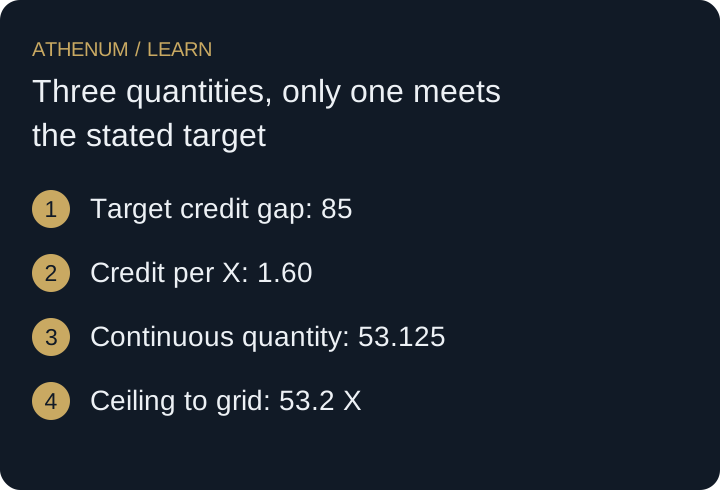
Three quantities, only one meets the stated target
At 53.2 X, nominal value is 106.40 USD but credited value is 85.12. Eligible equity becomes 275.12. The distinction between those two deposit values is the entire point of the calculation.
Sending 42.5 X supplies nominal value 85 but credits only 68. Sending 53.1 credits 84.96, missing by 0.04. Do not round the final equity display to a whole dollar and use that rounded display to decide whether the underlying target passed.
| Deposit X | Nominal value | Collateral credit | Resulting equity |
|---|---|---|---|
| 42.5 | 85.00 | 68.00 | 258.00 |
| 53.1 | 106.20 | 84.96 | 274.96 |
| 53.2 | 106.40 | 85.12 | 275.12 |
 Open full-size diagram
- Target credit gap: 85
- Credit per X: 1.60
- Continuous quantity: 53.125
- Ceiling to grid: 53.2 X
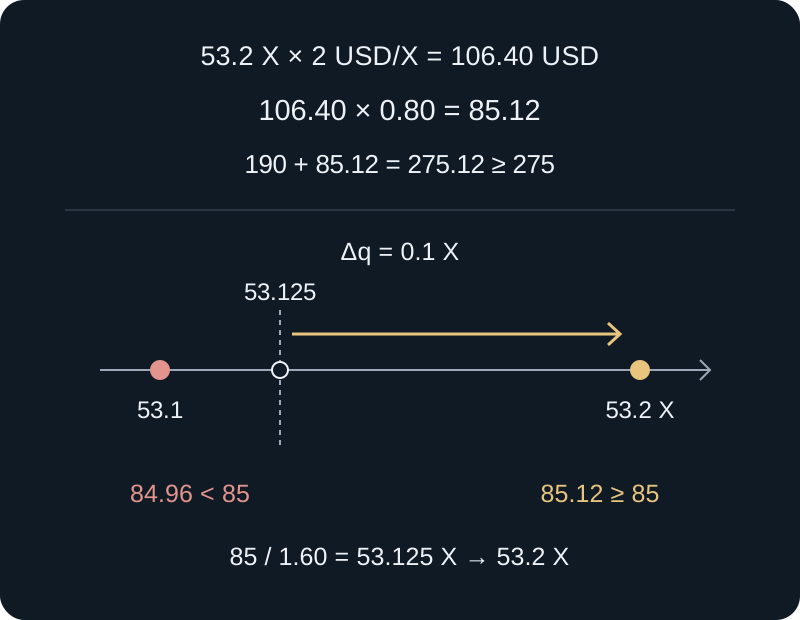
Invented asset, factor and grid; unchanged-input scenario in USD. The result is conditional on every input remaining applicable through crediting.
Nominal value: 106.40 USD. Collateral credit: 85.12 USD.
A deposit amount is not a liquidation guarantee
Do not turn the result into a countdown or rescue instruction. Real margin rules can change with positions, prices, liabilities and pending orders while funds are in transit. Market value, recognized collateral and withdrawable balance are separate measures.
Before acting
- State the target as a hypothetical input.
- Separate nominal value from credited value.
- Use the actual eligible asset and conversion assumptions.
- Round up only for this lower-bound quantity problem.
- Stress price, factor and crediting time before interpreting the result.
Check your understanding
Before crediting, X falls to 1.80 USD and its factor to 0.70. All other inputs stay fixed. What does 53.2 X now credit, and what quantity would mathematically supply 85 under the revised inputs?
Show the explained answer
Credit per X becomes 1.26. The 53.2 X credits 67.032, leaving equity 257.032. The revised continuous quantity is 85 / 1.26 = 67.460317… X; rounding up to the assumed 0.1 grid gives 67.5 X. This is a conditional recalculation, not advice to deposit again or a promise that the account remains open.