Reconcile margin, collateral and account exposure · 2 / 5
Cross margin risk: stress several positions together
Two positions cannot each spend the same shared account balance independently. Their joint stress result is the useful test, not two separate comparisons against the full balance.
Athenum7 minUpdated:
Define the account boundary
Use one hypothetical account with starting equity of 1,000 USD and two positions, A and B. There are no liabilities, open orders, fees or other assets. Define teaching surplus as account equity minus the sum of the two stated maintenance requirements. This is our exercise metric, not a venue's named margin ratio.
The starting requirements are 120 for A and 80 for B, so surplus is 800. Requirements are constraints on the shared ledger, not separate collateral pots. We assume no portfolio offsets or diversification benefit. A real account's calculation can differ because of adjusted collateral, reserves and product-specific rules.
Stress losses and requirements together
Specify a joint observation: A loses 550, B loses 260, and their requirements become 130 and 90. Both losses occur in the same scenario. Equity is 1,000 − 550 − 260 = 190; total requirement is 220. Teaching surplus is −30.
A negative result identifies a shortfall under these assumptions. It does not determine a liquidation price, a venue's reduction sequence or actual fills. Cross-margin account triggers and isolated position triggers are not interchangeable; even a displayed cross liquidation estimate need not be the complete account trigger.
One balance, one simultaneous stress ledger
Checking A alone gives equity 450 after its loss; checking B alone gives 740. Those are different scenarios. Adding confidence from both checks does not describe the joint case, where only 190 remains.
Track the requirements at the same observation as equity. Keeping the old combined requirement of 200 would report −10 instead of −30. A small-looking discrepancy still changes the answer and reveals a stale input.
| Observation | Equity | A requirement | B requirement | Teaching surplus |
|---|---|---|---|---|
| Start | 1,000 | 120 | 80 | 800 |
| Joint stress | 190 | 130 | 90 | −30 |
 Open full-size diagram
- Starting shared equity: 1,000
- Joint losses: 550 + 260
- Remaining equity: 190
- Compare with requirement: 220
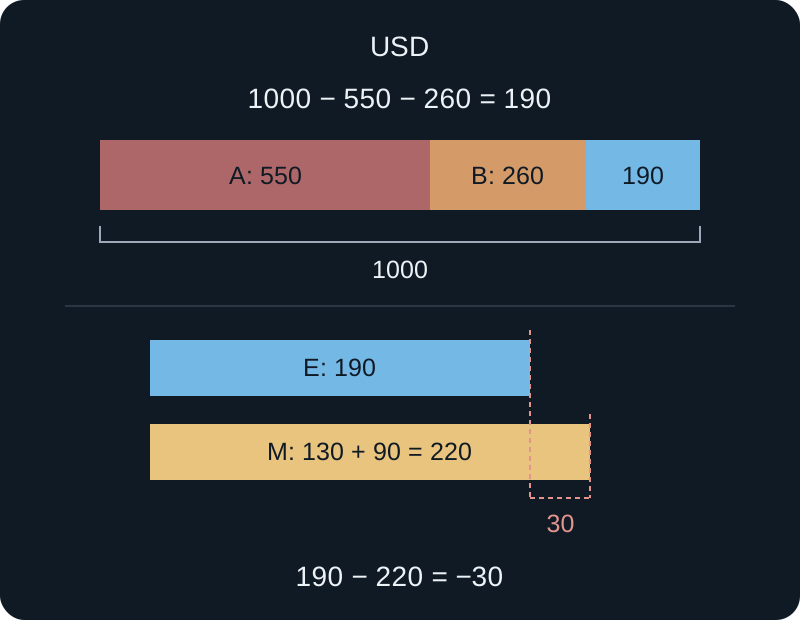
USD teaching ledger; no claim about a live venue's liquidation algorithm. Use a common account boundary and observation for every input.
E: Equity. M: A requirement + B requirement.
Teaching surplus: 190 − 220 = −30.
Top: losses and remaining equity partition the starting balance. Bottom: the equity–requirement comparison is enlarged; compare lengths only within each panel.
An isolated comparison needs explicit allocations
Do not label two calculations isolated while giving each the entire shared 1,000. Specify distinct starting allocations and any automatic top-up rules. Otherwise the comparison has silently doubled the capital rather than changed only the margin mode.
Before acting
- Define which positions share equity.
- Apply simultaneous scenario results together.
- Revalue requirements at that same observation.
- Keep the teaching metric distinct from exchange ratios.
- Do not infer execution or liquidation order from a shortfall.
Check your understanding
In the joint stress, change only B's result to a gain of 100. Keep A's loss and both stressed requirements. What are equity and surplus, and what does this prove?
Show the explained answer
Equity is 1,000 − 550 + 100 = 550. Surplus is 550 − 130 − 90 = 330. B offsets part of A's loss in this scenario only; this does not establish a reliable hedge under other price, liquidity or collateral shocks.