Trading journal: costs, decisions and honest performance · 3 / 4
Trade thesis changes: preserve the original plan and its revisions
A trade thesis may change as new information arrives. The journal should show that change, not make the original decision disappear. Keep immutable versions with their evidence, decision time and resulting action.
Athenum7 minUpdated:
Record a decision, not only a narrative
An actionable thesis specifies the observed condition, the expected behavior being tested, the invalidation and the allowed action. For example, a breakout acceptance rule needs a defined level, observation window and condition that rejects the hypothesis. A story about strong buyers without a rejection criterion cannot be audited in the same way.
At entry, freeze the thesis version, known data, proposed size and exit rule. Later notes append a new version and identify exactly what changed. Preserve original timestamps and source observations. A screenshot saved after the outcome can illustrate the review, but it does not prove what was visible before entry.
Treat a risk change as an explicit new decision
If a trader widens a stop, adds quantity or extends a time limit, calculate the new risk before acting. Calling the change an updated view does not remove its exposure. Keep the actual exchange instructions and acknowledgements alongside the intended action, since writing a new stop in a journal does not change the live order.
New evidence can justify a new hypothesis, but it does not retroactively validate the old one. If the original rejection condition occurs, record that result before opening a separate thesis. Avoid moving the rejection level repeatedly so the original trade is never allowed to fail.
Worked example: a wider stop changes risk from 40 to 70
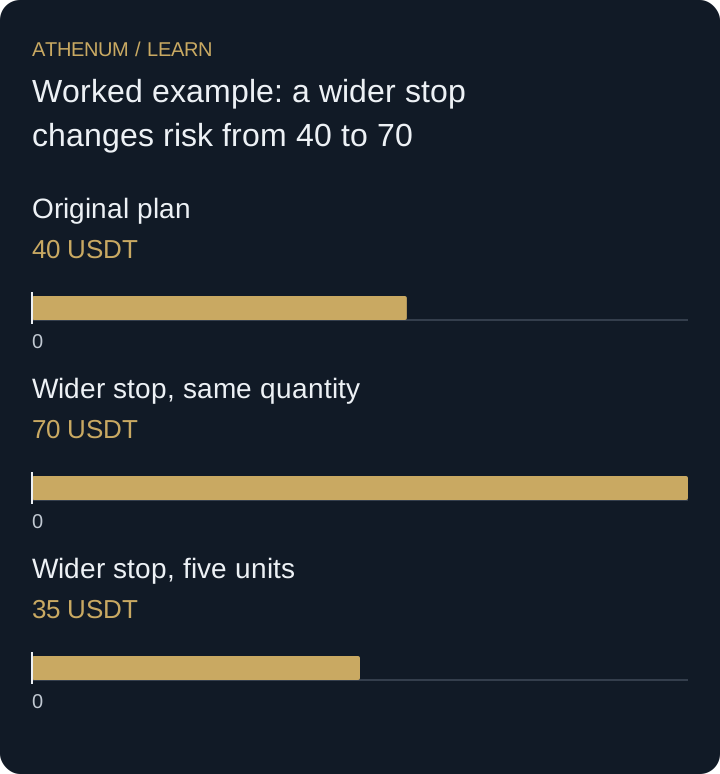
In an original hypothetical example, version 1 at 09:00 buys ten linear units at 100 with an invalidation reference at 96: 40 USDT of price risk before costs. At 09:10, version 2 proposes moving the stop to 93 after new information. With quantity unchanged, risk from the original entry becomes 70.
If the allowed total entry-referenced price risk remains 40 and quantity must be a whole unit, only floor(40 / 7) = 5 units fit the revised distance. Reducing from ten to five requires actual fills, whose P&L and fees also matter. The journal records the proposed change, approval under the rule and confirmed execution separately; it never rewrites version 1 as if 93 had always been the plan.
| Version | Recorded time | Entry reference | Stop reference | Quantity | Entry-referenced price risk |
|---|---|---|---|---|---|
| 1 | 09:00 | 100 | 96 | 10 | 40 |
| 2 proposed | 09:10 | 100 | 93 | 10 | 70 |
| 2 size-constrained scenario | 09:10 | 100 | 93 | 5 | 35 |
 Open full-size diagram
- Original plan: 40 USDT
- Wider stop, same quantity: 70 USDT
- Wider stop, five units: 35 USDT
Hindsight can make every trade look planned
Overwriting the entry note after a favorable move makes the journal easier to read but weaker as evidence. The same problem occurs when a chart annotation is moved to the level that later worked. Keep the original, append the correction and explain the reason. A transparent rejected hypothesis teaches more than an apparently flawless history.
Before acting
- Freeze the original conditions, size and invalidation.
- Append evidence and timestamps for every revision.
- Recalculate exposure before changing stops, size or holding time.
- Verify actual order changes separately from written intent.
Check your understanding
Eight units entered at 50 with a stop reference of 47. A revision moves the stop to 45. With the original 24-unit cash risk allowance and whole-unit sizing, what maximum quantity fits before costs?
Show the explained answer
The new entry-to-stop distance is 5, so floor(24 / 5) = 4 units fit, with 20 of price risk. Keeping all eight would create 40 of price risk. Reducing quantity is a new executable action; its realized P&L and fees must be reconciled rather than omitted.