Trade management: reconcile exits, exposure and time · 4 / 5
Recalculate average entry and risk before adding to a position
An add-on changes the quantity, average entry and loss at the planned exit of a position that is already open. Its risk cannot be calculated as though the existing position disappeared or received a fresh independent budget.
Athenum9 minUpdated:
Keep the existing position inside the constraint
For a linear long without interim settlement adjustments, average entry after an addition is (Q_old × E_old + Q_add × E_add) / (Q_old + Q_add). The quantity-weighted average is a useful reconciliation of entry value. It does not include trading fees, and it is not the price that automatically makes the complete trade break even.
Define the budget boundary. This lesson caps the complete position’s planned loss from its original entries through an assumed common stop fill, including paid entry fees and estimated later fees. No partial profits or funding occur. This differs from measuring drawdown from the current mark or spending a realized re-entry budget after an earlier position has fully closed.
Solve for an addition, then check execution state
Compute the existing quantity’s loss at the same assumed exit used for the proposed addition. Subtract that amount from the declared budget; only the remainder can support the addition. Include the new entry fee and the extra exit fee in the incremental cost per unit. Round the addition down to the permitted quantity step and check minimum size, notional and available margin separately.
The order sequence matters: a stop that protects four units may not protect a position enlarged to 5.8. A request to amend protection is not evidence of an accepted amendment or a completed exit. Declare how the additional quantity is protected during the transition and reconcile venue order state before treating the final planned position as established. A stop gap can exceed the arithmetic budget even when the final quantity is correct.
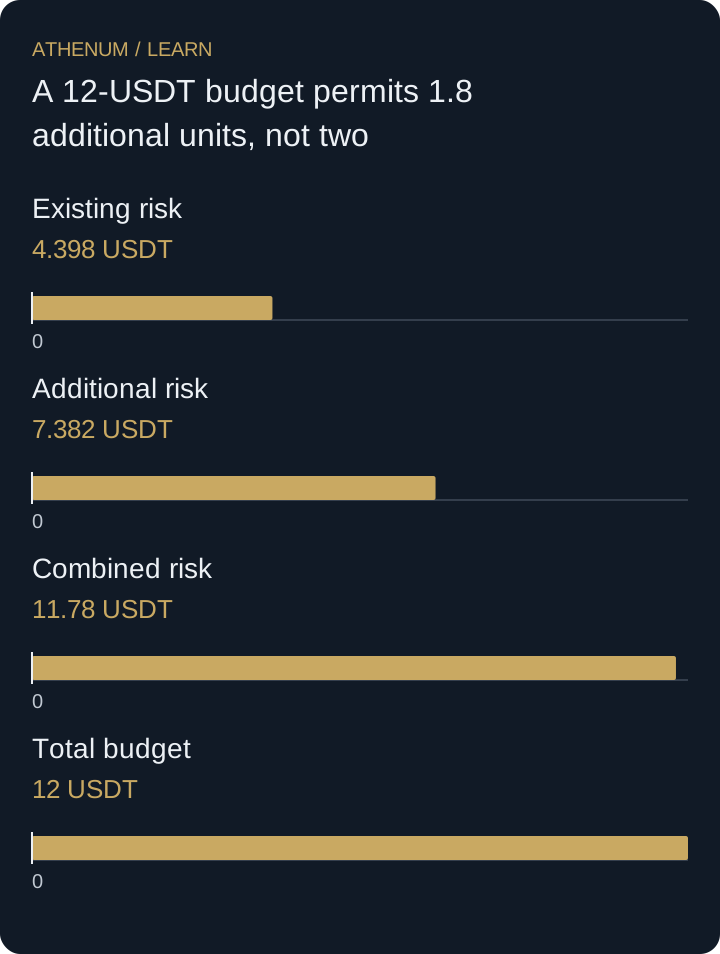
A 12-USDT budget permits 1.8 additional units, not two
An invented linear position holds four units bought at 100. A proposed addition would fill at 103, and the common assumed stop fill is 99 for the full final quantity. The total planned-loss budget is 12 USDT. Every entry and exit costs 0.05% of its notional in USDT, quantity increments are 0.1, and funding and other costs are excluded. Prices are assumed available for the complete hypothetical quantities.
Without an addition, planned loss is 4 × (100 − 99) + 4 × 100 × 0.0005 + 4 × 99 × 0.0005 = 4.398. Remaining capacity is 12 − 4.398 = 7.602. Each extra unit consumes (103 − 99) + (103 + 99) × 0.0005 = 4.101. The raw addition limit is 7.602 / 4.101 = 1.8536942, so round down to 1.8 units.
The resulting position contains 5.8 units with total entry value 400 + 185.40 = 585.40, giving average entry 100.9310345. Gross loss at 99 is 585.40 − 5.8 × 99 = 11.20. Entry fees total 0.29270 and the exit fee is 0.28710, giving planned loss 11.77980. This agrees with 4.398 + 1.8 × 4.101.
Adding 1.9 units would produce planned loss 12.18990; adding two would produce 12.60. Neither fits. The existing position’s gross paper profit at 103 is 12 USDT, but it has not been closed. Adding that paper gain as extra budget while also valuing the same position at a losing stop would mix two different price scenarios.
| Component | Existing four | Addition 1.8 | Combined |
|---|---|---|---|
| Entry value USDT | 400.0000 | 185.4000 | 585.4000 |
| Gross loss at 99 | 4.0000 | 7.2000 | 11.2000 |
| Paid entry fee | 0.2000 | 0.0927 | 0.2927 |
| Assumed exit fee | 0.1980 | 0.0891 | 0.2871 |
| Total planned loss | 4.3980 | 7.3818 | 11.7798 |
 Open full-size diagram
- Existing risk: 4.398 USDT
- Additional risk: 7.382 USDT
- Combined risk: 11.78 USDT
- Total budget: 12 USDT
An improved average entry does not replace the risk calculation
Whether an addition raises or lowers average entry, exposure still changes. Here an unexpected full exit at 98 instead of 99 would lose 17 USDT gross plus 0.57690 in fees, totaling 17.57690. The 12-USDT budget is conditional on the planned execution scenario. Evaluate adverse fills and the order-transition window before describing the position as safely inside a maximum loss.
Before acting
- Define a shared budget and its starting accounting point.
- Value old and new quantity at the same assumed exit.
- Include paid entry fees and incremental entry and exit costs.
- Round the addition down and verify the combined average entry.
- Reconcile protection for the entire final position.
Check your understanding
Keep the four units at 100, proposed addition at 103, 12-USDT budget, 0.05% fees and 0.1 quantity step. Change the assumed common stop fill to 98. What addition fits?
Show the explained answer
Existing planned loss becomes 4 × 2 + 400 × 0.0005 + 392 × 0.0005 = 8.396. Remaining capacity is 3.604. Each added unit costs 5 + (103 + 98) × 0.0005 = 5.1005. Rounding 3.604 / 5.1005 down to the 0.1 step permits 0.7 units. Combined planned loss is 8.396 + 0.7 × 5.1005 = 11.96635; 0.8 units would require 12.47640.