Trade management: reconcile exits, exposure and time · 5 / 5
Define a time stop and signal expiry before entering
A setup can fail to progress without reaching its price stop. A time rule makes that decision reproducible only when its clock, deadline and required action are specified before the result is known. Expiring an unfilled order is different from closing a position.
Athenum8 minUpdated:
Separate three clocks
Signal expiry is the absolute time after which the original opportunity no longer authorizes exposure under the chosen rule. Maximum holding time limits elapsed duration from a specified event, such as the first confirmed entry fill. Order time in force controls how long an unfilled order remains eligible. Expiring or canceling the original entry order does not close units already bought.
For the hypothetical policy here, start the holding clock at the first entry fill, retain the original signal expiry, and request closure when the earlier deadline is reached. Later partial fills or position updates do not restart either clock. If no entry has filled by expiry, cancel the remaining entry request and reconcile whether a fill raced with cancellation. These are chosen policy rules, not universal optimal horizons.
A deadline requests an action; it does not prove an exit
Record the deadline, decision timestamp, submitted instruction, confirmed fills and final flat-state evidence. At expiry, prevent further exposure from the same signal and reconcile competing entry or exit orders under the venue’s rules. Simply setting a signal flag to expired, canceling an entry order or receiving an exit acknowledgement does not establish a flat position.
Include costs for the actual holding interval, including any funding settlement crossed before the exit really fills. Compare candidate time rules only on the same predeclared opportunities with their respective executable outcomes, including losing and unresolved cases. Changing a deadline after watching price linger converts that observation into rule development; it does not validate a better exit.
A 09:19 deadline precedes the signal’s 09:20 expiry
Use a fictional linear market on one UTC day. A signal recorded at 09:00 expires at 09:20. The first and only entry fills five units at 100 at 09:04, and the maximum holding time is 15 minutes from that fill. The exit-request deadline is therefore min(09:20, 09:19) = 09:19. The illustrative stop at 97 and target at 104 are not reached before the scenarios below close.
In the correctly executed scenario, a timer requests the exit at 09:19 and all five units fill at 100.20 at 09:19:02. Gross P&L is 1 USDT. Entry and exit fees at an illustrative 0.05% are (500 + 501) × 0.0005 = 0.50050, leaving 0.49950 net. Define a hypothetical funding settlement at exactly 09:20 that charges this five-unit long 0.30 if still open. The correctly closed position does not pay it.
In a separate faulty-implementation scenario, the timer only attempts to cancel the old entry request and never submits an exit. The five units remain open across settlement, pay 0.30 and finally close at 99.60 at 09:24. Gross P&L is −2; execution fees are (500 + 498) × 0.0005 = 0.499. Net P&L is −2.799. Attempting to cancel an already filled entry order did not undo the position.
The two scenarios demonstrate compliance and an implementation defect under invented fills. They do not establish that 15 minutes is a profitable horizon or that waiting always worsens the result. A compliant exit could also receive a worse fill. Keep the original rule version and distinguish execution failure from the rule’s economic performance.
| Event or result | Exit actually submitted | Only entry cancellation attempted |
|---|---|---|
| Signal created / expires | 09:00 / 09:20 | 09:00 / 09:20 |
| First entry fill | 09:04: five at 100 | 09:04: five at 100 |
| Exit-request deadline | 09:19 | 09:19 |
| Final exit fill | 09:19:02: five at 100.20 | 09:24: five at 99.60 |
| Gross P&L USDT | 1.0000 | −2.0000 |
| Execution fees USDT | 0.5005 | 0.4990 |
| Funding paid USDT | 0.0000 | 0.3000 |
| Net P&L USDT | 0.4995 | −2.7990 |
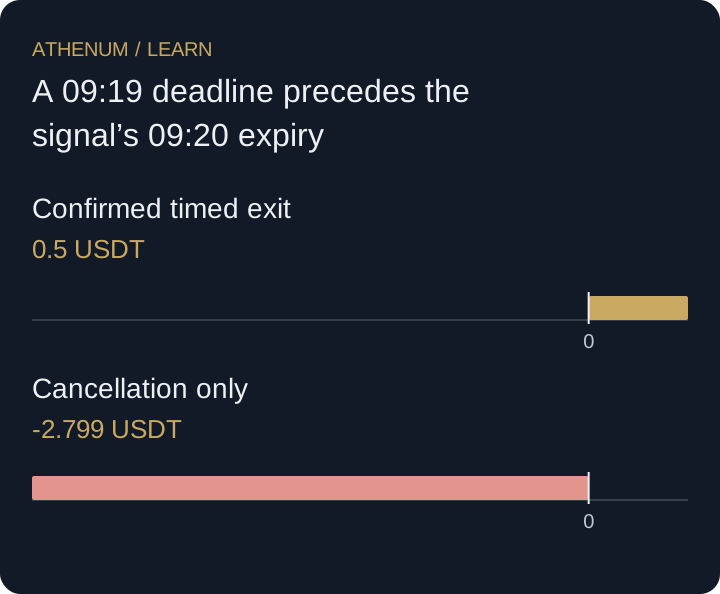 Open full-size diagram
- Confirmed timed exit: 0.5 USDT
- Cancellation only: -2.799 USDT
A late entry does not renew an expired idea
With the same absolute 09:20 signal expiry, an entry first filled at 09:12 would have a holding-clock deadline of 09:27 but still an exit-request deadline of 09:20. Starting a new full 15-minute allowance at each partial fill would silently change the policy. Likewise, after a timed exit an automated system must not immediately recreate the same exposure from an unchanged expired signal. A later re-entry requires whatever new-opportunity rule was specified in advance.
Before acting
- Choose the clock origin and absolute signal expiry in advance.
- Distinguish order expiry from a required position exit.
- Record request time, fill time and final remaining quantity.
- Charge costs over the actual holding window.
- Retain rule violations and execution failures when evaluating the process.
Check your understanding
Keep expiry at 09:20, a 15-minute maximum from first fill and the same five-unit entry price and fee rate. Entry now first fills at 09:12. An exit requested at its deadline fills at 100.05 at 09:20:02; the fictional 09:20 settlement charges 0.30 because the position was still open. What is the deadline and net result?
Show the explained answer
The deadline is min(09:20, 09:27) = 09:20. Gross P&L is 5 × 0.05 = 0.25 USDT. Fees are (500 + 500.25) × 0.0005 = 0.500125. After the 0.30 funding payment, net P&L is −0.550125. The request met its deadline, but the later fill crossed the stated settlement; request time cannot replace actual exposure time.