Orderflow measurement: resets, units and information timing · 1 / 5
CVD resets: distinguish a new session from aggressive selling
A CVD line can fall to zero because its accumulation window restarted. That display change is not a sell trade. Compare the anchor, timezone and underlying interval delta before reading a jump as market pressure.
Athenum7 minUpdated:
Separate interval flow from accumulated level
For a declared trade classification, interval delta is buy-aggressor quantity minus sell-aggressor quantity. CVD adds these signed observations from an anchor. Changing the anchor changes the level even when every underlying trade remains identical. The difference between consecutive CVD values equals interval delta only when both values belong to the same uninterrupted accumulation.
A session is a configured boundary. Crypto trades continuously, so midnight UTC, an exchange session and a viewer’s local day need not coincide. Document the exact timezone and reset rule. Daylight-saving changes can move a local boundary relative to UTC; a timestamp without its timezone cannot fully identify the window.
Reconcile a discontinuity before interpreting divergence
At a reset, reconstruct the new session from its own trades and retain the final value of the old session separately. A continuous comparison can be formed by adding the old cumulative offset only when the two sequences have compatible units, coverage and classification. Do not bridge an actual data outage by pretending its unknown flow was zero.
When comparing two tools, align instrument, venues, measurement units, anchor and availability first. A product built from lower-timeframe candle estimates can disagree with a taker-flag calculation for reasons beyond resetting. The reset test isolates one cause; it does not establish that every other setting matches.
Worked example: a reset creates a false −6 reading
The constructed tape has four interval deltas: +5, −2, +4 and −1 base units. The first two belong to session A and the last two to session B. Continuous CVD is 5, 3, 7, 6. Session CVD is 5, 3, 4, 3 because B starts from zero.
Immediately before B begins, the old cumulative level is 3. The reset itself takes the display to zero without any trade. If a chart instead ended A at 10 and the first B interval closed at 4, subtracting displayed endpoints would report −6, even though the B interval contains +4 net aggressive quantity. Preserve the boundary rather than interpreting that subtraction as selling.
| Interval | Session | Interval delta | Continuous CVD | Session CVD |
|---|---|---|---|---|
| 1 | A | +5 | 5 | 5 |
| 2 | A | −2 | 3 | 3 |
| 3 | B | +4 | 7 | 4 |
| 4 | B | −1 | 6 | 3 |
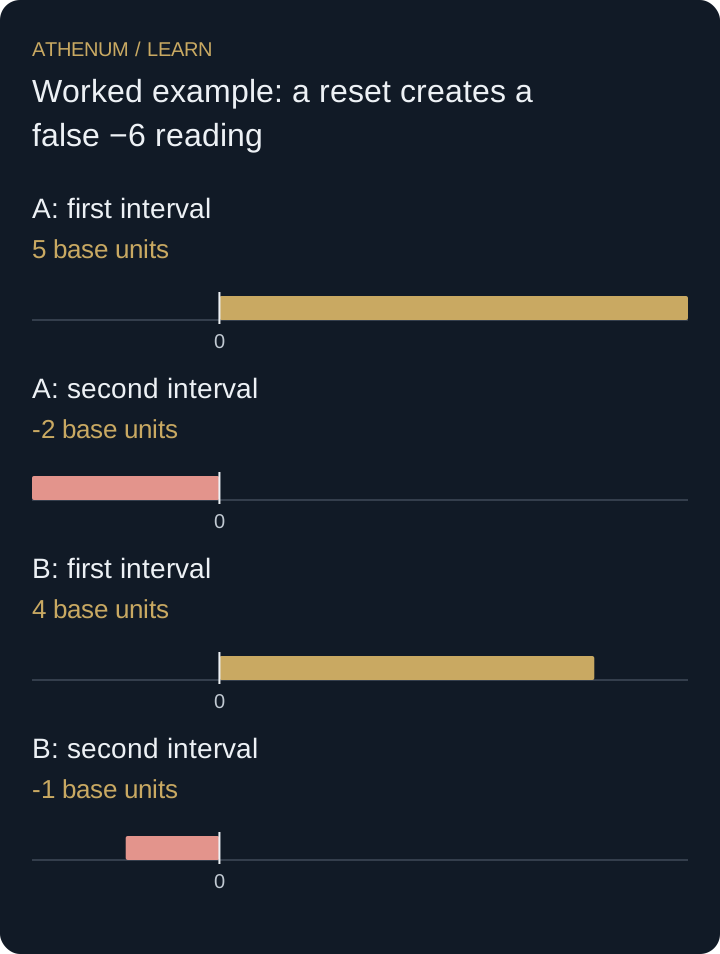 Open full-size diagram
- A: first interval: 5 base units
- A: second interval: -2 base units
- B: first interval: 4 base units
- B: second interval: -1 base units
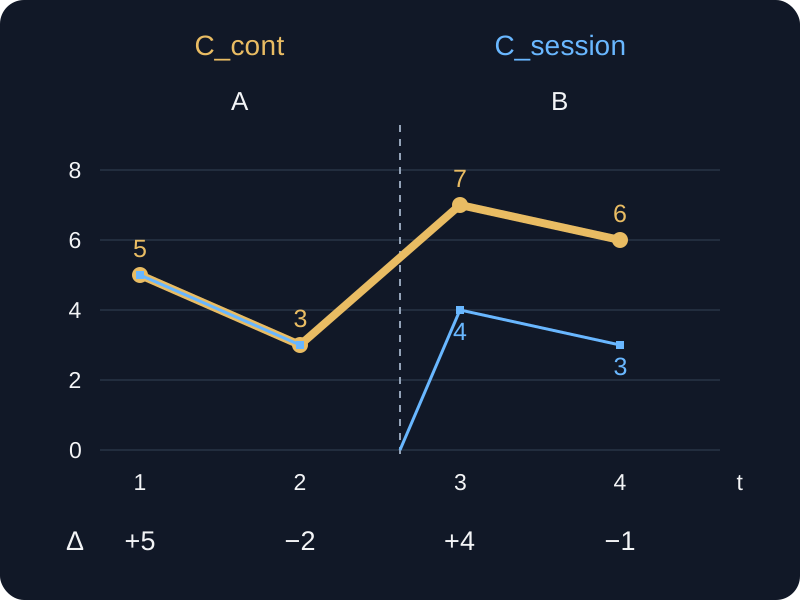
Zero may mean reset, missing data or balanced flow
A displayed zero is ambiguous without its status. A fresh anchor can legitimately start at zero; equal classified buy and sell quantity can produce zero delta; an unavailable feed should not silently become zero. Record data status alongside the value so an outage is not mistaken for a quiet or balanced market.
Before acting
- Record the anchor and timezone.
- Check whether the compared values cross a reset.
- Reconstruct interval delta from compatible observations.
- Keep missing coverage distinct from zero flow.
Check your understanding
Yesterday’s session closes at +18 units. The first two intervals today are −3 and +7. What are today’s session CVD and the compatible continuous CVD after the second interval?
Show the explained answer
Today’s session CVD is −3 + 7 = +4. Adding the known compatible prior-session offset gives continuous CVD of 18 + 4 = 22. Subtracting yesterday’s 18 from today’s displayed 4 would falsely suggest −14 units of new flow.