Table of Contents7 sections
- How often does each venue's published Bitcoin open interest change?
- Is a venue that rarely changes a slow feed, or a quiet market?
- Can you tell how old an open-interest reading is from its timestamp?
- Is this just a cache in front of the API?
- Does Athenum's own open-interest read refresh as fast as the venues?
- What does the spread do to a cross-venue open-interest comparison?
- How would you reproduce this?
TLDR. On 2026-11-13 we polled the public Bitcoin perpetual open-interest route of 12 venues once every 3 seconds, 260 polls each over 777 seconds and no failed call, and the number changed 254 times on Hyperliquid, 13 times on Deribit and 5 times on dYdX. Four venues sat at the 3.0 second floor of what a 3 second poll can resolve (Hyperliquid, Gate, Binance and MEXC). Deribit moved on what looks like a fixed clock: all 12 of its gaps were exactly 20 polls, 60 seconds, apart. dYdX changed 5 times, every gap between its changes was a multiple of 30 seconds, and each change followed a fill on its own trade feed by less than 21 seconds. The reading you receive can also be older than the field next to it suggests. On Bybit, Bitget, OKX, HTX and Deribit, every repeated reading (182 of 182, 183 of 183, 184 of 184, 237 of 237 and 246 of 246) still carried a newer timestamp, and Athenum's own by-venue read, measured the same way, refreshed Binance, Bitget and OKX about every 130 seconds while its ageSeconds field stayed at 8 or below on those three (Bybit's, on a 5 minute grid, ran up to 297).
How often does each venue's published Bitcoin open interest change?
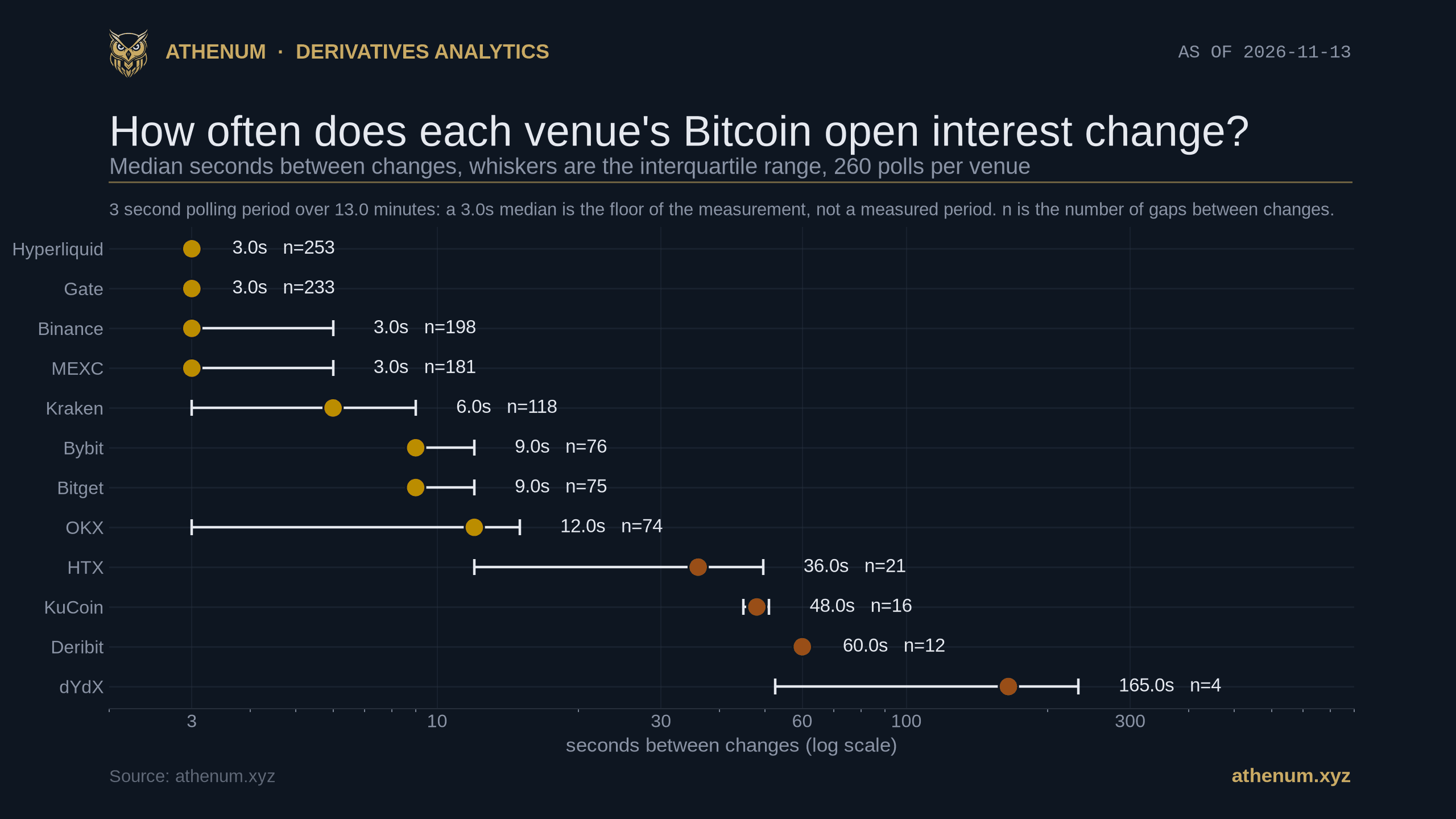
Between every 3 seconds or faster and every minute or slower, depending on the venue. The median gap between changes ran from the 3.0 second polling floor to 60.0 seconds on Deribit and 165.0 seconds on dYdX, where only 4 gaps were observed. This measures how often the served number changes, which is not the same as how often the venue recomputes it.
The method is deliberately plain: one request per venue per tick, one tick every 3 seconds, from 09:21:16 to 09:34:13 UTC, recording the value served as a string and the timestamp in the payload where the route has one. Twelve venues, 260 polls each, 3,120 readings, zero failed calls. The same capture run on the previous day gave a similar picture: Hyperliquid, Gate, Binance and MEXC fastest, and Deribit at 60 seconds.
Venue | Changes in 259 poll pairs | Median gap | Interquartile range | Longest unchanged run |
|---|---|---|---|---|
Hyperliquid | 254 | 3.0 s | 3.0 to 3.0 s | 3.0 s |
Gate | 234 | 3.0 s | 3.0 to 3.0 s | 6.0 s |
Binance | 199 | 3.0 s | 3.0 to 6.0 s | 6.0 s |
MEXC | 182 | 3.0 s | 3.0 to 6.0 s | 9.0 s |
Kraken | 119 | 6.0 s | 3.0 to 9.0 s | 33.0 s |
Bybit | 77 | 9.0 s | 9.0 to 12.0 s | 12.0 s |
Bitget | 76 | 9.0 s | 9.0 to 12.0 s | 9.0 s |
OKX | 75 | 12.0 s | 3.0 to 15.0 s | 15.0 s |
HTX | 22 | 36.0 s | 12.0 to 49.5 s | 75.0 s |
KuCoin | 17 | 48.0 s | 45.0 to 51.0 s | 54.0 s |
Deribit | 13 | 60.0 s | 60.0 to 60.0 s | 57.0 s |
dYdX | 5 | 165.0 s | 52.5 to 232.5 s | 237.0 s |
The longest unchanged run is the time from the first to the last poll that showed one value. The chart counts gaps between changes, which is one fewer than the changes in the table, so Hyperliquid reads 254 changes and n=253.
Read the top rows as a floor, not as a period. A 3.0 second median on a 3 second poll means only that the number changed on most consecutive polls. The true period could be a second or a millisecond, so this measurement resolves the slow end of the table well and the fast end not at all. The dYdX median rests on 4 gaps, which is why its whisker is so wide and why we read its gap pattern below rather than its median.
The interquartile column shows the character of each venue. Deribit's 60.0 to 60.0 second band is the signature of a fixed clock: all 12 of its gaps were exactly 20 polls, or 60 seconds, apart. KuCoin runs close to a clock without keeping one, with 14 of its 16 gaps between 45.0 and 57.0 seconds around a 48.0 second median, and two gaps of 3.0 seconds. HTX is looser still, a 36.0 second median inside a 12.0 to 49.5 second band, with individual gaps from 6.0 to 78.0 seconds. Quoting HTX's median without that band would be the more misleading number.

The same 777 seconds for all twelve venues. Deribit's 13 ticks sit almost exactly a minute apart, KuCoin's 17 and HTX's 22 are looser, and dYdX shows only 5.
The raster shows what a summary statistic hides. Deribit's 13 ticks are almost a ruler, HTX's cluster and drift, and dYdX has a handful of ticks and long silences between them.
Is a venue that rarely changes a slow feed, or a quiet market?
On dYdX it looks like both: in this capture all 5 changes fell on a 30 second grid and each followed a fill within 21 seconds. Five changes is too few to call that a rule. We checked it by pulling the same venue's trade route after the capture.
The dYdX indexer served a different open-interest value on only 5 of 259 poll pairs. The changes were first seen at 09:23:52, 09:27:52, 09:28:22, 09:31:52 and 09:33:52 UTC, so the gaps between them were 240, 30, 210 and 120 seconds, which on our 3 second poll grid are 8, 1, 7 and 4 times 30 seconds. All five land at 22 or 52 seconds past the minute. That is the shape of a feed that refreshes on a 30 second clock and finds something new only some of the time.
The trade route shows what the something is. It listed 12 BTC-USD fill records inside our window, at 9 distinct moments, because some partial fills share a timestamp. Each of the 5 changes was preceded by a fill: 10.9, 20.9, 2.8, 9.5 and 5.1 seconds earlier. Every fill moment before the last change (7 moments, 10 records) was followed by a change within 21.8 seconds. The last two moments, 09:33:52.465 and 09:33:57.400, came after the final change and before the capture ended, so no 30 second beat had yet passed for them. Open interest can only move when something trades, so changes following fills is the expected direction; what is worth noting is the 30 second spacing. We chose the length of that window after seeing the data, and five changes is a small number.

dYdX on 2026-11-13: five changes, all on a 30 second grid, each following a fill by 2.8 to 20.9 seconds. The 12 fill records, at 9 distinct moments, came from the indexer trade route.
That makes the dYdX row a different kind of number from the Deribit row. Deribit's 60 second regularity says something about how the venue publishes, while dYdX's gaps combine a 30 second clock with how busy its Bitcoin market was. The previous day's capture shows the other half: dYdX held one value for all 779 seconds, which fits a quiet market, although we did not capture its fills that day. A thin book will look slow on any venue that publishes only on change, and we have not tested whether the other eleven do. Five changes is a small sample, so read this as a pattern consistent with a 30 second refresh, not as a proof of how the indexer computes the field. The table therefore measures change frequency, which is the product of publication cadence and market activity, and it only isolates the cadence where the numbers are as regular as Deribit's.
Can you tell how old an open-interest reading is from its timestamp?
On five of the seven venues that stamp the figure, no. On Bybit, Bitget, OKX, HTX and Deribit every repeated reading carried a timestamp that had moved on since the previous poll, although the number had not.
Of 182 repeated readings on Bybit, 183 on Bitget, 184 on OKX, 237 on HTX and 246 on Deribit, the share whose payload timestamp had nevertheless advanced was 100 percent in all five. The timestamp on those responses tracks the request, not the record, so it cannot date the number sitting next to it. Their stamps sat just after our own request time, which is what a response clock looks like: the median stamp ran between 0.08 and 0.20 seconds ahead of the moment we sent the request on all five, and no stamp was more than 0.80 seconds ahead.
Binance and MEXC behave differently. Binance repeated 60 times and moved its timestamp on only 3 of them, so on the other 57 the stamp stayed with the value. That stamp trails our clock by a median 4.24 seconds, with an interquartile range of 2.95 to 5.67 and a range of 0.28 to 8.11 seconds, so a Binance reading typically describes a moment about four seconds before you received it, and it says so. MEXC's timestamp moved on 25 of 77 repeats and trails by a median 2.21 seconds. We assume the Binance and MEXC time fields are record times, which their routes do not state outright.

When the open-interest value repeats, five venues still hand you a fresh timestamp. Binance (3 of 60 repeats) and MEXC (25 of 77) are the exceptions, so their stamps mostly stay with the number they describe.
One caveat cuts against the clean version of that story. Across 259 consecutive poll pairs the Binance timestamp went backwards 8 times, so it is informative but not a clock you should difference to sub-second precision. Gate, KuCoin, Kraken, Hyperliquid and dYdX have no timestamp tied to the open-interest figure in the fields we read, so this check does not apply to them.
Is this just a cache in front of the API?
Not an edge cache replaying a response on Bybit, Bitget, OKX, HTX or Deribit, because their timestamps move on every repeat. An application-side cache on a fixed clock cannot be excluded, and Deribit's 60.0 seconds and dYdX's 30 are what one would look like. On Binance and MEXC the stamp mostly stays with the value, so it cannot separate a cache from a publisher.
Response headers. One request per route after the capture. dYdX sent cache-control: public, max-age=1 and cf-cache-status: HIT with an age of 0, so a Cloudflare layer is present, but a one second lifetime cannot hold one value for 237 seconds. OKX, Bitget, KuCoin, Kraken and Deribit returned cf-cache-status: DYNAMIC, meaning not cached, and Binance and Bybit reported a CloudFront miss. HTX sent no-cache, no-store, Deribit no-store and MEXC max-age=0, no-cache, no-store with a miss at its first cache layer. Gate sent no cache headers at all, KuCoin public,max-age=0, and we did not probe Hyperliquid.
Our own clock. Against the public server-time route of Binance, OKX and Bybit (three of the twelve), the median of five probes, each corrected to the midpoint of its round trip, put this host within 0.03 seconds of each: 19.0, 24.0 and 22.5 milliseconds. The 4.24 second Binance timestamp lag is therefore a real data lag and not our clock.
Those are checks, not proofs: a header tells you about the layer that sent it and not about any layer behind it. A response header cannot tell a publisher with a 60 second tick from a cache in front of one. For a user the distinction does not matter, because the number you can fetch refreshes on that clock either way.
Does Athenum's own open-interest read refresh as fast as the venues?
No. For Binance, Bitget, OKX, Gate, Hyperliquid and HTX it refreshed about every 130 seconds in this run, and on Binance, Bitget and OKX the ageSeconds it states stayed constant while a value was held. We measured it the same way, from the outside, on the same day.
Alongside the capture above we requested Athenum's public by-venue open-interest read for Bitcoin every 10 seconds, 69 requests from 09:21:16 to 09:32:36 UTC on 2026-11-13, with no failed call. The response gives each venue it lists a value and, where the venue supplies one, an observedAt time and an ageSeconds. For Binance the first sampled request showing a new value came at 09:23:26, 09:25:36, 09:27:46, 09:29:56 and 09:32:06, which is five changes in 69 requests, against 174 changes on Binance directly over the same 680 seconds. Bitget, OKX, Gate, Hyperliquid and HTX changed at the same five samples, and Bybit at two, 09:25:36 and 09:32:06. Four full intervals of 130 seconds is all we saw, so the period is about 130 seconds, give or take our 10 second sampling. Because we sampled every 10 seconds, each of those is the first request that showed the new value, not the instant it changed.
What the response said about its own age needs two fields. The observedAt time stayed fixed while a value was held, so the request time minus observedAt climbed to about two minutes, and it ran a median of 5 to 8 seconds above the minimum age we compute below on all three venues. In a few Bitget and OKX requests it sat up to 3.7 seconds below that minimum, which fits observedAt being rounded to the second and our 3 second poll grid. The ageSeconds field stayed constant while the value was held, which is consistent with a snapshot taken when the value was read. In every request the stated age for Binance was between 4 and 8 seconds, close to Binance's own 4.24 second median timestamp lag, and for OKX and Bitget it was 0 in all 69, including at the end of each 130 second window, when the value had been held for over two minutes. A client that trusts ageSeconds alone would under-state the age by about a minute at the median, whereas one that subtracts observedAt from the current time would not. We also asked how long before each request the venue itself had last served exactly that number, matching the latest direct poll at or before the request whose value, rounded to four decimals of a Bitcoin, equalled the one Athenum served (OKX converted at 0.01 Bitcoin per contract). That is a minimum age: the value was read at some point between the first and the last direct poll that showed it, so it can only be older. Requests whose value we never saw in a 3 second poll are not counted.
Venue | Requests matched | Minimum age, median | Interquartile range | Oldest | Request time minus | Stated age, range |
|---|---|---|---|---|---|---|
Binance | 65 of 69 | 59.9 s | 28.5 to 90.5 s | 120.9 s | 63.2 s | 4 to 8 s |
Bitget | 67 of 69 | 51.9 s | 21.0 to 85.0 s | 117.0 s | 59.2 s | 0 to 0 s |
OKX | 65 of 69 | 50.9 s | 20.5 to 84.0 s | 120.0 s | 59.2 s | 0 to 0 s |
In 45 requests on Binance, 45 on Bitget and 43 on OKX the minimum age exceeded the stated age by more than 30 seconds. Bybit is a separate case. Its observedAt sat on 09:20:00, 09:25:00 and 09:30:00 UTC, a five minute grid, with a stated age that ranged from 38 to 297 seconds, so by its own label a Bybit value was up to almost five minutes old. Gate, Hyperliquid and HTX carry no observedAt in this response, because the venue sends none for this figure.

Binance on 2026-11-13: the venue changed 174 times in the 680 seconds Athenum was sampled while Athenum's by-venue read changed 5 times in 69 requests, and the age printed in the response stayed at 4 to 8 seconds.
Treat that read as a level, not a timer. In this run its Binance, Bitget and OKX values were at least 51 to 60 seconds behind the venue at the median among the requests we could match, and at least 117 to 121 seconds at the worst point, which suits a slow-moving share-of-total view and not a trigger for anything that must fire within a minute of a position change. We are publishing the measurement against our own endpoint rather than only against other people's because it is the same blind spot as the five stamped venues above: a freshness field that cannot be used to date the number, there a timestamp that tracks the request, here an age that stays constant while the value is held.
What does the spread do to a cross-venue open-interest comparison?
It puts readings of very different ages into the same row. If you fetch all twelve venues at one instant, the Hyperliquid figure changed within the last few seconds at its 3 second resolution and the Deribit figure may be up to 60 seconds old, and nothing in either response distinguishes them.
That matters most for anything differenced or ranked. A venue on a 60 second clock contributes at most one genuine observation a minute, so minute-over-minute changes in its share of total open interest are partly an artifact of when its clock happened to tick. We did not test how much that matters on an hourly basis. The same caution applies to alerting: an "open interest just jumped" trigger built on polling fires when the venue publishes, not when the market moves, and on KuCoin or Deribit those two events can be a minute apart. If what you want from a jump is the price at which crowded positions start getting closed out, that does not need a fast feed: the free liquidation calculator answers it from your own entry, leverage and margin mode, and the position size calculator works from your own risk budget.
Two things this is not about. It is not about denomination, since these venues report in coins, contracts and quote currency, which is covered in open interest in coins versus dollars, and every comparison above is a venue against itself, so units cancel. It is also not about whether a venue counts one side or both, which we measured in one side versus both and which matters for concentration across venues and for the margin type a figure covers. A double-counted number that changes every few seconds is still double-counted. It is the same family of problem as the 60 second constituent clock of a Bitcoin index price: the venue answers a slightly different question from the one you asked, and the payload does not say so.
How would you reproduce this?
Poll one public Bitcoin open-interest route per venue every 3 seconds for about 13 minutes and compare each reading with the one before it. As run on 2026-11-13:
1. Pick one route per venue that returns Bitcoin perpetual open interest and keep the same route throughout. We used Binance USD-M fapi/v1/openInterest, Bybit v5 market/tickers (linear BTCUSDT), OKX public/open-interest, Bitget v2 mix/market/open-interest, Gate v4 futures contracts (open interest in contracts of 0.0001 Bitcoin), HTX linear swap swap_open_interest (BTC-USDT), KuCoin futures contracts, MEXC contract ticker, Kraken Futures tickers, Hyperliquid metaAndAssetCtxs (a POST request), Deribit public/ticker and the dYdX v4 indexer.
2. Poll on a fixed period, concurrently across venues but once per venue per tick, so no single host sees a burst. Record the value as the string the venue served, so rounding in a float cannot hide a change and formatting differences are not mistaken for one.
3. Record the payload timestamp with every value. The comparison that matters is whether it moved on the polls where the value did not.
4. Report gaps between changes as a median with an interquartile range and a count, never as a mean. Four of these venues produced fewer than 25 gaps in 13 minutes (HTX, KuCoin, Deribit and dYdX, the last with only 4).
5. Before believing any of it, check the response headers for cache status and check your own clock against the server-time route of any venue that publishes one.
6. For a venue that changes rarely, ask whether the market was quiet before calling the venue slow. Its own trade route is the cheapest check, and look at whether the changes fall on a regular beat.
Thirteen minutes is enough to separate a 3 second venue from a 60 second one and not enough to say anything firm about dYdX's cadence beyond the 30 second pattern above. The fast end needs the opposite fix: a sub-second poll or the venue's own websocket, since a 3 second poll cannot tell a venue publishing every second from one publishing every millisecond.
The Athenum figures can be re-requested by anyone at https://api.athenum.xyz/api/v1/derivatives/open-interest/by-venue?symbol=BTC, which needs no key and will read differently later, as everything above does. Every measurement in this post can be repeated with a short script, and the calculators beside the terminal stay free, with no account, no email and no usage limits. If you want the cross-venue view without running a poller, the terminal opens on a free 7 day Pro+ trial that asks for no card.
One terminal. All the data.
Liquidations, orderbook depth, whale walls & open interest, all real-time, in one place. 29 supported exchanges; coverage differs by tool.
No credit card required

Athenum Analytics
Athenum Analytics is our three-person editorial team covering crypto derivatives, market data and macroeconomic context.