Table of Contents7 sections
- What is inside a venue's bitcoin perpetual open interest number?
- How much of each venue sits outside the USDT contract?
- Why do the units make this easy to get wrong?
- Which contracts does Athenum's venue column include?
- Why does one Athenum endpoint give Binance two different numbers?
- What does this change for anyone who compares venues?
- How do you check this yourself?
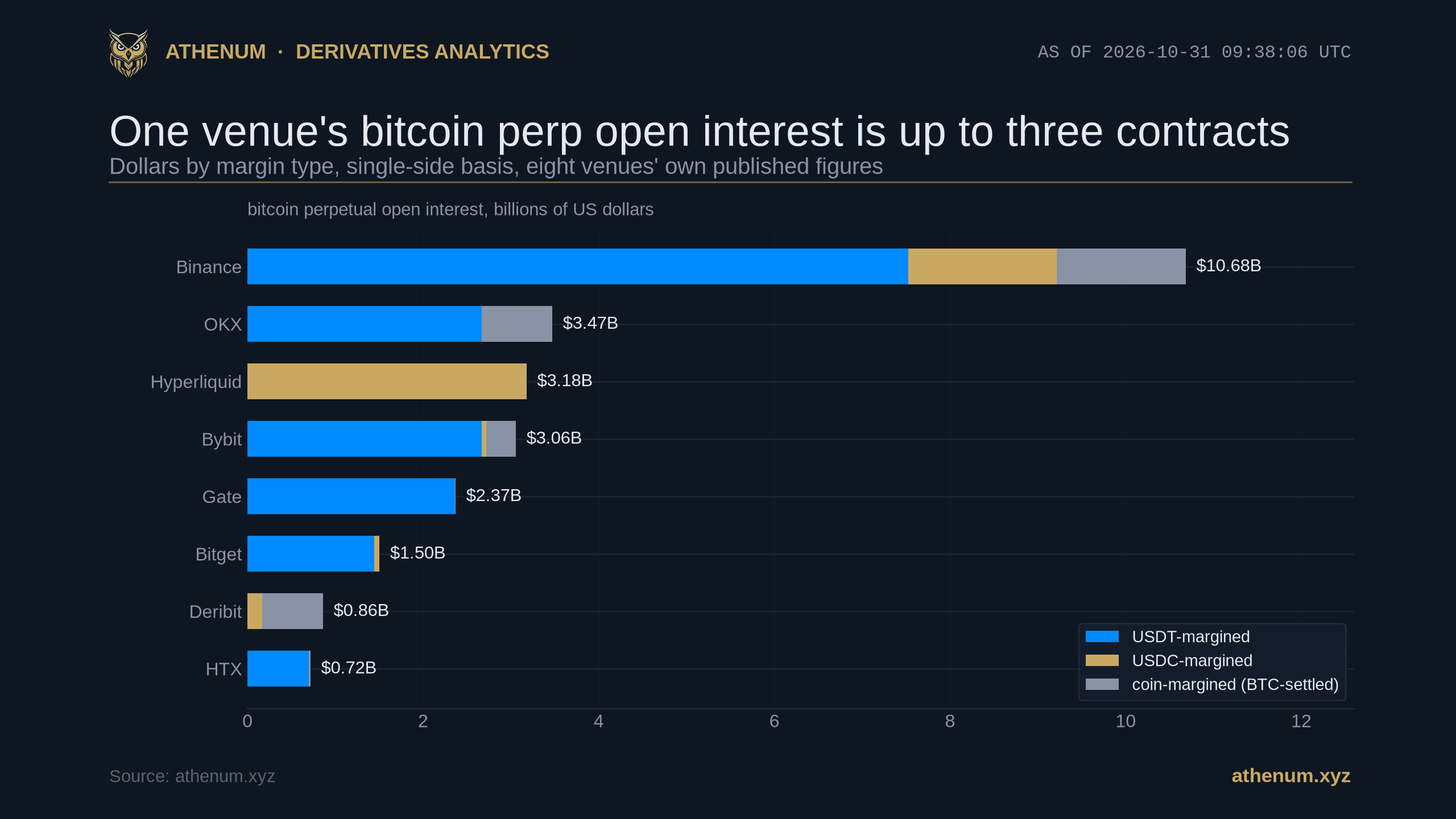
TLDR. "Bitcoin perpetual open interest on an exchange" is not one contract. Read from each venue's own public endpoint on 2026-10-31 (reads started 09:38:06 UTC), Binance's figure was $10.68B built from three contracts: $7.52B on the USDT-margined perpetual, $1.69B on the USDC-margined one and $1.47B on the coin-margined one. A pipeline that reads only the USDT symbol sees 70.4 percent of Binance, 87.3 percent of Bybit and 76.7 percent of OKX, and sees none of Hyperliquid, which lists only a USDC contract, or of Deribit, which lists a USDC contract and a coin-margined one. Across the six venues that do have a USDT bitcoin perpetual, the USDT symbol alone leaves out $4.44B of $21.80B, 20.4 percent. We then checked Athenum's own venue columns against those figures: seven of eight equal the sum of every margin type to within 0.13 percent on four reads, and the eighth, Deribit, is 19.2 percent low because its column appears to leave out its USDC contract.
What is inside a venue's bitcoin perpetual open interest number?
Up to three different contracts that happen to share the word bitcoin. A USDT-margined (or linear) perpetual is quoted and margined in tether and sized in coins. A USDC-margined one is the same idea with a different stablecoin. A coin-margined (or inverse) perpetual is margined in BTC itself and sized in dollars, so its contract count is a dollar amount and not a coin amount. They are separate order books with separate open interest, and an exchange page that says "BTC perpetual" may show one of them or a total.
On 2026-10-31 the mix per venue, in single-side dollars from each venue's own endpoint (first read, 09:38:06 UTC), was:
Venue | USDT-margined | USDC-margined | Coin-margined | Total |
|---|---|---|---|---|
Binance | $7,523M | $1,693M | $1,468M | $10,685M |
OKX | $2,664M | none listed | $807M | $3,471M |
Hyperliquid | none | $3,178M | none | $3,178M |
Bybit | $2,667M | $51M | $338M | $3,057M |
Gate | $2,362M | none | $7M | $2,370M |
Bitget | $1,445M | $58M | none | $1,503M |
HTX | $698M | none | $20M | $718M |
Deribit | none | $167M | $694M | $861M |
Three details sit under those cells. Bybit publishes both a both-sides field and a single-side field for each instrument, and we used the single-side one: 34,454 BTC on its USDT contract against 68,909 BTC in the default field, the counting-convention gap Athenum measured earlier. Bitget's USDT and USDC figures are halved because its support pages say its open interest is bilateral. HTX's documentation says its USDT swap reports the sum of both buy and sell sides and its coin-margined swap reports a single side, so only the USDT leg is halved: $1,395.9M published, $698.0M single-side.
How much of each venue sits outside the USDT contract?
On 2026-10-31 (first read, 09:38:06 UTC), 29.6 percent of Binance ($3.16B), 23.3 percent of OKX ($0.81B), 12.7 percent of Bybit ($0.39B), 3.9 percent of Bitget, 2.8 percent of HTX and 0.3 percent of Gate. Hyperliquid and Deribit are 100 percent outside it, because neither lists a USDT bitcoin perpetual. A read that takes the USDT symbol from each of the eight venues therefore drops $8.48B of the $25.84B total, 32.8 percent, but $4.04B of that is the two venues with nothing to read, so the fairer figure is the $4.44B, 20.4 percent of $21.80B, missing from the six venues that do have a USDT contract.

Dollars of bitcoin perpetual open interest outside each venue's USDT-margined contract, 2026-10-31, first read at 09:38:06 UTC, with that as a share of the venue's total. Gold bars are the two venues that list no USDT bitcoin perpetual, so the whole venue is outside it. Hyperliquid at 3.18 billion and Binance at 3.16 billion are 0.5 percent apart and kept the same order on all four reads, but that gap is too small to be a ranking finding. The six blue bars sum to 4.44 billion of 21.80 billion, 20.4 percent. Single-side basis as in the first chart, one moment in time.
The ranking at the top of that chart is not the point and we would not quote it: Hyperliquid and Binance are half a percent apart. The shares were steady across our four reads, and at 23 to 30 percent for Binance and OKX they are large enough that the choice of symbol changes a venue's number by roughly a quarter to a third.
Why do the units make this easy to get wrong?
Because every venue converts a different way, and the coin-margined contracts report in dollars while the linear ones report in coins. The conversions we used on 2026-10-31, all from the venues' own fields:
- Binance: USDT and USDC perpetuals report BTC, multiplied by the venue's mark (97,149 BTC at 77,442.60 and 21,892 BTC at 77,340.70). The coin-margined BTCUSD perpetual reports contracts, which we valued at 100 dollars each (14,681,848 contracts, $1,468M).
- OKX: the endpoint returns oiUsd directly, $2,663.7M for the USDT swap and $807.3M for the coin-margined one. OKX did not list a USDC bitcoin swap at that moment.
- Deribit: BTC-PERPETUAL is inverse with 10-dollar contracts and its open interest is already in dollars (693,669,710). BTC_USDC-PERPETUAL is linear and its open interest reads 2,156.52, which we read as BTC (about $166.9M at its mark of 77,378.44); a reading in dollars would make it negligible.
- Gate: the USDT contract reports 305,107,824 contracts of 0.0001 BTC each (30,511 BTC); the BTC-settled contract reports 7,415,001 one-dollar contracts.
- HTX: the USDT swap's value field is $1,395.9M; HTX's documentation defines that contract's volume and amount as the sum of both buy and sell sides and value is amount times price, so we halved it to $698.0M single-side; the coin-margined swap reports 199,263 single-side contracts we valued at 100 dollars ($19.9M).
- Hyperliquid: every perpetual is USDC-margined and reports coins, 41,037 BTC at a mark of 77,447.
Athenum's explainer on open interest in coins versus dollars covers why the unit alone can make the same market rise and fall at once. A pipeline that multiplies every venue's open interest by price treats Binance's 14.7 million coin-margined contracts as 14.7 million BTC, and one that adds dollars to coins gets a number in no unit. This is the same family of mistake as the contract-size unit trap, one layer up: not the size of a contract, but which contracts are in the sum.
Which contracts does Athenum's venue column include?
On 2026-10-31 we checked our own feed against the venue figures instead of assuming. Athenum's 1 hour series carries one open interest column per venue. Compared with each venue's own total, single-side, at the same moment, seven of the eight columns equal the sum of every margin type to within 0.13 percent on all four reads. On the first read the differences were Binance -0.08 percent, Bybit -0.07, OKX +0.02, Bitget -0.12, Gate -0.02, HTX +0.02 and Hyperliquid +0.09, and the other three reads stayed inside the same band. Against the USDT contract alone the same columns are 41.9 percent too high for Binance, 14.5 for Bybit, 30.3 for OKX, 3.9 for Bitget and 2.9 for HTX. So the columns match sums over USDT, USDC and coin-margined contracts, not USDT-only reads, with Bybit on its single-side field and Bitget and HTX's USDT leg halved.

Athenum's 1 hour open interest column minus the venue's own figure, percent, mean of four reads spread over 151 seconds from 2026-10-31 09:38:06 UTC, with a thin line for the range across the four reads (under 0.1 point wherever visible). Gold compares with the sum of all margin types, blue with the USDT contract alone; Hyperliquid and Deribit have no blue bar because they list no USDT contract. Seven venues sit within 0.13 percent of the gold zero line and Deribit is 19.2 percent below it, shown rather than hidden. Venue figures are as in the first chart, so Bybit is on its single-side field and Bitget and HTX's USDT leg are halved; the hourly column is a bar still forming. The values on the bars are means of the four reads.
One column does not fit, and we are reporting it rather than rounding it away.
Deribit. On 2026-10-31 our column read $694.8M against $860.5M for the venue's two perpetuals, 19.2 to 19.3 percent low on all four reads, and it sits within 0.21 percent of the inverse BTC-PERPETUAL alone ($693.7M). The reading that fits is that our Deribit column includes the coin-margined contract and leaves out the USDC-margined one, which was $166.9M, subject to the unit reading above. It is a fit to the numbers, not something we have confirmed from the feed's construction.
HTX, which does fit once its convention is read from its docs. Our column read $718.0M on 2026-10-31. HTX's USDT swap plus its coin-margined swap is $1,415.9M as published, which looks like a 49.3 percent gap, and that is the trap: HTX's documentation defines the USDT swap's open interest as the sum of both buy and sell sides and the coin-margined swap's as a single side. Halving only the USDT leg gives $698.0M plus $19.9M, $717.9M, and the column is within 0.04 percent of that on all four reads. A reader who halved all of HTX, or none of it, would conclude the column was wrong by 1.4 percent or 49 percent.
Why does one Athenum endpoint give Binance two different numbers?
Because the 1 minute interval returns a different series from every other interval. On 2026-10-31 at about 09:50 UTC, the same futures/overview/metrics?asset=BTC request returned a Binance column of $7.52B at interval=1m and $10.68B at 5m, 15m and 1h, $10.67B at 4h and $10.63B at 1d. The 1 minute figure equals Binance's USDT contract alone ($7.52B at 09:40 UTC), and at that interval every other venue's column was 0.0 or null, so the 1 minute series is a Binance USDT-margined series, not a cross-venue one.

Athenum Binance open interest column, latest bar returned at each interval of the same endpoint, 2026-10-31 around 09:50 UTC, one request per interval. The blue 1m bar equals the dashed line, Binance's USDT contract alone at 7.52 billion dollars; the five gold bars are the all-margin-type sum, 10.63 to 10.68 billion. The bars are the latest bar of each interval, taken within seconds of each other, so the 0.05 billion spread among the gold bars is the intervals' different bar boundaries, not a data error. We report this as a gap in our own product.
That is an inconsistency in our own product, and it is stated here because a reader who requests the 1 minute interval and compares it with the 1 hour one would see a 30 percent difference on Binance and no explanation. For a cross-venue number, use an interval of 5 minutes or longer.
What does this change for anyone who compares venues?
Three things. First, name the contracts: "Binance bitcoin open interest of $10.68B" and "of $7.52B" are both correct for different sets, and a comparison between venues is only fair if both sides use the same set. Second, expect the choice to matter most where the contracts are mixed: among the venues that list a USDT contract, the largest non-USDT shares on 2026-10-31 were Binance at 29.6 percent and OKX at 23.3 percent, so a USDT-only screen understates them by roughly a quarter to 30 percent. Third, converting is cheap, because every field above is a public, keyless call.
The limits are plain. This is one moment, 2026-10-31 from 09:38 UTC, a Saturday morning, read four times over 151 seconds (about 50 seconds apart), so it shows composition on that day and not how the mix moves; the non-USDT share of a venue can drift as traders migrate between contracts. We covered perpetuals only, so dated futures, which exist on Binance, Bybit, OKX, Deribit, Gate and HTX, are in none of these totals. The sum across venues mixes counting conventions, because Bitget and HTX's USDT leg are halved and Bybit is on its single-side field, each following the venue's own documentation. And the Deribit USDC reading rests on our interpretation of one field.
How do you check this yourself?
Keyless calls, no account, one request per contract.
1. Binance: GET fapi.binance.com/fapi/v1/openInterest?symbol=BTCUSDT, then BTCUSDC, then GET dapi.binance.com/dapi/v1/openInterest?symbol=BTCUSD_PERP. The first two are in BTC, the third in 100-dollar contracts. On 2026-10-31 they returned 97,149 BTC, 21,892 BTC and 14,681,848 contracts.
2. Bybit: GET api.bybit.com/v5/market/tickers?category=linear&symbol=BTCUSDT (also BTCPERP), and category=inverse&symbol=BTCUSD. Use singleOpenInterest if you want one side.
3. OKX: GET www.okx.com/api/v5/public/open-interest?instType=SWAP&instId=BTC-USDT-SWAP and BTC-USD-SWAP; the oiUsd field is already in dollars.
4. Deribit: GET www.deribit.com/api/v2/public/ticker?instrument_name=BTC-PERPETUAL and BTC_USDC-PERPETUAL.
5. Add the contracts for each venue, then compare with Athenum's column: GET api.athenum.xyz/api/v1/futures/overview/metrics?asset=BTC&interval=1h, last bar. Expect Binance, Bybit and OKX to land within a fraction of a percent of the sum of their contracts.
If you size positions in contracts quoted in dollars, our free PnL calculator is a quick way to check what a dollar-sized position is worth when the price moves, and the position size calculator turns a risk budget into a size.
Every venue figure above came from that exchange's public endpoint on 2026-10-31, so each can be redone by hand. The column comparison is Athenum's live normalized derivatives feed, and Athenum's calculators beside it are free, with no account, no email, and no usage limits. The normalized view behind the column comparison opens with the free 7 day Pro+ trial at app.athenum.xyz; the trial asks for no card and ends on its own.
One terminal. All the data.
Liquidations, orderbook depth, whale walls & open interest from 4 exchanges, all real-time, in one place.
No credit card required

Athenum Analytics
Athenum Analytics is our three-person editorial team covering crypto derivatives, market data and macroeconomic context.