Indicator mechanics: reconstruct what the chart calculates · 3 / 5
Fair value gaps: separate candle geometry from resting orders
A rectangle drawn from candles is an observation about those candles. It does not reveal an institution’s outstanding order, its owner or an obligation for price to revisit the rectangle.
Athenum7 minUpdated:
Define which gap the rule actually measures
For this exercise, define a bullish three-candle FVG when the third completed candle’s low is strictly above the first candle’s high and the middle candle closes above its open. The zone runs from that first high to the third low. Equality fails the strict rule. This is a declared geometry convention, not a universal specification for every indicator using the FVG name.
An adjacent full-range gap is a different comparison: the next candle’s low exceeds the immediately preceding high. A three-candle FVG skips the middle candle in its boundary comparison. That middle candle can contain executions inside the marked zone. Keep the definitions separate before counting events or claiming that no trading occurred.
Attach each statement to the data that can support it
A trade tape can document reported executions. A maintained order-book snapshot and its updates can document displayed depth within that feed’s coverage. Neither a candle rectangle nor a later price reaction supplies those records. A public book also does not expose every hidden order, private stop or participant identity.
Define the later event you want to study before it happens: first entry at or below the upper boundary, reaching the midpoint or traversal to the lower boundary. Here each event uses a later candle low at or below its stated boundary; this classification does not prove an execution at every intervening price. Record a deadline and retain zones that never qualify. Drawing only rectangles that later held as support would select the outcome you are trying to test.
A four-unit FVG exists although the middle candle traded inside it
The original hypothetical bars below satisfy the rule because 107 > 103 and the middle candle closes 109 above its open of 102. The zone width is 4. Neither adjacent pair has a full-range upward gap: candle 2’s low 101 is below candle 1’s high 103, and candle 3’s low 107 is below candle 2’s high 110.
Assume the corresponding middle-bar tape explicitly includes executions at 104.5 and 106. Those records disprove “nothing traded inside 103–107” for this example. They still say nothing about orders remaining there after candle 3. If a later downward visit reaches a low of 105.5, it has entered the zone but has reached neither its midpoint 105 nor its lower boundary 103.
| Candle | Open | High | Low | Close |
|---|---|---|---|---|
| 1 | 100 | 103 | 99 | 102 |
| 2 | 102 | 110 | 101 | 109 |
| 3 | 109 | 112 | 107 | 111 |
 Open full-size diagram
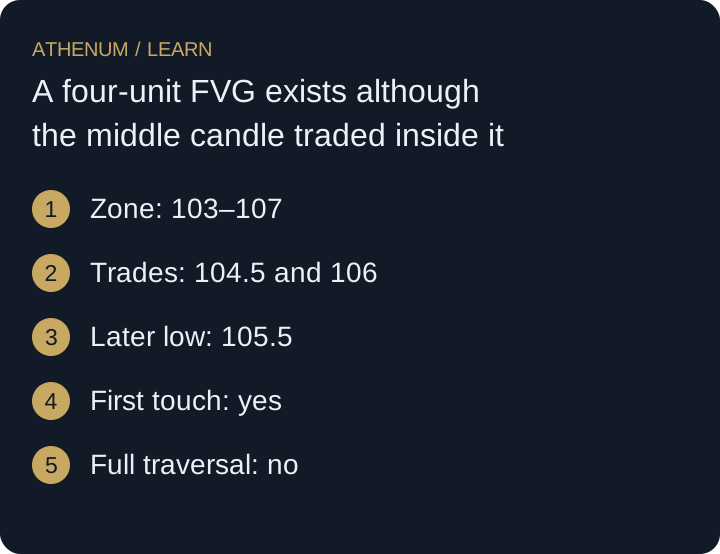
- Zone: 103–107
- Trades: 104.5 and 106
- Later low: 105.5
- First touch: yes
- Full traversal: no
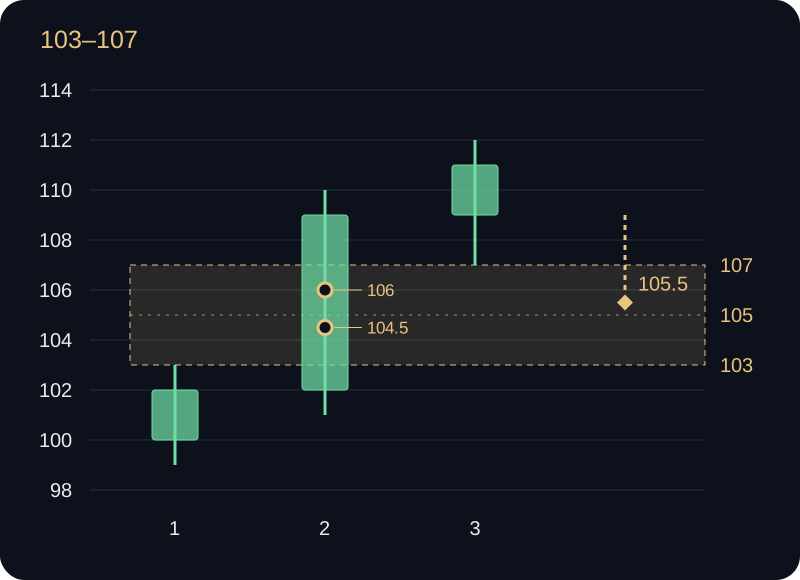
Three completed hypothetical candles from one instrument and venue; arbitrary price units.
Candles 1–3 use the table's prices. The gold zone spans 103–107; circles mark the two assumed trades during candle 2. The diamond marks a later low of 105.5, above the dashed midpoint at 105. Horizontal spacing does not measure elapsed time.
“Filled” needs an event definition
An indicator may remove a rectangle at its first touch while another retains it until full traversal. Their displayed counts can differ on identical prices. Neither convention establishes that a trader’s limit order filled; that requires a separate execution record and the relevant queue and liquidity assumptions.
Before acting
- Freeze the candle inequality and direction rule.
- Keep three-candle and adjacent gaps distinct.
- Use actual trades for execution claims.
- Use a synchronized book for displayed-depth claims.
- Declare touch boundary and follow-up horizon.
Check your understanding
The later candle reaches a low of 104.8. Under first-touch, midpoint and full-traversal definitions, which events have occurred for the 103–107 zone?
Show the explained answer
First touch and midpoint touch have occurred because the price reached below 107 and 105. Full traversal has not: 104.8 remains above 103. This classification concerns the declared price barriers, not an actual fill of a resting order.